
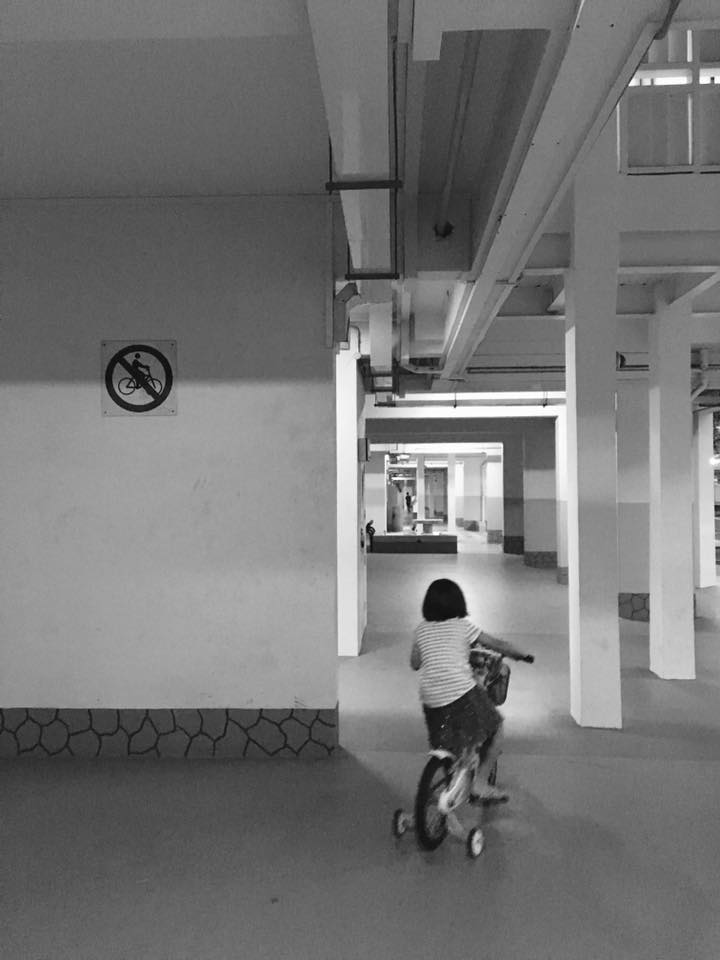
When our daughter was seven, we got her a tricycle for her birthday. We took her to the void deck of our block to practise because we figured it was safe—flat, no cars, few obstructions. As with anyone operating a vehicle for the first time, she was wobbly. But she still managed to make it up and down the length of the block a few times.
At some point, we noticed that she had been cycling past a sign on one of the walls. It wasn’t at her eye level and so she never saw it. Plus she was too busy trying not to fall off. It showed a bicycle with a red line through it—No Cycling.
I giggled to myself. “Our child, apparently committing civil disobedience at seven,” was my first thought. My second was how the sign was placed too high for anyone cycling—adult or child—to see.
Guilt was not something that ever crossed my mind though. I was quite certain that the sign was meant more for delivery riders cutting through, or for adults on PMDs moving too fast through a shared space. Not for a seven-year-old on a birthday present, wobbling left and right, trying to remember to brake before the void deck bench.
I’ve thought about that moment a lot since. Not because we were wrong, but because of how effortlessly we made that call. I didn’t have to think very hard or look up the HDB website to check the rules. It took about half a second to know that that sign wasn’t directed at our child. It wasn’t so much that we were ignoring the rule—we were interpreting it.
Behavioural scientists call this norm inference—we don’t just read rules, we construct a mental model of what a rule is trying to achieve, and apply judgment accordingly. Most of the time, we do this without realising it.
Void decks have tended to run on something informal—the ability to read a situation and respond without being told. Take the migrant workers who might rest there at lunchtime—finding shade, eating, calling home. When a family begins setting up for a funeral, they start to pack up. Maybe slowly at first, but then they read the arriving plastic chairs, the white tent going up, the family’s quiet purposefulness, and draw the right conclusion about what the space has become. Then they act on it.
There is, in fact, a fairly formal set of rules that governs how void decks are used—a booking system, rental charges, MP endorsements, police notifications, NEA forms. And yet residents navigate this space with more coordination than you’d expect—not because they’ve read the rules but because they’re constantly reading each other.
A few years ago, our family held a funeral in the void deck. It was a modest affair, near the lift lobby closest to the flat, which meant that anyone coming or going would walk past it. It fell during Chinese New Year, which kept the number of visitors down, but some neighbours came anyway. A few knew the family well. Others simply walked past, recognised who it was, and stopped. One neighbour pulled out whatever cash he had loose in his wallet—no white envelope because he hadn’t come prepared. People saw, and just knew what to do.
It would have been much harder for those incidental visits to happen in a funeral parlour across town. The void deck made them possible because it sits in the middle of everyday life—you can’t avoid it, which means you can’t avoid each other. And from that proximity, something useful grows—the ability to read each other, to know without asking what a moment calls for, and to respond without being told. Almost like a kind of invisible choreography.
This informal social intelligence that void decks run on is the result of decades of quiet negotiation, giving and taking, and trust. But something else has also been building—a different kind of response to friction.
Safety concerns have led to bans on ball games and skateboarding, and the removal of play equipment over the years. In 2016, metal railings were installed at one void deck after complaints about football. A resident told The Straits Times the space had been “originally filled with so much potential for use and creativity” but was now effectively a dead space.
That same year, posters went up at another void deck banning chess, or more precisely, draughts, played by a group of elderly men who gathered there daily. The situation that prompted it had no neat resolution—the players were loud, they blocked a covered walkway, and a resident with a wheelchair-using father had a legitimate complaint. The MP had tried talking to the group directly. So had the police, the town council, and grassroots volunteers. None of it worked. (The ban was reversed within weeks after public outcry)
What the chess episode shows isn’t necessarily overreach; it shows how hard managing shared space actually is. The players weren’t doing anything wrong, exactly. Neither was the resident trying to get his father’s wheelchair through.
The question isn't whether to intervene—sometimes you have to. It’s what gets lost when the intervention becomes the first instinct rather than the last resort. A poster, a railing, a frosted mirror each resolve a specific complaint. But they also relieve everyone involved of the harder work of figuring it out together. And that capacity—to read a situation, negotiate, work together a little without anyone being in charge—like muscle, atrophies if it is not exercised.
This capacity—collective efficacy, if you will—is the shared belief, and shared ability, of a community to solve its own problems. It is built through use, which means it can also fade through disuse.
There is some irony here. Singaporeans are regularly reminded not to look to the state to solve every problem—to take ownership, co-create solutions, find common ground. This is not bad advice. But it is advice that becomes harder to follow each time a complaint is resolved with a barrier—sometimes a literal one—instead of a conversation.
This is not an argument against rules, or against intervention. It is an observation about what shared spaces ask of the people who use them. Void decks have mostly worked because residents brought something to them—not just their weddings and funerals and daily routines, but a willingness to read a situation and respond to it. To know—without being instructed—when to move, when to stay, when to make room.
Singapore is getting denser. The number of people sharing the same corridor, the same void deck, the same covered walkway is only going to increase. So will the friction. The question is not whether that friction can be eliminated—it can’t—but whether we will still know how to navigate it ourselves when that happens.
Our daughter is seventeen now. She has long outgrown that tricycle. I still have the photo— her wobbling past the sign, neither of them aware of the other. I’m still not sure which one was in the wrong place.
Serene Koh is a behavioural scientist and director of the Behavioural Insights Team in Singapore. She also teaches behavioural science at the National University of Singapore.
Letters in response to this piece can be sent to sudhir@jom.media. All will be considered for publication on our “Letters to the editor” page.
If you enjoy Jom’s work, do get a paid subscription today to support independent journalism in Singapore.