

The government’s refusal to permit any pro-Palestinian demonstrations during Israel’s continuing war on Gaza has forced many in Singapore to find creative ways to build awareness, raise funds and expand spaces for solidarity. (Note: Jom currently refers to the conflict as “Israel’s war on Gaza”, and believes there is a plausible genocide occurring, though we’ve maintained interviewees’ own interpretations below.)
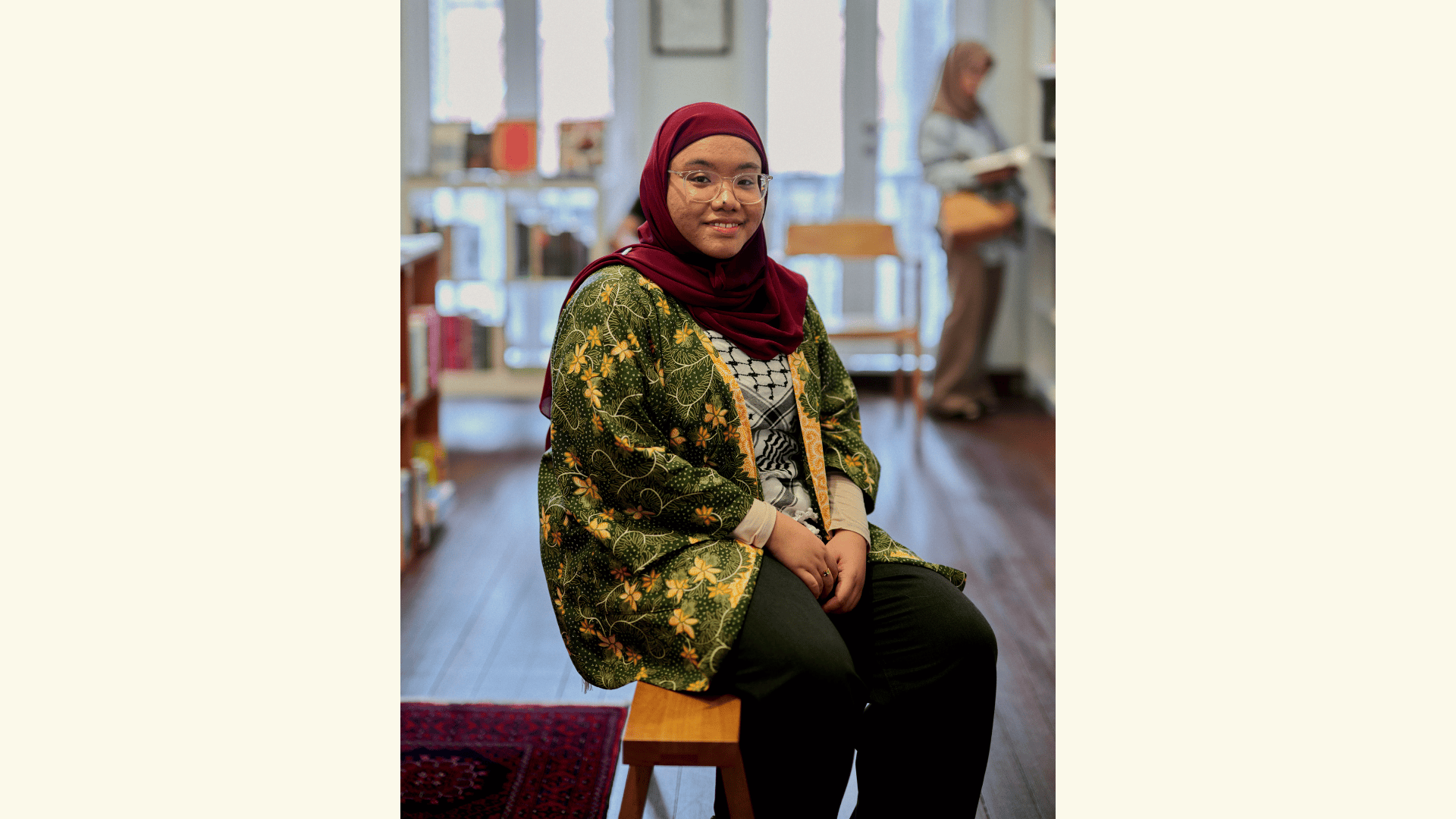
Yulianna Frederika
26, founder of Lepak Conversations
Lepak Conversations is an online community that facilitates interactions and public dialogue on critical Malay/Muslim issues in Singapore. In March 2024, Lepak Conversations organised a live Gaza Monologues reading followed by a panel discussion. The original panellists were actor Oon Shu An, Islamic speaker and community-builder Ustazah Shameem Sultanah, and Alvin Tan, minister of state. At the last minute, Tan pulled out and was replaced with Mr Janadas Devan, the government’s chief communications officer.
What do you perceive is the role of an organisation like yours in building pro-Palestinian solidarity within Singapore?
Lepak Conversations has always tried to make conversations about social issues more accessible. Since the Palestinian issue is often labelled “too complex”, our role is to break it down for the layperson. Allyship is one of our core values; [we believe] bringing together people with different levels of understanding is helpful in exchanging perspectives. This is crucial as the issue can seem “too far removed from Singapore”. Encouraging openness that brings forth diverse perspectives on pro-Palestinian solidarity helps us better understand how Singapore and its citizens have a role to play.
Singaporean activist Gilbert Goh, who runs LoveAid SG, mentioned in an interview with podcaster Plan B that his Chinese Christian friends perceive the situation in Gaza as a “Muslim problem”. As an organisation focused on Malay-Muslim issues, what are your thoughts? Do you think this viewpoint has changed or can change over time?
Gaza, and by extension, Palestine, is multi-religious just like Singapore. Though Muslims make up the majority of Gazans today, Christian and Jewish Palestinians are also affected by the war. Gaza’s oldest church, Church of Saint Porphyrius, was among the sites bombed. It is therefore imperative not to see it as a “Muslim problem”, because it simply isn’t. The war is indiscriminate.
The situation in Gaza has gotten so dire after the 7 October attacks that viewpoints are changing among Singaporeans. Those who were once apathetic now see it as a humanitarian crisis instead of a Muslim problem. Actor Oon Shu An, for example, publicly shares her journey [towards becoming an advocate for the Palestinian cause]. This is thanks to the Palestinian journalists who document the atrocities on social media, making the images of war accessible to everyone. As long as Singaporeans continue to look deeper into the long-standing violence in Palestine and past mainstream media headlines, they will find it hard to ignore Israel’s oppression of Palestinians. With the issue being taken up globally through the International Court of Justice and the International Criminal Court, I believe [more] Singaporeans will continue to open their eyes to its severity.
What were some of your biggest takeaways from hosting the Gaza Monologues? What impact do you envision these efforts making towards local and global solidarity for Palestine?
[One] takeaway [was] presenting creative ways to advocate for the Palestinian cause. The Gaza Monologues segment included readings of the original monologues written by Gazans under ASHTAR Theatre. Many attendees shared that they were deeply moved and were able to release their pent-up emotions. We also had the panel, “Being Palestinian Allies”, where we invited panellists with diverse perspectives to model how conversations about Palestine can be empathetic and sensitive, embracing emotions as part of the cause. This is important, as conventional ways of solidarity, like holding a rally at Hong Lim Park’s Speakers’ Corner, are not an option.
[But] one of the biggest takeaways was bringing people with different understandings of the issue together. We were intentional about inviting those who were on the fence, and were happy that some of them turned up and learnt a thing or two. We were also pleasantly surprised to see more children. We had a “Postcards for Gaza” segment where attendees wrote their thoughts and messages for Gaza. Seeing the children’s messages about wanting peace, safety and happiness for all reminded us that the issue isn’t all that complex. If children can understand it, anyone can. Encouragingly, some pro-Palestinian attendees engaged with the government representative on the panel.
There is an assumption that activists are generally in defiance of the state, but this openness suggests that there is room for Singaporeans and the state to negotiate with each other. For an issue seemingly as “sensitive” as this, it is crucial to continue building trust to achieve a shared ideal outcome. An inherently political issue requires a political solution and for that, negotiation with the state is necessary. After the event, people reached out for advice on how they could hold their own events and initiatives. The desire to continue creating spaces for pro-Palestinian solidarity within lawful means suggests that the state’s fears are unfounded. Pro-Palestinian Singaporeans are actually very mindful about protecting the nation’s social fabric. Doing so is not mutually exclusive from advocating for the safety and rights of Palestinians.
What is your opinion about the protest staged by two Singaporeans at Gardens by the Bay against the Singapore-Israel arms trade? How do you think this influences the way Singaporean society understands the Palestinian situation?
I am unsurprised that those two Singaporeans staged a protest at a public space like Gardens by the Bay. It only seems natural that such tight state control will push some to react in more extreme ways. Their willingness to defy the law signals the severity of the Palestinian issue. Some Singaporeans might label these activists as too extreme. After all, protests are unlawful and seen as disruptive and dangerous here. I reckon that many others will continue to be apathetic towards the Palestinian issue, as protests can be viewed as merely performative with no impact on the day-to-day lives of regular Singaporeans. I believe Singaporeans tend to care more about the issue when they start to feel the direct impacts of it.
Where does Lepak Conversations position itself on the spectrum of local activist voices, solidary groups and initiatives advocating for the Palestinian cause?
Lepak Conversations seeks to be the bridge that connects people and facilitates fresh and diverse perspectives. We will continue to do that with other initiatives, like our Instagram Live with Gilbert Goh. [Gilbert] has been an important figure in representing Singaporeans through humanitarian aid for Gazans. We are also in the midst of working with the interfaith community to facilitate discussions on the Palestinian issue through their lens, which has been lacking.
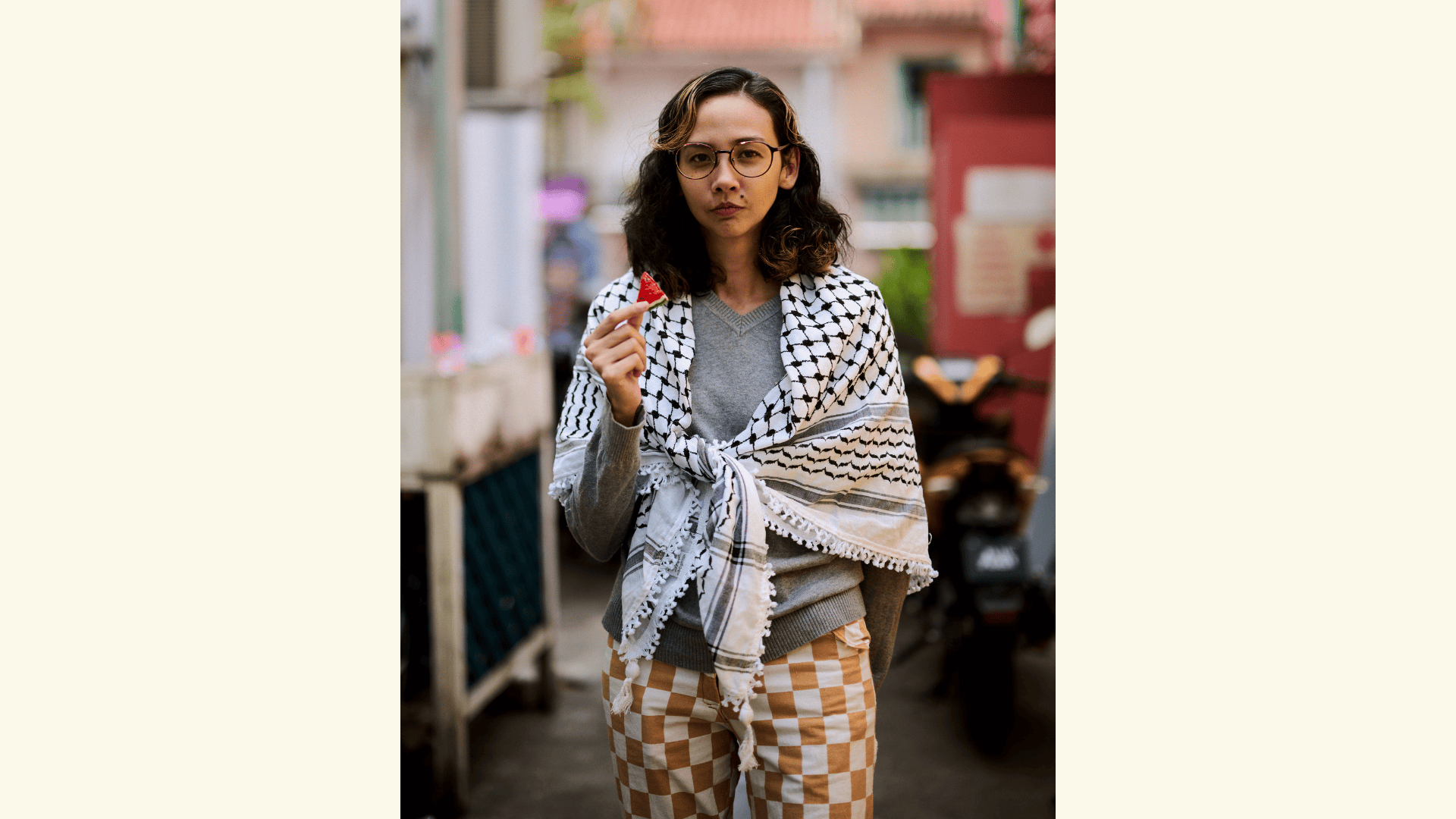
Jennifer Anne Champion
36, poet, artist, Master’s candidate in Creative Writing and Publishing, Nanyang Technological University (NTU)
In late October 2023, Jennifer started beading watermelon-shaped pins, pledging to donate the sales proceeds to emergency relief and medical aid efforts for Palestinians. By February 2024, she, with support from friends and volunteers, had sold more than 150 pins and raised S$3,915. The money has gone towards Medical Aid for Palestinians, purchasing e-sims, and supporting GoFundMe pages for Gazan evacuations, among other efforts.
How do you define activism? Would you call yourself a pro-Palestinian activist or advocate? Why?
I’m a language arts teacher so the element of activism that interests me is the verb part. It is the process of making someone active on an issue. This means supporting people to act, not simply to raise awareness (although that too can be useful). I have a lot of respect for civil society and its activists and the groundwork they have done. I’m afraid to call myself an activist, so I will say artist first. If my art or teaching does things or moves people to act, I am very happy. I do not have the head for history and politics, but I do make and share art to connect people.
What compelled you to raise your voice for Palestine? How was this different from the other causes you have supported in the past?
The Palestinian cause is personal because of my time in Tel Aviv-Yafo in 2015. I was a clueless Singaporean then and arrived having never heard of the word “Zionism”. I began to learn firsthand what it meant, along with other aggressions within the city’s society. On my last day there, I was in the streets and everyone went still when we heard a rocket launch into the sky. Our eyes watched its smoke trail, unsure where it was going to land. It was headed to Gaza. In some sense, I am motivated by guilt. I do not feel that with other initiatives that I have assisted with. Of course Palestine also moves me in its own right, but there is a personal element in the context of what I have done and have been doing.
Why did you choose your craft as a way to raise awareness about Palestine? What impact do you think it has made in the local community?
Craft and art is how I express my sentiments because they’re tangible objects. They are my first choice of response for everything in my life and [I want] to do it in the most extra way. When I started making beaded watermelon pins in October 2023, it was a personal activity—teaching myself a new skill, using every bead to honour a victim with some form of care and ritual. I was horrified by the scale and also by the fact that so many people killed by the Israeli forces would not have a proper burial. In a way, each bead I sewed on represented one death. I never reached the death count even by the end of that project’s iteration (February 2024).
I asked on Instagram if people would support the sale of these [pins] to aid charities and GoFundMes for Palestinians. Eight people said yes. Eventually, 100 people donated, and we sold 151 pins, raising S$3,915. While I do not share the photos and stories people have shared with me about where the pins have gone, I am very pleased to know they have been helpful in various communities and even made their way into the wider world [beyond Singapore].
I also held eight craft dates where I taught people to make watermelon pins. In 2024, there appears to be a sea change in the general public’s opinion on Palestine, but in those early months it was a little more silent and isolating. Many participants found it hard to even talk about Palestine with family and friends. I like to think all the people who came and participated found this activity to be a safe space to reflect, grieve and share their views.
The Ministry of Home Affairs (MHA) announced that wearing any foreign national emblems is a punishable offence. How did you navigate that considering Palestinian resistance and activism has many unofficial and evolving symbols, such as watermelons and strawberries, that have been adopted by those wanting to show solidarity?
I actually e-mailed my MP [Member of Parliament] about the watermelon pin project when the MHA announcement was made and explained my reasoning for continuing with the project. In his reply, he did not explicitly say that it could be construed as an offence, thanking me for my humanity instead. I think governments will always find ways to keep us under their thumb and we will always find new, creative ways to continue expressing our solidarity. Until such a time that they ban these unofficial and evolving symbols outright (which they have not), I will continue with their use.
Do you think art is also a form of activism?
Yes, although not always. Some artists continue unperturbed by the world we live in and the art and content they create reflects this. Some cannot help but let everything bleed into their work. I think I am in the second camp.
From 7 October till now, how has your perception about the state of activism and advocacy in the country evolved?
I would say activism and advocacy is alive and well—mutating and evolving, I think partially too from the groundwork and popularity of mutual aid collectives and initiatives during the pandemic. But also causes like Gaza appeal to our basic humanity and instinct to help others survive. Gaza has not been an issue confined to certain circles. Gaza’s desire for liberation has touched people from so many different profiles to move and act. I’ve never seen an issue so uniting [for] the people of Singapore. Instead of just civil society raising their voice, a loose collective of people of varying influence all over the island, the region, the world—we are all moving towards a common goal and I hope that before this article is published we would have reached it.
Francesca Harriman, 49, dancer;
Hafeez Hassan, 41, dancer
Co-founders of EktaSingapura
Francesca and Hafeez are choreographers and performing artists who have been organising Dabke sessions under their dance group EktaSingapura to raise cultural awareness about Palestine and support fundraising initiatives. Dabke is a traditional folk dance popular in Palestinian communities.
How do you define activism? Would you call yourselves pro-Palestinian activists or advocates?
FH: I would say action is any means “available” to you. In Singapore’s context action is driven mostly by what is legal. I call myself 100 percent pro-Palestinian; the Palestinian struggle has opened up my heart and eyes to being an activist. But, I would rather call it pro-humanity. The injustices, slaughter, ethnic cleansing, brutal oppression of a people for 75 years and now eight months into a genocide.
HH: I define activism as being aware of what the reality of the world is and acting upon it. I’m definitely on the side of the oppressed, which are the Palestinians, and I’ll continue using the resources [at my disposal] to bring awareness to this cause.
What compelled you to raise your voice for Palestine? How was this different from the other causes that you have supported in the past?
FH: The fact that they [Palestinians] have to livestream their deaths and suffering on social media because of the biased mainstream media and [its] complicity in reinforcing the lies of Israel, the United States of America, the United Kingdom and other powerful nations. I feel it is my basic responsibility as a human being to speak up for the voiceless.
HH: Honestly it is the amount of death that happened in just weeks, the histories I’ve read, the colonial greed, the amount of resources that have been extracted. How can the world be silent? How can anyone not [try to] stop it? I’ve realised that having a human spirit matters now more than ever. It’s the simplest things like being able to see what’s morally right or wrong, standing up or helping the weak, using our gifts to amplify a voice.
What was the response to your call for the Dabke class? What were some of the takeaways for the attendees?
FH: Mostly very positive. Participants enjoyed the energetic and fun feet-stomping Dabke. Above all, when we hold hands in a mini “humanity” circle and dance, all the sadness, anger and frustrations in response to the horrors that we have been witnessing, all those emotions are transmuted to love and hope and solidarity.
HH: It was nice to have like-minded souls gathering and liberating ourselves through Palestinian dance! You could see the smiles on everyone’s faces. The crowd was filled with both dancers and non-dancers trying and figuring out how to perform the Dabke. The energy was filled with so much joy and power!
Do you think artists have a responsibility to speak up against oppression? If an artist has never spoken about political issues, should we expect them to do so now?
FH: Absolutely! Artists can integrate their creative abilities to spread awareness and truth, especially since our laws on protest are super stringent! This moment in history is extremely crucial for artists to use their voice, there is a genocide unfolding before our eyes and a day longer means hundreds of people facing a death sentence.
HH: I think as an artist, you can either serve yourself or serve others. You either perform for yourself or you perform for others. The truth is there is no right or wrong in this, it’s just a matter of time and space. The way I look at it, Singapore has become such a safe and polished society that many will find it hard to get out of that safety zone. It’s a double-edged sword, the safety zone will lead us towards naivety and entitlement, making it hard to resonate with the ugly truths about current global affairs.
What is your opinion of other local artists who have largely remained silent in public since 7 October?
FH: No comments, I would rather focus my energy on what I can do, in whatever little means, towards putting an end to this holocaust rather than get upset over the silence of others.
HH: I believe it has got to do with where they are in their lives, because this will also project their narratives about the Palestinians. As within, so without. If one has no depth in their lives, it is hard to resonate with the depth of reality in the world. Maybe it’s their unresolved childhood issues, unhealed traumas, strong belief system, we will never know unless they honestly share.
What more do you think can be done within the artistic space in Singapore to show solidarity for Palestinians?
FH: We can have theatre productions concerning Palestinian history, stories, music and dance. A Palestinian festival featuring art, craftwork, food etc. Poetry and songwriting competitions featuring Palestine. Artists have the power to keep Palestinian culture alive!
HH: I feel we can build a platform, a community, safe enough for people to express solidarity because it hurts. I mean it is just simply and truly heartbreaking with what is going on with the world and we cannot just remain silent. We need to act, connect and share. Collectively, I feel this will continue to give the Palestinians a voice, keep embodying their culture, dancing the Dabke, eating and cooking their food. I feel artists have the power to use our gifts and talents to support Palestinians.

Member 1, 30, entrepreneur and community organiser;
Member 2, 26, community organiser
Echoes of Gaza
Echoes of Gaza is a community that has been calling for change in the Singapore government’s policies around Israel’s ongoing war on Gaza. The group has organised fundraisers, penned an open letter to the Ministry of Foreign Affairs to end diplomatic ties with Israel, supported efforts such as the Singaporean Campaign for the Academic Boycott of Israel, sent letters to organisers of the Asia Tech x Singapore that platformed companies directly complicit in Israel’s war on Gaza, among other initiatives. The interviewed members wish to be anonymous and their responses have been made collectively on behalf of Echoes of Gaza.
How do you define activism?
Collectively, activism for us is where everyone can take part in movement building, without feeling judged or overwhelmed. It’s for the common people. The word “activism” sounds very big and intimidating. I’ve never thought about activism like, okay, I’ll be part of it. But I feel like everyone has the chance to be part of a movement or any kind of activism in society. So, we want to make activism accessible to everyday people and encourage showing up in imperfect ways. Because there’s always that thought, if I do show up, will I be saying something wrong because I don’t understand jargon, big political words, all that jazz. We’re still learning about so many things.
It was during our first virtual event to commemorate International Palestinian Liberation Day, when we realised there was a need for a safe space to voice out things. We talked about the olive trees. We sang and there was a lot of joy and discussions about culture. Coming from Bangladesh, I do very strongly believe in cultural resistance, because that’s something that we had during our liberation war, where music, poems and everything really helped boost morale. So through that initial event, we introduced people to Palestinian culture, reeled them in a little bit, humanised people in Palestine a bit more because the dehumanisation was at its peak at that time, which is one of the stages of a genocide.
The intention behind all these community events where we draw in art as resistance, cultural stuff, it’s more than just activism. Resistance has so many layers. People think activists [are] superhuman beings with all this time and capacity and knowledge. And I do believe that some people have more knowledge about certain things than others. They’re subject matter experts. But we didn’t want people to feel intimidated by that. And subsequently, we created a space where people can self-organise and self-mobilise without relying on a few people at the top to run everything.
You’ve written an open letter to the Ministry of Education (MOE), organised fundraisers, petitioned the minister of foreign affairs online. Why have you chosen these initiatives as part of your activism?
I think there are various layers to how we can challenge the [government] narrative. The open letter to MOE targets the education system so that they’re encouraged to provide a more nuanced and inclusive curriculum. Through the fundraisers, we try to financially support the GoFundMe pages of those that have been affected by genocide, and online petitions really help to leverage on public opinion to influence policies and diplomatic stances. Most of the time we don’t get any reply, but we still do it anyway. We know they’re watching.
I think we have to take many, many different types of actions to be able to attack something from all sides—that’s the idea with Echoes of Gaza. A lot of these things are very community-led, so somebody will be like, “oh the MOE thing is going on, let’s start a petition.” [The MOE, as part of its Character and Citizenship Education lessons, produced teaching materials for students on the Israel–Hamas conflict, which according to some parents and educators was not entirely neutral, and largely focused on 7 October without providing historical context of Israel’s ongoing war on Gaza.] Then everyone will just chime in, they’ll write the letters, they’ll edit it together. That really keeps everything going.
We also recognise that people are on different parts of the political spectrum and that’s a challenge. You have people on the left who want to take direct actions and then you have people who are just starting to learn about the movement. Respecting that has been very important for us. People will have different entry points, different ways of looking at the issue. The vital question for us is: how can we bring everyone under one space through education and community-building?
Which initiatives have led to more meaningful conversations and solidarity?
I think events really do it. People love coming together and talking about things and venting. A lot of people can’t talk about the Palestine issue at their workplaces or schools. For example, my friend who is an MOE teacher was telling me how difficult it is for him to talk to his colleagues about it. I think when we had [our] first two events, we realised that people really, really want to meet in person. Before that, it had been just virtual events, so we also thought that for us to do such a movement together, we need to trust each other for it to even be sustainable. Social media posts, addressing concerns as things happen, that has also been very effective in capturing attention and keeping people engaged.
There was this tech show in May this year [Asia Tech x Singapore], and the Israeli ambassador spoke about it. So, we put up a post about the show [that highlighted links between Israeli companies at the show and how their technology was used for Palestinian oppression]. That’s the everyday action people take.
What are some of the biggest misconceptions you found Singaporeans had about the Palestinian cause?
The term Israel–Hamas conflict, it’s really not that. These are government narratives that vilify Palestinian resistance, terms like “terrorists” and things like that. I think that’s something that’s shifting. I think more people are supporting Palestinian resistance because they’re seeing that this is clearly provoked, and for survival, you need to resist. A lot of people are thinking how Singapore is complicit in this, especially after the recent arms show [the Singapore Air Show 2024, to which Israeli defence firms were invited]. In the comment sections, there’s always this comeback from people who are not pro-Palestinian that we have to maintain diplomatic ties, it’s very crucial for Singapore to do so for Singapore’s survival. That’s another thing that a lot of Singaporeans believe, that if we sever these ties, Singapore will be in trouble.
I think there’s also this necessity to acknowledge that [often] it is because of the systems we have been raised in. There are a lot of things to unlearn to be able to look at certain issues with clarity. Shifts in official stances also help [conversations]. For instance, when Vivian Balakrishnan, foreign minister, went to the Middle East, people on the internet were like, okay, the government’s stance is shifting about this, and we feel more comfortable with that. I think with each issue that is raised, whether it’s domestic or international, critical thinking is being built a little bit more. Which is why it’s really important to keep pushing the government and [continue] the advocacy that we are doing.
What is the future of activism and advocacy in the country?
The rise of social media and digital platforms is going to change the dynamics of how we are going to do activism, even in Singapore, because it’s so accessible and far-reaching. Young Singaporeans are more aware and vocal about these issues than maybe ten years ago. And I think leveraging this technology to mobilise support and drive change will be crucial to the future of activism. As long as Echoes of Gaza continues to stay in touch with ground sentiments, we will keep organising to the needs and responses of the people. We must also appreciate various tactics and risk appetites within and outside our organisation while helping people understand the power of coming together.
I think there are a lot of conversations about building critical movement. When the Palestine issue came to light, people were saying, “oh, we don’t have freedom of speech.” We have always known that, but the Palestine issue has uncovered a lot of other local issues. It has given us language to describe certain experiences that we have as a country. When we keep engaging with different issues, it also builds knowledge and momentum for other local movements. There also needs to be a lot of care in the way we do activism, the way we care for people. We want to build critical movement, but not abandon people in the process.
Echoes of Gaza is going to restructure a bit because we need more people. Right now it’s just a few of us and there’s a lot of work that happens behind the scenes. We don’t want to burn out. [We want to be in a situation where] even if a few of us are not active, the movement still continues.
When we think about doing collaborative work, we forget that we need to take care of each other first. We have to think about, if we do something, will it get the other person into trouble? And that’s something I constantly learn from my co-organiser. So, it’s thinking ten steps ahead sometimes just to make sure that the movement sustains without anyone getting into trouble. We hope to see different organisations coming together under one umbrella and collaborating more to maximise our efforts towards a certain cause.
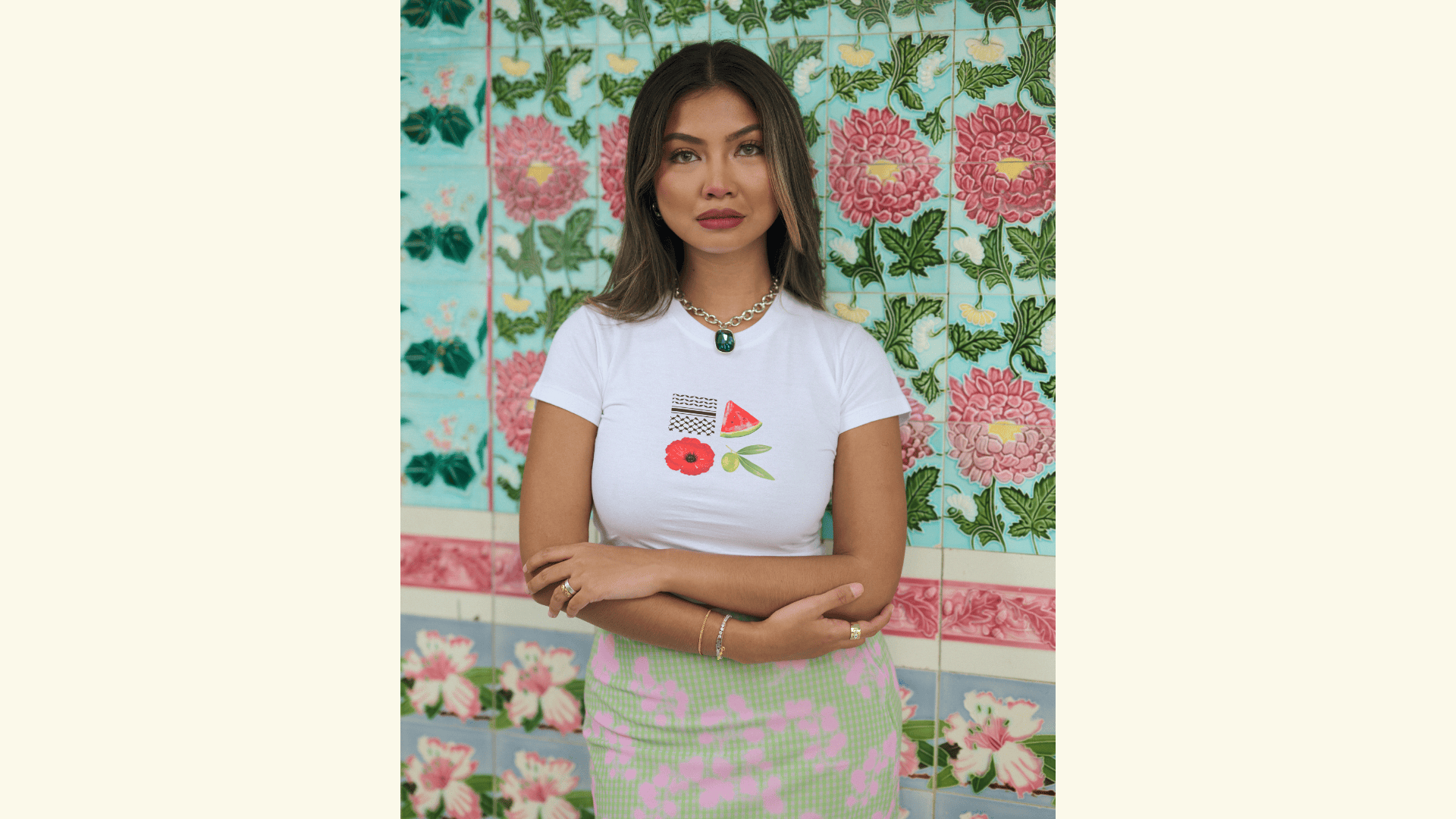
Camira Asrori,
29, fashion influencer
Camira is a fashion influencer who has been voicing support for Palestine through her Instagram account [@camira.asrori] which has nearly 32,000 followers. In February 2024, on re-entering Singapore from Malaysia, Camira was questioned by the immigration authorities for her pro-Palestine social media postings and for participating in a protest in Japan. The same month, she was one of the organisers investigated by the police for participating in a public solidarity action that delivered letters to the Istana in support of the Palestinian cause. In June, Camira, along with two other women, was charged under the Public Order Act for the latter.
How do you define activism? Would you call yourself a pro-Palestinian activist?
Activism to me is standing up for what’s right and calling out what’s wrong. Honestly, I wouldn’t label myself as a pro-Palestinian activist or advocate because I’m still new to all of this and I have a lot to learn. I’m just a fashion-lifestyle influencer who has a large following and has decided to use her platform to raise awareness about what’s happening in Palestine.
What compelled you to raise your voice for Palestine? How was this different from the other causes that you have supported?
The atrocities being done to Palestinians. Nobody deserves that. The genocide that is currently happening to Palestinians should be on everyone’s minds because it can happen to any of us. We learn about it in the history books (we’re even forced to memorise the facts!) but here we are, with some of us still looking away. I’ve always advocated for LGBTQIA+ rights and sustainability in fashion. I can still somehow accept if people are unbothered about these issues but the Palestinian cause should be an exception.
Has your experience with the immigration authorities changed the way you advocate for Palestine in Singapore?
Yes, definitely. I’ve become more fearless than ever. That interrogation session with the immigration authorities actually made me braver in standing up to the state. If they felt so challenged by my social media posts, I realised the power is in my hands.
How do you think your activism has helped your followers understand the Palestinian cause? Have you received any online trolling for your views?
For those who did not know [about Israel-Palestine], I hope they learnt a thing or two and are able to share it. I do get a few people letting me know that my posts brought awareness and I’m the only person on their timeline who is sharing about this (shocking, I know) so I think it’s very important for every single person to post about this issue. It’s not too late, keep posting and don’t stop at reposting just an AI image. Yes, of course, I’ve received a lot of online trolling and hate comments but I’m used to it (haha!). I’ve put myself out there on social media since I was 15. But the biggest tip I have to share is—don’t read the comments; most of these comments are posted by anonymous accounts anyway. If you want to have a real conversation with me, post with your actual account with your real name and photo. Then, we can talk.
How has being charged under the Public Order Act affected your stature as a pro-Palestinian voice? What would you like others like you to draw from your experience?
It has definitely changed as I’ve garnered a lot of attention (which I did not expect at all) but it’s good, because I get to channel it to some of the initiatives I’ve been spearheading and also to other pro-Palestine initiatives in Singapore. Do not be afraid and continue doing what you’ve been doing. At the end of the day, you know you’re on the right side of history and whatever the outcome, you know it’s for a bigger cause.
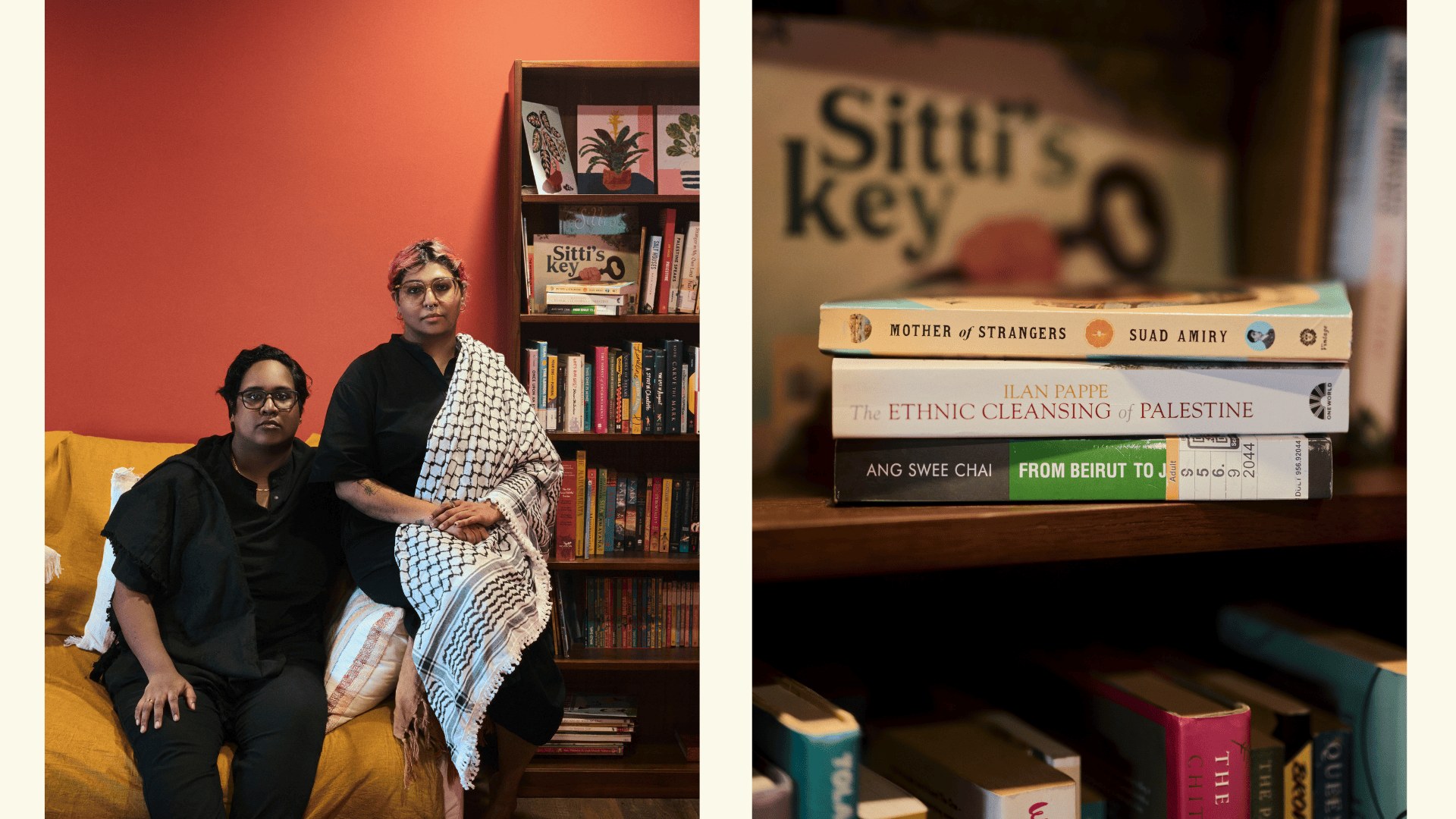
Trishnu Kaur (they/them), 38, entrepreneur and educator;
Shafna (she/her), 30, junior director
Co-founders of Chai Baba Book Club
Trishnu Kaur and Shafna founded the Chai Baba Book Club as a way to create space for discussion around mostly Palestinian fiction in Singapore. As of September 2024, the club has hosted three book club readings. These readings have a sliding-scale admission fee, most of which goes towards fundraising for Palestine, such as GoFundMe efforts and LoveAidSG. It also collaborated with Birds of Gaza to organise Wings of Hope, a book club gathering for children that included arts and crafts, where each bird crafted was dedicated to a martyred child from Gaza. As a business owner, Trishnu has also ensured that Chai Baba is seen as a Palestine-supporting endeavour.
What was the thinking behind starting the book club?
TK: When 7 October happened, I along with my circle of friends began feeling an extreme sense of hopelessness. “Shaf” is that one friend who loves to read as much as I do, and she’s an incredible organiser. I ran the idea past her, she agreed and we decided to just focus on Palestinian fiction. I thought that might be a way for us to do our part and maybe just create a space for people to come together. Once we started the book club, it gave us a reason to gather more often, and the lead up to each book club gathering was us just having lots of our own conversations about Palestine and diving into the book’s characters.
S: We went for a session at No Readgrets book club. The book was On Palestine by Noam Chomsky and Ilan Pappe and at the same time, Trishnu was reading Ahed Tamimi and Dena Takruri’s book [They Called Me a Lioness: A Palestinian Girl’s Fight for Freedom] and although it is non-fiction, the authors were very intentional about it being accessible, which was something that we wanted to take into account. We read Mother of Strangers by Suad Amiry, and there was a lot of understanding of what was happening on the ground through these characters’ stories.
TK: We sent attendees reading guides with questions. It wasn’t mandatory [to read] but it was highly encouraged. We were also very mindful of ground rules, telling people if you sign up for this book club there needs to be a level of commitment, like commit to reading the whole book, be familiar with it because there will be discussions and group activities. I think fiction just moves us in a way that non-fiction cannot. I feel that non-fiction book clubs might be a little bit intimidating. I remember attending a book club where suddenly everybody’s just chiming in with a lot of facts that I’m not familiar with, and then feeling I don’t know so much, which is not a bad thing but it’s almost like a contest of who knows more, trying to intellectualise everything. I feel at this point with regards to Palestine, what new intellectualisation can we bring to the table that has not already been explored? Fiction cuts through all that; you don’t need to be a brown person, you don’t need to be Muslim, you don’t need to be Palestinian to empathise with that. All you need to be is human, to be able to read the story and just feel.
What were your takeaways from the sessions?
TK: Most of the people who attend our book clubs, I would say 90 percent of them, are brown, either Indians or Malays, maybe Muslims, very few non-brown people, which is interesting because the majority of my customers and clients are actually non-brown people. I’ve made peace with the fact that most of my customers will be non-brown people. That’s the part that breaks my heart a little bit. I would rather you show up to the table, than buy my chai. But it’s the brown people who are showing up. It’s easier for them perhaps because being brown in Singapore, you’re already part of a marginalised group. But do you have to be marginalised to empathise? That’s the question that keeps boggling us. We also want to find ways to bring different types of people to the table.
S: We guided the conversations to centre how an instance in the book could inform whatever action or resistance that we take next or what it could teach us about Palestinians. Some people who attended couldn’t talk about it at home or at work. Seeing people come out of their shell and talking about something that they care about for the first time. I think for a lot of people it was a rude awakening, like “I cannot be asleep at the wheel anymore, everything is interconnected.”
As a brown and queer-run book club, have you had conversations about how intersectionality plays a part in Palestinian liberation?
S: A lot of the conversations that we are having at the book club are not meant to focus on our identity. With the conversation about, “Oh, you care because you’re Muslim. Do you know that if you’re queer, you’ll get killed in Palestine,” those assumptions come from a very hyper individualistic kind of mentality. People fail to realise that the liberation of Palestinian people is connected liberation for us all.
TK: We have never shied away from the fact that we’re queer but it’s also not something that we necessarily bring up or focus on. If it comes up naturally then it’s something we talk about.
As a Palestine-supporting business, what response did you receive from customers?
TK: Our business revolves around chai and our audience has been mostly millennials and Gen Z. When we started vocalising our support for Palestine, a lot of people were very surprised and I got DMs [direct messages] like, “Oh, I didn’t know you were Muslim,” or, “Oh, it makes sense now, like the chai and everything.” And I was like “No, I’m not Muslim and I still support Palestine. I don’t really see what the relationship has to be between the two of them?” But the fixation on that was very interesting to me. I suppose it’s not surprising because in Singapore, I would say that the majority of Palestinian supporters or fundraising initiatives are led by people of Islam.
At the heart of the business is always community and creating a space. When I started the business, I was very new to everything, very lonely and looking for community. And I managed to find all of that. And then it got to a point where I was grappling with how to organically pivot from a business focus to a more community focus, or figure out a way to balance the two. When the book club happened, the business took a backseat because I just felt uncomfortable trying to sell things during this time. So I was like, okay, I’m not going to advertise the chai anymore. If I get orders, so be it. I will fulfil them. But then the focus became the book club.
The first post that we put up stating our support for Palestine, I disabled comments because I was very scared. And I did think that this could really jeopardise my business. I even thought, could the government take away my licence because I was being vocal about this? But I didn’t receive any negative reactions, just very nice comments via DMs and in-person conversations. A lot of people were like, “What can we do to support you, are you going to organise a fundraiser?” Customers have said, “If you’re going to organise a fundraiser, if you need support, let us know, we’re happy to help.”
Within the range of voices speaking for Palestine in Singapore, where does Chai Baba place itself?
TK: I started out with Chai Baba because chai just connects people in a way that feels very seamless, and the conversations you have over chai are so beautiful. The most impactful thing we’re doing right now is the book club and just organising things. I have to acknowledge my immense privilege because I have a job that pays quite well. And then I have my partner who handles things on the financial front at home. I don’t have [big] financial concerns. So in that sense, I am extremely lucky and very aware that I’m able to just focus on the book club because we don’t make anything from it.
I think in Singapore, we’re all very new to this rise in political consciousness. The [established] civil society spaces can be very intimidating for people, so I don’t know if I’m being overly optimistic or naive here, but I would like to think of Chai Baba as an entry point to that [politically conscious] space. Shaf and I use the word “brave space” where you can still feel things out, learn and unlearn with one another and then you can move on to the next step. I think that’s why reading feels like a very non-threatening way to have lots of difficult and uncomfortable conversations. Most of us are so afraid, we’ve been led to believe that we cannot speak up. For us, it’s just about being creative. We have very low thresholds for risk; the thing that feels natural to us is reading and creating a community around it.
Mariyam Haider is a writer-researcher, podcast host and spoken word artist, with works focused on gender, identity, and culture. She is currently based in Singapore.
This piece was first published in Jom’s annual print magazine issue No. 2. Letters in response to it can be sent to sudhir@jom.media. All will be considered for publication on our “Letters to the editor” page.