
Our picks
News this week included: Bloomberg commentary on why SG can fix South-east Asia’s haze; MRT reliability hits a new high; commentary by NUS prof on property wealth tax; GIC’s 45th ann public exhibition; Anthropic opens SG office; Lawrence Wong and Tharman Shanmugaratnam on AI’s threat to the “bottom rung” of career ladder; MY’s “Silicon Island” for its AI ambitions; new measures to block malware and phishing sites; “MOST Pathetic BTO 4 room Kitchen EVER SEEN” video draws rebuke from HDB; how new big cars are outgrowing older parking spaces; 71-year-old graduates from SUSS with multiple degrees; ST commentary on 60 being the new 40 for work; lawyer Charmaine Yap wins global award for work and advocacy for vulnerable groups; pre-school teachers to get 2 hours of weekly protected time for non-teaching tasks from Nov 2027; Singaporeans advised to postpone pilgrimage to S Arabia amid security concerns; SG startup recovers lithium from EV batteries; goodbye IMH, hello National Centre for Mental Health Singapore; commentary by NUS prof and comms manager on the limits of Singapore’s Nutri-Grade labels; woman who molested man and teenage boy by kissing them gets 21 weeks’ jail; SGIFF stands by “The Assassin(s)” despite controversy and calls for withdrawal; 2026’s F1 sees second-highest turnout; and Cassidy, the 3-legged cat who’s SMRT’s “Big Boss”.
Below are the issues we explore in depth:
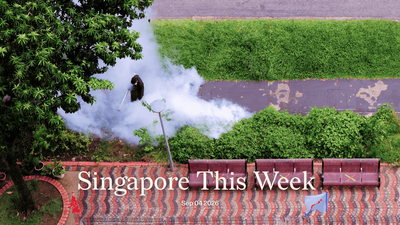
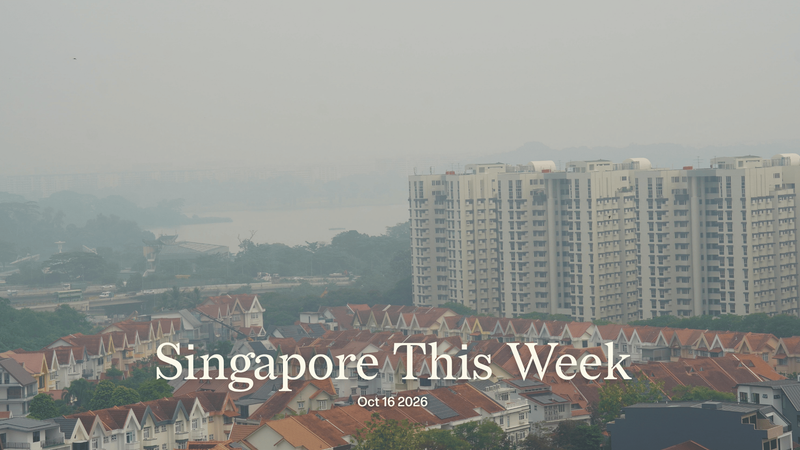
Society: OMG, it’s the haze!
A door whines open, in the first-person video, and we hear a woman moan as she emerges from her home to survey the street. The yellow-orange sky and immense smog are reminiscent of the scene after a bomb goes off. But we are frozen in that moment, eternal damnation. Her neighbours’ houses appear like fossilised structures from an earlier civilisation. A few urchins, but nobody else. “ [Indiscernible] gak kelihatan, benar tak ini masih di bumi?” (Can’t see the housing infront, is this still earth?) It’s a scene that marries the lonely angst of “The Last of Us” with the scorched palette of “Mad Max: Fury Road”. Environmental collapse is clichéd now as the premise for Hollywood blockbusters, all the more because a post-apocalyptic future is already the lived reality of our Indonesian neighbours. Palangkaraya, Central Kalimantan’s capital where she lives, recorded PM2.5 levels as high as 3,340. (Anything over 250 is considered “very high”.)
Most Singaporeans would not give two hoots about any of this. Except that the haze is now bothering us too: this week’s 280 reading sparked runs on N95 masks and purifiers. And so a script, as familiar to us as those West African palms that have blanketed our region, is now playing out. Malaysians and Singaporeans whine. This prompts our governments to complain and offer help to Indonesia, which rebuffs us with witticisms. 2015: “For 11 months, they enjoyed nice air from Indonesia and they never thanked us”; 2026: “When there is no smoke, we send oxygen”.
Greenpeace and other activists point out the obvious ironies that Malaysians and Singaporeans love to ignore: many of our companies, domiciled and/or listed here, are the ones implicated through “haze source points”. Corporate PR responds with polished proclamations about strict zero burning policies. (It’s the slash-and-burn farmers’ fault, you neocolonial do-gooders.) Our government considers action through the Transboundary Haze Act, through which it can fine firms up to S$2m—what they make in half a day—demonstrating simply that it is as feckless as those chummy patriarchs at batik-wearing ASEAN jamborees, promising to forever save each other’s faces.
As the wayang proceeds, the vulnerable suffer most. Haze inequality is not unlike heat. As surely as our construction moguls immerse themselves indoors with purified blue air, their South Asian minions will continue building our glorious future outdoors, one gnarly breath at a time. We’ll take comfort that it’s not as bad here as in Indonesia: more than 4,390 additional hospitalisations due to acute respiratory illnesses, says Greenpeace, as well as at least 635,000 cases of severe asthma attacks among children. In two months, we will pretend like none of this ever happened, and will slowly reformat our minds so they can be surprised again in a few years.
Same same, but a bit different every time. On Wednesday Malaysia said that “for the first time” it’s discussing collaborations with Indonesia to fight the forest fires. Yesterday Indonesia said generally that it’ll accept foreign help to do so. Encouragingly, civil society is growing stronger. Kynan Tegar, an Iban filmmaker, made a searing short video explaining how plantation interests have drained peatlands through canals. “These are decades of massive and wholly intentional terraforming,” she said. Residents of West Kalimantan are part of an unprecedented class action case against their government, claiming “negligence, omission and failure” that’s led to “a massive public health crisis.” Meanwhile, Greenpeace Malaysia and a range of other climate activists marched peacefully to Parliament to demand accountability from implicated corporations. (No, dear Singaporeans, this did not result in a breakdown of law and order in KL.)
All that said, it’s also too simplistic to blame governments, corporations, somebody else, without acknowledging our own complicity, through our addiction to palm oil. (See next blurb.)
Some further reading: a CNA explainer on PSI, PM2.5, AQI, and making sense of differing measures; and a TOC explainer on peatland drainage.
Society: The evil palm
Activist narratives around oil palm and deforestation in the region focus, perhaps understandably, on extractive industries. “Forest and peatland fires that continue to persist are not part of a natural cycle, but a reflection that economic expansion based on global commodities are valued more highly than the lives of citizens,” thundered the Greenpeace report implicating Malaysian and Singaporean firms. “Continued exploitation left unchecked that sacrifices the health of citizens and ecosystem sustainability for the sake of commodity exports must no longer be tolerated.”
What complicates the picture is that many local communities in Malaysia, Indonesia, and elsewhere have benefited from oil palm’s growth, including through job creation and rising incomes. Separately, we must contend with our unquenchable thirst for one of the world’s most versatile oils. From instant noodles and margarine to infant formula (it helps mimic the fattiness of breast milk). From soaps, shampoos, and toothpaste to laundry detergents and dishwashing liquids. From fertiliser and animal feed to biodiesel, lubricants, and other industrial products. And on and on and on. Palm oil has not so much crept into modern life as slathered itself all over it. It mostly sustains the populations of China, India, and the Global South; North American and the EU accounted for only 15 percent of global consumption by the 2010s, said Sunil Amrith in The Burning Earth.
“Palm met the nutritional needs of an urbanizing Asia with a colossal environmental impact—but an impact that was still smaller than would have been the case with any known alternative, given that palm uses only a fifth as much land, for the same yield, as soy and other vegetable oils. What palm demonstrates is more broadly true—the prime motor of environmental change in the 1980s and 1990s, still the factor above all others, was what and how people chose to eat.” And so when the price of palm oil goes up, Asia’s poor suffer. This truism of course makes for an appealing defense for corporate PR at palm oil firms.
That there are no easy short-term answers to this seemingly intractable problem does not negate the need for radical long-term ideas. To the usual list—corruption, transparency, corporate governance, supply chain management, concessions and zoning, forestry, and peatland management—we’d add reduced consumption and more enlightened stakeholder capitalism. It’s outrageous that palm oil companies in Singapore mint hundreds of millions of dollars in profits every year while, directly or indirectly, consciously or unconsciously, through their actions our neighbours contend with armageddon every few years.
Is there a better profit sharing model, perhaps involving equity stakes for local communities? How do we make firms more responsible for their entire supply chains, as well as externalities from their actions? In addition to much larger fines for negligence, can we also get them to contribute a share of profits to environmental defence and public health funds?
Society: Slices for all
“Singapore is not a welfare state”, is an assertion many leaders have made to emphasise the three principles of Singapore’s social security system: self-reliance, family as the first line of support, and community organisations operating under the “Many Helping Hands” banner. The latter involves non-state actors such as non-profit organisations or race-based self-help groups, voluntarily meeting the needs of less-resourced Singaporeans.
The government provides some funding while fundraisers—be it staff members or volunteers—fill the gaps in annual budget requirements. Some organisations outsource this labour to external vendors who offer commission to their recruits (commercial fund-raisers) for donations they’ve raised. It’s hard to miss them: enthusiastic individuals clutching tablets positioned at MRT stations or busy pathways leading to shopping centres, eagerly trying to catch the eyes of commuters who’re equally keen to avoid them. The fact that they’re paid workers and not altruistic volunteers leads some to cast doubts on their legitimacy. To be clear, their work is legitimate and vital for charities, which can use only 30 percent of the funds raised for expenses like wages and marketing materials.
Still, the discomfort lingers, perhaps because we expect charities to act out of benevolence, which donors then reciprocate. But the truth is that people too need to be incentivised to give, evidenced by so many non-profits’ desire to get the Institutions of a Public Character (IPCs) status. IPCs can issue tax deduction receipts for qualifying donations—an incentive that both charities and government expect to attract more donations. This introduces a transactional element in the relationship between donors and charities.
What’s more, local businesses and more broadly, the ultra-rich are not donating enough. Most Singapore companies say they have a moral duty to give back, but only 30 percent of them volunteer or donate, according to a National Volunteer and Philanthropy Centre study of 1,100 firms. Overall, 14 percent volunteered and 26 percent donated, with some doing both. Additionally, as scholars argued at Academia.SG, donations by the ultra rich everywhere are a tiny fraction of their wealth and do not make up for the paltry taxes they pay—“at much below 1 percent of annual income, compared with the 24 percent paid by an average taxpayer in rich countries and the 40 percent paid by high-salaried”.
Commercial fund-raisers may help widen the donor base but do not address these tensions. A more reflexive approach is to question the donation system in relation to our principles of self-reliance and meritocracy. When aid is non-universal, conditional, and shaped by a persistent anxiety over “free-riders”, those who give can be seen as having earned the right to be rewarded, as with a tax deduction. It also ignores measures that could fund broader redistribution—such as taxing wealth, capital gains, or inheritance—supposedly to protect competitiveness. But the recent Parliamentary discussion by young People’s Action Party (PAP) leaders on taxing the rich shows the ground may finally be shifting. Hopefully, we’re moving to a society that’s “ready to share more”.
Tech: The last word
If you were in Suntec City in early March 1999, you probably traipsed right past the inaugural meeting of the Internet Corporation for Assigned Names and Numbers (ICANN). How could you have not, with that name?
But ICANN is one of the most consequential bodies around. It was formed in 1998, a laudable move by the US government to transfer oversight of the internet’s naming system to an independent, global non-profit. Before that, one company, Network Solutions Inc. (NSI), held a juicy monopoly over registrations under generic top-level domains (gTLDs) like .com or .org. Anticipating a catastrophic failure of regional governance, say you wanted to set up a site called www.haze-lailiao.com. Your only option was to register it through NSI. It was both the “registrar” selling you the address and the operator of the .com “registry”, the master list of existing .com addresses. With mass internet in the offing, this was simply not on; and discussions at ICANN’s Suntec meeting helped transform the monopoly into a marketplace of thousands. (In case you’re worrying about NSI, it was acquired by Verisign in 2000. Verisign still operates the .com registry which makes it some S$1.92bn annually.)
In time, ICANN’s authority expanded to doling out gTLDs, that is, the equivalent of .coms and .orgs. Here’s how it works: periodically, ICANN puts out a call for a fresh set of gTLD applications, and after assessing them on a variety of technical and financial criteria, decides which ones can proceed. The first round introduced us to .info and .museum among others; the second to .cat and .xxx. The most recent completed round, in 2012, brought forth some 1,200 new ones, ranging from .media (as in jom.media) to .wtf (as in idiocracy.wtf).
You could be forgiven for thinking that the majority of applicants are adolescents. But ICANN charges over S$250,000 per application, so probably not. TLDs are big business, a particularly desirable one can invite multiple applicants who may end up in a bidding war. For instance, Google paid ICANN US$25m (S$32.1m) to beat out 11 others for the right to operate “.app”. Other companies base their entire business models on buying loads of internet real estate, hoping some hit pay dirt. Many have in the past.
ICANN has been criticised for failing to impose sufficiently tough safeguards on the registries and registrars it oversees, allowing some TLDs to become scammer havens. “They have zero interest in making life difficult or less profitable for registries or registrars because they are essentially wholly dependent on the money that they get from them,” said one industry veteran. “[A]s soon as you start…asking for proof of this or that, you’re introducing overhead costs…therefore reducing your income.”
The organisation is currently reviewing some 1,600 fresh applications. Predictably, .agi, .superintelligence, and .agent are being fought over by the likes of Google, Meta, and OpenAI. Accompanying them are the hot-air trio of .trump, .maga, and .fart, the latter among scores of applications sent in by one group backed by US$36m (S$46.2m) from a single investor.
But naked profit doesn’t drive everyone. A queer-owned and operated Belgian NGO has applied for the .meow TLD—meowing can be a queerness tell in internet subculture—because “each time someone registers a .meow domain, most of that money comes directly to us. Instead of pocketing it, we’ll funnel it straight back into queer people and projects worldwide.”
When ICANN releases new TLDs on November 17th, you know who to root for.
Arts: Life after loss
The poet Wendell Berry dreams of a dead friend. Then he realises: “the dead are changeless. / They grow no older. / It is I who have changed, / grown strange to what I was.” In “A Meeting”, his friend looks at him and smiles: “I been eating peaches / off some mighty fine trees.” Many of us have dreamed of our lost loves, so plump with life in our minds that our hearts break again when we wake. It is we who must grapple with the change their absence brings. Over the past decade, artists in Singapore have been turning their attention to the slow mourning that accompanies the silver tsunami of our ageing population. Faith Ng’s 2018 play, “A Good Death”, follows a palliative care doctor as she tends to patients in their final days while also grappling with her father’s failing health; she compares end-of-life care to ghost writing, and how the hardest part is often “getting the ending right”. The long-running community project “Both Sides, Now” has, since 2013, encouraged “living well and leaving well” through end-of-life conversations, exhibitions, and performances. One of its more recent forum theatre productions had audience members weigh in on the small domestic dramas unfolding on stage between three siblings as they sorted through their late father’s estate—a rehearsal for a drama that plays out in homes across Singapore almost every day. And T:>Works’ AGEncy Fest features an ongoing workshop on guided autobiography for those aged 60 and up, where participants are invited to make sense of the paths they’ve taken with family, career, health and identity through a framework for “life review”. Gerontologist Robert Butler developed this reflective strategy when he found that “[as] people at the end of their lives reflect on their experiences and relationships, they can either achieve a valuable sense of fulfillment and coherence...or become mired in bitterness, fixating on failures and unrealized dreams.”
There’s now a much more substantial arts-based support system dedicated to those about to depart. But what of those who are left behind? If you feel, like Berry, that you’ve “grown strange” to the person you were in the wake of impossible loss, there’s a festival at the end of the month that might speak to you. “Rites of Us”, a two-day programme dedicated to grief literacy, seeks to be the balm to well-meaning but blunt clichés like “time heals all wounds” or “they’re in a better place now”. The community arts festival is co-produced by veteran arts producer Audrey Perera, who herself lost both parents when she was nine. You can hear from death doulas who’ve shepherded people across the threshold, better understand how children navigate grief, or participate in a choral and spoken word performance that also invites the audience to offer up their last words. And grief isn’t particular to death, even if death is the focus of the festival. Ng Yong Hao, a social work professor who specialises in loss and grief, cites the loss of a marriage or a job also as sites of mourning. “People don’t recognise these losses or minimise them because they think that these are not as serious as death,” he told The Straits Times. He’s echoed by fellow researcher Paul Victor Patinadan: “People may think they are grieving wrongly if they don’t reach a clear resolution. Grief is more complicated than that...Grief is messy and unique. It’s personalised. Nobody can dictate what your grief looks like.” Ambiguous grief, prolonged grief, anticipatory grief: they all have a place at the table, and so does yours.
Some further reading: Fashion researcher Xingyun Shen writes about how the garments of departed loved ones might offer us both solace and support in “The soft companionship of grief-garments”, first published in Jom’s Print Issue No. 3.
Abhishek Mehrotra, Sakinah Safiee, Corrie Tan, and Sudhir Vadaketh wrote this week’s issue.
Letters in response to any blurb can be sent to sudhir@jom.media. All will be considered for publication on our “Letters to the editor” page.
If you enjoy Jom’s work, do get a paid subscription today to support independent journalism in Singapore.