

News this week included: widening war in the Middle East, with ripple effects on transportation and possibly, food costs, here; Lawrence Wong visits Japan amidst global turmoil; Singapore’s bristling response to Australia’s national broadcaster for having the temerity to suggest unfairness in our political system where, it is known, of course, that no party is more equal than others; POFMA orders issued to activist Han Hui Hui; the struggles of older children leaving the care system; uncertainty about the future of Komala Vilas, beloved Indian joint; multi-day disruptions in Singtel’s services; Singaporean of the Year gong for doctor helping the intellectually disabled; higher likelihood of autism symptoms in toddlers given more screen time; Amos Yee deported back to these shores.
Below are the issues we explore in depth.
Our picks
Society: A dearth of mental health professionals
Getting mental health support in Singapore can be almost as daunting as the struggles that make help necessary in the first place. Stigma and workplace discrimination still deter many from seeking help. But even for those who do, a persistent shortage of mental health professionals makes care difficult to access. In 2021, the Ministry of Health noted there were 8.9 psychologists and 4.5 psychiatrists per 100,000 people here, and “no international consensus” on the ideal ratio. Just as a comparison though, Australia and Korea have 19 and 9 psychiatrists per 100,000 population respectively. Although the ranks of psychologists, psychiatrists, and counsellors have grown in recent years—amid rising awareness and a stronger national focus on mental health and well-being—they haven’t grown fast enough to meet demand.
The reasons are structural. Training pathways are long and costly, typically taking about seven years and requiring postgraduate qualifications, with expenses rising further for those who study overseas. Limited clinical placements and a lack of qualified supervisors further constrict the pipeline. At the same time, clients are often reluctant to see interns or psychologists-in-training, making it harder for trainees to log the practical hours they need to qualify. “[W]e’re caught in the middle,” one aspiring psychologist told CNA: “[I]f we don't have opportunities to gain the experience effectively, then we’ll just be stuck.” Some efforts have been made to ease the bottleneck. The National University of Singapore has, among other actions, shortened training to five years by compressing its undergraduate programme and removed the requirement for a year of work experience before a master’s degree.
Elsewhere, the government’s mental health and well-being strategy, launched in 2023, has begun to improve access and quality of services. Measures include expanding capacity across acute, primary, community, and long-term care; training over 160,000 frontline personnel and volunteers to identify people in distress and to help them get support; educating parents on how to respond to their children’s mental health needs; and strengthening workplace mental health provisions. Since last year, psychologists have also been required to register in order to practise, a move aimed at improving patient safety.
In the meantime, some who cannot afford the support they need are turning to AI chatbots—an unregulated option that professionals warn carry real risks. Accessibility will remain crucial if people are to get the care they need without fear or delay. Experts have called for better insurance coverage, stronger regulation, and wider use of digital tools for early intervention.
Still, these measures are, at best, reactive. Without addressing the root causes of poor mental health, they can only help people manage distress, not prevent it. Well-being is shaped not only in clinics, but by the conditions in which people live; lifestyle factors and the broader social determinants of health remain among its strongest drivers. That requires a broader shift away from a model that’s centred on clinical intervention, towards one that prioritises environmental and behavioural change. It means, for instance, reducing social isolation, improving nutrition, and reducing stressful living and working conditions. Until then, the system will remain focused on managing the fallout; relying on therapy and medication to solve problems that are, in many cases, also social and structural.
Some further reading: In “Therapising queerness, navigating the mental health system in Singapore”, Charmaine Poh discusses the challenges queer people face when seeking mental health help here.
In “The AI will see you now”, Nicole Chan contends with the many benefits and pitfalls of getting mental health advice from generative AI.
Society: Being forced to give up paid work for caregiving
Something to cheer, and much to worry about in the latest caregiver figures released by the Ministry of Manpower (MOM). Nearly 40 percent of the 12,300 people who dropped out of the workforce last year to care for ageing parents were men, up from around 28 percent in 2021. For centuries, women have borne the lion’s share of familial caregiving—unpaid, exhausting, and mostly thankless. So, yay gender equality? Well, yes and no. Firstly, while observers concede that changing gender norms are probably playing a role in this ongoing shift (which may also be a proxy marker for a tapering pay gap—as women’s pay edges closer to men’s, income considerations become less decisive in who stays at home), smaller families mean that when a son is an only child, he is more likely to step up. Secondly, research from even more rapidly ageing societies, where the trend took hold earlier, suggests that traditional masculine mores remain intact, including a reluctance to ask for help. Finally, women are still the overwhelming majority of those who have left paid jobs to become full-time caregivers, including of children and other relatives. So, by all means, let’s cheer a slightly fairer division of labour but let’s not get carried away.
Further, equality in burden-sharing is cold comfort when the burden itself is becoming unmanageable. People regardless of gender are being forced to leave the workforce prematurely, which “may affect long-term financial security,” Millie Su, a lecturer at the Singapore University of Social Sciences, told CNA. To some extent, there is help—including the higher means-tested subsidies for households with seniors needing long term care, set to take effect in July, as well as the Home Caregiving Grant, which offsets some informal caregiving costs. But these are unlikely to suffice in Singapore, at a time of soaring costs. A forced departure from the workforce may also provoke struggles with identity and self-worth, compounding the already heavy emotional toll that accompanies caring for a loved one. At a national level, it shrinks the local talent pool, potentially increasing reliance on immigration or simply shrivelling the ranks contributing to the economy. Peer further into the future, and things get bleaker—the financial, physical, and emotional caregiving pressures are justifiably spooking many from having children. Whither Singapore’s TFR?
Eileen Chong, Workers’ Party MP, recently raised the prospect of mandating flexible work arrangements to ease the financial, emotional, and physical pressures of caregiving on parents with young children. Those caring for older relatives desire job flexibility too, but MOM has refused to go beyond “guidelines”, on grounds that it would hurt businesses and reduce job opportunities in the long term. Regardless of whether these grounds are valid, here is an opportunity for an enterprising policymaker to craft innovative solutions that go beyond well-intentioned tinkering at the margins.
There’s opportunity for businesses too. Realising the acute shortage of caregivers, especially for physically demanding roles—something cited by people here too—Nagoya-based company Visionary launched “Macho Caregivers”, to entice male bodybuilders into the industry with perks like free gym sessions and protein shake subsidies. Applications soared, and revenues have increased tenfold since the campaign launched in 2018. Japan’s caregiver problems haven’t magically disappeared—the shortfall is expected to cross 500,000 by 2040—but at least the likes of Visionary are helping. Singapore too needs its government, its citizens, and businesses to work in concert as it transitions to a super-aged society.
Earth: Help, don’t punish, bird feeders
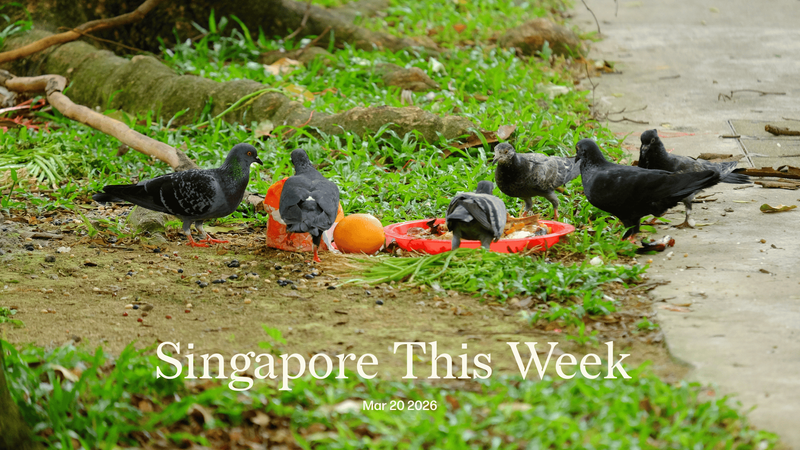
Perched on a parapet, red-brown irises scanning for scraps, the rock dove (or the common pigeon) is a familiar fixture of Singapore life. Moving in flocks that can swell into the dozens, these gregarious birds occupy a curious place in the city’s rhythm. Equal parts charming and nuisance: an unexpected dropping might be laughed off—huat ah, can buy TOTO. But most days, its presence is enough for you to seek shelter or think twice before hanging your laundry out on a bamboo pole.
Between 2023 and 2025, a CNA report found that the National Parks Board (NParks) received a yearly average of nearly 320 complaints of illegal bird-feeding. A majority of these cases involved seniors aged 65 and above. In one case, a woman in her 70s was fined an initial S$1,200, and then S$3,200 for feeding pigeons again near her Toa Payoh flat.
It’s an offence to feed wildlife in Singapore without written approval from authorities. Illegal feeders can be fined up to S$5,000 for a first offence, and up to S$10,000 for subsequent offences. The rationale is that feeding wildlife disrupts natural foraging behaviours and fosters dependency on humans. Pigeons, in particular, are often framed as a public health concern: they can carry pathogens such as salmonella and ornithosis, and their droppings create unsightly and unhygienic conditions in shared spaces. Yet notably, there have been no reported cases of pigeon-related illness here to date. Complaints tend instead to centre on mess, inconvenience, and discomfort in public areas.
Our level of tolerance in coexisting with animals is shaped by the ways of categorising wildlife: “community” cats, otters “families”, and “invasive” pigeons. Language does more than describe—it gives meaning to our human-animal relationships and the policies that determine which interactions are encouraged and which are punished. The Animal & Veterinary Service (AVS) has published guidelines on responsible caregiving for community cats, and their management is often supported by informal volunteer networks and online communities. Similarly, the recent nationwide otter census relied heavily on volunteers from the Otter Working Group, who spent months observing and documenting the creatures.
Pigeon management is rarely community-driven and remains largely enforcement-driven. It’s framed in passive terms: do not litter, clear food trays, and refrain from feeding. But what if this approach overlooks an opportunity? For many elderly feeders, the act of feeding birds is not simply a habit—it is a form of care. It offers routine, purpose, and a sense of connection. To treat this behaviour solely as a violation risks ignoring the underlying human need it fulfils.
Other cities have taken a more integrative approach. Swiss authorities faced a similar challenge in Basel in the early 1980s, when pigeon populations surged to around 20,000. Earlier attempts at culling (through methods such as shooting and trapping) proved ineffective. In response, the city introduced managed pigeon lofts, where birds could be housed, fed appropriately, and monitored. Eggs were controlled to limit population growth, and public feeding bans were maintained alongside this system. Crucially, these lofts also provided a designated space for bird feeders to continue their routines in a regulated manner. The result was a significant reduction in pigeon numbers—halved within 50 months—achieved not just through restriction, but through structured care.
While a feeding ban may be the most effective form of population control, the UK and Europe have trialled feeding pigeons a “breakfast” of corn grains containing contraceptives. Instead of punishing bird feeders, Singapore could explore channelling existing behaviours into something more sustainable that involves bird feeders—many seniors—in community-led initiatives. Designated feeding zones, supervised care programmes, or pilot pigeon lofts could offer a middle ground between prohibition and participation.
Besides improving the management of pigeon populations, these methods recognise a deeper social reality: the desire to care for another living being, to feel useful, and to remain connected to the rhythms of daily life.
History Weekly by Faris Joraimi
Before our citizen-historians built their followings through podcasts, TikTok, Instagram, and Facebook essays, there was the radio. “Singapore Ninaivugal” (Memories of Singapore) was a popular programme on the Tamil radio station OLI 96.8, featuring bite-sized discussions of Singapore’s South Asian history. One of its contributors was Dhoraisingam Stephen Samuel, who passed away on March 14th, at the age of 101. Samuel wasn’t a metric-driven historian chasing “research output”; but he wrote at least seven books on Singaporean heritage, was once president of the History Association of Singapore, and also a notable Tamil language- and culture-activist. He formed the Tamil division at the Teachers’ Training College (the predecessor to the NIE) in 1961, teaching graduates of the Umar Pulavar school that was founded in 1946 by the Singapore Kadayanallur Muslim League.
Samuel was born in 1925 in Kuala Selangor to a Methodist pastor and educator, LA Samuel, who taught at a school for Indian rubber tappers toiling in the plantations that made Malaya a profitable colony. The vocation of learning and teaching was taken on by Samuel the younger, who probably also recognised the value of education in social and communal uplift. The Japanese Occupation made available books published in India by Indians, shifting Samuel’s consciousness; he had previously only read British accounts of the past which gave the imperial view on subjects from the Indian Mutiny to the Black Hole of Calcutta. In the rising nationalist tide, writing and learning history started to offer something else, the chance to take the reins of one’s destiny and remake it.
From 1970, Samuel organised tours with the History Association, covering Empress Place, Raffles Place, Fort Canning Hill and Boat Quay for a fee of S$10 per participant. But at the time, they drew interest mostly from foreign tourists and a few history teachers. The material was supposedly relevant for lower secondary school students who would’ve taken a subject called “Social and Economic History of Singapore”, a syllabus Samuel helped design. “I want to kindle their interest. Most Singaporeans know hardly anything about their history,” he told The Straits Times (ST) in 1985. Locals were only beginning to appreciate the wealth of historical wonders around them. He started writing books upon a student’s suggestion. Among his works, Peranakan Indians in Singapore and Melaka: Indian Babas and Nyonyas—Chitty Melaka (2005) is perhaps the most notable and to date remains the defining publication about that community. With the abundant volunteer-guided tours and heritage trails available today, covering not only the old colonial downtown but even the stories of far-flung residential neighbourhoods, public history is not what it used to be. So much loss and change—the destruction of the old National Library in 2004 being one turning point—seems to have awakened a curious, even activist public that cares about its national, cultural, economic, and urban history. In a way, all public history tours in Singapore today follow in Samuel’s first footsteps.
Arts: Mooty says goodbye
His face like a teardrop, tipped with a tiny pink nose. Round eyes that could dart between shyness and mischief in the flip of a page. And a tiny red sarong around his fuzzy waist, his tail trailing behind him. Mickey had nothing on Mooty the mouse. Jessie Wee first dreamed up her beloved children’s book character in 1980. She’d been a secondary school teacher for 12 years, then caught a bad bout of “teacher’s throat”. Chronic laryngitis, the doctor said, spelling the end of a vocation that relied on her voice. “It was such a loss to me because I enjoyed the job so much,” she told ST in 1986. “I felt I had to channel my energy into doing something else.” Wee quickly found her voice elsewhere, after a chance encounter with a mouse in her kitchen. She screamed, but soon regretted her outsized reaction to the tiny thing. She wondered: what if, “instead of being frightening, he turns out to be a very lovable creature”?
Mooty’s adventures unfold against the slow backdrop of kampung life; a former student recalled Wee living in the Bukit Ho Swee kampung before the 1961 fire gutted the neighbourhood. And the little mouse’s stories, perhaps drawing from the closeness of a village community, are full of friendly overtures, unexpected rejections, and eventual repair. In Mooty and the Satay-man, all he wants is a juicy skewer off the grill. He gives the satay-man and a grandma a fright, and she promptly gets a cat to keep Mooty away. “Poor Mooty! He ran back into his hole just in time, his tail held tightly in his quivering hands. Tears ran down his cheeks. ‘Nobody likes me,’ he sobbed.” But the exiled mouse quickly finds home in the hearts of others: he rescues a baby bird, glues the tail back onto a baby lizard, and even falls in love. And he was loved in return. Generations of Singaporean children grew up in between the pages of Wee’s books, where Mooty and his friends were brought to whimsical watercolour life by the late illustrator Kwan Shan Mei. Mooty would eventually make a trip to the US in 1987, when bookshops there put in an order for 60,000 copies by way of Singapore’s Federal Publications.
But home was always here. Wee died last week, aged 88. There’s a photograph of her reading to a packed cabin of rapt children in 2002, as part of The MRT Read and Ride programme. She believed that Singaporean kids needed stories they could call their own, and her touchpoints, from the click of the cicak to the drape of a sari, were part of that creative placemaking. “For most Singaporeans, she will be known as the author of Mooty,” said her publisher, Goh Eck Kheng of Landmark Books. “For me, she’ll be forever Mooty’s mummy.”
Faris Joraimi, Abhishek Mehrotra, Sakinah Safiee, Corrie Tan, and Tsen-Waye Tay wrote this week’s edition.
Letters in response to any blurb can be sent to sudhir@jom.media. All will be considered for publication on our “Letters to the editor” page.
If you enjoy Jom’s work, do get a paid subscription today to support independent journalism in Singapore.