



Dear Jomrade,
Today we’ve published:
- “Singapore This Week”, by Jom
- “Everyday Economics #8: The price of everything”, by Serene Koh
First, next week is our usual mid-year break. The only thing we’ll be publishing is this newsletter, which will be written by Abhishek, our head of content, and presumptive next editor. Thanks for your understanding as we build this organisation together.
You know what we write about, but you don’t often hear about the stories we pass, or pause on, as was the case this week. A few friends and followers of Jom wrote to us about Foundation Healthcare Holdings’s IPO, slated for July 8th, with its prospectus out this week.
One concern of theirs: the in-laws of Ong Ye Kung, health minister, are early investors slated for a big payday. Ong is married to Diana Kuik. Her father is Kuik Ah Han, real estate magnate who, according to Forbes, was worth some US$800m (S$1.08bn) in 2019. The entities in question amongst Foundation’s shareholders are Kuik Pte Ltd and KCM Investments. Is there a conflict of interest? We looked into it, but one isn’t immediately apparent.
Sure, there are structural things that worry us about the nexus of political and corporate power in this country, about our horrendous gross inequalities, about the fact that many global plutocrats want to move here.
Even as we strive to nurture more enlightened and socialist values in a market economy, there are notions around democratic and individual liberties that we cherish. Put another way, it seems, from our limited viewpoint, that the Kuiks were simply doing what investors believe they should do in a system that the majority of our country seems to have endorsed.
But perhaps there’s an argument for greater disclosure and transparency, perhaps we’ve glossed over something, so do let us know. (By contrast, when it came to K Shanmugam, law minister, and the Ridout Road saga, it struck us as a potential conflict of interest, which is why Jom commissioned a piece on it. And yes, dear minister, we know: you disagree.)
Among other concerns: whether Foundation’s business model, based on consolidating the fragmented specialist care sector, will somehow leave patients worse off; and whether Temasek should be even deploying our money to back such a private healthcare firm. I believe these get to larger questions around healthcare provision in this country, and the old debate about whether a single-payer system is preferable. I hope it’s something Jom gets to explore in greater detail one day, in a piece that must surely also scrutinise the practices of insurers here.
Regardless, thank you to all who wrote to us!!! You know who you are. For now, I’ll leave you with a story that we did indeed decide to write about. It’s about a progressive Malay-Muslim dance company coming under attack by conservative forces for a show that deals with love charms and sex. There’s a lot more to it, and I’m chuffed that the story is told from two perspectives. Corrie Tan, our arts editor, and Faris Joraimi, our history editor, both address it in “Singapore This Week”, a quite pleasing literary couplet.
- What do university rankings actually depict?
- Why are so many workers disengaged from their jobs?
- The return of pig’s blood to our tables
- Khatijah Terung’s compendium of charms, and bodily pleasure in the Malay- Muslim world
- “Berahi: Holy Unions” by P7:1SMA
- “Dear You”, and Mandarin versus Teochew
Above are the issues we chose to explore in more depth.
Other news this week included: Lawrence Wong meets Vladimir Putin; Lazada the latest firm to cut jobs; soaring AI course enrolment; some 400 workers claim unpaid wages from air-con firms; a foreign worker housing ban in a Geylang condo; TAFEP investigates an alleged “Malaysian only” job ad by Micron; UN concludes that Israel deliberately targeted children and committed genocide in Gaza; two Singaporeans issued orders under the Internal Security Act for Gaza-related extremism; more families to receive support from the Chinese Development Assistance Council after the income threshold is raised; a LawSoc study finds that lawyer attrition is driven by a toxic culture, bullying, and court pressures; petrol prices down; greater transparency on property firms’ and agents’ disciplinary records; the success of “siu dai by default” is prompting the Health Promotion Board’s new “low sodium by default”; Sheikh Haikel and Anna Belle Francis share their struggles building their halal Hainanese food group; the challenges with overseas adoptions; ST multimedia piece on Changi Airport’s rough sleepers; CNA on a mum’s awkward first period talk with her daughter; muted coral spawning in our waters this year; a new species of scarab beetle discovered in Pulau Ubin; and holidaymakers celebrate 11 public holidays and five long weekends in 2027.
Join 1,700 members keeping Jom independent. From S$10/month—full access, no compromises.
“Everyday Economics #8: The price of everything”, by Serene Koh
Talking about couplets, we also have an unintended one around the much ballyhooed Royal Pop by Audemars Piguet and Swatch. Last week, Maria Oshige, our intern from NUS and perhaps our most junior writer, dealt with the concept of queueing and the lipstick effect from a cultural angle in her blurb. This week, Serene Koh, our Everyday Economics columnist and one of our most senior writers, interrogates it through her trademark behavioural lens. Here’s a key para:
“The question of what things are worth is not new. Adam Smith puzzled over it in 1776. Why are diamonds—which no one needs—expensive, while water—which everyone needs—is cheap? Price and value, it turns out, are not the same thing. They never were.
In The Picture of Dorian Gray, Oscar Wilde’s Lord Henry Wotton says, ‘Nowadays, people know the price of everything and the value of nothing.’ The Royal Pop queue had both kinds of people—the ones who knew more or less what they wanted to re-sell it for on Carousell, and the ones who just wanted to own ‘something valuable’ (in the words of one 18-year-old who was second in line outside ION). I used to think that Wilde’s line wants us to judge the first kind and sympathise with the second. These days, I’m not so sure.”
Jom beratur,
Sudhir Vadaketh, editor-in-chief
Jom
Jom on everyday economics
 Serene Koh
 Serene Koh
 Serene Koh
 Serene Koh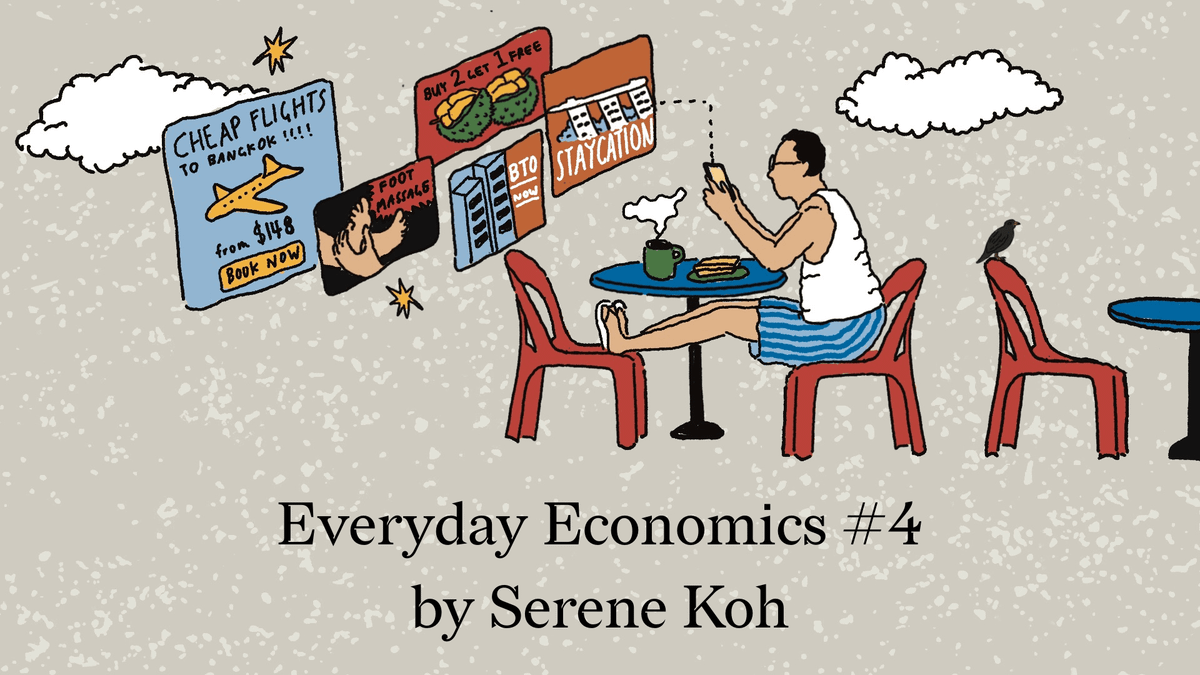
Singapore This Week
Arts: Speak Teochew Campaign

Your grandfather flees Southern China in the 1940s to dodge a civil war conscription. He finds refuge in Thailand where, like many other migrants seeking their fortunes in South-east Asia, he sends qiaopi (番批), or remittance letters, to the wife and family he’s been forced to leave behind. Back in her Shantou village, your grandmother receives both money and tracts of poetry that would crack the coldest heart: 江海万里,心中念你,便不觉遥远 (jiang hai wan li, xin zhong nian ni, bian bu jue yao yuan). “The rivers and oceans may span thousands of miles, but with you in my heart, this sprawl feels small.” It’s a love story for the ages, and one lost in translation the moment it washed up on Singapore’s shores. “Dear You”, the multi-generation sleeper hit moving (or perhaps manipulating) millions across the Sinophone world to tears, was filmed almost entirely in Teochew, then dubbed into Mandarin for its general release here. An initial run of 4,800 tickets in the original language—allowed with special permission from the authorities—were snapped up; when cinema operator Golden Village released an additional eight screenings, those sold out in one and a half hours. Singaporeans are crossing the border into Johor Bahru just so they can watch the un-dubbed show, and they’re also calling on the authorities to loosen restrictions on Chinese dialects in film, television and radio.
The dialect restriction on broadcast media is an old chestnut, one dating back to the 1979 Speak Mandarin Campaign, so effective it wiped out the use of Chinese dialects in a single generation. Part of Lee Kuan Yew’s mission to maintain cohesion across a linguistically diverse ethnic community, the movement essentially pared its lush polycrop down to a manicured monocrop, slashing the percentage of households deploying dialects as a primary language from 76 percent in 1980 to under nine percent in 2020. The Workers’ Party, built on a Teochew stronghold, was quick to recognise the recent saga’s political potential. Kenneth Tiong, one of its Aljunied MPs, wrote: “Mandarin is not under threat from Teochew. If anything it is Teochew and other dialects that are fading.” Dennis Tan, Hougang MP, took the opportunity to resurface previous parliamentary questions on dialect preservation, and champion his clan connections. The Ministry of Digital Development and Information and the Infocomm Media Development Authority have since made some concessions, promising an openness to “facilitating and supporting” more Teochew screenings, and “a more flexible approach” towards dialect films; and following that up by approving 50 additional screenings. But piecemeal tradeoffs may not be enough to buttress what has already been quietly eroding for decades, with kin cleft by language and lineages lost to time—by a policy founded on the flimsy belief that exposure to Chinese dialects impedes the learning of Mandarin.
The Teochew phrase 家己人 (ka ki nang)—meaning “our own people” or “one of our own”—is one of the dialect group’s most recognisable aphorisms, a pithy badge of pride for its fierce sense of community. But can you belong to a community without speaking its language? Singaporean artists have long mourned this linguistic loss. In the play “Grandmother Tongue”, a young man struggles to connect with his Teochew-speaking grandmother across the chasm of language. And in his autobiographical play “Roots”, playwright-performer Oliver Chong is derided by a Cantonese-speaking Hong Kong netizen for lacking the very roots he’s searching for. “My surname is also Chong. But my ‘Chong’ is different from yours. Yours has been castrated. So why bother to find any roots? You don’t have roots any more.” Yet some hardy cultivar might persist. In one of the film’s most wrenching letters, the absent husband writes: “I have been practising my brushwork lately, and I have learnt to write your name. It is clumsy still, but a few more days and I think I will have it.” A younger generation of Singaporeans, striving to escape the CMIO identity straitjacket, has been insistent on reclaiming their grandmother tongues; it is clumsy still, but a few more years, and perhaps they will have it.
Some further reading: Chinese journalist Chu Yang offers political nuance and historical context for qiaopi in her essay “What the Letters Did Not Say”, noting how some of these remittance letters—so romanticised in “Dear You”—ended up becoming more like ransom notes that fleeced many of the Chinese diaspora and their families of their hard-won earnings.
Other stuff we like
States of Unease: From Critique to Collective Imagination. AcademiaSG and Ethos Books are co-organising this public forum featuring panel discussions and an audience dialogue on what our shared envisioning of a good life in Singapore might be. July 24th, 7.30pm.
Names Have Been Changed by Yu-Mei Balasingamchow. “I think names are something very ordinary, but when you’re deprived of it against your will, almost, that it suddenly takes on additional emotional weight,”said Yu-Mei, writer (and Jom contributor) when discussing her debut novel, published this week, with NPR. We’re looking forward to reading it.
AI firms want philosophers. The Economist explains why the heirs of Socrates, Kant, and Locke are leaving cobwebbed library nooks for shiny AI labs.
A flavour of Jom. Occasionally, Jom publishes essays outside the paywall. These are on issues we think are in the public interest, and deserve a wider airing. In the past two years, we have published nearly 50 such pieces. Read some of these if you’d like to see samples of our work. We hope they’ll convince you to subscribe. And even if you’re here with no intention of doing so, we hope you’ll enjoy these offerings and consider it time well spent!