

Smell is the presence of another in ourselves - Anna Tsing, The Mushroom at the End of the World
Like so many around me, I intensified my efforts at learning to cook during the pandemic. And like so many of my generation, the internet has been my teacher; filling in the gaps left by family, circumstance, and a lack of Home Economics classes at school.
And what a thorough and earnest teacher it is for a student willing to engage in some self-directed learning! To all the seasoned cooks for whom this is mere common knowledge, please read the following in the voice of a four-year-old sharing facts about dinosaurs:
Regular bay leaves are not a substitute for Indonesian bay leaves (daun salam), but NTUC-available kana chye (preserved olive) can replace the less common 碎米芽菜 sui mi ya cai (preserved mustard green);
There is a genre of YouTube videos created by Indonesian domestic workers in Taiwan that share both recipes and advice on living and working with Taiwanese employers;
To soften banana leaves for use you should steam, blanch or pass them over a dry flame, but you can also iron them; and
Steaming rice will give you a better texture than a rice cooker (but it requires boiling on the stove before transferring to a steamer, unless you have one of those lovely Indonesian steam pans, or something similar).
And yet for all this content, I am missing one essential component—I don’t know how exactly things should smell: what exactly does it mean to “sauté until fragrant”, 爆香, or “tumis sampai aromanya keluar”? As a result, I’ve eaten my fair share of bland or odd-tasting food, often alone, since my family doesn’t share my tastes.
Smell, it has been observed, is our most underappreciated sense: only when we lose it do we realise how much we once sensed through it. I am thinking of the grocery runs I made during the pandemic to fuel my new hobby. Leaving after midnight to avoid the crowds, I would make sure no one was watching, take a few furtive breaths of unmasked air, and be struck by the damp, grassy odour wafting from one of the last open fields in the area: a smell that in greater intensity would trigger unpleasant memories of National Service, but for now was a reassuring, invisible presence resting over the neighbourhood, one I could tell myself I had always known was there.
In the videos I like best, there is a happy chemistry between those in the kitchen: Auntie Liew bantering with her husband behind the lens, the shared passion of Chris and Stef in Chinese Cooking Demystified, the granddaughter translating her grandmother's Hakka (and agak-agak measurements) for the HappyMoi audience. As I write this, replaying the videos in my mind, they merge into a single montage of happy conviviality that warms the heart behind the screen, beyond the kitchen’s heat.
Watching these, I often wonder whether harmonious collaboration in the kitchen is meant to be the norm. My own experience of cooking is solitary: I wash up after my family's dinner—either prepared by my mother or, more often, tapau-ed (taken away) from across the road—to make space by the sink, then cook, eat, and tidy up by myself, clearing a space in the fridge amongst the leftovers in their plastic takeaway boxes for my own glass containers. But if anyone were to put this down to simply a malaise of my generation, I would point them to Boey Kim Cheng's Between Stations, where he describes his grandmother in the kitchen as a “one-woman show, the conductor, orchestra and score”, “jealous of her culinary responsibilities and secrets” and banishing everyone from the kitchen, her “station in life”, while she worked on “food as medicine, to assuage the ills that plagued the family.”
As I remember, my maternal grandmother—ah ma—was similarly solitary. When she and my grandfather were still alive, my family would drive up to Kajang in Selangor, Malaysia to visit. The various small cars we used over the years have merged into one indeterminate shade of slate, but the hot, plasticky smell of their searing interiors still permeates the memory. From the monotonous rush of Malaysian highway my mind cuts to a crowded street, then turns into a quiet road beside a muddy river, with a chokingly foul shack not far from the junction, white balls of raw rubber piled outside. Leaving this behind, pulling up to our destination, we would tumble out and head into that house which memory has clouded an indelible sepia, the main exception being the dining room whose blue-tiled floor and fluorescent lighting halo it in a clear brightness that cuts through to today.
This dining room, together with the narrow, shadowy kitchen behind it, formed the section of the house that I thought of as ah ma’s. Over the years, she has been distilled into a few well-worn reels: now laying out food on the round marble-topped table; now back in the kitchen, eating alone with her hands off an enamel plate; now shying from the afternoon heat, napping in the cool darkness where her bed rests next to the table; now, by the light of a small kerosene lamp, massaging herself with a curiously round stone, heated over the stove then wrapped in cloth, before turning in for the night. A few clips have her in other settings—walking with me to buy cendol from the Indian man across the river, decanting it from the clear plastic bags into beige enamel cups, plucking jasmine from the bush outside the house to place at the altars, blowing—rather than waving—sandalwood joss sticks to temper their flame into a slow, burning glow. In all of them, she has been dressed in a light pink kebaya and a batik sarong, faded and worn. In none of them was I allowed to help her cook; instead, I can vividly recall her voice shooing me out of the kitchen when I said I wanted to help—Help? What help?— and, somewhat peculiarly, this is the only utterance I am confident was truly from her—everything else feels like a trick of the mind’s ear. Although it may not have been the case, I cannot remember anyone ever being allowed to help or learn from her, not even when we learned of the cancer that seemed to swell her belly while hollowing her out.
All the time, she continued to feed us when we visited: nasi dagang, pineapple curry, slabs of fried fish pickled in rice wine—I do not know the name of this last dish, nor have I ever found a recipe that is even remotely similar to it, and its appearance not long before she passed away gives it the quality of something fantastical, as if a dream, or an omen. It happened one afternoon on her bed, in that room, as my uncle was tending to her; as I heard him cry out, something clicked that the correct thing to do was to rush upstairs and howl theatrically into a pillow, a move that was somehow not recorded in the first person, but instead as a 10-year-old boy in shorts and t-shirt turning and running up the stairs. In the following years, my grandfather passed away and the house was let go. Our own car was sold as my father took on more work overseas, and each member of my family pursued, with ever strident intensity, their separate paths in life, leaving in our wakes an accumulation of detritus that grew dusty in their boxes, stacked up in the hallways, obstacles in each other’s way.
When I think of what ah ma smelled like, I can remember the jasmine we plucked, and the nasi dagang she cooked, but oddly enough, find it near impossible to describe the smell of her, herself. Perhaps there was a similarity with Boey’s grandmother:
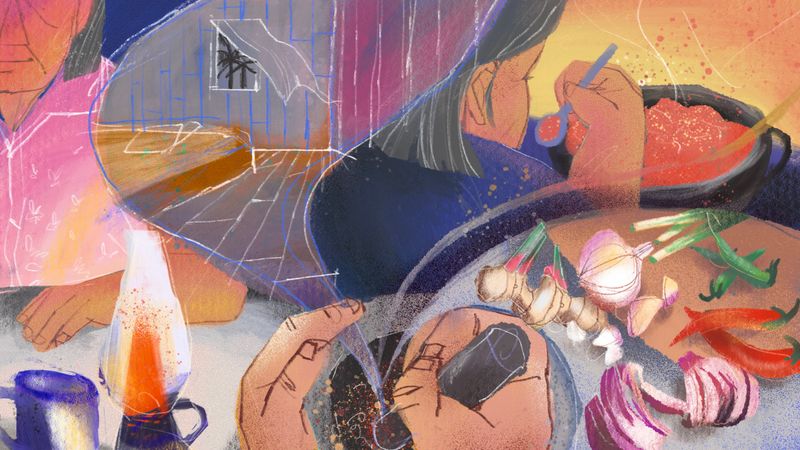
The kitchen was her domain and naturally the cooking smells saturated her clothes, and left a deep blend of spices on her hands and body. A tiny but potent amount of belacan would be pounded in the granite mortar with galangal, chillies, garlic, onion, turmeric, tamarind juice to make a paste that releases pungent fumes when fried to make assam fish or prawn.
Much of what she does, I can imagine ah ma may have done. But in the end, this loving recipe (in his next paragraph garnished with Tiger Balm and Chinese talc), remains, as it were, in an airtight container: I see the close-up of a pair of hands, deft and wrinkled, expertly slivering, mincing and pounding, the jade bangle on its wrist quivering just a millisecond behind, the juices yielding into the mortar, but I cannot find the scent that would herald their presence within me.
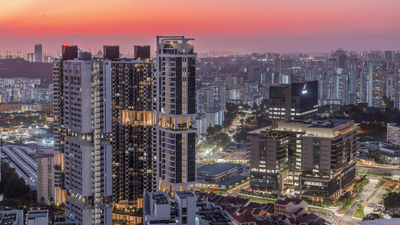
Between Stations is full of loving recollections of the smells he has lost—his grandmother, his father, and, prominently, the streets of old Singapore. In the text, Boey is unequivocal about the connection of smell and the meaning of a place, asserting that “a place that is devoid of odours has no character and cannot be experienced in any meaningful way.” In his text, the erasure of Singapore’s smells—casualties of development and sanitation—removes a meaningful human presence from the city, our connection to those who came before us, their bodies, efforts, wares and effluvia. What is left is a mere collection of “anonymous sky towers”, a “vast air-conditioned complex” that is visually impressive, but little more. I am tempted to agree wholeheartedly with these sentiments, which supports the disaffection I share with him to the country—geographical, though not temporal—we both grew up in. In my more angsty teenage days, I might have written something grandiose like, “where he had lost a city he loved with the purging of its smells, I have grown up with nothing meaningful left to love.” But as I grow older, I realise the implications of such a statement for the memories I do cherish, whether scentless from being born in an odourless space, or faint and faded through careless neglect. I wonder if this lack of smell is a cause or a symptom of the disconnect I have felt from the people and places around me, a kind of emotional—though not physical—anosmia that has kept them all at a distance. It is temptingly convenient as an explanation for my obsession with Javanese gamelan and my frequent trips to Indonesia pursuing it, as if I were chasing the sound of something that was still too far away to smell, the way you would head to a bakso vendor pushing his cart through the neighbourhood at night, calling you out with the ting ting ting of a spoon on a bowl.
My current impulse to cook is not based in a desire for connection, but rather in an effort at withdrawal. Coming back from Java in early 2020—the last three years had only seen me in Singapore for short, visa-renewing bursts—I felt my familiar sense of dislocation amplified: everything seemed too fast, too shrill, too strident. It also meant an antipathy to eating out: too expensive, too much, too meaty, and yet, for all this, somehow unfulfilling.
While allowing these feelings to settle themselves—the way one accepts a spell of diarrhoea travelling abroad—I decided to try my hand at cooking again, something I had done sporadically over the years. It seemed as good a time as any since there was a new electric steamer sitting idle while my family tapau-ed. Through the pandemic, I would slowly add on more and more specific items: a stand mixer, a Javanese-style pestle and flat stone mortar, jelly moulds, an electric blender.
Unpacking each new purchase, I would avoid recriminations by squeezing them into corners and containers, repacking my mother’s collection of saved glass jars, and dusty crockery only brought out two or three times a year, striving to avoid the terse moments when she would complain that some obscure item could not be resurrected from its usual place. In the steady work of peeling shallots, chopping vegetables, and pounding spices, I felt able to quiet the thoughts that floated in like smells from the flat of a neighbour, a space where I could maintain a “live and let live” attitude to the strangers around me with their dreams and dreams for me.
I wonder if this attitude is akin to what made ah ma so assiduous in, and so protective over, her kitchens. My mother has occasionally hinted at hardships shuttered away in that house I remembered so fondly, but to enquire more, I have always felt, would be to pry into a space deliberately kept apart from me: the small circle cast by the kerosene lamp by ah ma’s bed, where she and my mother conversed late into the night in the Hokkien which was not used on me nor my brothers for pragmatic reasons. But perhaps they were merely discussing recipes. For me to frame the urge to cook in terms of escape and coping would surely be only half the story, because surely part of her joy must have come after the food had left the kitchen, when something crafted alone became something shared together, its smell and warmth lingering in a grandson’s memory.
As I became more comfortable at the stove, and it became clear that a trip back to Indonesia would be out of the question, I started to experiment with cooking the dishes I had enjoyed in Java—gudeg, trancam, sayur asem, sambal tumpang. While some of these efforts have become good enough to share with friends, some of my happiest moments in the past few years, none of them have really achieved the level of a Proustian Madeleine, transporting me back to the roadside warong with their long benches, canvas tents, and woven mats for lesehan. They have, however, given me a new appreciation for the wet markets that I explored looking for ingredients impossible to find in NTUC: young jackfruit, kencur (aromatic ginger), daun melinjo (belinjo leaf), daun salam (Indonesian bay leaf). Previously, I had been shy to go in: it was not a part of my childhood and I felt that I lacked the social and linguistic skills attributed to previous generations, such as Boey’s grandmother:
She would poke the pomfrets and the cuts of meat for freshness and haggle and would be oblivious to me and everything else except getting a fresh bargain. She knew the dialect of each stall owner and switched between Hokkien, Teochew and Cantonese, gliding to Pasar Malay when choosing the cocktail of spices from the Indian stalls.
But in the end, like so many things in life, the experience turned out to be less daunting than I had expected—and I took inspiration from the domestic helpers around me. Slowly I started to appreciate busy interactions that flowed around me: the greetings, the cajoling, the bargaining, the impromptu calculations, even if I rarely managed many of them myself. At times, forced to ask the stallholders about the availability of something unseen, I would learn a little about the web in which Singapore drew its sustenance: that this week there was no young jackfruit because the Malaysian truck drivers were focusing on ferrying durian; that kemangi (lemon basil) used to be sold here, but there had been no supply since the pandemic. And every now and then I would sneak a breath from under my mask, taking in the smothering assault of the butchers, the metallic tang of the fishmongers, and the leafy smell of the vegetable stalls, resting, not unpleasantly, on a bed of damp cardboard. I am thinking of the montage that opens Colin Goh and Yen Yen Woo’s “Singapore Dreaming” which sets everyday scenes from markets and hawker centres to an unapologetically maudlin soundtrack, imagining a new kinship with all I had seen, borne on the wind.
Eventually, it occurred to me to try my hand at nasi dagang, the dish of ah ma’s that I remembered most fondly. Arriving at her house, tumbling out of the car we had been cramped in for the long drive north, we would head to the dining room where a huge steamer was sitting in the middle of the table. The rice inside was reddish, with a fragrance that I couldn't identify at the time; it was so distinctive that I have no memory of what was served alongside it.
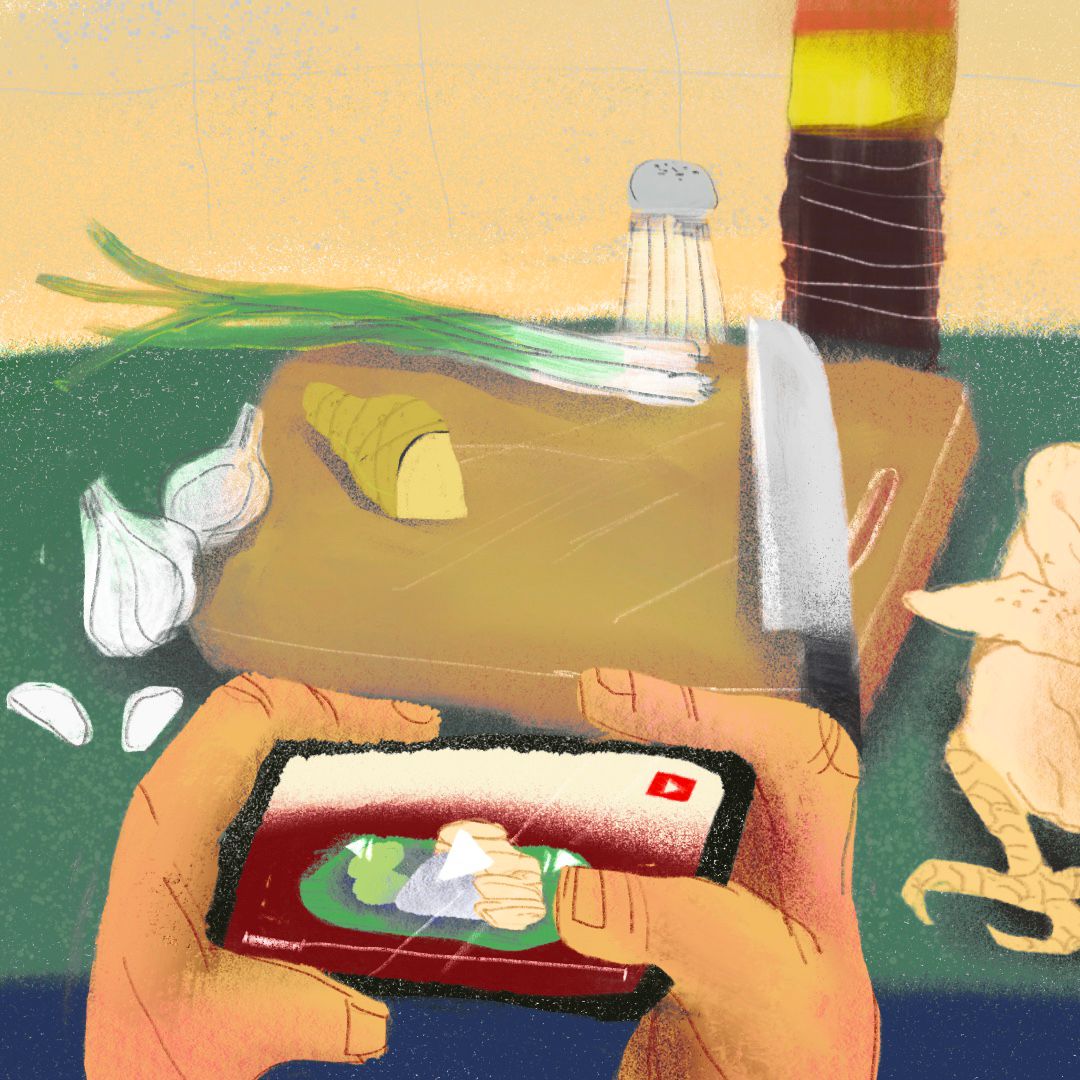
In attempting to recreate it, I turned again to YouTube and the internet, combing through videos that were in a north Malaysian accent I was less used to, and comparing them with the more accessible recipes which I found in English, but felt unfairly prejudiced against. As it turns out the rice I remembered—beras nasi dagang—was a specific variety difficult to obtain outside of Kelantan, but acceptably substituted with a mix of white, red and glutinous rice. Meanwhile, the fragrance was achieved by stirring in halba (fenugreek), chopped shallots and slivers of ginger towards the end of the cooking process. The method that ran through many of the videos I had seen for cooking rice with santan (coconut milk), nasi lemak, nasi langgi, nasi uduk. Previously, I had either parboiled the rice with santan before steaming, or merely mixed everything directly in the rice cooker. But nasi dagang required thick santan to be stirred in at the end while the rice was still hot, a process confirmed by my mother who said that was what she remembered ah ma doing.
While putting together this information into a reasonable recipe to test, I started to feel an irrational excitement build up inside me, some fantastical expectation of a glorious result. I tried my best to tamp it down. It's not wise to be so emotionally invested. Not even now. Not everything works the first time—remember your gudeg? But such is cooking during the pandemic, when the present seems so threadbare and the future so frayed that one turns towards the fabric of the past, its patterns now faded and indistinct, yet unmistakable in its well-worn familiarity.
I soaked a small batch of rice overnight, and woke up early the next morning to steam it. After draining it, I steamed it for around 25 minutes, stirred in some thinner santan before returning it for another 15 minutes, then finally added in the thicker santan and the spices. The smell drew my mother out of her room and I offered her a spoonful. She paused, then said, “I wish your ah ma was alive to see this.” I tried a mouthful myself and found it too creamy. And there was neither glorious delusion nor disappointing defeat, just enough for a few lines added to my notes, and a planned trip to the market.
Like with many ailments, things felt worse before they began to feel better: the beginning of 2022, with the onset of the Omicron variant, inundated us with figures that a mere few months ago seemed reserved for reporting on other countries. And yet there was also seemed a curious sense of indifference, akin to how one loses the ability to smell oneself: after all, explains one researcher, our noses evolved to detect difference, and as such help us “quickly detect things that are new and strange, but…has no use for the boring and typical.” It would be overwhelming and counterproductive, it seems, to remain hypervigilant in a more endemic state.
At the time of writing, restrictions have eased significantly: when I see someone walking brazenly unmasked in public I now follow their lead—that’s right, we can do that now. The reproachful signs on the windows telling you to remain silent while commuting are happily ignored. Coffeeshops are coming back to life, though many have changed their line-up, and one overhears stall owners telling their familiar customers about their plans to close, what with rising rents and business slow to recover from disruption.
As my work picks up, I find myself drawn to their convenience more and more, saving the long, solitary effort in the kitchen when preparing for special occasions with friends, and leaving the various implements stored in cupboards and boxes. At one vegetarian stall, a favourite of mine for many years, the youngish shop assistant who recognises me always gives me less rice, and will apologise on the odd occasion I don’t ask and she forgets. And slowly, the smells of places return—the damp, leafy heat from the manicured bushes, the plasticky fumes of resumed construction, the domestic odours of soap and must floating from first- and second-floor apartments. But for now at least, most masks stay on. Better to be safe.
Already the feeds and stories show friends holidaying overseas, and I want to as well, in order to rediscover that uncanny sensation of finding your past in a strange and unexpected place, a stroke of unlikely recognition that Boey describes, in Between Stations, as a “seizure”:
Perhaps if there is any purpose to my wanderings, it is to discover the places that will match the torn olfactory map I carry in my head. These moments of correspondence occur unexpectedly, and when they do, you feel a strange sense of arrival, as home and abroad, the past and the present slide into one place.
Travelling throughout South-east Asia, I have recognised smells that struck me as belonging to ‘ah ma's house’. On a trip to Ayutthaya, Thailand, I was shown a cheap room in a random guesthouse that was so redolent of its bedrooms that there was no option but to accept. Writing this passage, it comes back to me: all I see are the solid wooden floors and windows of one, alternating with the dingy mattress and threadbare curtain of the other. Another smell feels more difficult to evoke since these two years marooned in Singapore, my longest unbroken span: all my mind offers are images of hot days in dusty streets, making me suspect that what I was smelling is not just her house per se, but rather the base notes of small-town South-east Asia that thrum through the region. And yet, I feel somehow confident that it is there, just beyond what I can see, and that when I draw closer, it will rush up to greet me, as if I had never left. I am thinking of an early trip to Indonesia, roughly halfway between ah ma’s passing and now. I sat at a warong and ordered ayam goreng, not the most exotic of meals, but the one most manageable for my rudimentary Bahasa at the time. It came with rice, sambal merah, and lalapan—a mix of raw vegetables including cabbage, long beans, cucumber and kemangi. The lack of cutlery and a small plastic bowl of water gave me permission to eat with my hands, and, after I had finished, the smell that lingered on my fingers was unmistakably hers: sitting in a corner, watching the talk, laughter and eating at a table just beyond, a montage of happy conviviality.
Damien Thow Xin Wei graduated in 2009 with a degree in English Literature, and, more importantly, a love for Javanese gamelan which has shaped everything thereafter. In 2012, he spent a year in Java pursuing the music, a trip from which he arguably never returned. He is interested in the arts—especially music and literature—ethnography, cooking, travel, and memory.