


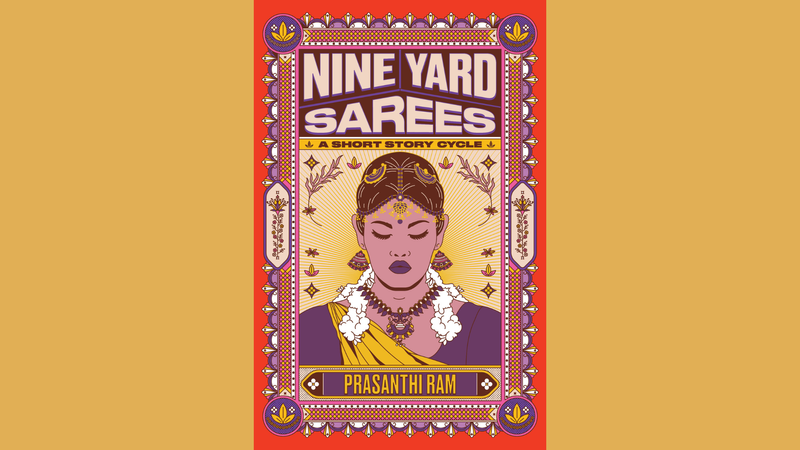
A cassette, a photograph, a rice cooker, the eponymous nine yard saree—simple objects like these find themselves at the centre of anxieties and conflicts spanning generations in matriarch Rajeswari “Raji” Iyer’s family. Raji, born in the 1940s in Kalakad, a village in Tamilnadu, India, is the oldest member of the Tamil Brahmin family at the centre of Nine Yard Sarees. Raji hews to tradition for most of her life. She marries young and has two daughters, Padma and Prema, who migrate to Singapore, settling there with their husbands and children. Across 11 short stories, each crafted and placed carefully into a cycle by author Prasanthi Ram, the Iyer family women and others in their orbit are laid bare by what these items represent, and the contradictions they hold.
The items’ symbolism recurs throughout the book. Playing a cassette of a fiercely-loved father’s voice only reminds his daughter of the time they have spent apart. Years later, the intricate threads of a wedding madisar are called upon to mend a clash between that same daughter and her own child. These items are almost always specific to Tamil Brahmin culture and its sensibilities. In particular, of a family grappling with the impact of migration across several generations and countries: Australia, India, Singapore, and the US. The objects are also emblematic of broader conflicts shaping these diasporic communities: the tug between modernity and tradition, between kith and kin, and between taking ownership of one’s life and sticking with staid customs as they’ve persisted over decades, even when these stand in the way of one’s own happiness.
These conflicts are familiar ones in diasporic fiction, especially in South Asian literature. Nine Yard Sarees attempts to stand out from the pack through its form. It is not a novel or a collection but a short-story cycle, “a set of linked stories that can both be read as self-contained pieces and as an interdependent, unified whole”, an insight Ram offers in an author’s note at the book’s close. The note reveals her intentions behind choosing the genre, inviting her readers’ “active engagement” in the text’s “light tapestry” so they might “revel in the discovery of these patterns”.
Ram cites Alice Munro’s work as a key inspiration, likely in reference to Lives of Girls and Women (1971), a collection of interlinked stories featuring women protagonists coming of age. In Nine Yard Sarees, three characters in particular—Padma, Keerthana and Raji—function as the core characters, with the other stories revolving around theirs. This doesn’t undermine Ram’s vision of the book as an egalitarian space shared by nine women, but reaffirms why the cycle is an apt conduit for these stories. As we work our way through the cycle, connections between the Iyer family—across time, geography, perspective—are revealed through each new story, while continuing to strengthen our understanding of the characters we’ve already met.
First, there’s Keerthana, one of the book’s younger and more progressive characters. Her personality and choices gain depth as we see her grow up, both from her own gaze and through the eyes of others in her sphere. In “Rakshasa”, her second appearance, she’s a gregarious and opinionated child, on a perpetual emotional seesaw of arguments and affection with a mother who constantly belittles her. Keerthana is illuminated from multiple vantage points: by her mother Padma, her brother Krishnan, his Korean-Australian girlfriend Fiona, and Sivagami, the woman who cleans her family’s home. Like other characters who recur across stories, the eventual portrait we get of Keerthana is akin to an image conjured up in “The Perfect Shot”: hands tilt the slats of window blinds, allowing us to see her anew in the shifting angles of light.
In “The Perfect Shot”, queer photographer Mira clumsily attempts to spotlight her acquaintance Vani’s psoriasis, a skin condition she has been taught by her mother to hide. The resulting set of photographs brings the two women together, but also ignites a homophobic blow-up within Vani’s family.
In “Amma’s Suitcase”, Shweta is the cool aunt, a single woman in her 50s who endures side-eyes from her conservative extended family for eschewing a marriage and children. As a creative pursuit, she cuts up and redesigns old family sarees and, by metaphorical extension, her own past. Her status is bolstered with the younger members of her family due to her progressive values, but brought low by her brother and his condescending critique of her clothing business, despite its success.
While offering unique premises that resonate with themes across the cycle (modernity versus tradition, excising past grief and trauma), the characters in these stories sometimes feel tailor-made to fit what we “need” to learn from them. While Ram’s deftness with characterisation and detail ensures that they are never two-dimensional, they do lean into trope territory.
Shweta, for instance, is a fashionable and fiercely independent girlboss whose troubles with overwork and professional fulfilment wrap up a little too neatly: a new professional project keeps them at bay. Mira is described like a character straight out of “The L Word”: a “social media superstar”, a “lanky woman” wearing “jeans artfully ripped over the knees” complete with “dusky matte eyeshadow”.
Occasionally, we’re told how we should feel about certain characters in ways that are more clichéd than cool, more gestural progressiveness than genuine representation. Take this line about Mira’s photography career: “Once, she photographed a portrait of a nonbinary Chilean street busker in New York for a travel piece in an online international magazine.” This is in stark contrast to how Ram deploys character details elsewhere, even within the same story: as subtle hints towards a character’s sensibilities and motivations.
Shweta and Mira also end up in more far-flung character orbits, away from the planetary pull of the cycle’s favoured protagonists—Keerthana, Padma, and Raji. We do get to witness their doubts and uncertainties, and well-chosen details about their complicated pasts. Yet their worlds feel much less lived-in than those of other characters.
Take Fiona, who makes a surprising entry in “Loose Threads” as the only non-Tamil protagonist. She’s the girlfriend of Keerthana’s brother Krishnan. As one of the few outsiders to the Iyer family, her focus swivels between considering how Krishnan navigates his conservative upbringing, and how she has come to grapple with her own Korean, Christian and Australian contexts. Here, Nine Yard Sarees briefly becomes a college rom-com about young love set in Sydney. Ram purposefully employs cultural and geographical markers to create a precise sense of place—as we follow Krishnan’s journey of assimilation, and the part Fiona plays in it, references to North Bondi and flat whites feel natural. They function more as set dressing, adding layers to how the two are characterised, rather than the sole indicators of who they are.
Fiona isn’t just a character device, even if she is a keen observer of Krishnan’s life. She, too, is dealing with the idiosyncrasies of a conservative upbringing, even if it’s a fact her partner often forgets. Independent of his universe, she navigates a troubled relationship with her own parents, the stigmas of the close-knit Korean church community she grew up with, and her own troubled feelings about Christianity. It is a bold move on Ram’s part to name Fiona as a protagonist alongside magnetic personalities like Raji and Padma. I see this as a claim of kinship between these women, however different or distant they may be, and a potential for finding solidarity, even if this may never come to pass.
These characterisations wouldn’t work nearly as well as they do without the rooms they sit in, the atmospheres Ram has constructed around them. To expound on what works about her writing style, I’ll indulge in a tangent that you’ll find in almost any diaspora narrative: talking about my mother. She’s also Tamil and Brahmin, and migrated to Singapore from Chennai in her late 20s after marrying my father. She devours novels about the Indian experience as a means of bringing her senses back to where she grew up. She gravitates towards writing that luxuriates in description, that takes its time to set a scene, its scents, its textures.
Nine Yard Sarees follows a rich lineage of diasporic fiction: Balli Kaur Jaswal’s Inheritance and Jhumpa Lahiri’s Interpreter of Maladies find kinship with the stories here, particularly in their explorations of family ties across generations and borders. Inheritance sees a Singaporean Sikh family across two decades, and while religious customs diverge from the Tamil Brahmin experiences detailed in Ram’s work, the contours of protagonist Amrit’s life are also deeply influenced by her experience navigating a traditional family.
Jaswal and Ram’s work are connected by gendered expectations, their characters’ pride in their queerness amidst deep-seated bigotry, but also inherited traumas. Ram cites Jaswal and Lahiri, along with Chitra Banerjee Divakaruni, as “a home” for her in times of burnout. It’s clear how Nine Yard Sarees finds a place alongside these works, and with readers who have found themselves uprooted and displaced.
Books by Lahiri, Jaswal and many others have been fixtures on my mother’s bookshelves for years, and Ram’s evocative work has now joined them. Her prose is lush, lingering over long sentences. She is deft at creating scenes that spring to life, particularly on a sensory level: animated conversations over steaming ginger tea, the swarming Chennai streets, a tense reunion at a temple. Subtleties like a squeeze of the arm, or knees touching during a wedding ceremony, become revelatory through her prose. These tactile moments highlight the largely conservative Iyer’s family’s difficulties with genuine honesty. When words between them risk obfuscating the truth, a single gesture or touch can reveal much more.
At times, Ram’s descriptions do veer into the unwieldy, especially when similes jut out awkwardly during tense moments. Mantras playing from a cassette envelop a character “like the cling wrap your mother uses to pack your father’s chapati rolls”. An aunt’s complicity in staying quiet about abuse leaves her “lips sealed silent by some invisible wax” that Mira imagines “must have looked a lot like what had dripped out from between the maid’s legs onto the sheets earlier.”
Ram is at her best when she doesn’t flinch from unpleasantness and pain, when there is nothing left to do but sit with the weight of a moment. In one of the cycle’s most remarkable stories, “Agni’s Trials”, we hear from Sivagami, who moves from a village in South India to Singapore to work as a cleaner in several homes, including Padma’s. When her phone runs out of data, she buys an international calling card to reach her family. Over a call she can barely afford, Sivagami’s husband verbally abuses her, and her children barely remember her. Amidst the yelling, the crying and the chaos, she hangs up the phone and she sits. She listens to the crickets. It is among the book’s most intense moments, and does not shy from one of the strongest feelings connecting our protagonists: ironically that of distance, both literal and figurative, of being cast adrift. All nine women feel their loved ones slip from their grasp, and wonder if they might ever reach them again.
There’s one other element of Nine Yard Sarees that will likely give South Asian readers some pause: the focus on a Brahmin family. As Keerthana and her partner Vikram jokingly discuss, ‘TamBrahm’ as an identity carries much in the way of traditional and cultural baggage. What they do not delve deeper into, similar to the rest of the book’s characters, is the exalted position of Brahmins within the caste system.
Caste is largely considered a part of life in India, one that carries far less weight elsewhere. For Nine Yard Sarees, borne out of her doctoral thesis, Ram embarked on research into Tamil Brahmins’ history and evolution in Singapore. In her thesis, she describes Singapore as “a cosmopolitan country far from caste-based traditions”, whereas India still “socially operates upon notions of caste”. These tensions are reflected in the cycle’s younger characters, namely Keerthana and Krish, who form identities and senses of self that have little to do with caste. Their caste consciousness is usually restricted to family, where traditional parents remind them of the standards they must, ideally, follow.
The position of Brahmins within the caste system is instead implicitly reflected within characters’ mindsets, especially the older women and men. Padma is perhaps tradition’s staunchest cheerleader, even more so than her mother Raji. She is a strict follower of Tamil and Hindu traditions, but only by way of her Brahminism: she is critical when a woman speaks Tamil in an accent different from hers, when marriages are not conducted in accordance with caste, religion and astrology, when a Brahmin marries someone of a “lower caste”. She assigns virtue on this basis: being a good Brahmin daughter, son or husband preoccupies her greatly, to the point that she seeks out a husband for Keerthana on a (very real) site called BrahminMatrimony. Other characters see this inclination in Padma more than she sees it in herself, and attempts to open her mind are often fruitless.
It is a completely realistic and unnerving portrayal, and Ram does not hold back in her depictions of how this discrimination runs deep within the Iyer family. It is also clear that the book does not set out to be a statement on caste consciousness, but rather a portrayal of a Tamil Brahmin family with varying ideals. Ram speaks of “gaps deliberately left” between stories, ones in which readers may make meanings of their own. In these gaps, it seems that the Iyer family—and those in their circle—never quite name or contemplate their relationships with those from other castes.
This can be perceived as commentary in itself. There is so much bigotry contained within the notion of considering one’s self the default, that the Tamil Hindu experience is naturally Brahmin, that Brahmin ways of life are the norm unless prompted otherwise. For characters like Padma, this goes even further when they assume they are, in fact, worthy of sitting atop an oppressively hierarchical system.
But these oppressive elements are rarely directly addressed, because intra-community dynamics are the focus of Ram’s work. Outsider characters, such as Fiona, do have strong opinions on how an adherence to tradition has affected Krishnan’s life, as well as their relationship. However, these thoughts never quite engage with caste as a vector of power. In their case, Krishnan’s refusal to tell his family about Fiona, due to her being neither Tamil nor Brahmin (thus unacceptable to them), acts as a significant fissure in their partnership. Yet to Fiona, this wielding of caste status is merely one of many aspects of Krishnan’s traditional family background (parallelling her own) rather than a means of oppression in itself.
In a work of Singapore fiction that centres caste-specific experience, I was waiting for a perspective on the subject from a character who was not Brahmin. I wondered what these stories would look like, and how their shapes might change, if we had the opportunity to hear from a character who articulates a different experience of caste entirely. One that isn’t about their own family’s prejudices, but being at the receiving end of them systemically. There is an unease permeating a story like Sivagami’s, which traces her life from birth till her time in Singapore working for affluent families, some of whom are likely upper-caste. Sivagami is likely not Brahmin herself, and might not even wish to name the power disparity she faces on a daily basis. I wonder how realistic it is that this does not seem to cross her mind at all.
Yet, as we began, we return to Raji for “Before the Rooster Calls”. It is the cycle’s second-last and longest story, and it is crushing. The story chronicles Raji’s coming of age in Kalakad: a witness to her childhood joys, but in larger part a documentation of the immense violence, loss and heartbreak she’s had to hold onto for most of her life. This story carries enough to be its own novel, and these fraught unearthings recolour our experience of the rest of the cycle. Their impact lingers throughout the final story: a climactic reunion in Singapore for Keerthana’s wedding.
While the cycle is crafted with a deliberate hand, one could also scatter these stories and see where they fall, what this might reveal or obfuscate about the Iyer family and the outsiders caught in their ever-intersecting trajectories. Some stories connect neatly and others remain adrift, waiting for a resolution that may never come.
It is clear, both from the text and by her own admission, that Ram took a great deal of inspiration from her own family. I took in alarming similarities to my own life and family as well, in its past and present confusions. Even if one didn’t read the author’s note, where Ram expounds on how the book is a love letter to both the women in her family and “fellow diasporic children”, the detail in these stories speaks to her close relationship with the subject matter. In a letter to her daughter Padma, Raji sketches a small, purple-rumped sunbird. She sees the sunbird outside the ashram she retreated to following her husband’s death, a move Padma had strongly disapproved of at first. The quaint yet beautiful sketch, accompanied by an ageing mother’s attempts to seek her daughter’s forgiveness and understanding, struck something deep and unexpected within me. On WhatsApp, my mother’s profile picture is a blurry image of a bird she was excited to spot in a tree. It is this picture I see when I ask her how her day is, when she apologises after we fight, when I type out a message, delete it, and type again. When I wait, sometimes for words that might never come, I stare at the bird. It remains still, and small.
Raji’s sketch of the sunbird evokes a similar kind of melancholy. Her desperate hope for connection and forgiveness from Padma let me in on a feeling I didn’t think I would find outside of my own kin.
Nine Yard Sarees is not a manual to a culture some readers might not be familiar with, nor is it an attempt to recreate a safe place for nostalgia and relatability for those who are. It is like witnessing treasured negatives bloom into images in a dark room, waiting to see what they have become—a moving portrait, a dish left to simmer, an immense and loving effort—finished but not quite.
Varsha Sivaram is a writer and the co-editor of What We Inherit: Growing Up Indian. Their writing can be found in publications such as Mynah Magazine, Esplanade’s Offstage, the National Gallery’s Perspectives Magazine, and Rice Media.
Nine Yard Sarees: a short story cycle is available from Ethos Books.
Correction: an earlier version of the article asserted that Sivagami works “primarily for Brahmin families eager to make their caste status known.” However, only Padma's caste is explicitly made known in the book. Sivagami's other employers are clearly affluent, but their caste is not mentioned. The review has been emended to reflect the same.
Letters in response to this piece can be sent to arts@jom.media. All will be considered for publication on our “Letters to the editor” page.