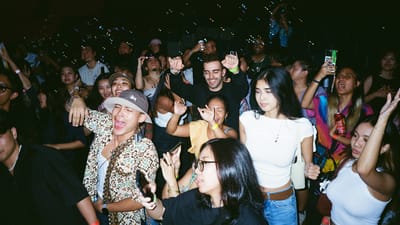

In the closing sequence of “Extended Love| A Chinese New Year Short Film”, a group gathers for a photograph. Enveloped in loving familiarity, everyone is smiling and laughing. It’s a picture-perfect representation of multicultural Singapore: an Indian woman sporting the obligatory pottu, and a bearded Malay man holding a rainbow-coloured agar-agar jelly cake. (A subtle nod to the queer community, perhaps?) As the film ends, Ah Ma, who orchestrated this annual gathering at her neighbourhood cai png (mixed rice) stall, turns to her granddaughter Adeline and says: “Even the most flavourful meal can never compare to the richness of relationships.” Adeline is moved to tears. She has travelled from distant shores, where she migrated with her parents, to persuade her grandmother to join them. But Ah Ma is clearly content here, with members of her chosen community. These reunion dinners have become a tradition, shaped by choice and circumstance.
Released in February last year, the three-minute Royston Tan-directed short for gov.sg extends the idyllic vision of the annual Chinese New Year (CNY) reunion dinner beyond familial lines. It’s an opportunity to share unbridled communion and joy not just with kin, but with found friends too. While we can appreciate the potentialities of this tradition and festival in a multicultural society, this utopian vision runs counter to the lived realities of many Singaporeans. Unlike the apocryphal Ah Ma, these individuals don’t always have a community to fall back on. Instead, they’re faced with the daunting prospect of spending Chinese New Year with families they would rather avoid.
Ironically, this pressure to conform stems partially from decades of state-driven messaging. New Naratif, a movement promoting democracy in South-east Asia, has suggested that the ruling People’s Action Party-led government has deliberately constructed Singapore’s concept of the traditional, heteronormative nuclear family in order to forge a distinct national identity grounded in their definition of “Asian values”. Safeguarding this ideal, it argued, was essential to providing citizens with purpose and stability. From a young age, we’re told that family is the basic unit of a community. This notion feeds into the constructed reality that the heteronormative family that stays together (and eats together) is the cornerstone of a peaceful and stable society. In this version of reality, Chinese New Year is the time when this idea is reified; thousands of reunion dinners across the island breathing fresh life into familial bonds. There is of course, a strong cultural element at play too. Societies influenced by Confucianism tend to emphasise family, especially the idea of “filial piety”, as the basis for individual and social harmony.
Other realities—how we celebrate these occasions, where we celebrate them, whom we celebrate with, and whether we eschew celebrations altogether—are unable to break free of this socio-political straitjacket to find wider acceptance.
This conception of a “normal” Asian family, however, has changed over time. Many Singaporeans, for instance, have been shunning traditional, family-oriented celebrations for years, preferring to travel instead. When I ask friends why a holiday is more important than hongbaos and family time, I’m frequently greeted with an awkward silence. Turns out, there’s another silence that they can’t handle—the unbearable silence of CNY gatherings. For many, the new year is a time when they are expected to keep up appearances while setting aside unhealthy family dynamics, often rooted in unresolved childhood conflict, that manifests as parental favouritism, sibling rivalry, narcissism, gaslighting and bullying.
Singaporeans aren’t alone in pushing back against widely accepted traditions and narratives of family and merry making. Youngsters in China are cutting ties with their relatives and boycotting important Chinese festivals like the Mid-Autumn Festival in increasing numbers. They feel emotionally disconnected from overbearing relatives, who compare and judge their life choices. They’re also tired of playing the trophy child, so their parents can boast about their accomplishments to extended family.
China and Singapore appear to be in the midst of a cultural and societal shift, where focus on the individual is gradually eclipsing the collective; younger generations are exercising their personal freedom—choosing to centre their own self-care and emotional well-being. This can foster social cohesion in two ways. Firstly, distance, rather than a forced coming together, can actually improve intra-family bonds. Secondly, the normalising of “stepping away” can create space for those who, for whatever reason, may never be a part of the idealised nuclear family that we have been told is the basic building block of society.
To help get a sense for these dynamics, three Singaporeans agreed to share their stories under pseudonyms. Rather than ask them, “Where are you running to?”, when boycotting Chinese New Year, I thought the more revealing question would be: “What are you running from?”
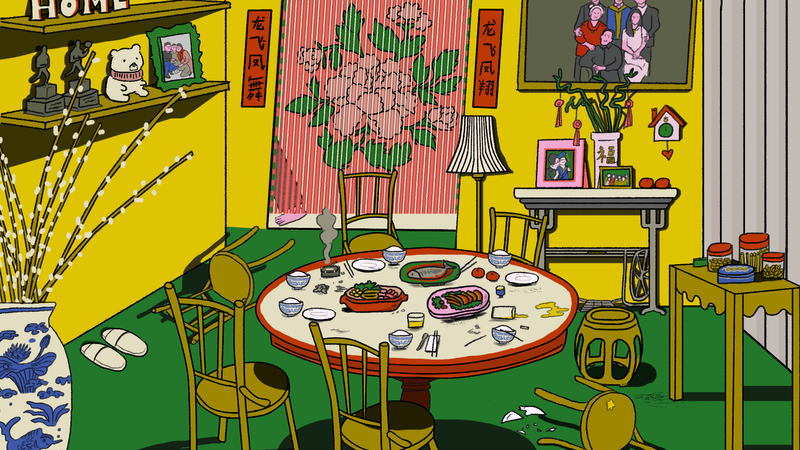
“My siblings were jealous of my success, and I felt bullied into caring for my sister,” said Elaine. Elaine used to own a business, and has spent her retirement caring for her sister, who has schizophrenia. Her brother had lived with their late mother, and her elder sister was bedridden. “My mother was difficult and favoured my brother to no end. I even remember asking her point blank whether I was truly hers!” Elaine recalled neither joy nor laughter at the dinner table, just silence at best. “We never took any reunion dinner photos,” she lamented. The silence Elaine experienced at CNY gatherings only amplified her sense of loneliness and of being disconnected from her family. Eventually, she stopped attending reunion dinners. Instead, she sent food to her family on the eve of the holiday, preferring to watch Korean dramas over dinner, with her cats for company.
As social creatures, humans have an innate need to belong—to experience real connection with others—but not at the cost of authenticity, freedom or power, wrote Brené Brown in Atlas of the Heart. Caught in a “we vs them” situation, feelings of spiritual disconnection or a diminished sense of a shared humanity emerge. Love and belonging are irreducible needs for all people, and in the absence of these experiences, there is always suffering.
At the crux of Elaine’s suffering was that the silence among her mother and siblings had denied her the opportunity to confront the fact that her family had hurt her. The constructed reality—a family that eats together, stays together—required her to keep quiet so that her mother could continue to tell the world they were a happy family. If her pain didn’t matter, did she? Small talk or no talk had choked her ability to be authentic and nullified her sense of self, which was screaming to be seen and heard.
It’s been more than a decade since her mother died, but the trauma lingers. Two years ago, her elder sister succumbed to cancer. The relationship with her brother remains troubled. “I’m tired [of] taking care of everyone’s needs and pretending that it’s OK,” said Elaine. “But it’s not OK because pretending makes me sick. And who is going to take care of my needs?”
It’s not just the ethnic Chinese who can develop an aversion to family gatherings due to unresolved family conflict. The trend is widespread among those who no longer wish to put up with their parents’ manipulation, indifference and lack of affection. TikTok is awash with viral videos in which grown children tell their stories under hashtags like #nocontactwithparent and #raisedbynarcissists. The movement has also spawned a subreddit called “Estranged Adult Kids” with more than 46,000 members sharing advice and experiences. These people are setting firmer boundaries and trying to normalise stepping away from unhealthy parent-child relationships.
Regine is one of them. The only child of a religious leader and a homemaker, she discovered a new side to her parents when she returned home to the Philippines after six years abroad. It made her dread spending Christmas with them. “[When I was] growing up, my parents would impose a ‘my house, my rules’ approach, where children were seen and not heard,” she said. Every conversation at the dinner table was loud and revolved around the elders’ opinions. If her father felt that attention had shifted to her for too long, he would resort to shaming or mocking her. Regine said that he took great pleasure in his paternal role because it made him feel connected, powerful, and in control.
Sharmishtha Gupta, a counsellor at Odyssey Wellness, frequently works with clients navigating familial expectations, cultural identity, and their own emotional well-being. She said that for many, the Chinese New Year holiday isn’t the joyful reunion that it is often portrayed to be. Instead, it is a period of intense emotional strain, especially for those who are navigating stressful family dynamics. Gupta works with individuals who are learning to untangle these dynamics and to more intentionally define what “family” means to them—whether that involves healing from past hurts, stepping back from unhealthy relationships, or finding ways to engage with family on their own terms. “It’s not necessarily about rejecting traditions but about finding a way to participate that feels authentic and manageable for you,” she said.
In collectivistic cultures like Singapore and the Philippines, Gupta explained, people are more likely to define their sense of self in terms of their relationships, social roles, and perceived status within their community. While this can create a strong sense of belonging, it can also lead to feelings of pressure or guilt, especially when someone struggles to meet these expectations.
“It’s a given for Filipinos to be generous and open their homes to feed strangers. But my parents were unkind and showed little empathy and respect to their own daughter,” Regine said. “I’d rather skip Christmas dinners and enjoy my own company or that of real friends who’ve met and know me.”
The idea that our parents are controlling, manipulative and even emotionally abusive may be mortifying, especially in Asia. It clashes with the gratitude that we are taught to have because our parents gave us life, clothed and fed us, sacrificing much to secure for us a brighter future. It is the children’s duty to honour and repay them through kindness, time or money.
Siew Cheng held this belief well into her adult life, until she discovered that her mother was also mothering her daughter, Nancy. Siew Cheng, a single mother, recalled one reunion dinner when she had asked Nancy to greet her elders before eating. Her mother, Nancy’s grandmother, contradicted her and told Nancy that she didn’t need to, proceeding instead to offer her a piece of salmon. Over time, these grandmotherly indulgences became more egregious and damaging. When an older Nancy brought home a boy to stay in the family home, Siew Cheng found herself isolated. Even when the boy became verbally abusive, and shook his fist at her during a disagreement, Siew Cheng’s mother took his side. Nancy remained quiet.
Every time Siew Cheng pleaded for support, her mother’s refrain would be how much she loved her granddaughter and how family meant everything to her. Just entertaining the thought that her granddaughter had misbehaved or made a mistake upset her notion of a family utopia, so much so that she would always shut down when Siew Cheng challenged her. “I realised there was nothing in the world I could do or say to change my mother’s mind that she had the ‘perfect’ family and granddaughter,” Siew Cheng said. “Just being around her made me feel unsafe, so I started to withdraw from family gatherings.”
One’s inner narratives don’t always conform to reality. When that realisation dawns, it can rattle one’s core beliefs and cause severe emotional distress. At once, Siew Cheng had “lost” both her mother and daughter, and the closeness that she thought they shared. “At my lowest I did not know who I was anymore, and I felt afraid and unsafe in my own home,” said Siew Cheng. “I hated how CNY could make me feel so confused and invisible.”
The families of Elaine, Regine and Siew Cheng stubbornly live out their narratives too. Whether there is any truth in these narratives is inconsequential because they help them cope and survive in an uncertain world. Any attempt to change their behaviour may mean revisiting their early traumas. Often, this possibility proves too frightening to consider because there’s a chance of discovering that they were wrong all along.
Another common thread running through these stories is the inherent disconnect that Elaine, Regine and Siew Cheng have experienced between their authentic selves and others’ expectations. The way forward and through is complex and painful because the wounds are deep and the journey terribly lonely. Professional help often involves creating new narratives that focus on re-evaluating what “family” really means. This can include setting new expectations of family and drawing boundaries based on new values and roles for one’s own sanity and survival.
According to Charlie Health, a US-based outpatient treatment service for those struggling with mental health problems, the idea of chosen families has its roots in the LGBTQIA+ community. Rejected by their own family, its members had to find new connections so they could survive. The beauty of choosing our family is that it empowers us to make important decisions based on our own values, which in turn restores control, so critical to healing and recovery. Regine and Elaine are both single, and the holidays served only to enhance their sense of disconnection. However, this has not stopped them from finding their own chosen family. Regine found solace in her friends, and Elaine sought refuge in her felines. Siew Cheng, meanwhile, found love at 48, marrying a man who has given her a sense of protection and belonging. Even as we celebrate her new partnership, we may rue the difficulties she had faced when trying to find meaning and connectedness as a single mum.
Whether or not Elaine, Regine, and Siew Cheng enjoy strong social bonds in the coming decades will depend on numerous factors. What we do know, from research conducted in 2015 by the Centre for Ageing Research & Education (CARE) at the Duke-NUS Medical School, is that 39 percent of elderly Singaporeans studied reported feeling lonely; and that loneliness increases an older person’s risk of dying by seven percent, when controlling for existing health conditions. In a commentary for CNA last year, CARE researchers argued that Singapore’s emphasis on self-reliance makes it difficult for individuals to acknowledge their loneliness and to seek support. They also noted the misconception that elderly loneliness is confined to those who live alone: “In fact, a significant percentage of older Singaporeans who are living in multigenerational households report being sometimes or mostly lonely.”
With Singapore’s population ageing rapidly, this is an issue that the government is focused on, its efforts spearheaded by the multi-ministry Age Well SG programme. But attending to a loved one’s loneliness is not something that should be left purely to government intervention. It’s vital to understand that feeling disconnected is also a form of loneliness. There is nothing lonelier and more isolating than conforming to a narrative that is far removed from one’s reality; pretending that all is well when it is not. It’s work that all of us can do, every day, and also every year at our reunion dinners, when we try to make sense of the unbearable silence of Chinese New Year—and of why some choose to stay away.
James Leong is an independent counsellor at Listen without Prejudice and works as a freelance Rehabilitation Counsellor with the incarcerated in Changi Prison. Informed by more than 20 years’ experience in journalism and public relations, he is a mental health podcaster and collaborates with Temasek Foundation, Sg Enable and Audible to develop podcasts that tackle the topics of anxiety, grief and caregiver stress. James also co-facilitates the first men’s support group for suicide survivors with the Samaritans of Singapore.
Letters in response to this piece can be sent to sudhir@jom.media. All will be considered for publication on our “Letters to the editor” page.