
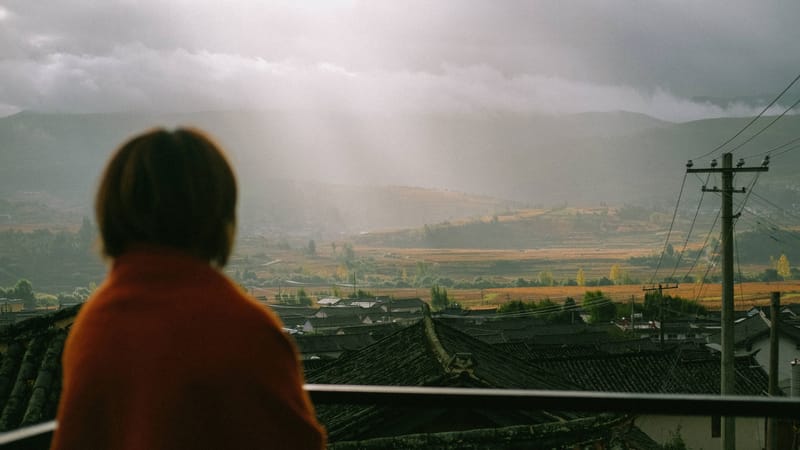
My foray into rural life began when I was scrolling through Instagram. A Bright Place offered a window into an unhurried world, brimming with heartfelt reflections and dreamy photographs of life in a small mountain village in Yunnan, China. “...Surrounded by gentle mountains that shift with the seasons, I wish for you to unload what burdens your heart, even just for a while,” Ting Wang, author and owner of the account, wrote. “If you prefer quietness over crowds, enjoy peaceful company and genuine conversations, and if you love unrushed, intuitive activities, welcome to my humble space.”
Wang, a Shenzhen native, had lived in Singapore for over 20 years. Like many children in the city, she spent her childhood at school, shopping malls, restaurants and theme parks. As she grew older, new possibilities shimmered tantalisingly; to learn pottery in Taiwan or to move to Portugal. Mirages, all. By the time she was in her 30s, Wang had found love, marriage, a mortgage, a wedding photography business—a stable life; predictable and quotidian. Then came the Covid-19 pandemic. Work dried up, allowing Wang to explore other artistic pursuits. A chance encounter with a Chinese dyer opened a new path; he agreed to share his craft in exchange for photographs of his journey and the dyeing process.
In 2021, Wang bought a one-way ticket to Shaxi, a town located between Yunnan’s more famous cities of Dali and Lijiang. Surrounded by picturesque landscapes, she was soon captivated by the vibrant colours and textures of natural dyeing. Three months passed but she felt a calling to stay, finally making the hardest decision of her life: to trade her comfortable existence in Singapore for a life more deeply connected to nature but filled with uncertainty and challenges. At 38, her website says, she left behind “a comfortable life, a sustainable photography business, a stable 6-year marriage, a peaceful house of our own; last but not least, everything I was familiar with and in-love with.” With her life savings, she built a two-storey home on a rented plot of land in the village. In contrast to Singapore, life there lacked modern conveniences, technology, work opportunities and entertainment options.
I learnt of Wang’s journey during a period when the constant pressure of rent and the uncertainty of freelancing forced me to take on as many as 10 gigs at a time. I raced to answer messages and e-mails, coordinate meetings, busy myself with finding new leads—always striving to do more, to stay productive. My Google Calendar was a Tetris block of colour-coded deadlines and to-do lists, stacked on a packed social agenda. Life in the digital world moved at a frantic pace. It was a difficult time for me, taking on more work to distract myself from mental health struggles, but then feeling hemmed in by the pressure of juggling assignments.
Wang’s space seemed restorative and healing.
After corresponding for nearly a year, I found myself outside Wang’s home in late October 2023, her first guest from Singapore. She had started hosting slow living retreats, and it became my first experience with one. To fly to a new destination and remain in one place seemed contrary to my idea of travel. But here I was. Wang’s youthful appearance was striking, although she seemed to carry a weight that hinted at having withstood tough experiences. Her gentle energy was calming, and everything she did—slow, careful, and precise—reflected her thoughtful approach to life. Stepping into her house, I was surprised by the mix of modern and traditional features. It had a courtyard with a wild pine tree sourced from the mountains, pine wood interiors, and full-length glass panels that reflected the sky. The second floor included a cosy bedroom, an outdoor deck, and a spacious tearoom with a long table made from walnut wood, fronted with windows that opened to face the surrounding mountains.
If the town Shaxi sounds familiar, that’s because it’s featured in the hit Chinese television drama series 去有风的地方 (“Meet Yourself”). After her best friend’s tragic death, career-oriented Xu Hongdou (played by Liu Yifei) leaves her hotel job in the city to live in a village, where she discovers a meaningful life. Unlike its chic Shanghai cousin, big brother Beijing, and powerhouse relatives in industrial Guangdong, Yunnan feels like the family maverick who rejects convention and does their own thing. The southwestern province exists in a separate time and space, distinct from the rest of China. It draws wanderers, non-conformists, Chinese creatives and foreign backpackers in search of utopia. Nestled within rolling green mountains, the Shaxi valley is filled with bucolic farms and pastoral villages. People move at a laidback pace, content with the wildflowers, fruits, mushrooms and tea forests that the hills provide in abundance.
Life moves with the seasons. In spring, Wang painstakingly harvests wild pine pollen, known for its gut health benefits, in the mountains. Mixed with black sugar and ginger powder, it makes a delicious tea. In summer, she collects wild plums for plum wine and preserves, and joins mushroom gatherers in the hills. Autumn is for baking persimmon cakes and fresh walnut bread; winter calls for the preserving of vegetables, bean paste, pork and chilli paste. Her neighbours have taught Wang all this. They extend invitations to festivals and often give her fresh vegetables or homemade pickles. Foods here aren’t treated with chemicals, and fruit, especially, spoils quickly. “Once you’ve eaten these natural foods, supermarket produce tastes different...Your senses sharpen in nature,” Wang said.
Halfway through my 10-day stay, I woke later than usual, feeling an unusual chill. Outside, the sky was cloudy and misty, so I snuggled in bed a little longer. Wang told me that October 23rd marks the beginning of 霜降 (frost’s descent). “In winter, you naturally want to sleep more and become reserved. Don’t blame yourself for not being very active,” she assured. By observing Wang, I saw how each activity done with full awareness became a form of meditation. I understood what it was like to slow down and be present; to appreciate the ordinary moments, without the rush, shopping malls and mindless scrolling of social media. I awoke to crisp mountain air, was nourished by healthy, home-cooked meals, and engaged in leisurely conversations and reflection. I spent my days taking early morning walks with Wang’s dogs—奇奇 (“Kiki”) and 黑小猪 (“Black Piglet”), writing in the tearoom, and listening to the river and birdsong while skipping stones. I even started my first fire, and was aglow with ineffable satisfaction when it crackled to life. What would life be like in Singapore if people embraced slowing down and hibernating?
Wang has a dyeing studio and an online shop selling one-of-a-kind wearable pieces and home décor items awash with nature’s colours. She uses indigo from fermented indigo plants, deep amber from unripe persimmons, and materials like bark and leaves from eucalyptus, Chinese rhubarb, black bean, pomegranate shells, walnut shells, sappanwood, and black tea. The pieces are primarily dyed on handwoven cotton, grass linen (ramie), wool and silk.
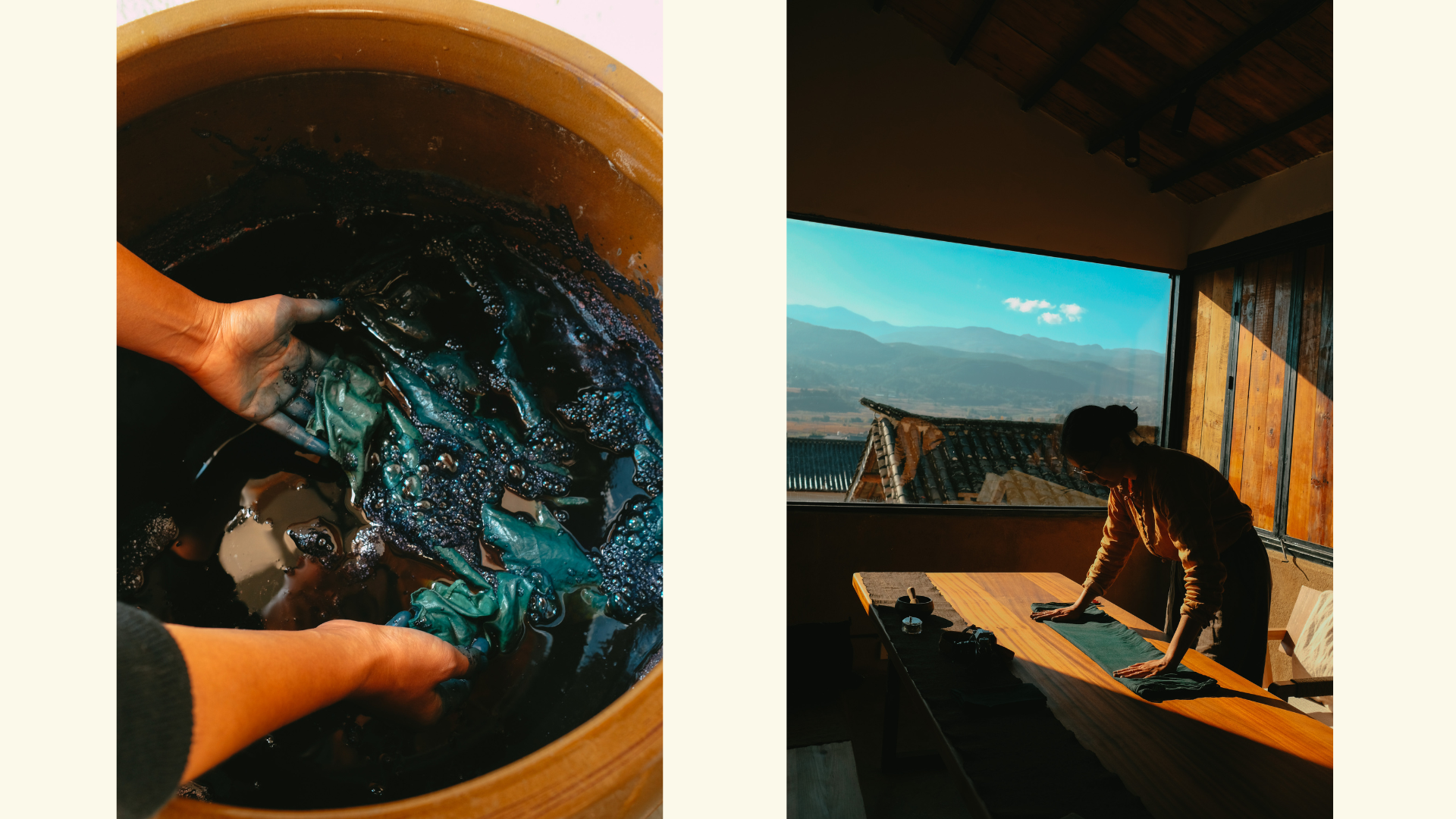
In the backyard one day, we peeled and chopped overripe bananas and apples. A dozen dye vats lay scattered about the airy space; hundreds of walnut shells lay drying on the ground. We boiled the fruits over a charcoal stove until they became pulpy water. Then, stirring this mixture into a blend of indigo paste and limestone powder, carefully transferred it into an enormous ceramic vat. The next morning, a layer of purple and blue-green bubbles had formed over the vat’s surface, glinting, gem-like. The longer I gazed at this pool of midnight blue, the more it felt like staring into the depths of a tiny galaxy. “Congratulations—you have witnessed the birth of the indigo vat,” Wang said, stirring its surface with a long wooden pole. Dipping the first piece of fabric in with reverence, she thanked the indigo for giving us its colour. At its birth, the first batch of indigo yields the deepest, purest and most vibrant blue. Accustomed to buying clothes from fast fashion stores, it felt miraculous to witness this ancient craft of transferring colour from nature to fabric.
Another afternoon, while walking the dogs, I stumbled upon a home perched on a small hill. A man sat reading, enveloped in classical music. The place was called 波罗的海 (“Bono’s Sea”). Around 2020, Bono, an electrical engineer from Shanghai moved to Yunnan. The music enthusiast and book lover had amassed over a thousand titles during the pandemic and transformed his home into a community library. This delightful space was dotted with reading nooks. Stacks of literature from The Odyssey to Ayn Rand to Chinese classics, history, philosophy and politics lined the walls. Repurposed items, like an old toilet bowl blooming with flowers, added charm. While serving me tea and snacks, Bono lamented that “few people read” these days, preferring to stare at their phones. Later, he led me to a rooftop deck where he plucked some “ugly” apples and offered them to me; as I bit into them, they burst with sweetness.
I also met Miao Miao from next door, a petite model who was based in Shanghai. On a five-year sabbatical, she’s exploring designing and making fabrics using natural dye. She spends her days cooking, meditating, practising yoga and attending spiritual classes. Working on her sewing machine, she spoke about the ubiquity of depression and anxiety in urban areas. “In the city, we become disconnected from the earth,” she said. “People today are busy and stressed, often trying to fill the void through material consumption. But nothing material can truly fill that void; only you can do that for yourself.” Yet, she felt it was time to 出山 (leave the mountain) and possibly return to the city to start a small business focused on sustainability. Her words struck me: “You can’t escape; you must face the problems and their roots. Much of the suffering we feel is created by ourselves.”
In Yunnan, stories like Miao Miao’s are common. Young urbanites retreating to the countryside to reset, re-centre, learn something new and figure out their next steps. I can understand why, having felt the joy and contentment that she, Bono and Wang got from living in concert with the seasons and embracing life’s natural rhythms.
After returning from Yunnan to frenzied Singapore, I attended “Digital Nomading 101”, a talk organised by Stranger Conversations—a collective that supports self-discovery and exploration—in collaboration with Going Slow, a social travel community. Attendees shared experiences of spiritual retreats, fire-dancing in Nicaragua, farming in Taiwan, remote tutoring while diving in South-east Asia, and backpacking to heal from trauma. The talk, the organisations, the attendees, they’re all part of a trend: of a growing desire for discovery and rediscovery; of seeking new directions in life.
Human beings have sought refuge in nature for millennia, so what makes it different now? Vincent Chua, a sociologist at the National University of Singapore (NUS), explained that while technology allows for seamless work-life integration, it also blurs boundaries, making “a real, uninterrupted break” increasingly elusive, he said. “Technology has not increased leisure time. It has only accelerated work. To put it plainly, capital seizes the chance to do even more.”
Similarly, Canadian writer Carl Honoré argued in In Praise of Slow: How a Worldwide Movement is Challenging the Cult of Speed that “turbo capitalism” drives everyone to move faster, creating great wealth but at a high human cost: long hours, burnout, and mental health struggles. In an age when social media and binge-watching fill downtime, we’re less accustomed to being alone with our thoughts. Our incessant need to stay “on” erodes deep connections with others, makes us less productive and reduces our ability to be happy. The 40-hour work week, implemented to protect factory workers during the Industrial Revolution, now fuels consumerism. It limits our free time to weekends, spurring spending on entertainment and convenience. This scarcity of hours reduces a desire for slower activities that are cost-free and nourishing, such as walking and reading. In Singapore, identity is so often intertwined with work. Our education system has conditioned us to prize academic achievements and career success. The city’s competitive environment for jobs, housing and educational opportunities, coupled with kiasu (fear of losing out) culture, defines success in terms of stability, wealth and tangible achievements. Office culture tends to reward those who put in extra hours and subtly criticises those who don’t. This dynamic can distort people’s sense of self and self-worth even outside of work. A 2022 NUS survey found that Singaporeans are less happy, with a decreased sense of achievement, control and purpose.
What are the contradictions of trying to live free and easy in a hyper competitive, hyper-urban state like Singapore? Often, “taking a break means having to pay back later” in the form of a backlog of work, which obliterates the restorative effects of the break, explained Chua.
Today, more people, especially the young, see and appreciate the beauty of “slow”. Millennials are embracing slow living, and Gen Zs are “quiet quitting” and “radical resting”, conserving their energy for meaningful pursuits beyond work. The Slow Movement advocates for balance, allowing people to control the pace of their own lives and decide when, how and how much they work. In today’s information economy, creative thinking often occurs outside rigid schedules. By promoting a better balance between work and life, we can live better if we consume, manufacture and work at a more reasonable pace.
“I don’t see the call for work-life balance as a call to being lazy,” said Chua, “but rather as a growing recognition that life is more than work, and that identities are more comprehensive than one’s job per se. It is a call to see bigger, to see more accurately, to see that humans are ‘beings’, not just ‘doings’.” Movements like slowing down and global nomadism seek to wrestle back personhood, to allow humans to live fully, as opposed to giving their all to capitalism. “It is in the interest of capital to make machines out of people because it feeds the bottom line,” argued Chua. “But people aren’t machines. People are people.”
There is so much wisdom steeped in the ways of the past, yet modern life increasingly leaves us disconnected from making and doing. Honoré wrote about a resurgence in crafts as a response to industrialisation, which many blame for stifling creativity. Artisans are returning to handcrafting—designing and building furniture, textiles and pottery using traditional methods. Hobbies like gardening, with its focus on planting, weeding and watering, offer a sanctuary from stress and haste, realigning us with nature’s rhythms. Art and reading also allow for stillness in an efficiency-driven world. This trend appears to align with the concept of 复古 “fu gu”, defined as a return to old ways (a Confucian aspiration). But 复古 is not merely a longing for the past, it reflects a dissatisfaction with the present. It indicates a “desire to change current conditions”, making the past—real or imagined—seem more appealing, according to Chua. Understanding nostalgia requires examining what is missing in today’s world.
In 2024, as rents soared, I moved back to my family home in a quiet suburban neighbourhood. Away from the city, I experimented with my versions of digital nomading and mini sabbaticals—taking on fewer gigs, switching off e-mail notifications, and setting my phone to “do not disturb” at night. I carved out a routine that included fussing over my tiny plant corner, caring for my pet turtle, doodling in an art journal, living more sustainably, going on walks and borrowing library books—a childhood habit that was lost along the way. Chua noted that taking a mini retirement allows for personal and community growth. “The word ‘retirement’ is seen with some suspicion as entailing the ceasing of productive work. It need not be,” he said. “Retirement can mean contributing in other ways, not to the taxpayer base, but through community: volunteerism, unpaid childcare, elderly care, and so on. Services that capital wouldn’t pay for.”
During my mini-sabbaticals, I spent extended periods volunteering abroad too. In May, I completed a three-week stint in Peru with Worldwide Vets, staying on a local family’s horse ranch in the Sacred Valley. And in July, I spent two weeks volunteering at a restored 120-year-old Japanese house in Ryujin village, a tranquil hot spring district nestled in the mountains along the Hidaka River.
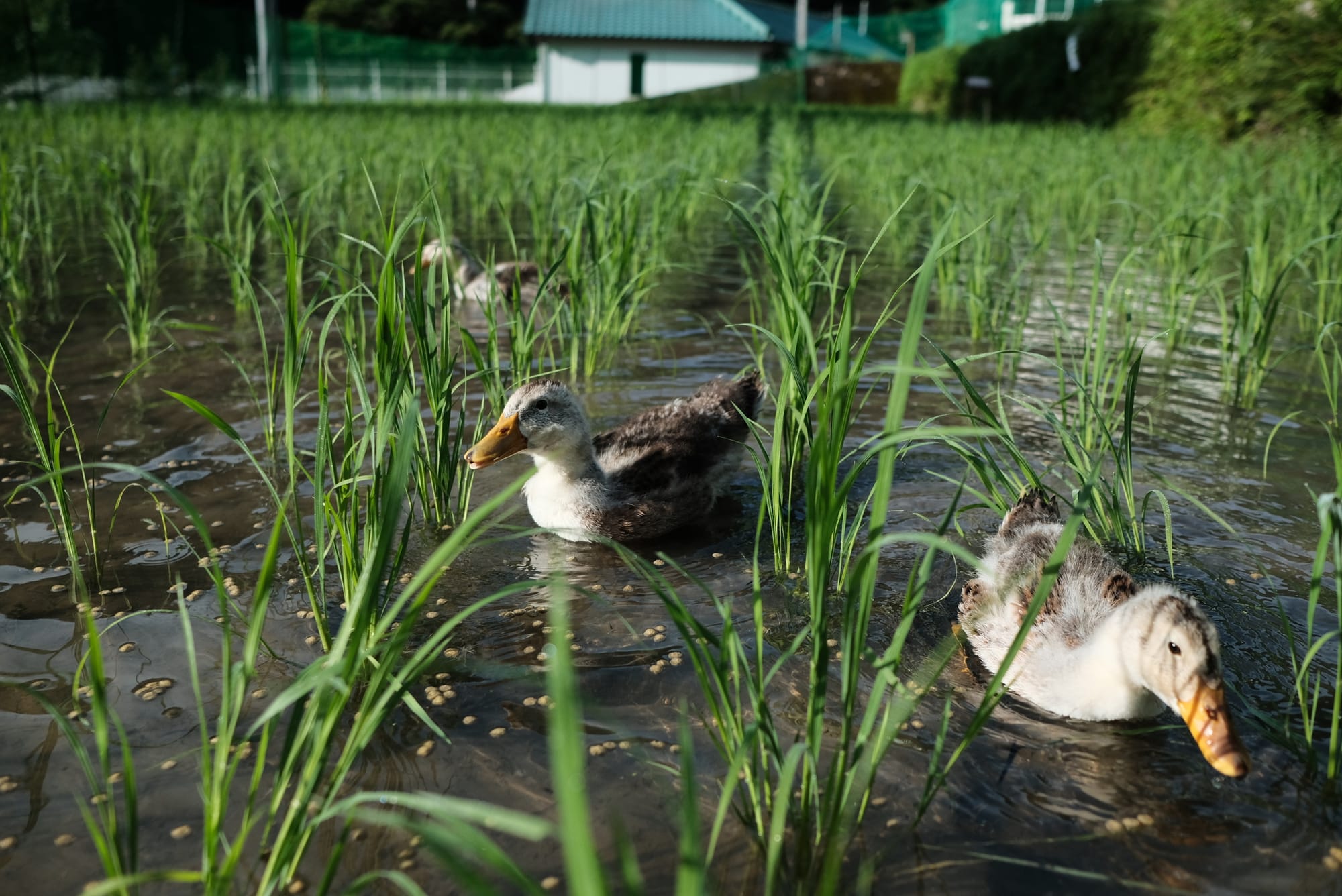
There, I met Cheah Wenqi, co-founder of the media company Our Grandfather Story. Wenqi’s mother passed away from cancer in 2022. Grieving, and burnt out by the demands of running an online outfit, she decided to explore new ways of living. Wenqi is elf-like with a bright smile and expressive eyes. “All I’ve known is small but comforting Singapore. I’ve never really lived apart from my family. But I’ve wanted to go on a big adventure…To see what else is out there, beyond safe harbours,” she said. Despite the support from those around her, Cheah grappled with fear, self-doubt and the weight of her expectations. Delaying her wedding plans, Cheah booked a one-way ticket to Japan. She saw snow for the first time, honed her pottery practice in Tajimi, plucked strawberries and harvested rice at various farms. Initially, the countryside life was as romantic as she imagined it, “a kind of simplicity I’ve only seen in movies and imagined in my dreams.”
It was a season of many lessons. She learnt about the precious gift of time, of long days deep in the countryside with no deadlines, no traffic, no distractions. Slowing down taught her to savour each moment. Cheah went on meandering train journeys; mountain bike rides; silent meditation retreats in temples and gardens; long walks in the woods; and aimless drives along the coast. She took her time to respond to people, smiled more, and found a temporary home through interactions with strangers and new friends. She discovered a newfound joy and ease. Farming rice for the first time, she shovelled soil, built and reinforced paddy field banks and moved seedling trays. Labour follows the seasons and weather on a farm. On overcast days, Cheah laid in bed, watched the fog roll in from the mountains, and let the sound of rain lull her to sleep. “I spent years running like a hamster on a wheel, thinking consistent peak performance was success. Now, I’ve learned to rest instead of always sprinting.”
For the longest time, Cheah was obsessed with understanding why artisans and craftspeople in Japan devoted their lives to the single pursuit of perfection. She was raised to believe that “the economics of our pursuits must always make sense.” But as she watched a 和紙 (washi) maker hold up a feather-thin sheet of paper he had just made, tears glistening in his eyes, she realised that these artisans lived for the satisfaction of creation, not for money. She had uncovered the value of quiet observation—not grasping but allowing the lessons to emerge over time. Sabbaticals aren’t a magic wand though, Cheah said. Despite being removed from busyness, her mind still raced with doubt and impatience about her next steps in life. Some days she felt “like a drifter, not knowing which of these different lives would be hers to live.”
In The Pathless Path: Imagining A New Story for Work and Life, author Paul Millerd talked about the practice of non-doing; not being lazy or escaping, but attaining a deep connection with the world. Quoting from the Tao Te Ching, Millerd wrote: “When nothing is done, nothing is left undone. True mastery can be gained by letting things go their own way; it can’t be gained by interfering.” When one shifts away from pursuing extrinsic goals aligned with societal expectations of progress and achievement, alarm bells and questions often arise. (“Don’t you want _____?” “What do you mean you aren’t focused on making more money?”)
Chua pointed out that the understanding of work and purpose is evolving. There’s work driven by materialism to “fortify one’s own kingdom,” tying identity to success and accumulation. Conversely, there is work done in service of others and guided by a sense of purpose. “I would like a world where ‘being’ (purpose) is the wellspring of ‘doing.’ Capitalism reads it in the reverse, where a person’s ‘being’ is legitimated by their ‘doing,’ meaning their personhood can only be affirmed by acquisition and accumulation,” he said. Similarly, 无为 (wu wei), a concept in Taoism that refers to inaction or non-doing. It does not imply complete inactivity, but instead a natural, playful way of engaging with life. Non-doing is the space where interesting things happen, leading one down new, unlikely paths.
Nothing contrasts more with city life than my year of volunteering—when I engaged without a specific goal, offered my labour as capital, and experienced work that prioritises community well-being and mutual aid over financial gain. It’s a step toward the post-growth movement, where purpose becomes rooted in collective welfare and sustainable living rather than individual accumulation. But as the novelty of constant movement wears thin, I find myself missing Singapore’s efficiency, the comfort of routines, home-cooked meals and the ease of familiar relationships.
Nomadism sets you apart from life’s typical trajectory. While others climb the corporate ladder and nest with partners, I’m confronted by questions like: is travel a crutch?; what am I seeking? My ability to navigate a lifestyle with a degree of freedom and rest comes with inherent privilege. Not everyone can afford to step away from the grind. “Unequal options,” said Chua, mean that those with more resources can detach from the system more easily, while those who rely heavily on their jobs face greater risks and pressures. “Wealth and privilege confer the ability to detach from the system as and when one desires,” he noted. “The more dependent you are on the system, the harder it is to say ‘no’ to it.”
A year after my first retreat in Yunnan, my last volunteer stint of 2024 brought me to Heart Ranch, a sprawling haven in far eastern Hokkaido—often described as Japan’s last unexplored frontier. This wild region is home to diverse wildlife, from the endangered red-crowned crane to the Ezo red fox and white-tailed eagle. At Heart Ranch, the father-daughter founder duo, Rika and Junichi Tatsukawa, warmly welcomed me into the family. Life felt contained in a peaceful bubble. We spent each day mucking out stables, caring for horses, assisting with tourist rides, creating content for social media, brainstorming ideas for the ranch, painting artwork for the cafe, and preparing for an upcoming horse show. One of the most incredible moments was lying cuddled together on the grass with a baby foal named Eve, her head resting gently in my lap, or watching all the horses race freely across the upper pasture.
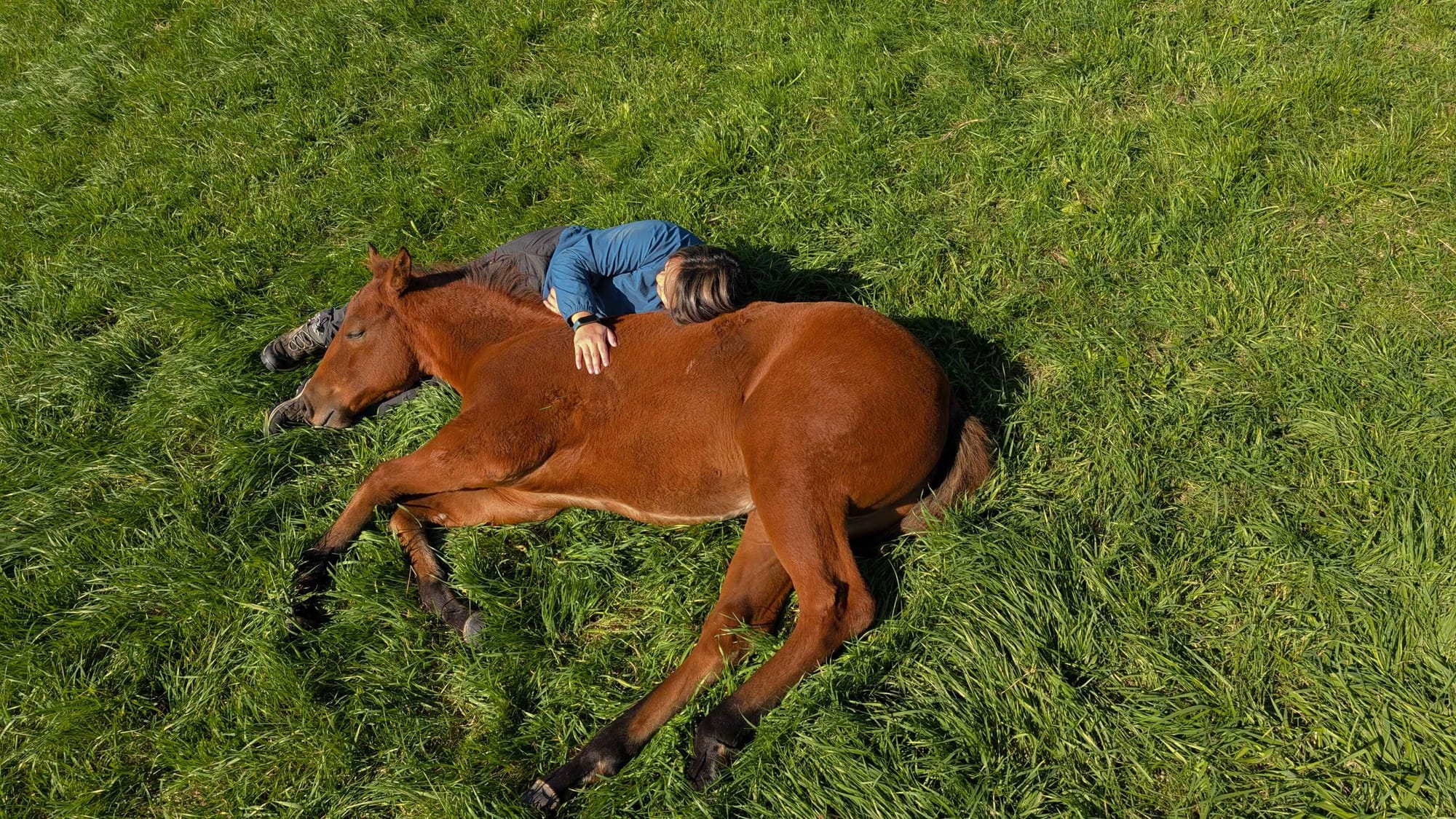
When was the last time you were truly dazzled? The last time you lay beneath the sky, sauntered through woods and hills, or let yourself disconnect from a screen? Whether it was a nine-day hike along the Michinoku Coastal Trail, or taking in Nepal’s snow-capped peaks that year, I experienced an emptiness that felt full. In nature, we learn to detach from life’s trivialities, to recognise impermanence, and to let go. While others may have experienced more seismic shifts in their sabbaticals, my journey was one of subtle, everyday shifts—like honing the art of noticing.
People once called me “slow” with derision, but in slowing down I was able to heal from loss, to find joy again in this vast and beautiful world, and to approach each moment with mindfulness. Back in Singapore, I have become a shelf-owner at Casual Poet Library, a charming space dedicated to sharing books and building kinship. It’s a place rooted in mutual solidarity, where the simple act of lending builds bridges that deepen community bonds. Perhaps my journey mirrors what philosopher Agnes Callard described as “aspirational”. Aspiration, she said, is about trying on the values we hope to embody one day. Unlike ambition, which strives toward known achievements, aspiration embraces ambiguity. I’m still figuring it out. Perhaps through rest, clarity and calm, we can imagine a world we deserve, and one that is deserving of us.
Toh Ee Ming is a freelance journalist focused on social impact, the environment, travel, and culture. Driven by deep empathy and curiosity, she wanders the world in search of stories about everyday people and communities, aiming to shed light on the experiences that shape our world.
Letters in response to this piece can be sent to sudhir@jom.media. All will be considered for publication on our “Letters to the editor” page.