

Dear Jomrade,
This week we’ve published:
- “Singapore This Week”, by Jom
- “The Kadayanallur Muslim thread in our fabric”, by Abhishek Mehrotra
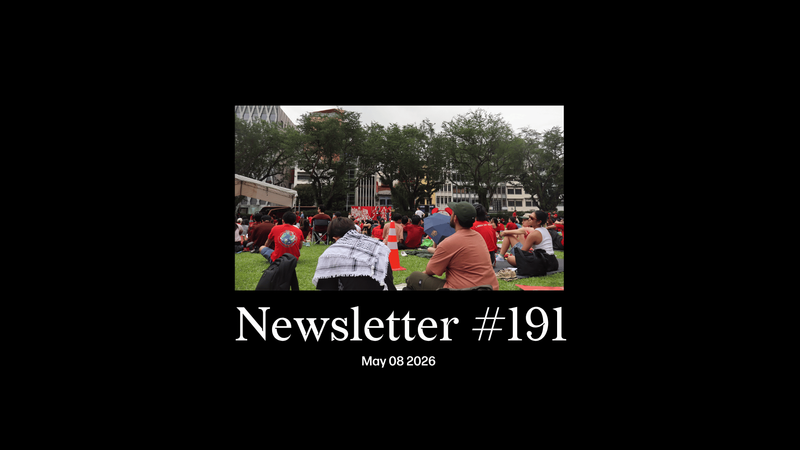
- Snippets from the Labour Day Rally 2026, by Jom
Jomfest, 1-6pm, May 19th, ACM. Early-bird pricing is over. We’ve got a few regular-priced tickets left.
The opposition Workers’ Party (WP) engaged the ruling People’s Action Party (PAP) on important issues in Parliament, including: a National AI Equity Fund that would tax rich corporations and pay dividends to every Singaporean, to ensure all benefit from our AI embrace; stronger protections for displaced workers; and the ethics of retroactive legislation, in this case amendments to an MND bill that would validate fees collected perhaps since independence. (All WP MPs voted against it.)
The issue that all of us at Jom paid particular attention to were amendments to the IMDA Act in order to bring media regulation in line with the telecommunications sector. Ostensibly to promote fair competition, it allows the government quite extraordinary powers over media firms: ownership approvals, proactive directions, and separation orders.
Andre Low, WP non-constituency MP, highlighted the dangers he sees: “The more significant read of this bill is as a pre-emptive measure. Not about managing the existing players. About ensuring that no new actor—a well-capitalised private investor, a media group with genuine editorial independence—can build a meaningful presence outside the government’s reach.”
He mentioned Hong Kong’s Apple Daily, the Washington Post and (gulp) Jom. “This bill is not written for Jom as it stands today. It is written for what Jom—or a publication like it—might become in ten years. A publication with the reach to shape conversations. To hold power to account. To be read by Singaporeans because it has earned their trust.”
(Low said he’s one of 8,000 paying members. Thanks for the boost, we wish! Actually the number is just under 2,000, with another 6,000 odd getting this free newsletter. But in the prophecy we trust.)
Low’s entire speech is worth watching partly because he elucidates many of the editorial principles and legal safeguards that are necessary for media outfits to thrive. He asked the government to clarify that the bill’s intent is not to foreclose “a future when Singapore has a genuinely independent press—publications that owe their survival to their readers, not to the goodwill of any government, that can ask hard questions of whoever holds power, including of us.”
And I’m glad it did. Tan Kiat How, senior minister of state for digital development and information, said: “The regulatory intent is for fair market competition and protecting consumer interest.” He also said that, especially in an age of AI and disinformation, the government cares “about who owns and controls” key media entities.
That’s all well and good. Sceptics will point to numerous instances in the past, such as with POFMA, when noble intent appears to have fallen prey to mission creep, if not abuse. But for now, with the Bill passed, we’ll remain cautiously optimistic. We’re grateful to Low for raising the issue, and for Tan’s clarification.
Jom Baca book club: Unease with Ahmad Zaid
From April 7th to May 20th, we’re reading Unease: Life in Singapore Families by Teo You Yenn. Next Monday, at our final Zoom session, we'll be discussing Chapter 5, Parenting and Class: The Cost of Inequality and Chapter 6, How We Live Is Who We Become.
📆 Monday May 11th 2026
🕑 8pm - 9pm
🎙 Discussion led by Ahmad Zaid, Jom’s community manager
Register below to participate. You’ll be sent reminders before each Zoom session and also some post-session highlights.
The interplay between culture and structure has been at the heart of Chapter 4’s discussion of gendered unease. In our Telegram group, a reader further extended a metaphor from the book:
“I find the metaphor of the Supertrees at the Gardens by the Bay ingenious. As stated in page 169, Singapore has been described by academics as an ‘airconditioned nation’ where governing is as ‘gardening’. TYY also states (or implies) somewhere that the metal scaffolding of the Supertree is the structure and the way the plants grow is nature to give us an imagery of how structure and nature are interconnected. She also asks us to listen out for the ‘creaking of branches and leaves trying to grow beyond the cage’ (p. 170).
For me, it inspires another more disconcerting imagery of the black garbage bags of the pruned branches and fallen leaves that are either disposed or composted back into the soil which we fail to notice or observe.”
Discussions are ongoing throughout, so drop in any time.
- What did the PAP-NTUC Labour Day rally tell us about the state’s views on workers’ rights amid tripartism?
- What did the alternative, activist-driven Labour Day rally reveal about the real challenges faced?
- A S$13m Toto windfall for one punter, but who really benefits from state lotteries?
- With three tuberculosis clusters recently detected, we examine the history of the disease Charlotte Bronte called “a flattering malady”
- Historical nostalgia, and the Gen Zs pining for a return to the pre-attention economy
- “Passion Is Volcanic: Desire In Southeast Asian Art” at the National Gallery Singapore
Above are the issues we chose to explore in more depth.
Other news this week included: NUS among those being blackmailed following data breach; two Singapore residents isolated after Hantavirus exposure; some HDB flats are hotter than the outdoors; tourism receipts blazing new records; plans for a potential government-run dating service (oh, the horror); the implications of falling fresh-grad employment numbers; a new agency to support workers and employers; Indranee’s parenthood reframing, and performance, draws flak; a boost to palliative care; don’t buy contact lenses from unverified online sources; Trump’s war the reason moms can’t have flowers on Mother’s Day; a historic Singapore-New Zealand essential supplies pact; more than a thousand people go missing in Singapore every year; Workers’ Party reprimands Pritam Singh; news about caning for bullying goes global (TLDR: no one approves); jail time for those feeding pigeons, crows, and others (watch out, ah ma!); High Court overturns acquittal of three women who delivered letter to Istana; SG’s press freedom score falls further (yes, possible); bus guitar-hero told to strum from seat; man arrested for church assault; new railway laws ahead of December’s RTS Link launch; Sentosa croc put down; companies can now simultaneously list on SGX and Nasdaq; and SG athletes’ late-career struggles.
Join 2,000 members keeping Jom independent. From S$10/month—full access, no compromises.
“The Kadayanallur Muslim thread in our fabric”, by Abhishek Mehrotra
From the Jews in Cochin to the Sindhis in Shanghai, one of the great characteristics, and triumphs, of port cities is as a safe harbour to microcommunities that migrate, congregate, propagate, and prosper. One of Jom’s values, meanwhile, is Diversity, which we interpret partly as a charge to “shine a light on issues and personalities typically under-represented in the media.”
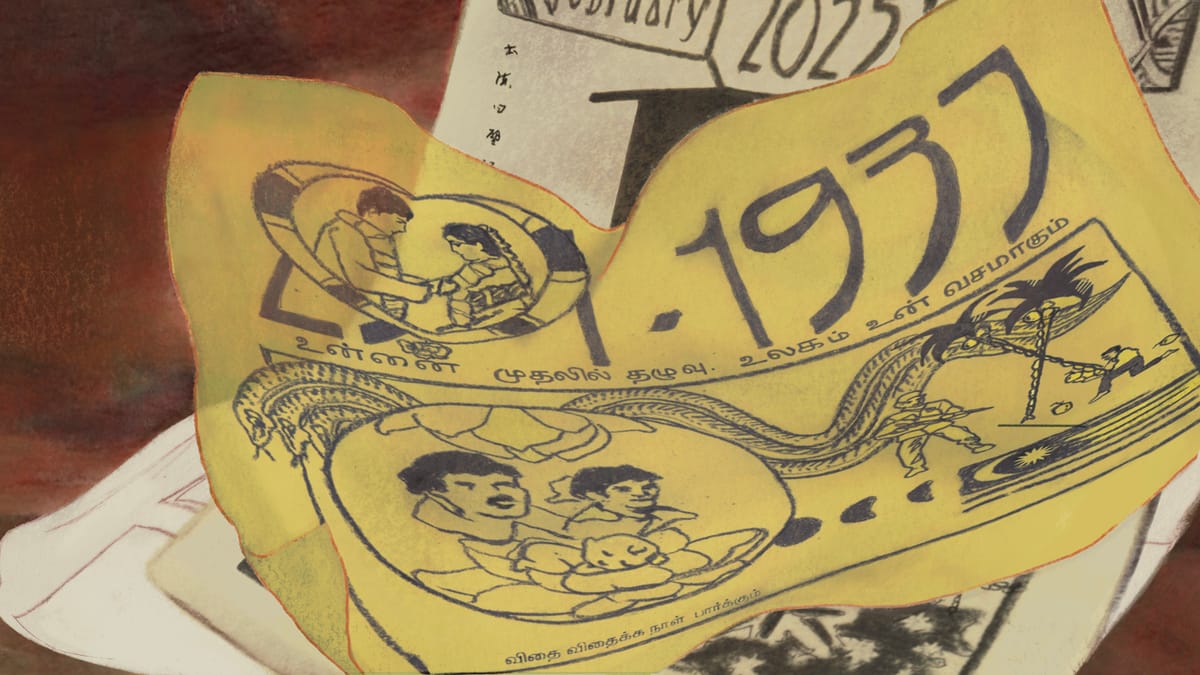
Today’s piece, by Abhishek, our head of content and presumptive next editor, is a wonderful confluence of the two. Many of you might be familiar with Kadayanallur Street, along one end of Maxwell Food Centre, leading up to Ann Siang Road. But from where does it get its name? When I read this piece, which first appeared in Jom’s print issue No. 3, I was, even as the descendant of two very different migratory Indian communities, just overwhelmed by awe and curiosity about the journey of these people from a small area in south India.
Separately, this is also a relevant week for us to be publishing this, as much of their story is about the uplifting of workers’ rights. I’ll leave you with bits of Abhishek’s opening:
“When AP Nagoor Masood stepped ashore in Singapore in 1920, he was following a rich tradition. For centuries, Muslims from south India had braved the tempestuous Bay of Bengal to trade in Malaya and beyond—daring archipelagic odysseys that turned mendicants into merchants, obscurities into icons…
Masood, his wife Meeral, and their children came from Kadayanallur, in the lower reaches of the subcontinent’s mighty Western Ghats mountain range. Kadayanallur was part of the ‘handloom belt’, one of numerous weaving settlements clustered in India’s deep south. For generations, its Muslim weavers had worked on looms perched in the front rooms of their narrow, palmyra-thatched houses that opened out into the streets. It was hard work, often involving entire families. From morning to night, Kadayanallur rang with the clacking of the wooden shuttles moving across the loom, carrying the weft back and forth through the warp to produce textiles that were sold in the town bazaars…
When famine struck in the wake of the first world war in 1920, even that gruel vanished. ‘Starvation deaths became common,’ recalled one of Masood’s sons, Maideen, then seven. Desperate, Masood tied his meagre savings in a cloth bag slung around his waist, Meeral gathered the brood, and they set off on a punishing 400km road trip to Nagapattinam. There, they boarded a ship for Penang and thence to Singapore.”
Jom baca,
Sudhir Vadaketh, editor-in-chief
Jom
Jom on migration
 Sudarshana Chanda
 Jonathan Chan
 Shen Chenzi
 Miguel de la Fuente-Lau
Singapore This Week
Society: Workers’ paradise, according to WMP-SGCR
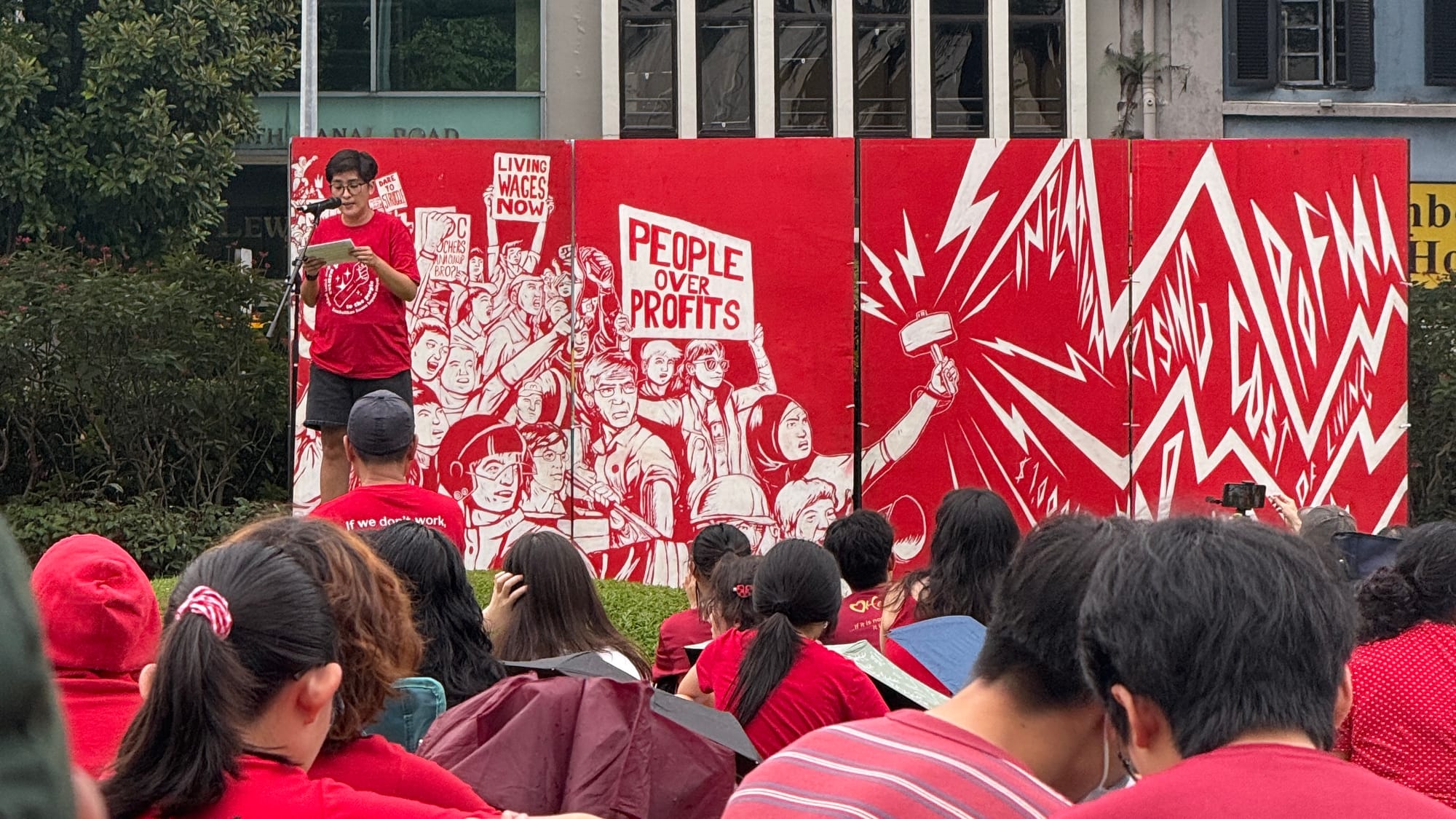
Tripartism may be working for the faithful, but not for many others. Dramatic demonstrations of resistance, like the “illegal strike” by bus drivers in 2012, capture the country’s attention. But away from the public’s eye, little perturbations by disparate groups of disgruntled employees have been steadily coalescing into a larger disturbance to the force. Awakened and energised by a new breed of youth activists, and spurred on by the success of 2022’s criticism of Watson’s alleged no-sitting policy, workers are fighting for their rights. Not just those enshrined yet unfulfilled by unscrupulous bosses—but also those that they believe they deserve in a caring, humane society.
Their defiant solidarity was on display at Hong Lim Park last week. Over 1,500 gathered for the fourth edition of the People’s Labour Day rally organised by Workers Make Possible (WMP), an activist group. In substance and form—worker booths festooned with petitions, protest stickers, and poetry; artworks strewn across the lawn; keffiyehs of varying colours and imaginative folds fluttering in the heart of the business district—it was a stark contrast to the predictable triumphalism of the PAP-NTUC bash.
This year's event was jointly organised with SG Climate Rally (SGCR), an eco-socialist collective. Their unified message: people and the planet are being sacrificed for the pursuit of profit. Among other contradictions, they highlight: workers are told to reduce their personal carbon footprint while large MNCs continue polluting with government subsidies and invest in AI-driven data centres that consume vast resources. This year’s demands include an eight-hour workday and a maximum five-day work week for all workers; and the assertion that Singapore’s green transition cannot come at the cost of others—all overseas projects should be done with free, prior, and informed consent of local communities. Their “Labour Day 2026 Campaign Paper”, a blend of analysis and polemic, is worth reading in full. (As is their post-event joint statement.)
Jom reported on five of the 30 groups: Makan Minum Workers, which represents F&B workers; the Interfaith Environment Coalition, consisting of Buddhist, Christian, and Muslim groups; the Urban Birds Initiative SG; the PHV Driver Community, which promotes the welfare of all private hire vehicle drivers of all platforms; and Function 8, co-founded by former political prisoners, which seeks the abolition of the notorious Internal Security Act. (For the second year running, political parties had booths. On show this year were the Progress Singapore Party, Red Dot United's youth wing, and the Singapore Democratic Party.)
Among the speakers on stage were Carmen, the voice behind Confessions of a Grab Driver; and Nasita, a single mother of five, who grew up working in her mum’s satay stall and now, among other things, works with We Support Us, a grassroots network that seeks to enhance mutual aid and community building among rental flat residents. Among the performers were Dakbe Singapore, whose four-person Palestinian Folkloric Dance ended with a giant jam alongside attendees; and Satu Jiwa (One Spirit), a choir that roused the crowd with songs of emancipation.
What began as an inchoate project of some 300 people in 2023 has blossomed into a well-oiled jamboree of over 1,500. It’s appalling, then, that much of society continues to ignore it. Mainstream media journalists were there, but it appears like only Lianhe Zaobao published something. Perhaps ignorance is part of the Faustian pact. The mainstream press, handmaidens of the neoliberal state’s tripartism, surely can’t afford to bite the corporate hands that feed them. Shame. It is not just the tears of Wong that we should watch, but those of the dispossessed and disenfranchised, finding strength in numbers, hands on hearts, bodies swaying, as they sang “We shall overcome”.
Other stuff we like
Catch NTU’s School of Art, Design and Media (ADM) grad show, “Altered Variables”, from May 10th to 17th, 11am to 8pm at New Bahru School Hall, Level 2.
Chef and food journalist Jenney Dorsey explores the systemic contradictions and muddled policies that are pushing Singapore's hawkers to the brink.
A flavour of Jom. Occasionally, Jom publishes essays outside the paywall. These are on issues we think are in the public interest, and deserve a wider airing. In the past two years, we have published nearly 50 such pieces. Read some of these if you’d like to see samples of our work. We hope they’ll convince you to subscribe. And even if you’re here with no intention of doing so, we hope you’ll enjoy these offerings and consider it time well spent!