
Elena reached out to me on Wechat a few years ago. We’d first seen each other amidst mutual friends at West Coast Park, but hadn’t interacted much then. At the time, between my first and second years at NUS, I was in the UTown hostel study room, trying to catch up on lectures from the previous semester that I hadn’t really understood. “Hey, I’m staying on campus for the break and getting pretty isolated in my room. Want to meet up sometime?” Elena messaged.
(“Elena”, like my other interviewee, prefers to use a pseudonym given the perceived sensitivity about commenting on her adopted home, Singapore.)
I remember walking to the Japanese restaurant nearby on a humid afternoon. As soon as we sat down, Elena confessed that she’d been feeling unwell and unusually tired lately, both physically and emotionally. I told her that ever since I was hospitalised in high school, I tended to get exhausted much more easily. “Oh wow, same here,” she immediately said.
I wasn’t expecting that level of honesty. Most people I knew, especially in the Chinese student circle, only talked about their successes, often on WeChat Moments: straight-A grade reports; LeetCode problems they’d solved; offers from big tech companies; and their latest impressive projects.
Elena was different. She was talking about pain, about vulnerability, about the parts of the “elite overseas scholar” experience that no one wants to admit. I felt something inside me ease.
I thought about my own second semester—just months earlier—when I couldn’t get out of bed, when I sat in the lounge until 2am staring at problem sets I couldn’t solve, when my brain had stopped working the way it used to.
I hadn’t told anyone about that. I thought it was my personal failure, my weakness. But sitting across from Elena, I realised: maybe it wasn’t just me. “This is normal,” I reassured her, again and again.
Those words gave her, perhaps for the first time, a sense of acceptance rather than judgement—and marked the beginning of our friendship. Over the next two years, Elena and I spent countless nights together, sometimes studying, often just talking. When we both struggled with insomnia, we’d squeeze onto one of the narrow dorm beds, holding hands in the dark, keeping each other company until sleep finally came. We’d sit on the stairwell until 3 or 4 AM, talking about everything and nothing. I wonder if this is what previous generations of migrant Chinese female students also did here.
Since 1819, when Singapore became a British free port, its population growth has been deeply shaped by migration, with Chinese immigrants as a core group. From the 19th to mid-20th century, waves of labourers and merchants—many as “sojourners” hoping to earn money and return home—were drawn in by colonial economic expansion into the docks, plantations, construction, and services.
In the last 30 years, a distinct new wave of “mainland Chinese” or “PRC” [People’s Republic of China] migrants has emerged, driven by two parallel trends: the normalisation of outbound migration after China’s reform and opening, initiated in 1978; and Singapore’s strategic “talent” policies since the 1990s, aimed at building a global city and knowledge economy. Migrants from China today range from blue-collar workers to a significant middle-class group—students, skilled professionals, and entrepreneurs. Singapore has offered them an attainable “study-work-stay” trajectory, supported by expansionist policies that bolstered the labour force in order to sustain economic growth.
After a temporary drop during Covid-19, non-resident numbers rebounded to pre-pandemic highs. Of Singapore’s total population of 6.11m by June 2025, non-residents comprised almost a third (1.91m). Permanent resident (PR) numbers have stayed stable at about 540,000. Critically, the policy focus has shifted. Where the 1990s–2010s prioritised expanding the workforce for global competitiveness, the current phase stresses selectivity, local protection, and complementarity—every new entry or renewal must show a “positive impact on local jobs”. The Complementarity Assessment Framework (COMPASS), a points-based system, institutionalises this approach.
Yet behind these institutional shifts and numbers lies a more complex, deeply personal reality. The “measured pace” of admissions, the rising thresholds, and the constant need to prove value—all of these accumulate as lived pressure, shaping each migrant’s journey long before and after the potential citizenship ceremony.
Their journey is marked by the tension between belonging and displacement, by struggle and a sense of powerlessness, but also by profound moments of warmth and connection.
For decades, Singapore has adopted a strategy of attracting high-performing teenagers from the region through pre-tertiary scholarship programmes. This includes, since at least the 1970s, the ASEAN Scholarship scheme from the Ministry of Education (MOE); and, since the 1990s, the SIA (Singapore Airlines) Youth Scholarship, administered with MOE, which drew teenagers from India. (Following a nativist backlash, it appears like MOE and SIA are no longer offering scholarships reserved only for Indians. MOE did not return a request for comment.)
China was next. In 1991, the Senior Middle 1 (SM1) scholarship was launched. Each year, a few hundred of China’s top junior high (grades 7-9) students win a fully-funded education in Singapore’s elite secondary schools and junior colleges (JCs), starting from Secondary Three. (Business China appears to be running the equivalent programme now.) By contrast, students from my hometown weren’t eligible for the SM1. I came to Singapore only for university, which is where I met many SM1 students (more on my own journey later).
Elena was one of them, arriving from a new first-tier city at just 14. At first, she carried a sense of distinction as a scholar, and the two-month bridging course felt easy and relaxed. But when school proper began, Elena encountered the real challenges of adapting: the language barrier, the unfamiliar culture, and the subtle ways by which English proficiency became yet another marker of status in this meritocracy.
“I felt I couldn’t integrate,” she told me. The language barrier incited a complicated mix of emotions—shame and frustration at not being able to express herself the way she wanted; and a fierce determination to prove herself and master the language.
But what truly wore Elena down was the SM1 program itself. The competitive pressure she had first felt in China grew uncontrollably in Singapore. The incipient SM1 “scholar” identity, notwithstanding any attendant social capital, came with immense expectations. The pressure intensified in JC with the scramble for university places, creating a “suffocating” environment. “We lived together, studied together, and competed with each other.” Separation from the rest of the student body led to a toxic echo chamber.
Elena would sometimes sit in the middle of the road and cry. She’d spend long stretches in the bathroom, alone, crying where no one could hear. She’d go to a school “lounge” that was “a small, kind of dirty place where students would go to sleep”, because she was so exhausted.
“It was the darkest time in my life. It got to the point where I ‘wanted to die’.”
Until now, the two of us circle back to the years we struggled here—again and again—as if we can’t help it. Maybe it’s anger, maybe it’s tenderness, maybe it’s regret. Maybe it’s the confusion and exhaustion that still linger even now. Whatever it is, the memories keep returning.
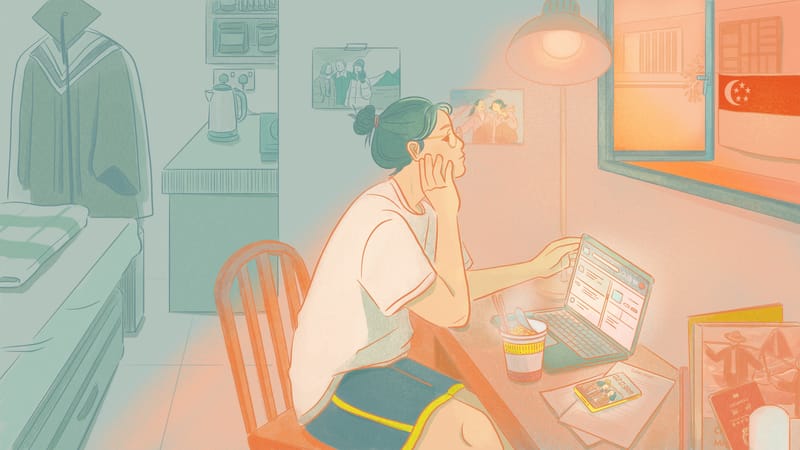
One is of a night during our final year. Elena was renting a tiny HDB room without air-conditioning. She had just finished an essay and, from sheer exhaustion, fell asleep immediately. I sat beside her, next to an old fan whose blades were edged with dust, trying to solve an algorithm problem. The room was so warm the walls felt close, and outside the corridor lights hummed faintly.
Elena stirred, half awake, and whispered into the dimness, “If I’d had access to more people, a bigger world, different ways of living… I wouldn’t have felt so desperate.” She paused, her voice barely audible above the droning of the fan. “Like there was only one path, and if I couldn’t stay on it, nothing else seemed possible.”
She drifted back to sleep, her breathing settling into the small room. I sat there, the laptop screen glowing in front of me, and felt something loosen in my chest. I opened a forum for overseas Chinese women and found myself rereading a line by Mimi Yana, over and over:
“Instead of striving to become a happy and strong person, start by honestly facing your own vulnerability.”
Tears welled up in my eyes.
To cope, Elena immersed herself in philosophy and long periods of introspection, trying to make sense of her inner world. I found a different language in sociology, in my gender studies minor, in Judith Butler, in bell hooks, who wrote, “I came to theory because I was hurting. The pain within me was so intense that I could not go on living.”
I kept interrogating privilege and oppression, social construction, and agency as a disturbance within the system. In a gender studies tutorial, I met another SM1 student, Wren. Quiet in class, she was more open in private. We discussed feminism, and soothed each others’ stresses.
Whenever I shared articles or book excerpts on my feed about feminism, gender, or similar topics, she would respond with thoughtful comments and sometimes drop the name of a book she likes. Once, before an exam, I posted about having too much coffee and feeling jittery. She replied right away: “Drink more water. Go to the bathroom and wash your face.”
After graduation in 2025, and a failed two-month job hunt, I decided to return to China, at least temporarily. The cost of living, especially rent, was crushing. My boarding school said I could take the mini-fridge and microwave from my room. I posted on Moments, asking if anyone needed them. Wren responded.
It was 7pm on a Thursday when we met. She’d just gotten off work. I was a bit dizzy—I hadn’t eaten much all day. We waited twenty minutes, standing outside in the thick evening heat, before loading the appliances into a Grab.
When we arrived at her HDB block, we carried the fridge and microwave through the long corridors, talking as we walked: housing policies, whether we wanted to stay in Singapore, how to find jobs, how to repay the Tuition Grant. Her room was small. A bed, a hot plate, shelves of snacks, everything visible at a glance. After years here, this was the space to call your own: tiny, transparent, transient.
At the nearby McDonald’s, Wren stretched out a leg and laughed, “A week ago, I couldn’t have done this.” She’d had an ingrown toenail, but put off seeing a doctor until it got so bad she could only wear slippers. A colleague noticed her limping every day and dragged her to the polyclinic.
“I don’t dare see specialists either,” I laughed—bitter, knowing. “Fifteen minutes of consultation would bankrupt me.”
Wren was an unlikely SM1 candidate. The program typically recruited from established partner cities, but another municipality had restricted recruitment to “protect its talent”, and her small provincial city was chosen, less than a month before her high school entrance exams. “The students ahead of me probably said ‘No’,” she said, picking at her fries. “They were unfamiliar with it, or their families couldn’t afford the supplementary living costs. I was the only one in the top ranks who agreed.”
For her family, it was a calculated bet. The scholarship covered tuition and board, but they still budgeted 400,000 RMB (around S$80,000) for four years. “They figured it was like paying for a private high school [in China].”
“At that time, I just felt, ‘Oh, abroad must be better than domestic,’” she said. Singapore was a place she knew nothing about, but it held an “unknown beautiful filter.” It also carried the prestige of “returnee” (海归) status, which she equated to opportunities in top-tier cities like Beijing or Shanghai. But the “beautiful filter” dissolved pretty quickly. The bridging course was where the chasm—the hongou (鸿沟)—opened up.
“The students from Jiangzhe and Wuhan had so many more educational resources than me,” she explained. “I’d never even heard of ‘New Concept English’, TOEFL, or IELTS. I only knew my middle school textbook.” While others had programme history and seniors to consult, Wren, the first from her city, felt “like a headless fly.”
The language barrier was brutal. “I had to read all these articles in English, understand a new country in English…I couldn’t even read the words clearly. I’d never learned phonetic symbols.” The bridging course teacher would often exclaim that they can’t understand Wren. “You go from being top-ranked in your city to being here, where you can’t read or speak. The sense of falling was immense.”
Once she entered the school system, the pressure mutated into a battle for survival. “If you fail, you get talked to. If you keep failing, your scholarship and visa are cancelled.” The thought of returning “in disgrace” was a constant terror. In her third year, she hit a wall with political philosophy. “I couldn’t even read the texts, let alone engage in logical debate,” she said. Her marks dropped to the 20s and 30s (out of 100).
For the final exam on “Meritocracy,” she forced herself to email the teacher for help—”the first time in my life I summoned that courage.” The teacher taught her to write a baguwen (八股文), a rigid essay structure. “He told me, ‘Go read the local news. If you can’t read the English, read Lianhe Zaobao first.’” She memorised the structure, memorised social issues, and passed the final with an 88, pulling her average just over the line.
“I had extreme thoughts, many times,” she admitted quietly. Then she told me about the sirens. One night, they flooded her boarding school. The next day, they learned a student had hung himself from the second-floor railing of the adjacent school hall. He’d been facing retention after failing his A-Levels for the second time.
“Suddenly, death felt so close,” she said. “We were the same age, and we understood his reason.” She paused. “You take these 15-year-olds, put them under this pressure with no guidance, and it’s basically sink or swim. Who knows if they grow crooked, or just die?”
Wren’s words lingered. They brought back my own memories—four years in university, three students who “fell”. One, I knew for certain, was from China. The first was in my freshman year. We lived in the same residential area. In the middle of the night, he stepped off the building. Someone sent me a photo of the blood on the ground, before it had been cleaned. The brightness of it jolted me.
My desk, right up against the window, faced that building. Many times, I sat there tugging at my hair, trying to fix code that refused to run. When I finally looked up, I could see the opposite corridor through the layers of greenery outside—rain trees and angsana leaves crowding the view, thick and restless in the wind.
Fourth floor. I knew that was the height he fell from. The image kept replaying in my mind, unbidden, each time my eyes drifted toward that corridor.
For months afterward, I walked past that spot every day. On nights when I couldn’t sleep, I would wander through the campus and the residential blocks for hours, just to get away from that desk, that computer, those classrooms where the air-conditioning was always set too low.
In her first two years in Singapore, Wren was similarly plagued by insomnia. She’d spend her nights walking endlessly around the central business district, where she lived. Her early impressions of Singapore were shaped by these night walks: big, international, fashionable, expensive. In JC she moved to a residential heartland. “I began to understand what an HDB is,” she said. She discovered the pulse of local life in food centres, found refuge in walking alone in small parks—“a way to release the academic pressure.”
This slow exploration shaped her contradictory impressions of residential neighbourhoods. “The good part is that it has this real sense of daily life. The bad part is that it’s monotonous. They all start to feel the same.”
For Wren, it meant a certain numbness. “No matter how long I stay, I always feel I can’t get used to it.” She pauses. “I’d say Singapore is a vessel that temporarily held a certain stage of my life. I use the word ‘vessel’ or ‘accommodate’ because I’m grateful. It accepted my existence here. It wouldn’t deliberately trip me up. But it can only hold a stage of my life. I cannot give my entire life to this place.”
That sense of never quite settling in, of always being on the edge, wasn’t just Wren’s experience. Elena put it more directly: “To be honest, most of the time I still feel no sense of belonging.” Elena believes belonging is about people, not place. “Singaporeans are friendly, but they keep a certain distance.” This distance manifests as a constant “othering”, a polite but clear reminder: “Ah, you are the one from China.” Even those who became naturalised Singaporeans still hung out and played with those from the motherland.
The concept of nationhood only crystallised in Malaya around world war two. Earlier waves of migrants to Singapore would not have encountered a nationalist barrier to integration, given the fluidity of archipelagic places. It’s only in recent decades that locals have rebelled a bit against newer migrants from China and India. Observing Brexit and recent developments in the US, where long-time residents and even citizens have been stripped of their papers, perhaps it’s just in keeping with a global nativist zeitgeist.
Indeed, Elena’s true moments of belonging come from being “treated well”, she noted. “My sense of belonging doesn’t come from Singaporeans. It comes from the other international people here.”
Hearing Elena and Wren talk about belonging, I felt a tangle of emotions I couldn’t easily name. I’ve seen so many different sides of Singapore—sometimes right in my classes, sometimes just outside the window.
In my community engagement projects, I watched migrant construction workers sleeping in the midday heat by the roadside, under an overhead bridge, just steps away from campus. On social media, I saw an employer complaining that she didn’t want to buy sanitary pads for her domestic worker, and that for the worker to eat an egg every day was “too much.” In my feminist theory class, I argued with classmates about a person’s right to wear the hijab—some suggested that prohibition was actually about hygiene, or to avoid making others uncomfortable. I was furious.
I’ve spent months writing and revising a long-form feature about female genital cutting in Singapore. I’ve spoken up against those who insist there’s no such thing as gender privilege or Chinese privilege here, who think everything is just a matter of personal effort and capability.
And in this long, uneven process, my feelings for this place grew complicated. I care about it, about the people who live here, about the stories that keep surfacing when no one wants to look at them. I care because I’ve been shaped by this place too. But I also want to escape from it, from the memories that still grip me, from the struggles I keep being pulled back into, again and again, with nowhere to go.
I came here for a Computer Science degree at the National University of Singapore—a decision shaped by rankings, global career opportunities, and, most practically, by cost, by the offer from Singapore. With MOE’s Tuition Grant scheme, my annual fees would be around S$18,000, instead of the full international student rate of nearly S$40,000. In exchange for the subsidy, I would have to sign a bond committing to work in Singapore for three years after graduation.
As a teenager sitting in my bedroom in China with the contract in front of me, I didn’t hesitate. The contract was proof of my value: proof that I was capable, independent, and wanted by a system that recognised my potential. I could make exchanges. I could take on debt and responsibility and build a future. I was, in short, “an adult”. I arrived in August 2021, five months after my 19th birthday.
Four years later, at 23, I graduated. I spent three months applying for jobs. Over 100 applications were met often with rejection, but mostly with silence. I could no longer afford the cost of staying in Singapore. MOE and the Ministry of Manpower had no easy fixes.
So I had no choice but to return to China and continue searching for a job remotely. If I am unable to secure employment by the end of this year, I will be required to repay the full tuition grant plus 10 percent compounded annual interest—already well over S$120,000. The Singapore dollar’s rise from 4.78 yuan when I first arrived to 5.48 today complicates matters further still. It’s completely beyond my financial means.
Every morning, I refresh my inbox, hoping for a reply—anything that looks like an interview invitation, or maybe even an offer. Mostly, what I get is emptiness.
In 2025, as Singapore marked SG60, we all stepped into the uncertain “after”—post-graduation, post-pandemic, post-contract. Our paths, shaped by both circumstance and choice, began to slowly diverge.
Elena and Wren, who took the A-levels here and arrived earlier than I did, both became permanent residents. (Unlike our male compatriots, it’s a decision unaffected by the question of National Service. Those seeking residency before university must serve.) My own status, all along, has been foreign; university was my only route to Singapore, so PR isn’t on the table until I can secure a job in Singapore. Every job application depends on whether a company is willing to sponsor my Employment Pass.
Elena then made the final leap, converting to citizenship and picking up her red passport. Wren has found a job, but already knows: as soon as her Tuition Grant bond is fulfilled, she will leave.
Elena describes the decision to convert to citizenship as almost “a vibe” (感觉), a culmination of “too many factors to calculate clearly.” This choice, finalised during her third and fourth year of university, was ultimately a “purely practical” calculation.
A significant trigger was the impending three-year Tuition Grant bond; converting to citizenship would erase this obligation. “I might have changed it eventually anyway,” she reflects, “but the bond prompted me to do it before graduation.”
These benefits were a hedge against China’s hyper-competitive job market, the promise of social and medical safety nets, and a fundamental “trust” in the Singaporean government to “protect its citizens.” She also observed, with some frustration, that the system seemed to “favour Chinese”, noting Korean and Burmese friends who were “fully integrated” but repeatedly failed to get PR. The transactional nature of modern migration has never seemed clearer.
The same set of circumstances gradually led Wren the other way. “It wasn’t a sudden decision,” she clarifies. “It was an increasing feeling that I wouldn’t stay in Singapore.” While she can “fight” here in her youth, “the thought of still being here at 40 or 50 feels very depressing.”
This depression isn’t rooted in work stress; in fact, her Singaporean job is a welcome reprieve. She happily pivoted to the supply chain after a toxic internship in China’s finance sector, which she found rife with patriarchal nepotism and a humiliating “drinking culture”. Her current role, while paying half of what her finance peers earn, offers low stress, simple human relationships, and good work-life balance.
But it’s not enough. The depression, she explains, comes from a life that feels “too predictable” (一眼望到头). She feels she is living by “inertia,” not active choice. “I’m still moving forward because I haven’t found a reason to stop,” she says. “But I don’t know why I’m moving forward. I just haven’t thought about dying yet.”
The pull from home is twofold. The first is family duty; as an only child, “My family needs me.” (Her parents, by contrast, want her to stay here, seeing Singapore as a stable refuge from China’s “35-year-old curse” and “unfair” work culture.) The second, and perhaps more powerful pull, is friendship. “My friends are all in China...I feel that even if it’s just for my friends, I have more motivation to live,” she says. “Thinking I’m meeting my friends next month gives me hope, a ‘pan tou’ (盼头).”

On Singapore’s 60th National Day, Wren spent the day at home catching up on sleep. “[During China’s National Day celebrations] everyone was so renao (lively, bustling), watching the military parade, feeling ‘wow, the country is so strong.’ But in Singapore? It’s one day off. For office workers, that day is for catching up on sleep.”
Elena and I went to watch the fireworks from a bridge along West Coast Park Avenue, a spot I’d stumbled across one night while skateboarding. It was quieter than the city’s famous fireworks bridges—Helix Bridge and Jubilee Bridge—and we watched the bursts arc across the sky with only a handful of people around.
As the sky lit up, I made quiet wishes about work, visas, and debt, sending them up with each burst of color.
I turned to Elena and asked: “How does it feel to be a citizen now? What do you hope for Singapore’s future?”
After the last echo of fireworks drifted away, Elena spoke—she wished for a city with more culture, more space for psychology, arts, and the humanities, but most of all, she wanted the system itself to change.
“I hope they stop discriminating against single people,” she let out a small laugh. “Why do I have to wait until I’m over 30 to buy a flat? Let me buy one now.”
She also points to the “toxic” education system—the one we’d both complained about so many times. “It shouldn’t be so obsessed with streaming. I hope for a bit more diversity, as long as it doesn’t threaten stability,” she added. “And just more human warmth. Stop treating people like bureaucratic cases to be ‘fast-tracked and dismissed’, kicking you from one department to another. A little bit of compassion would be more useful than all that.”
I called Wren later to ask the same question. Her answers came quickly, almost as if she’d been turning them over in her mind for a while.
“First, protect the legal rights of international students, especially when it comes to renting. Landlords hand you these totally one-sided contracts because they know you can’t fight them in court. And the education system—it’s such a weird mix. The curriculum is UK-style, pretty easy, but the environment is as competitive as anywhere in East Asia. It’s this intense rat race over a small pool of knowledge. Kids have to bear too much.”
Four years on, I still don’t know if this place wants me. “They chose the wrong person,” Elena had once told me. “I am not the person they wanted, the one who can walk that so-called ‘shiny path’.” I, too, often feel like a “mistake” in Singapore’s selection process, which promises to gather the world’s brightest, the “global talent,” and turn them into efficient engines for growth. But talent here is just another word for precarity. You only have value as long as you keep producing, as long as your skills are in demand and your output can be measured in market terms.
So what do I wish for Singapore’s future, on this sixtieth birthday?
Maybe what I wish for, after all these years, is both simple and impossibly hard. That in a place where efficiency so often takes center stage, where stories can so easily become data points and lives are measured by what they produce, there might still be room for each person’s history, ache, and hope to leave a mark that doesn’t fade away. That there’s space for something beyond the roles we take on and the debts we carry.
That each life—messy, unfinished, impossible to sum up—can matter here. Even if only for a moment.
Shen Chenzi is a writer and researcher. She has a major in computer science and a minor in gender studies from the National University of Singapore. Her work explores feminist theory, postcolonial politics, and digital storytelling in South-east Asia.
Letters in response to this piece can be sent to sudhir@jom.media. All will be considered for publication on our “Letters to the editor” page.