

Whenever I have a hankering for home-style Filipino cooking, I head into town to Orchard Road’s Lucky Plaza. But on this day, I had to put my cravings aside, as I couldn’t imagine conducting an interview while scarfing down a hot, hearty meal at a classic “turo-turo” (“point-point”) joint. I suggested to Ellen Lavilla that we meet instead at Tiong Bahru Bakery, across the road at Tang Plaza.
Here we were, away from the boisterous, frenetic energy of Lucky Plaza, two kababayan (“fellow Filipino”), meeting for the first time. Our circumstances of arrival in Singapore could not have been more different. My partner and I moved here three years ago, fortunate to secure an employment pass, international education for our kids, and a condo with a verdant view, overlooking the lush Upper Peirce Reservoir. Ellen moved here two decades ago, a “foreign domestic worker” on a work permit, living with her employers.
A few beats from Ellen’s life: her family’s business suffered while she was in college studying accounting. She dropped out to come work here. At first, the plan was to stay for two years, just long enough to put her younger siblings through college. But when her parents fell sick, Ellen decided to remain in Singapore to help with their medical expenses. After twenty years as a domestic worker, she managed to buy them a house—a house she expects to return to, someday.
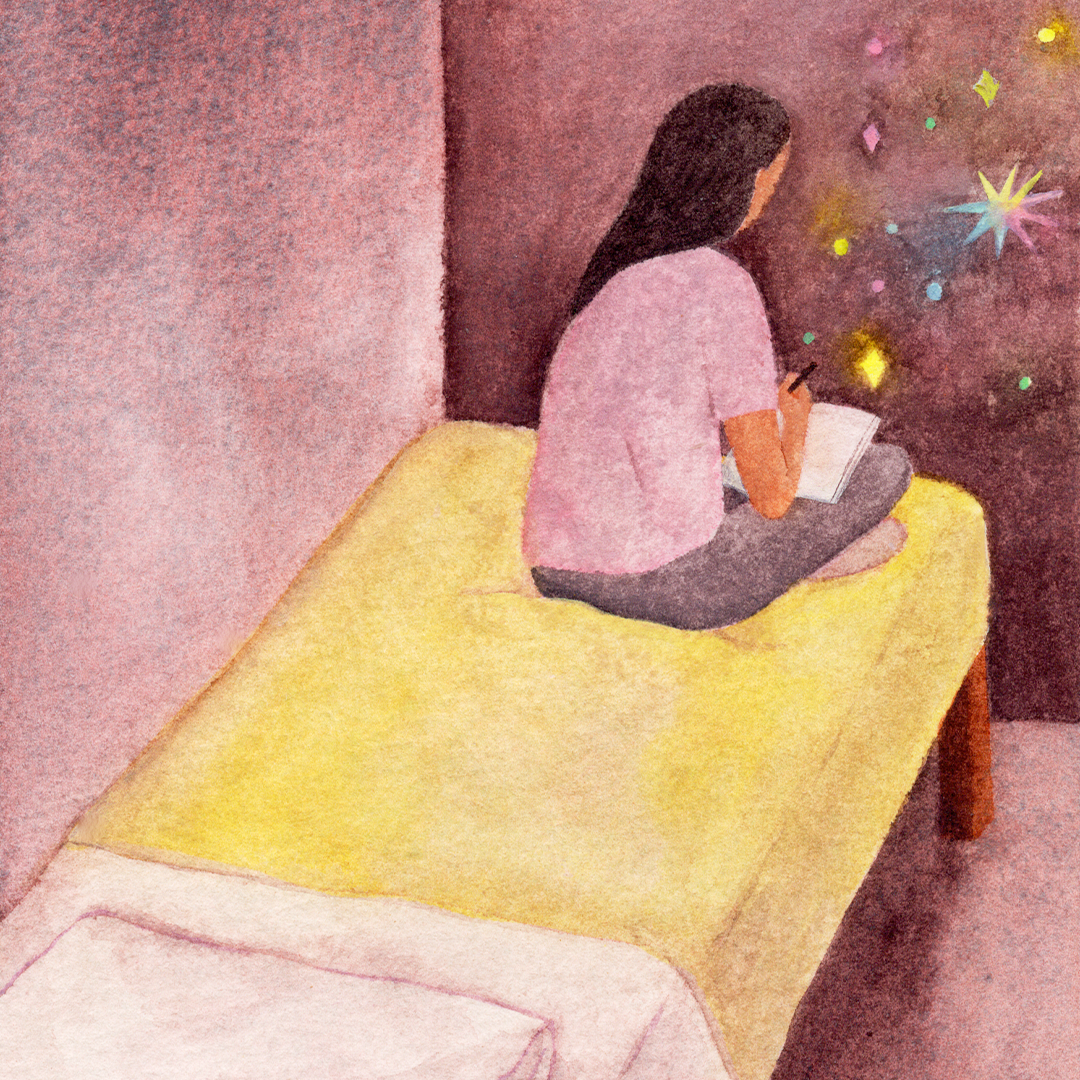
Ellen began journaling while working for a Chinese family that gave her only one day off a month. “Sometimes it’s very lonely, sometimes it’s so busy, sometimes I was so stressed. And it’s difficult to find people to talk to, so I relied on writing.” Then right before the Covid-19 pandemic, she discovered the Migrant Writers of Singapore (MWS) on Facebook. “I went there [to the MWS workshop space] alone and then the minute I went upstairs, it was so warm, like they welcomed everybody, it’s open for everybody.”
Most of our conversation played out like two friends enthusiastically talking about the craft of writing rather than an actual interview. I learned that Ellen found the haiku quite flexible, beyond the common 5-7-5 rhyme scheme. The quatrain—a four-line stanza with an ABAB rhyme scheme—is her favourite. She also introduced me to the ghazal, a lyrical poetic form originating in Arabic literature. If it isn’t apparent already, Ellen loves poetry: “I think it’s more beautiful. It’s more beautiful if you put it in stanzas or in lines.” Informed by her careful, observant disposition, she tends to write sad poems, like the one inspired by the cuts on the arms of a fellow MWS writing workshop attendee. “I realise that I can’t write happy poems like others do…I don’t know, it’s too easy for me to write painful ones.”
We discussed whether she felt her writing should educate people about migrant workers’ experiences. “I think it’s a good way to tell them that…we are not just here as migrants, as domestic workers. If we have talent, we can share it. We don’t have to be a domestic worker forever.” Only at the very end of our conversation did Ellen mention that she had written a play. I had already marked my calendar to see “The Homecoming”, but little did I know I’d been sitting with its playwright all along.
The first appearance of migrant writing exploring specific migratory themes in printed form is hard to pin down. We encounter Asian migrant writing in the Americas in the mid-19th century when Chinese immigrants wrote songs and poems about the Gam Saan Ha (“Gold Mountain”), referring to the California Gold Rush. Following the Chinese Exclusion Act of 1882—the first significant U.S. law banning the entry of an immigrant group based on their ethnicity—Chinese detainees carved poems into the walls of Angel Island Immigration Station in San Francisco. Many of these writings captured the fervent hope and sobering hardship these immigrants carried across an ocean, and back.
When the United States annexed the Philippines around the turn of the 20th century, Filipinos “enjoyed” access to the country as “US Nationals”. But America’s “little brown brothers”, in reality, served to fill the labour gap left by the departure of the Chinese. Among them was 17-year-old Carlos Bulosan, who migrated to the US in 1930. Over the next decade, Bulosan worked menial jobs in California, Washington, and Alaska, a transitory existence common among the Filipino male migrants, or manongs, of his generation. He wrote candidly about his racist encounters, capturing America’s prevailing paternalism and discrimination against Filipinos in the semi-autobiographical novel, America Is in the Heart. Bulosan’s writings drew the ire of the FBI for spotlighting horrific labour conditions, unliveable wages, and structural inequities that sought to suppress union activity and intimidate organisers.
Remarkably, for someone who wrote unflinchingly about the harsh realities experienced by migrant workers like himself, Bulosan ended America Is in the Heart with an unwavering faith in the country, hoping to “contribute something toward her final fulfillment.” He died in relative obscurity in the 1950s, but his writings resurfaced in the 1970s among a new generation of Asian Americans grappling with identity politics following a surge in Asian migration to the United States, and growing anti-imperialist sentiment in conjunction with America’s war in Vietnam. Today, Bulosan is considered among the foremost migrant writers of the last century.
Bulosan’s literary resurrection coincided with mass migrations across Asia. Economic reforms in late 1970s China spurred millions to move from the countryside to the cities; by the 1980s, the first shoots of migrant writing had already surfaced in the southeastern city of Shenzhen. Later, the internet gave countless others the tools to capture their realities through poetry, prose, and music. Among them are Zheng Xiaoqiong, whose intimate, blogged accounts of the backbreaking conditions many migrant factory workers endure later became a printed collection called “In the Roar of the Machine”; and Xu Lizhi, who wrote poems about the nightmarish conditions in a factory owned by Foxconn—maker of Apple and Huawei products. “Once you’ve entered the workshop / The only choice is submission,” he mourned in one. Tragically, Xu died by suicide.
While Xu’s life was sadly cut short, many of his contemporaries pressed on, finding solace, even courage, through writing. By the mid-2010s, Chinese migrant literature was flourishing. The Picun Literature Group, named after a village peopled by thousands of migrants, was established in 2014. Dozens of workers attended classes and workshops led by volunteer academics from universities in nearby Beijing. The group has published several poetry anthologies and has run a bi-monthly journal since 2019.
Large-scale, low-wage migration to Singapore began around the same time as the appearance of the first shoots of the Chinese migrant literary corpus. In 1978, Singapore introduced the Foreign Domestic Servant scheme to free local women from domestic chores, allowing them to enter the local workforce and paving the way for the employment of foreign domestic workers. A second wave, this time mostly men, arrived with the construction and maritime services boom in the 1980s and 1990s. By 2006, there were over half a million “lower-skilled” foreign workers in Singapore (the number today is at least 800,000, around 13 percent of the total population).
Ada Cheong, a Singaporean writer and researcher, traced the origins of migrant poetry here to Bangladeshi workers who arrived during the early 2000s. They drew from a powerful literary tradition central to their country’s struggle for independence. In 2014, Shivaji Das, a volunteer at Transient Workers Count Too (TWC2) and Alvin Pang, co-founder of The Literary Centre, organised the first Migrant Worker Poetry Competition at the National Library. It was only a year after the Little India riots, and tensions between native Singaporeans and migrant workers had not yet settled. Das and Pang sought to reintegrate migrant workers positively and honour their experience. Some 28 workers, all Bangladeshi men, participated in that inaugural edition, one of the first instances wherein the city’s most vulnerable and invisible occupied the same space as its elite.
The competition’s first winner, Zakir Hossain Khokan, a former freelance journalist-turned-construction supervisor, became an instrumental figure in nurturing Singapore’s nascent migrant literature scene. In 2015, Zakir founded MWS to help migrants with literary inclinations “develop and enhance their talents”. As increasing numbers of construction and domestic workers blossomed into writers, poets, and playwrights, Zakir felt MWS should work with local writing collectives to “use the migrant arts as a space to encourage migrant-local interaction…to celebrate our shared humanity through literature.” He found willing partners in Sing Lit Station, then a young charity founded by local luminaries Joshua Ip, Daryl Qilin Yam, and Jon Gresham to better shape Singapore’s reading and writing culture.
The partnership allowed MWS to move from online to the real world, into Sing Lit Station’s Dickson Road office in Little India for in-person workshops and community-building. It has since yielded several spaces for collaboration between MWS and local writers, including at the Singapore Writers’ Festival (there is also a separate Migrant Literature Festival) and the Carnival of Poetry reading series, open to all Singaporean residents. There have been two poetry anthologies, both titled Call and Response, in which more than 30 migrant-produced works were each paired with responses from local Singaporeans.
Besides anthologies, fests, and community events, this ongoing literary ferment has yielded substantive migrant works, including No Cinderella: Poems of a Filipino Domestic Worker) by Rolinda Espanola; Stranger to Myself and Stranger to My World by Md Sharif Uddin, Me Migrant by Md Mukul Hossine, and Language Of My Heart by Janelyn Dupingay. Curated collections of personal essays, such as Das and Yolanda Yu’s The Visible Invisibles, and HOME’s Our Homes, Our Stories, suggest a shift in the country’s attention toward those so integral to its prosperity—even as some critics remain skeptical of the potential exploitation or appropriation of migrant experiences.
Those who appreciate this rich new vein of creative self-expression must also remember that it exists within—and partly because of—an inherently unjust system. External economic forces have reduced migrants to mere workers, to disembodied, disposable units of labour. Dr. Noel Christian Moratilla from the University of Philippines, described migrant workers as a “globaletariat…whose most fundamental rights are coldly ignored if not brazenly violated.”
Today, Singapore’s migrant writers have numerous public platforms through which to share their emotional worlds, as long as they stay within predetermined lanes. That means avoiding any trenchant interrogation of the system itself. After all, when the state has tools like the Societies Act and the Internal Security Act to curtail resident activists and critics, how many questions can someone with a flimsy Work Permit ask before inviting repercussions? Cheong called them the “precariat”, a portmanteau of “precarious” and “proletariat” coined by the labour economist Guy Standing and his colleagues.
This precarity was cruelly exposed in 2022 when the Ministry of Manpower refused to renew Zakir’s permit for an alleged “adverse record” of “false public posts” about migrant workers’ living conditions. Therein lies the struggle of the migrant writer: to express themselves creatively while making peace with a global economic order that demands docility, compliance, and surrender. When one remembers the scrutiny Bulosan endured in the US for raising similar issues nearly a century ago, it’s natural to wonder: how much room do migrant workers have to freely express themselves while living in such vulnerable conditions? And yet, by turning inward through literature and their own writing, migrant workers find some semblance of hope. In studying poems written during the pandemic by migrant workers in Singapore, Moratilla observed common themes of family, job security, and fear of losing remittances. But he also saw optimism, resilience, and reliance on community.
All these endure at MWS despite Zakir’s departure. Sing Lit Station has become a steady source of capacity and programmatic support for the group, providing workshop space and helping it navigate leadership transitions and challenging internal dynamics. In 2022, the year Zakir was forced to leave, the group received its first grant from The Majurity Trust, a local philanthropic institution. It provided funding for a series of workshops, the Carnival of Poetry monthly readings, a podcast (“Bridging Worlds Through Words”), and covered the costs for the collective’s first website. The 18-month pilot grant has since been renewed and will be used to cover, among other initiatives, an exhibition, “Here & Elsewhere”, featuring artwork produced and curated by MWS workshop participants. Today, the group is largely composed of dedicated Filipino domestic workers who have assumed greater responsibility for managing MWS’s weekly events and longer-term art projects.
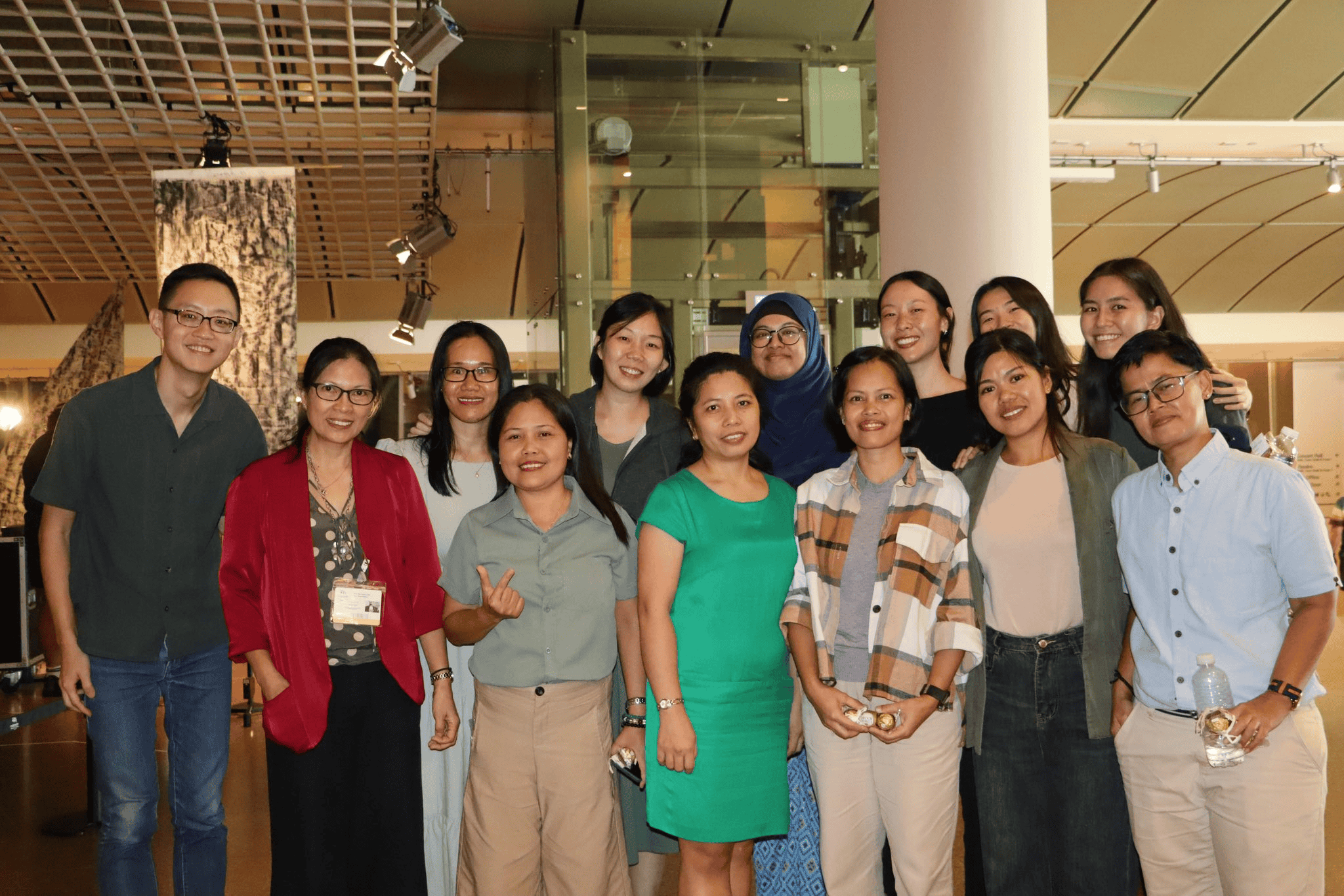
Ellen’s play, “The Homecoming”, is the latest MWS-driven endeavour to convey the fragility and transience of migrant workers’ experience. The plot depicts the episodic adventures of a group of friends, all connected by their decision to join MWS, thereby blurring the line between fact and fiction. Ellen admitted to being hesitant about writing it at all. “It started as a casual conversation with Pei Hua, the events organiser of Esplanade…I know how difficult it will be to write. I may have a bit of an idea about theatre…but I was never involved in drafting a script.” She credits the mentorship from Sing Lit Station and MWS for guiding her, despite many delays and a strong urge to quit. Ultimately, she wanted to write less about issues like abandonment, abuse, or worker rights and focus on more universal hopes migrant workers shared and the sacrifices they made to be away from their families.
This departure from heavy-handed approaches to addressing social inequities is evident even in Ellen’s earlier published writings. In Call and Response 2, she contributed “Horror in District 10”, a story about a mundane gathering that takes an unexpected turn when a domestic worker accidentally locks herself out of her employer’s house. The Call and Response volumes capture a growing landscape of “dreamwork” literature which, Cheong explained, does not exist to “resolve or explain the structural inequalities around labour and migration, but allow its emotional charge to reappear.”
Despite being a bite-sized, bare-bones production, “The Homecoming” packs an emotional punch and presents the unique complexities migrant workers face as they build community locally. How do they navigate relationships here? How do they honour their commitment to familial ties back home? The characters seek some semblance of an everyday life among friends, taking trips to nearby islands or going bargain-hunting. Their camaraderie captures a fleeting experience of belonging, cut short by the inevitable pull to leave. It is the longing for the love of children, of parents left behind, and the need to restore those frayed familial bonds that wins out.
In one tense scene, two migrant workers argue over how to spend their wages. Ameera, a restaurant supervisor, admonishes her friend, Hamiza, a storekeeper, for spending her money on a box of Ferrero Rocher chocolates. Hamiza retorts defensively, “I’m ready to starve myself to give the best for my daughter. It’s her only happiness!” Later, a dramatic voice recording is played of Hamiza reading a letter to her daughter: “...I remembered how every time I came home, you would come running to hug me and softly whisper in my ear, ‘Did you bring me a box?’ When I said yes, your eyes would light up like the morning star.” Hamiza assures her daughter that she will never stop bringing her a box, telling her, “The joy on your face melts away my tiredness and chases away my homesickness.”
The Ferrero scene cut to childhood memories I had as a young boy in the Philippines, opening a balikbayan box (balik means “return” and bayan means “nation”) packed to the brim with chocolates from America. This box came from my lola (grandmother), who had moved to America permanently. But unlike my lola, the central characters of “The Homecoming”, like most migrant workers of a particular working class in Singapore, do intend to return. The gifts they bring are pasalubong—a Filipino custom in which travelers bring back food, gifts, or souvenirs. But I imagine their pasalubong serves as a peace offering for having to leave once more, a reminder that someday they will return for good.
A different exchange in the play complicates these transactional elements when Sally, another character, complains about her daughter’s constant appeals for her to return. “They blame me for leaving them…they don’t want my money, they want me.” This is a core dilemma migrant workers often allude to in their writing: as valuable as their regular remittances might be, they cannot account for the loss of the more valuable currency—time.
The woman who plays Sally, Nelie Bautista, is another member of the MWS core team. Her character mirrors aspects of her own story: she is a single parent and provider for her only son, whom she left at just six months old. Now 24, her son completed his collegiate studies this past May. Nelie asked her employers if she could stay a few days longer in the Philippines to attend his graduation, but they refused. She was on a plane back to Singapore on the day of the ceremony. In a mix of English and Filipino, she divulged other challenges she has had to navigate from a distance, including conflicts with her ex-husband’s family, who are helping raise her son.
She recalled how her son found one of her notebooks and discovered a poem that is now included in an anthology. Impressed, almost in disbelief that his mother was capable of such depth of thought, he hugged her for the first time. “Parang doon na lang nag-uugnay yung relationship naming dalawa. (“It was as if that were the first time the two of us connected in our relationship.”)
Her hopes for him are profoundly simple: “Hindi ko hinahangad na maging mayaman ka. Ang akin lang is yung lumaki ka na meron kang determination sa buhay na ipagpatuloy yung mga nasimulan mo yung mga pangarap mo. (I don’t want you to be rich. All I want is for you to grow up with the determination in life to continue pursuing what you started, your dreams.”)
Amidst all the difficulties, Nelie attributes her mental health and well-being to the writing group: “As long na nagsusulat ako, I'm safe. As long na nagbabahagi ako ng karanasan ko, I'm safe. [Because for me, as long as I’m writing, I’m safe. As long as I’m sharing what I’m experiencing, I’m safe.]” All the core MWS members I interviewed—Ellen, Nelie, and another peer writer, Julie Ann—shared how much they had valued finding a community with whom they could share life, learn craft, and even volunteer their limited free time together to serve other migrant workers through book distributions and blood drives.
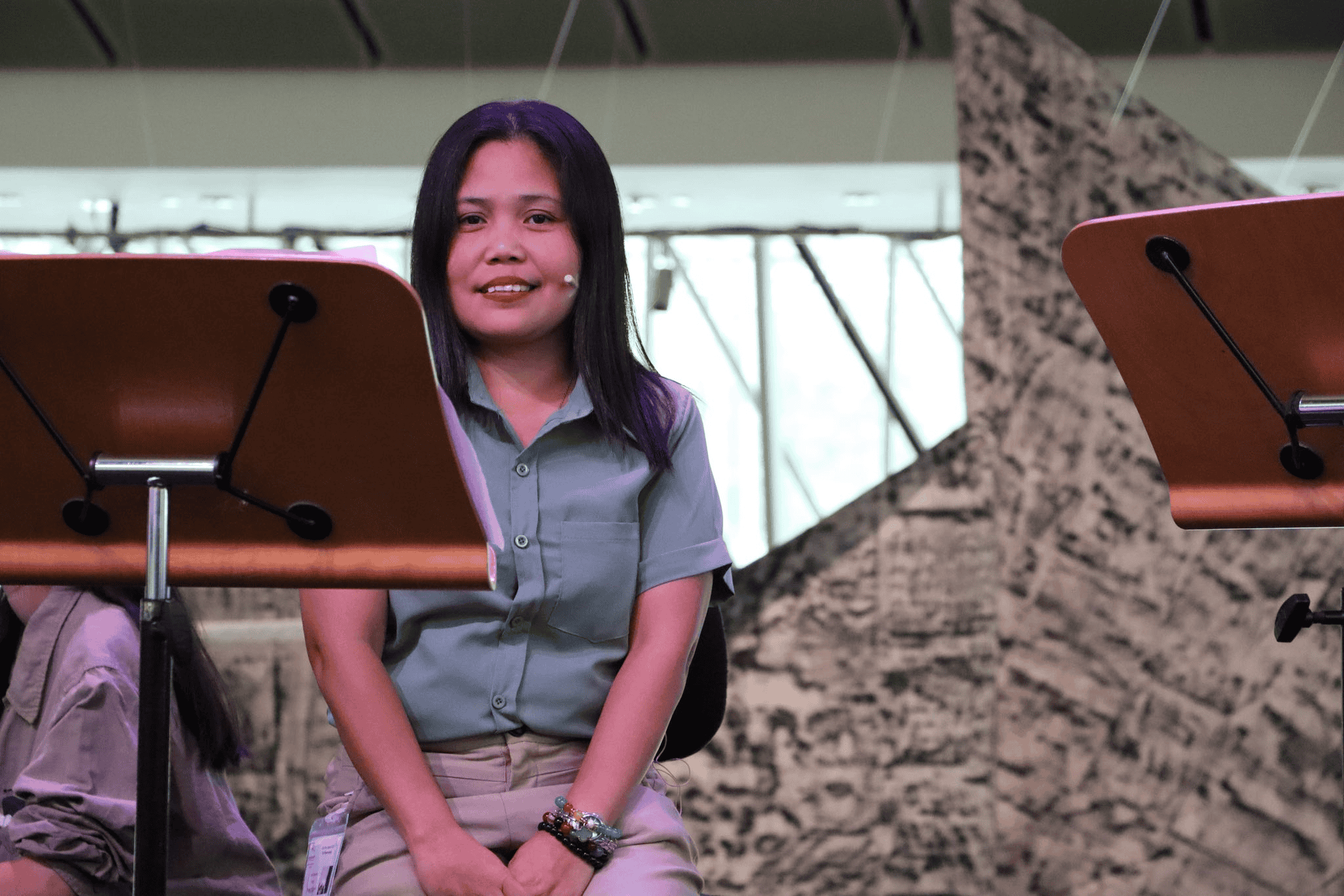
When I managed to get Ellen on a late-night Zoom call after her work hours were through, she remarked how funny it was for the writers at MWS to consider themselves poets, artists, and playwrights. To her, such titles felt “so grand”. When she speaks, Ellen tends to deflect attention and is a bit coy about her creative ambitions. And yet, thinly veiled by her humility is a profound belief that she is something more. After all, for her to overcome her insecurity and become a first-time playwright for a production shown publicly at the Esplanade suggests that a quiet confidence is growing.
“When we say domestic workers, we’re only, you know, cleaning houses and doing housework. We have potential to be a leader. We have potential to be authors if we wanted to one day, so it’s (about) developing our talents.” During our initial meeting at the bakery, she spoke about wanting to weave together her interests in poetry and photography in a book. After her play debuted, she texted me that a filmmaker in the audience had approached her about possibly adapting it for film.
Public productions like “The Homecoming” signal a broader, more inclusive arts community emerging in Singapore. Yet much work remains to name and challenge prevailing cultural mindsets, even among supporters and event attendees. For one, questions linger about how migrant expression is valued by the general public. In China, dagong (“worker”) poets have taken exception to their works being deemed significant only for what they represent historically or politically. Meanwhile, in Singapore, suffering as an overarching theme for migrant writing risks becoming a performative crutch. As Luka Lei Zhang wrote: “migrant workers are ‘empowered’ in a showcase format and thus included in the national narrative. At the same time, in this way, their works are paradoxically ‘included’ only in a particular narrative.”
This also means that, often, well-meaning supporters champion migrant works simply because they are migrant works, rather than for their literary merits. As Miranda Cardenas, an Associate at Sing Lit Station, candidly noted: “Just because it’s migrant work, doesn’t mean it’s inferior work, and that it’s not an act of charity [to support it]. It should just be part and parcel of the culture of art in Singapore.” She felt that biases about language and the limited use of English might be shaping public sentiment around what is considered “good” writing.
Can performance-driven avenues such as poetry competitions and state-supported writing festivals complicate prevailing narratives about migrant life in Singaporean society? Can these spaces adequately dispel highly subjective notions of what “good writing” is—problematising the ambiguous criteria against which it is measured, and questioning who has the authority to apply it? In addition, the ongoing conversation about “migrant” versus “local” writing remains a salient topic for the literary community, but perhaps it is best reserved for a public forum, where the ideas that confront the question about why such distinctions matter can be debated publicly. Meanwhile, taking place in an entirely different space out of public view, the grind of growing one’s craft tethers together the Migrant Writers of Singapore, week after week.
One Sunday morning, several weeks after “The Homecoming” was performed, I hit the road early, well before Dickson Road started bustling, to join MWS for a poetry performance workshop with Singaporean slam poet, ArunDitha. I sat outside the small circle, watching ArunDitha gently guide the group through a series of breathing and vocal exercises, asking them to “send love” toward any tension in their bodies. She later instructed pairs to silently stare into each other’s eyes. At first, the group playfully bantered but eventually fell quiet, and the space became meditative. Later, all collectively hummed a calm, guttural drone that sounded like a Buddhist prayer.
ArunDitha brought in a mic on a stand and encouraged them to practice the feeling of getting “onstage” and to adjust its height so it rested right in front of their mouths. She urged them not to be “afraid of the violence of your own words”. Christine, whom I recognised as one of the actors in “The Homecoming”, delivered a thunderous spoken-word piece she had written entirely in Tagalog. Her peers voiced raucous approval.
Ellen was much more subdued in her delivery, but looked comfortable on the makeshift stage. She has performed her writing in slam form before. If you Google her, you will find a video from a storytelling festival in 2022. During her early days in Singapore, she would exchange letters with her family; her grandfather was her most prolific pen pal. Her employer discovered the box of letters and demanded she throw the “rubbish” away. She resisted. Soon after joining MWS, she wrote and performed her first slam poetry piece, recounting this exchange. She has the box of letters to this day.
After watching Ellen perform and recalling my conversations with her, it is clear she has a hunger to improve as a writer and genuinely approaches her work as a craft. This helps explain in part why she never misses Sundays. Just like any writer serious about cultivating their talent, she models what it means to “show up” to the work regularly, push forward new ideas, and diligently workshop them with peers.
One day, might the writers at MWS remember themselves not only as migrant workers in Singapore, but also as artists whose unique stories have shaped the cultural tapestry of this cosmopolitan city? Could they see their contributions as a call for a more cohesive and inclusive society? Maybe. As things stand today, their ambitions appear more modest. Every Sunday, they show up in a quiet room along Dickson Road. And amid the laughter, tears, and energy of creating together, they hone their craft without any pretense, receive each other’s work without judgment, and make room for their whole selves to emerge, buoyed by community.
Miguel is an independent writer and social impact communications consultant based in South-east Asia, a region he considers home. He currently provides business development strategy for the independent, Asia-focused, English-language quarterly Mekong Review. As a Filipino-American immigrant and expat, his writing explores themes of inclusion and belonging as experienced by diasporic communities, especially his own. Along with his partner, he is raising two creative, kind, and globally minded daughters in Singapore.
Letters in response to this piece can be sent to sudhir@jom.media. All will be considered for publication on our “Letters to the editor” page.