

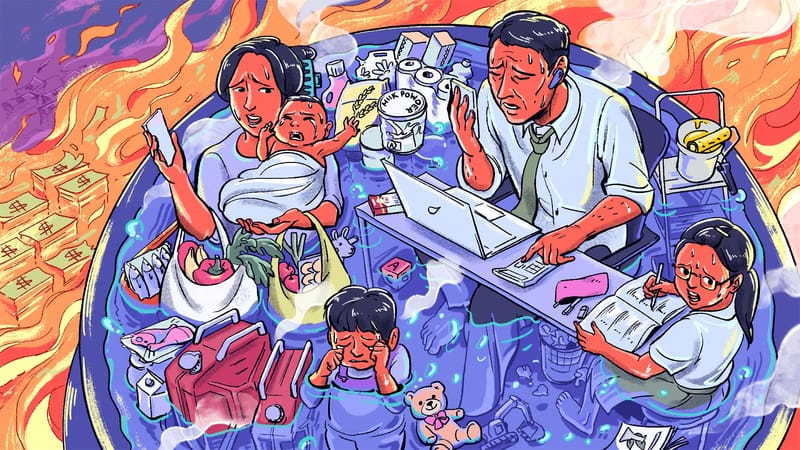
“not poor enough to qualify for those smlj subsidies
not rich enoough to live comfortably
sandwich in between basically 吃不饱, 饿不死”
(a Chinese phrase that broadly translates to having enough but not plentiful)
A definition of the “sandwich class” by user 5adisticD3vil on Hardwarezone
On a narrow lane off Serangoon Road is Krsna’s Free Meals, a soup kitchen. “The free food point”, reads the subtext on its white billboard, alongside its pink lotus logo. Unlike the nearby Sri Veeramakaliamman Temple, one of Singapore’s oldest and most distinctive Hindu temples, Krsna would never make it onto any of the Singapore Tourism Board’s “Little India” campaigns. Yet each has its own devoted following. Every morning, Krsna volunteers sort through mounds of potatoes, okras, chillies, cabbage, cucumbers, and other donated vegetables, tossing out the few rotten ones and then peeling and preparing everything else, under the guidance of Krsna’s staff, to make at least 1,000 meals daily. Just minutes from downtown Singapore, where Michelin-starred restaurants serve foie gras and Burgundies, Krsna’s caters mostly to this rich city’s 1-million odd low-wage migrant workers.
That is, until last year. Latha Govindasamy, one of Krsna’s co-founders, started seeing many Singaporean middle-class professionals, in their 20s to 40s, also standing in line for free food. “When we speak to them, they say it’s becoming too expensive to eat out or order online. At least 8 to 10 of them come on alternate days,” the former teacher, in her 50s, observes. Occasionally, even volunteers surreptitiously “bring home extra food or vegetables,” Latha said. “Normally, locals will never take home anything for free. Now, it’s a trend we’re seeing.”
In the broader discourse around inequality, much attention, rightfully, focuses on those at the bottom. Some 30 percent of working households earn less than the amount required to meet basic needs, according to the Minimum Income Standard (MIS) 2023 report, produced by Nanyang Technological University and the LKY School of Public Policy. (The government disagreed with their delineation of “needs” versus “wants”.)
But what about the segment just above them? Living in one of the world’s costliest cities, those Singaporeans face a different kind of financial precarity, one in which they can rarely afford to take a break, never mind have another kid or contend with a health calamity. Life is a constant struggle to ensure that they don’t unwittingly fall into that bottom 30 percent. In order to get a sense for this group’s dynamics, and their struggles, it’s worth first assessing definitions around that generic term, “middle-class”. After all, Singaporeans tend to believe that their country is largely middle-class, the late Adrian Tan, a prominent lawyer, told the BBC last year, despite the presence of the “crazy rich” and the less fortunate. But who is in the middle-class?
Definitions of the middle-class vary significantly between nations, but researchers often define it based on income, for which data is easily accessible. The Organization of Economic Cooperation and Development (OECD), a club of mostly rich countries, defines it as households earning between 75 percent and 200 percent of their respective country’s median income. The World Bank uses a dollar-per-day amount adjusted for purchasing power parity (PPP) to facilitate cross-country comparisons. In 2015, the US-based Pew Research Centre expanded this metric to include four additional income levels, with ‘lower-middle’ and ‘upper-middle’ together constituting the broader middle-class.
China is home to over a third of the global middle-class. Of its 1.4bn population, about 30 percent, or around 400m people, are middle-income earners. The country’s National Bureau of Statistics defines the “middle-income group” as a three-person household earning between 100,000 yuan (S$18,535) and 500,000 yuan (S$95,240) a year. Beijing is keen to double its size to become an advanced economy by the middle of the century. In India, which is more populous but poorer than China, a less stringent definition means that its middle-class is theoretically bigger. The People Research on India’s Consumer Economy (Price), a not-for-profit research firm that conducts household income surveys, classifies middle-class as comprising households earning annually between 500,000 and 3,000,000 rupees (S$8,041 to S$48,236). By that measure, there are about 420m middle-class Indians—about one in every three people–in a segment growing at 6 percent per year, faster than any other. In 2021, the Pew Research Centre estimated that the pandemic may have effectively pushed millions of people, including some 10m in China, out of the middle-class or into poverty. Singapore probably wasn’t immune to this.
In the 1980s, Lee Kuan Yew declared that the city-state was a “middle-class society”, given the high-level of property ownership. More than half of Singaporean households are classified as middle-income, a proxy for middle-class, notes Tan Ern Ser, associate professor of sociology at the National University of Singapore (NUS). Tan’s own research suggests that, depending on how the question is framed, between 42 and 86 percent of Singaporeans believe they are in the middle-class.
The segment of middle-class Singaporeans caring for their children and ageing parents is referred to as “the Sandwich Generation”, a term coined by sociologists Dorothy Miller and Elaine Brody in 1981. While there’s been some debate by experts over the finer points of the definition, the Sandwich Generation is broadly understood to be those supporting themselves, their children and their parents at the same time. They earn too much to qualify for significant government assistance or other forms of financial aid, but not enough to comfortably afford private housing and other higher-end services. In short, it describes those who are stuck between the “haves” and the “have-nots” when it comes to aspirational lifestyle choices, as Hardwarezone user 5adisticD3vil so eloquently alluded to. In 2018, OnePeople.sg’s chairman, Dr Janil Puthucheary, remarked that this divide between the haves and the have-nots is now “creating the most tension” within society.
The Singaporean middle-class and their aspirations are often viewed through the lens of two constructs: the Singapore Story and the Singapore Dream. The Singapore Story is the narrative of how, in slightly more than one generation, the city-state rapidly moved from supposed “Third World” to “First World” status. At the individual and familial level, the Singapore Story “is experienced as upward social mobility, rising from poverty or low-income to middle-class status,” wrote Tan. Achieving upward social mobility is important to this group, Tan said, “not only for the symbolic rewards of attaining social prestige but, more importantly, for arriving at a life stage of relative comfort and security.”
Alongside that emerged the Singapore Dream, embodied by a ubiquitous ‘5Cs’ tagline: cash, car, credit card, condominium, and country club membership. This uniquely materialistic aspiration of the middle-class developed organically in the 1970s-80s, almost as an observational joke to symbolise the desire for social mobility and status. During this period, there was significant emphasis on home ownership as a means to establish nationhood. For the masses living in HDBs, the “condominium” represents the pinnacle of home upgrading. (Given that landed property is beyond the reach of most.) Similarly, in 1990, Mr Ong Teng Cheong, then Secretary-General of the National Trades Union Congress who later became Singapore’s first elected President, advocated for making golf and country clubs more accessible to the average worker. His intention was for golf to “no longer be a game for the executives only”. This led to the establishment of the Orchid Country Club, among others. Again, a well-meaning policy reinforced the narrative of material success and the 5Cs ethos of a burgeoning middle-class in a rapidly modernising nation.
Popular culture followed suit. Television dramas such as Channel 8’s “Marriage Dollars and Sense” (1996), and movies like “Singapore Dreaming” (2006), depicted the pursuit of these material aspirations amongst the middle-class. In one scene in the movie, Seng, the Loh family’s son, tells his fiancée Irene: “Nowadays, people look at what car you drive, what house you live in, what university you go to! If you want to make it, you’ve got to look like you’ve already made it”. It is a poignant reflection of the broader societal pressures that contribute to the relentless pursuit of the 5Cs.
In recent years, economic realities have rudely intruded on the Singapore Dream. Case in point: if I went out to a restaurant last year and spent $100 on food, that would have cost me only some S$86 in 2019 based on the Monetary Authority of Singapore’s Goods & Services Inflation Calculator. The calculator indicates how prices in Singapore have changed over the years. It is also a stark reflection of how inflationary pressure means everything from the humble kaya toast to Certificate of Entitlement (COE) premiums now cost more. Inflation in the city-state has generally been low, notes MAS. Headline inflation averaged 1.8 percent over the last four decades (1981-2021). It jumped in 2022 to 6.1 percent, due to a confluence of external inflationary pressures—among them the Covid-19 pandemic and the outbreak of the Russia-Ukraine war—before falling to 4.8 percent in 2023.
In January, the government raised the Goods & Services Tax (GST) from seven to nine percent, driving up the cost of everyday staples. Nevertheless in 2024, MAS expects both headline and core inflation, which excludes accommodation and private transport costs, to ease to 2.5-3.5 percent. However, taming inflation can be tricky, warns Selena Ling, OCBC’s chief economist, because of risks to global food and energy prices from geopolitical tensions or other supply-related disruptions. Separately, Linda Lim and Nigel Chiang, economists at the University of Michigan, have argued that public discourse on inflation in Singapore has been narrow—because it focuses on imported inflation, while ignoring domestic sources, such as high rents and wages, which are rooted in our overall developmental strategy.
Over the last two years, property prices have soared, including for public housing, which is often considered more affordable. In “Affordability in the lion city: is Singapore’s public housing model built to last?”, Jonathan Lin points out that Singapore’s housing price-to-income ratio, 5.8 in 2021, is classified by Demographia International as “severely unaffordable”, and well above the level (4.0) that the Ministry of National Development appeared to have been targeting. (A recent assessment from the Urban Land Institute said that Singapore had a ratio of 4.7 in 2023.) Last year, Singapore remained the world’s most expensive city, taking pole position for the ninth time in 11 years, according to the Economist Intelligence Unit. Though the index mostly assesses the cost of a foreign MNC worker’s lifestyle in Singapore, it’s further proof of how costly this city has become. Other societies face similar pressures. In China, insufficient jobs and punishing property prices have crushed the dreams of many to buy a home. The Economist said that online, sentiments are darker, with talk of tangping (lying flat) and bailan (letting it rot)—synonyms for giving up—gaining traction. Social mobility is stalling, observed The Guardian, with many educated Chinese lacking the confidence that they or their children can improve their lives as their parents did. Many Singaporeans feel the same way.
Holding her 19-month-old son, Sitti Fatimah Zahrah Muhamad, 33, feels apprehensive about the future. She has two older children, both girls aged six and four. Her mother-in-law lives with them, and her parents live a street away in Marsiling. Sitti is a student welfare officer, and her husband is an army regular. The couple’s combined take-home pay of around S$7,000 just about covers their monthly expenses, with a little to spare for emergencies.
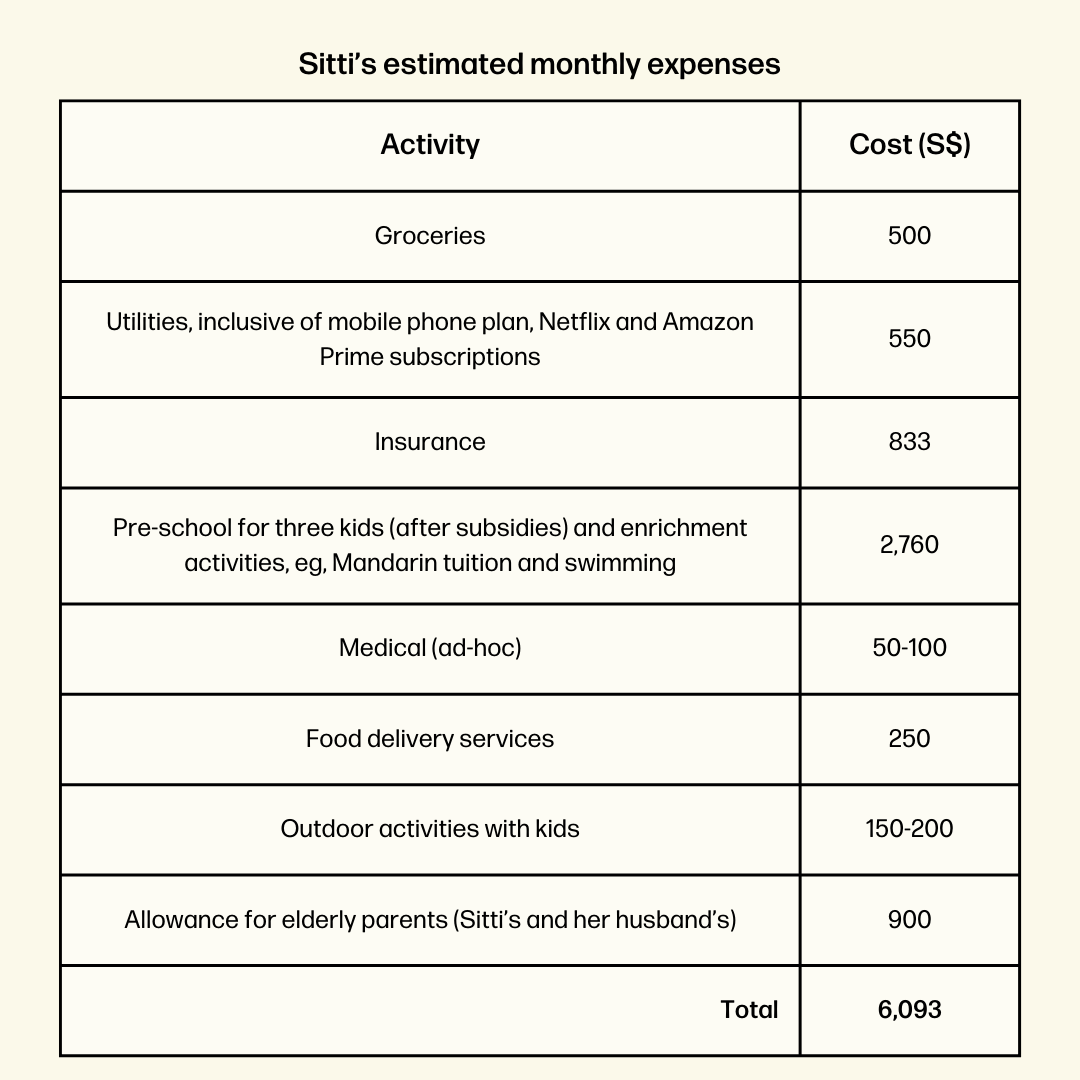
Sitti is acutely aware of the increased cost of living, particularly over the past year. “Every week, groceries alone will come up to at least S$100,” she said. “It is scary.” She used to order meals online daily, but that’s now reserved for the weekends. “In the past, I could order a dish for about S$5. Now it’s at least S$7 or S$8,” she laments. Weekly family outings have become a thing of the past because “we cannot afford to,” Sitti said. Each trip to an indoor playground or to the zoo can set the family back by between S$150 to S$200, so “we bring the kids to places that are free of charge, maybe the stadium or some garden so they can run around.” Sitti owns a 5-room build-to-order (BTO) flat. Her biggest fear is that her children may not be able to afford their own homes. “Everything is so expensive now,” she laments. “I don’t know if it will get better.”
To offset the GST hike and ease cost-of-living pressures in the near-term, the government has given households hundreds of dollars more in vouchers to use for groceries and daily expenses, and utility rebates. But as Sitti points out, the vouchers for groceries do not go far enough, “maybe just one month” for her family of six.
Ammar Nizar, 22, has a similar story to Krsna’s Latha. He’s a senior operations manager with Free Food For All, a food charity set up by his late father, Nizar Shariff. Ammar said that he receives at least six to eight emails daily from families and individuals, including middle-class Singaporeans, asking for help with food. “In my opinion, this group [the sandwiched middle-class] is the hardest hit because there is still a stigma of asking for help,” he said. “Most people try to manage on their own but eventually head down a rabbit hole of spiralling debt and despair.”
Tony Tay, 77, the founder of Willing Hearts, a charity that operates a soup kitchen, said from his observation, getting immediate help when you reside in a four or five-room flat (typical of the middle-class) is not easy. “You need to do all the paperwork - by the time you die already!” he chortles. “But if you are in a three-room flat, very fast to get help”. It squares with what Suraendher Kumarr said. Kumarr often accompanies needy families to Social Service Offices (SSOs) run by the Ministry of Social and Family Development (MSF), the government body in-charge of social support policies and initiatives. SSOs are set up across the city-state to directly bring services such as financial and legal aid, among others, to the community. “They (the families) will bring a file worth of documentation (to receive financial aid),” he gestures to show how thick it can be. “You have to prove so much”. Kumarr, who’s a member of Workers Make Possible, a worker’s rights group, said he understands that the funds need to go to those who require them the most and there is a due process involved, “but does the process need to be this onerous?” he wonders.
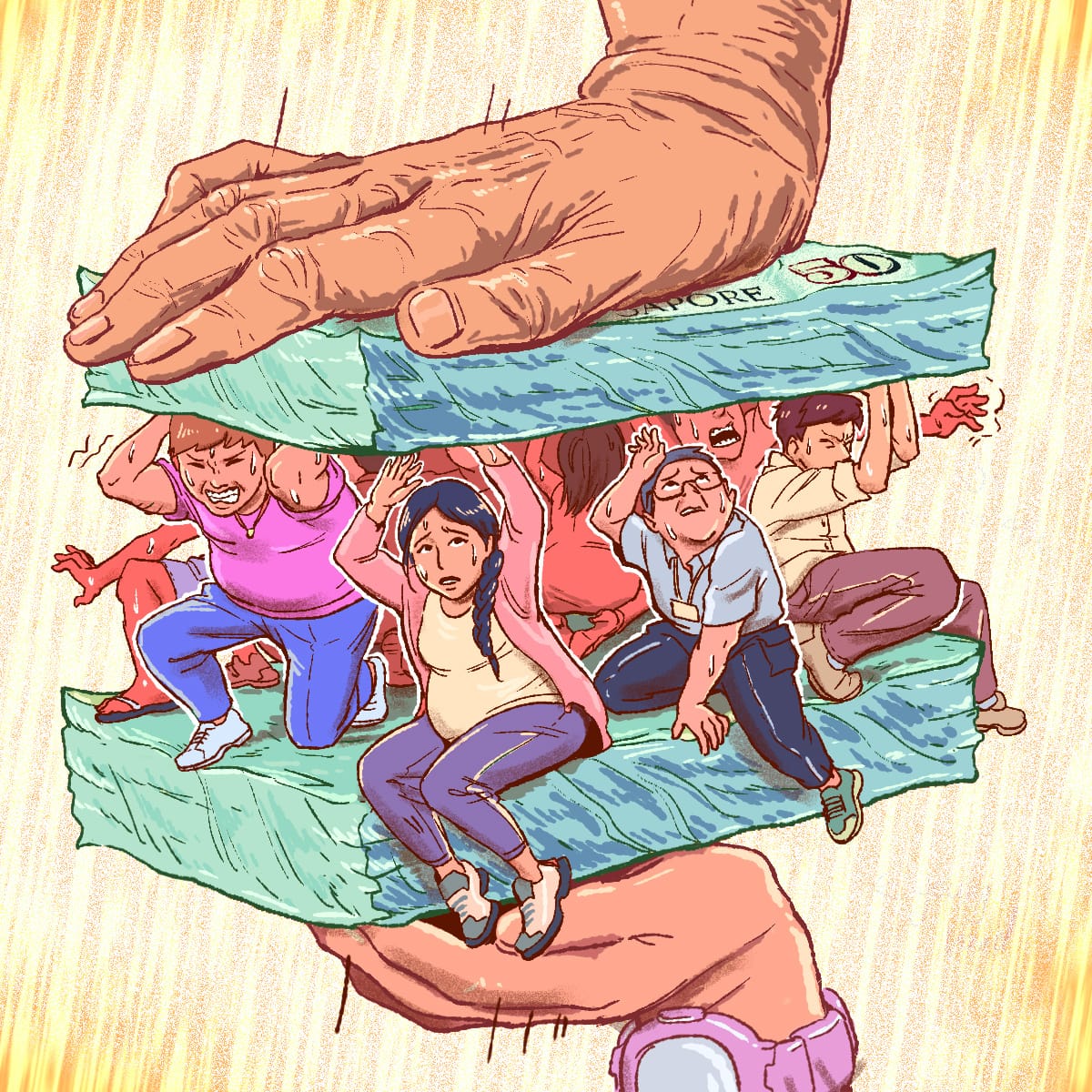
While Tay and Kumarr did not elaborate, a check on MSF’s website revealed that typically, applicants for temporary financial assistance under ComCare for instance, which is targeted at helping vulnerable, lower-income families (such as those earning a monthly household capita of S$800 or below), will need to produce their identity cards and updated bank account statements, including those of their household members, along with a variety of supporting documents ranging from utility bills and medical certificates to pay-slips and insurance letters, to assess their eligibility for financial aid. Income and by extension, housing type, are among the criteria used to evaluate a person’s qualification for financial subsidies and assistance, although MSF notes that “the income criteria for ComCare schemes are not hard thresholds”. Even so, it is unlikely that Sitti or other sandwiched middle-class households will easily qualify for such financial support given that such schemes are primarily targeted at lower-income households.
Means-testing and targeted assistance are important to ensure help reaches those who need it the most. But some observers note that such data may fail to reveal the full picture. Economist Walter Theseira, an associate professor at the Singapore University of Social Sciences (SUSS), previously suggested to CNA that the problem with means-testing is that those who genuinely need help may fall through the cracks because they do not fit the criteria in one way or another. “We often think people who stay in larger flats don’t need financial assistance since they could afford a big flat,” he said.
In the aftermath of this year’s undoubtedly generous budget, Clara Lee, a research fellow at the Institute of Policy Studies Social Lab, noted that middle-income households, particularly those with financial obligations such as caregiving, could continue experiencing cost-of-living concerns. As she points out, the impact of cost-of-living pressures have been deeply felt, not just by lower-income families, but also by the “middle class whose aspirations for a better life have been derailed”. This is consistent with the findings of the Cost of Living Report published in March 2023 by Havas Media Group, one of the world’s largest communications organisations. The report noted that in Singapore, the rising cost of living was the biggest concern across generations, with low- and middle-income households attempting to cut back on non-essential spending the most—just like Sitti. “It is not going to be easy,” Clara Lee said, but the middle-class will need to “moderate their expectations and reliance on the government for financial assistance moving forward”.
Last year, a 17-year-old and her Charles & Keith tote bag caused a stir in the usually staid city-state. Zoe Gabriel posted on TikTok about her “first luxury bag”, purchased by her father for S$79.90. The post drew snide remarks from netizens. "Calling this luxury is the same as calling a fast-food restaurant fine dining," said one TikToker. Another responded with a laughing emoji, “Who’s (going to) tell her?” implying that the local brand did not count as ‘luxury’. Zoe, the eldest of four children, responded, saying she and her family “did not have a lot” growing up. “To you, an $80 bag may not be a luxury, but to me and my family, it is a lot.”
By then, the incident had snowballed into a wider debate about class, with even Lawrence Wong, then deputy prime minister (and now prime minister), alluding to it in a speech, urging Singaporeans not to be overly preoccupied with status and social prestige. The government is acutely aware that inflation has eaten into Singaporeans’ wages, affecting mostly the lower and middle classes. In Parliament, Pritam Singh, the leader of the opposition, raised the possibility of ‘Two Singapores’ emerging—one where high salaries and global work opportunities abound and the other where there are perceptions of slowing social mobility and rising housing prices.
As Nathan Peng observed, in his paper “Inequality and the Social Compact in Singapore”, the “recasting of inequality as a serious societal problem in Singapore has become increasingly prominent in recent years”. In February 2018, Lee Hsien Loong, then prime minister, told Parliament that if widening income inequalities were allowed to create “a rigid and stratified social system, Singapore’s politics will turn vicious, its society will fracture, and the country will wither”. Three months later, in her inaugural speech as president, Halimah Yacob echoed that sentiment, observing that inequality had broken the social compact in many countries and Singapore “must tackle inequality” before the problem became entrenched.
It hardly comes as a surprise that Wong has made refreshing the Singapore compact—the glue that holds society together—a key tenet of his Forward Singapore (Forward SG) initiative. The Forward SG report, titled Building Our Shared Future, was released last year after a feedback gathering exercise spanning 16 months and involving some 200,000 Singaporeans. It suggests that Singaporeans need to broaden their definition of success beyond the Singapore Dream of the past (the 5Cs), and consider “fulfilment, meaning and purpose” and inclusivity. It appears to acknowledge, perhaps unintentionally, as Singh points out, “...that a fair number of the 5Cs are unattainable for most Singaporeans today.” Tan agrees. He posits that the traditional Singapore Dream, under the current context of economic uncertainty, “is less easily attainable, as compared to the late 70s and early 80s, which I have previously characterised as modern Singapore’s golden age.” Beyond the unattainability of the original Singapore Dream, it is also a reflection of shifting societal changes—both within Singapore and globally. Wong acknowledged as much during the launch of the Forward SG exercise in 2022, saying that “we know in our guts it cannot be business-as-usual” because the world and Singapore society have changed and will continue to change.
When I asked Sitti what she desired most, she quickly said a salary hike, in large part because “with more money, I can achieve more things” such as attaining a Masters degree to become a certified counsellor. Her sentiment is hardly surprising since a key finding of the 180-page Forward SG report was that society still measured itself using the “same old yardsticks” of the past, such as the size of pay cheques and property—the 5Cs. It will therefore take years before middle-class Singaporeans can be convinced to forgo the materialistic aspirations of the Singapore Dream, for one that is more “we” than “I”. But can Sitti and others like her wait till then? And is it even fair to ask them to accept lower material standards while the world's rich move here to enjoy much higher ones?
As a journalist and educator who has worked across print, broadcast and digital platforms, Reeta Raman enjoys feature writing and covers everything from social and cultural issues to human interest pieces.
Letters in response to this piece can be sent to sudhir@jom.media. All will be considered for publication on our “Letters to the editor” page.