


Dear Jomrade,
This week we’ve published:
- “Singapore This Week”, by Jom
- “Designing for truth”, by Dr Kanwaljit Soin
- “Spilling the tea on social media politics”, by Jo Teo
Jomfest, 1-6pm, May 19th, ACM. Early bird sales expire at the end of Monday, April 13th. Ticket prices double after that. We’ve already sold over half our tickets. Get yours now.
On Wednesday, we published Dr Soin’s incredible recent award acceptance speech as a direct e-mail newsletter to you. Do you enjoy getting full pieces in your inbox? Reply and let me know. If so, we’ll try and do more of it when we can.
Singapore has been absorbed this week by the defamation trial of the century: K Shanmugam and Tan See Leng, two ministers, are suing Bloomberg and Low De Wei, its Singaporean reporter behind the 2024 article, “Singapore Mansion Deals Are Increasingly Shrouded in Secrecy”, about good class bungalow (GCB) transactions. The article mentions, among many other things, their 2023 transactions: Shan’s sale of his Queen Astrid Park bungalow to UBS Trustees for S$88m, and Dr Tan’s purchase of a Brizay Park bungalow for almost S$27.3m.
Over the past few years some of the best financial journalism here, imo, has come not from our taxpayer-supported local behemoths, but from the likes of Bloomberg and Financial Times (e.g. on GIC and Temasek). Low’s piece touched on an issue close to many Singaporeans’ hearts: whether wealthy foreigners are somehow gaming the system to park their (perhaps illicit) money in our scarce real estate. Citizenship for sale, runs the joke about many Mainland Chinese magnates snapping up GCBs, sadly tarnishing our opinion of all.
This is the first time in recent history that Singapore, a financial hub, has challenged this bastion of global business and finance, whose founder is often fêted here. It’s one thing to sue TOC, quite another Bloomberg, armed with its battery of well-heeled lawyers. (One reason people have waited hours for entry is to watch Singapore’s legal elite cross swords: Davinder Singh for Shan, N Sreenivasan for Bloomberg, and Chelva Rajah for Low.)
Shan’s numerous allegations against Bloomberg and Low, partly based on their internal e-mails, are serious, including that: they had an agenda and had targeted him in the piece; they were “just finding a way” to reveal details of his property sale; they were “laying a trap” by seeking his comment pre-publication; and their internal e-mails are “venomous and full of nastiness”. (Sreenivasan cross-examined Shan on these points, and if you’re craving more on the first week’s proceedings, this TOC piece is the one.)
We’ll keep you updated on the case, and will write a fuller review once it’s done. For now, I’d like to discuss confirmed falsehoods that get propagated through cyberspace by rogue actors and their useful idiots. “How Iran’s Information War Machine Operates Online” is a multimedia piece that shows how Iranian disinformation, about an American F/A-18 under attack, “went from a single post to a global audience of millions in 69 minutes.” No surprise that Iranian, Chinese, and Russian state broadcasters, ginned up on anti-American-imperialist sentiment, were key provocateurs.
In recent years many people across the political spectrum, including on the left, have been seduced by propaganda emanating from rogue actors who’ve learned how to weaponise rapid-fire information flows. They prey on anti-American and anti-Zionist fervour, and do so partly by leveraging attention-seeking (and fact-ignoring) influencers on X and other platforms. I think I first understood their sheer sophistication when I watched Chinese influencers parroting Russian talking points right after its invasion of Ukraine.
These are tough times for all of us, in terms of comprehending the world. We’re forced to both contend with illegal American and Israeli aggression, while not becoming vulnerable to falsehoods. In our first blurb in “Singapore This Week”, my colleague Abhishek offers a clear-eyed analysis of the conflict in the Middle East, discussing Singapore’s response to it, and identifying the main person responsible for our miseries.
Join 2,000 members keeping Jom independent. From S$10/month—full access, no compromises.
- How is Singapore responding to the conflict in the Middle East?
- What’s behind the trend of more Singaporeans seeking to study around Asia?
- A brief history of additive manufacturing, as Singapore announces its first 3D printed bridge
- The appeal of HYROX
- Was Esquire Singapore’s use of AI to fabricate an interview ethical and respectable?
Above are the issues we chose to explore in more depth.
Other news this week included: a survey of South-east Asians finds Singapore to be a regional leader on issues and rates “US leadership under President Trump” as the top geopolitical concern; FairPrice supermarkets freeze prices of 100 essentials for over a month; the first wholly-government-owned worker dormitory opens; Sar-El Volunteer Corps, the Israeli outfit where two Singaporeans volunteered, but have been cleared of wrongdoing; a new surgical procedure trialled at Changi General shown to improve symptoms associated with Alzheimer’s; the number of kids sexually assaulted, and the number attacked by family members, both rose in 2025; a 38-year-old Indian national (and Singapore PR) faces two careless driving charges after killing a 6-year-old Indonesian child; Amos Yee returns, and our minister for home affairs wishes “the Americans had kept him”; as “irritating as incessant drilling”, says a man in Clementi after he stands in the middle of a pickleball court to stop a game; Aloysius Yapp wins a surprise 8-ball world title in US (and here’s Jom’s earlier profile of him); the “Singapore Pokedex”, a free online wildlife library, launches; the Singapore Art Book Fair gracefully walks back a controversial idea for its 2026 edition following online criticism; and our very own MacGyver, as a 39-year-old man is charged after weapons, including firearms and homemade crossbows, were found in his Potong Pasir flat.
“Spilling the tea on social media politics”, by Jo Teo
Introducing the real Jo Teo! No, not the minister, but the “theoretical physicist who brings a quantitative lens to their witty TikTok political commentaries, most notably on GE2025.”
Those of you who follow Jom on social media would have seen our first few video collaborations with Jo (like here and here). And today we’re delighted to publish their very first essay for us. They use the Nepal Gen Z uprising as a central story to help us peek under the hood of broader Gen Z identity, communication, and organising. It was humbling for me as a Gen X to learn about how rapidly and significantly information flows have evolved from the time I first encountered the internet in the 1990s. And I love how they end with suggestions for how Singapore can foster a healthier discourse and engagement across generations. I’ll leave you with a segment from their opening third:
“These protests began as isolated uprisings, such as the one in Bangladesh in 2024, where Gen Z-led protests against the job quota system built up to a full-fledged uprising that ousted the then-prime minister. By 2025, they had spread globally and gained a distinct Gen Z identity…
This wave washed closer to home too. In the Philippines, the youth protested against corruption following the flood control project controversy. In Indonesia, protests against the Subianto administration and its policies exploded nationwide. The government suspended TikTok’s license until the platform handed over the data of individuals who livestreamed the protests.
Whether we like it or not, TikTok, and to a lesser extent, Instagram Reels and YouTube Shorts, has become a geopolitical force. Gen Z, the first digitally-native generation, has finally aged into the voting bracket. Naturally, we’re bringing our unique brand of civic energy along with us. Sure, we use TikTok to lip sync and dance to trending songs, but we also use it to organise, mobilise, and occasionally take down governments.
The language of these uprisings is telling. They’re not called “youth” or “student” protests— terms with decades of precedent. They’re called Gen Z Protests, a label that marks not only age, but a shared identity that transcends national borders and social structures. This, in itself, is unusual. Previous monikers like Boomers or Millennials gained currency after distinctive cultural patterns had already emerged. With Gen Z, generational identity has become an active, present-tense lens through which culture is understood.”
Jom fikir,
Sudhir Vadaketh, editor-in-chief
Jom
p.s. and yes, you know it’s coming: the JoTeo Jom video on the JoTeo Jom essay. Follow us today on Facebook, Instagram and/or TikTok so you don’t miss it.

Behind Jom’s art with Charmaine Poh
This week’s illustrator is Meghan Poh, a first-time contributor who also makes animated films. Her colour-saturated imagined worlds are a welcome accompaniment to Jo Teo’s essay on the energetic and chaotic deployment of social media by Gen Z. The header image depicts a giant hand, a symbol of legacy powers, trying to crush a phone, but failing to see that online sentiments have spilled out onto the streets. The iron fist tries to catch up, but as the spot indicates, perhaps the torrent of social media flows too rapidly for anyone, even a generation native to it. The ultimate winner here is, begrudgingly, the platform itself.
Jom on the Gen Z experience
 Shen Chenzi
 Jean Hew
 Toh Ee Ming
 Sakinah Safiee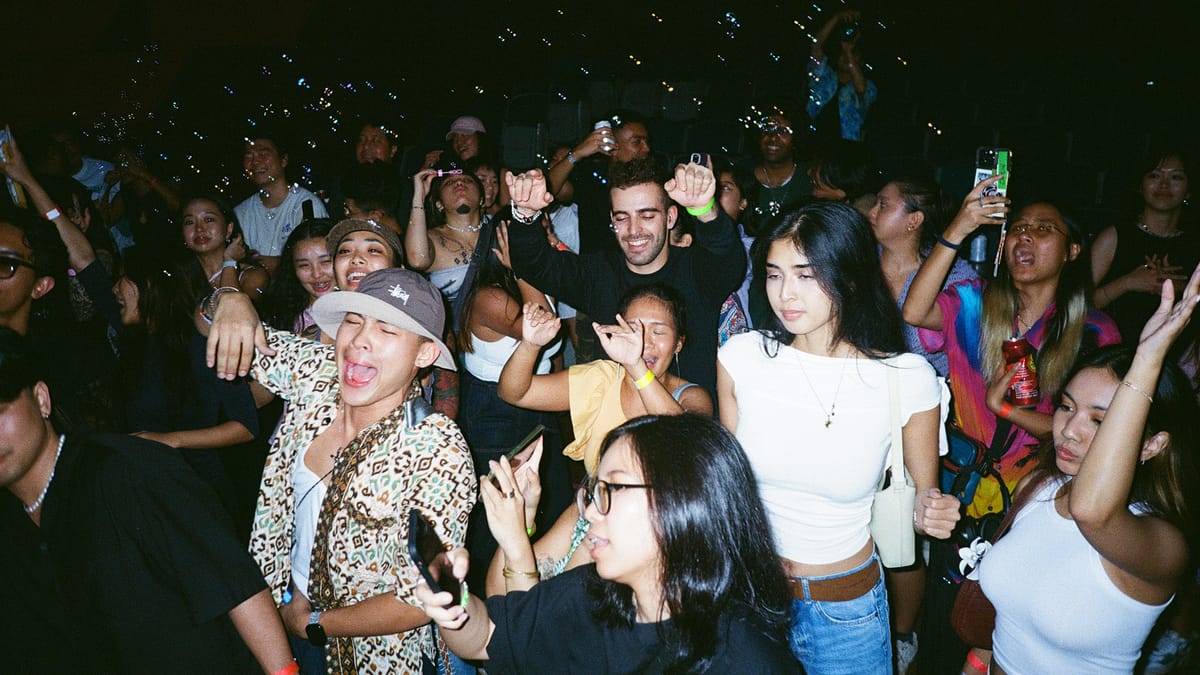
Singapore This Week
Sports: HYROX is everyone, everywhere, all at once

You step into the National Stadium, and for a moment it feels like complete chaos. There’s a horde of grunting people trying to lob weighted balls (the size of a globe) at a target (the size of a fist) about 3m overhead. Then there’s another line of folks speedwalking with clanking kettlebells in each chalked hand. You’ll get lapped by a stampede of bronzed men with abs you could grate garlic on; then shortly after by a pair of sisters in colour-coordinated outfits and ribbons in their braided hair, who look like they’re taking a casual morning jog down a Bali beach; and then perhaps a little later, two grandmas in neon dancercise leggings who are singlehandedly hauling a sled that’s double their bodyweight. And if you’ve come to support a friend, you might feel like you’re in the race yourself, because you’re in the trenches with them, dodging flocks of competitors and a regular spray of sweat. And wait: Was that former minister of state Teo Ser Luck? Oh, that’s definitely Singapore Idol Taufik Batisah. And up on the podium, a more planetary kind of star power: K-pop idol Minho and Netflix reality celeb Hong Beom-seok. Welcome to HYROX, one of Singapore’s latest obsessions, the functional fitness race that’s derived its success from pushing itself as the race for anybody, and any body.
HYROX might just outstrip the multiplying pilates studios and padel courts as one of the fastest-growing fitness fads not just in Singapore—where over 14,000 enthusiasts competed over the weekend—but in the world. This year, some 1.5m athletes have signed up to hoist sandbags on shoulders, barrel through burpee-broad jumps, and run a total of 8km, one between each gruelling workout station. There’s no cutoff time, no qualification to enter; at this year’s Singapore race, the youngest registrant was 16 and the oldest, 74. You can go the entire race alone or you can share the pain with a friend, or even a group of friends, and decide how you want to divvy up your approach to each station.
It’s this community aspect that’s won the race its diehard fans. There’s Carolyn Soemarjono, a 57-year-old cancer survivor who discovered the race through her neighbourhood gym in Tanglin. She told The Straits Times: “There’s that mental image that people have of people in their 50s and I’m happy to try and redefine that, like I can be a grandmother and super fit, I can develop muscles, I can be strong, I’m lifting heavier weights now than I’ve ever lifted in my whole life.” She finished the race in just under three hours, close to the top of her age group. Or the mother-daughter team who decided they’d do the race together for a bit of family bonding: the 73-year-old is part of a gym catering to seniors, many of whom came down to support her, complete with decorated cardboard posters. This may be a competition, but it isn’t the usual rat race. One of the rules for the popular doubles category requires that teammates be close enough in stride or risk being disqualified. Each station is a collaboration, where one person makes up for what the other lacks. You watch couples, best friends, siblings, athlete-coach duos lap the arena together, regardless of their asymmetries in speed or strength. The way they’ve paced each other for months, years, or perhaps even decades, in the long-distance race of life. In the end, we’re all really walking—or in this case, running—each other home.
Other stuff we like
Dominic Khoo and The WatchFund. An NYT investigation into an apparent Singaporean fraudster who lured rich investors here and around the region into “investing” in his luxury watch trade.
“Microeconomics in Public Policy: A Practitioner’s View”. This essay by Lee Hsien Loong, senior minister, gives a good overview of how the current government balances its market fundamentalism with more socialistic interventions, through among other things discussions on the pricing of housing, healthcare, and COEs.
Community book read with Faizah Zakaria. Join the historian and Jom print issue contributor on April 16th as she discusses her award-winning book The Camphor Tree and the Elephant: Religion and Ecological Change in Maritime Southeast Asia.

A flavour of Jom. Occasionally, Jom publishes essays outside the paywall. These are on issues we think are in the public interest, and deserve a wider airing. In the past two years, we have published nearly 50 such pieces. Read some of these if you’d like to see samples of our work. We hope they’ll convince you to subscribe. And even if you’re here with no intention of doing so, we hope you’ll enjoy these offerings and consider it time well spent!