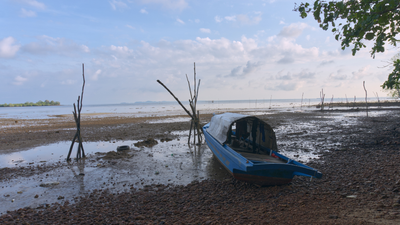

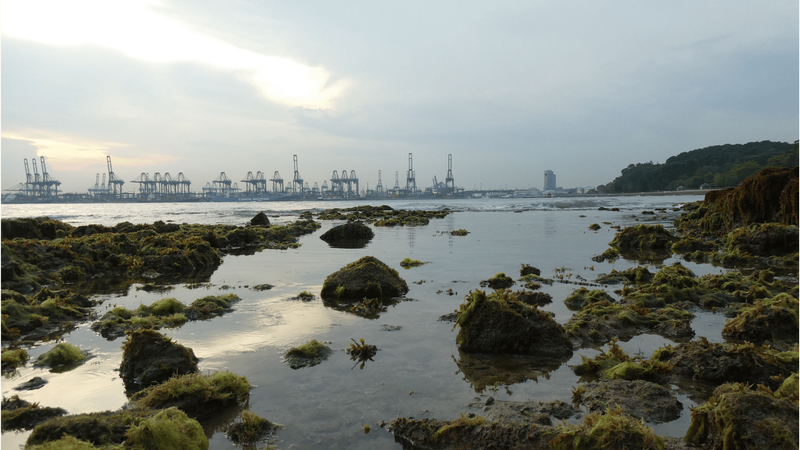
Tucked behind Changi Village’s bustling hawker centre and iconic ferry terminal is a quiet and unassuming stretch of beach. It is one of the last publicly accessible places on the mainland where you can come face to face with Singapore’s marine denizens.
For a few days every month, when the sun and moon are aligned, the waters of the Johor Strait draw back, revealing meadows of lush seagrass. Hermit crabs pick their way over the soft substrate and sea cucumbers trawl their feathery feeding tentacles through the nutrient-rich waters. Carpet anemones sit in tidal pools, waiting patiently for the darting fish fry to blunder into their sticky tentacles.
When the tide is low, it is not uncommon to see beachgoers turned into intrepid explorers wandering the shores of Changi Beach. No two days are alike—every tidal cycle brings a renewed cast of intertidal inhabitants. Some become familiar faces, like the brittle stars with their snaking arms that hide within the cavities of sea sponges. Others, like the colour-changing cuttlefish, are only occasional visitors, and spark gasps of wonder and excitement from those lucky enough to have glimpsed them.
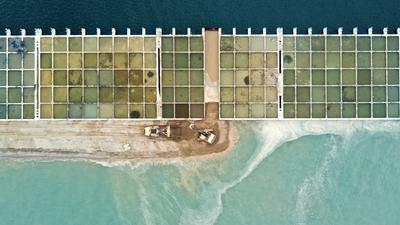
For years now, Changi Beach has served as a free site of education, exploration, and connection to the marine world for anyone with a pair of booties and an evening to spare. Yet, in July 2025, it was announced that land reclamation would soon commence at nearby Changi North. The associated effects, such as sedimentation of the surrounding waters, will have a negative impact on the seagrasses of Changi Beach.
The local nature community was understandably upset. Nature advocates Neo Xiaoyun and Julian Lee published an open letter and petition, arguing that the rich intertidal biodiversity at Changi Beach Park warranted further scaling back of the reclamation footprint.

This pattern is not new. The removal of natural ecosystems for urbanisation sits at the core of Singapore’s developmental history. Our island has lost over 90 percent of its original forest cover since 1819, when the British cleared vast tracts of forest for gambier, pepper, and later, rubber plantations.
Today’s online discourse around ecological loss follows a script familiar to many by now: a news headline announces a project and the concomitant habitat loss that it will entail. Quotes from scientists and nature lovers are dropped in to illustrate the impacts on local wildlife. Comments start pouring in from netizens lamenting the loss of nature on an island that is already so heavily urbanised. Days turn into weeks, and the news cycle moves on. Another project is announced at another site. More frustration is articulated, ad nauseam.
What has been a growing cause for concern for many is not just the frequency with which these projects are being unveiled, but what they collectively spell for the fate of Singapore’s wild spaces. Our natural ecosystems dwindle with every passing year despite vocal objections from different sectors of society. Will there come a time when there will be no nature reserves left in Singapore? No mangroves for our migratory shorebirds to rest their wings in, and no forests within which wildlife may roam free from the disturbance of traffic and construction?
This may seem alarmist, yet the loss of Singapore’s last wild spaces has continued unabated, and arguably even accelerated in recent years. The developmental state has over the years finessed its engagement with nature groups and environmental consultants to provide the sheen of green legitimacy it needs to march on, unimpeded. Given the drastic power imbalance between the government and other stakeholders, the prospect of a significant shift seems remote. But there is hope yet, in the power of the voices of ordinary people.
Last year, in particular, was devastating for ecological loss. In May 2025, HDB disclosed that 5.5ha of forest in Bukit Batok would be cleared for new housing estates. Despite its relatively small size, the forest serves as a key habitat for the critically endangered straw-headed bulbul and boasts notable butterfly diversity. In December, JTC separately announced that 52ha of undisturbed forests containing freshwater stream ecosystems—about 4.5 times the size of Suntec City—at Bahar and CleanTech Park would be cut down as part of plans for the further expansion of Jurong Innovation District. Rare species such as the Sunda pangolin have been sighted in this area, and it is also the only known breeding ground for the harlequin butterfly in all of mainland Singapore.
These two project footprints fall more than six km apart, yet the health of each is dependent on the other. Scientists use the concept of ecological connectivity to describe how ecosystems are linked to one another through processes such as dispersal and migration.
To borrow from a different context, ecological corridors play an important role in the migration of African elephants between the Udzungwa Mountains and the Selous Game Reserve in Tanzania. For many generations, elephants crossed the two regions via the wetlands of Kilombero Valley. Yet, as agriculture expanded into the fertile wetlands, elephants stopped crossing between the two areas due to the presence of farmland and livestock, losing access to resources they would require for survival.
The importance of ecological connectivity in the context of Singapore’s highly fragmented forest patches has already been brought to the attention of government agencies. NParks released the results of an ecological profiling exercise in 2021 to document patterns of wildlife movement. Ecological corridors, which function as bridges between ecosystems, were identified between various parts of Singapore.
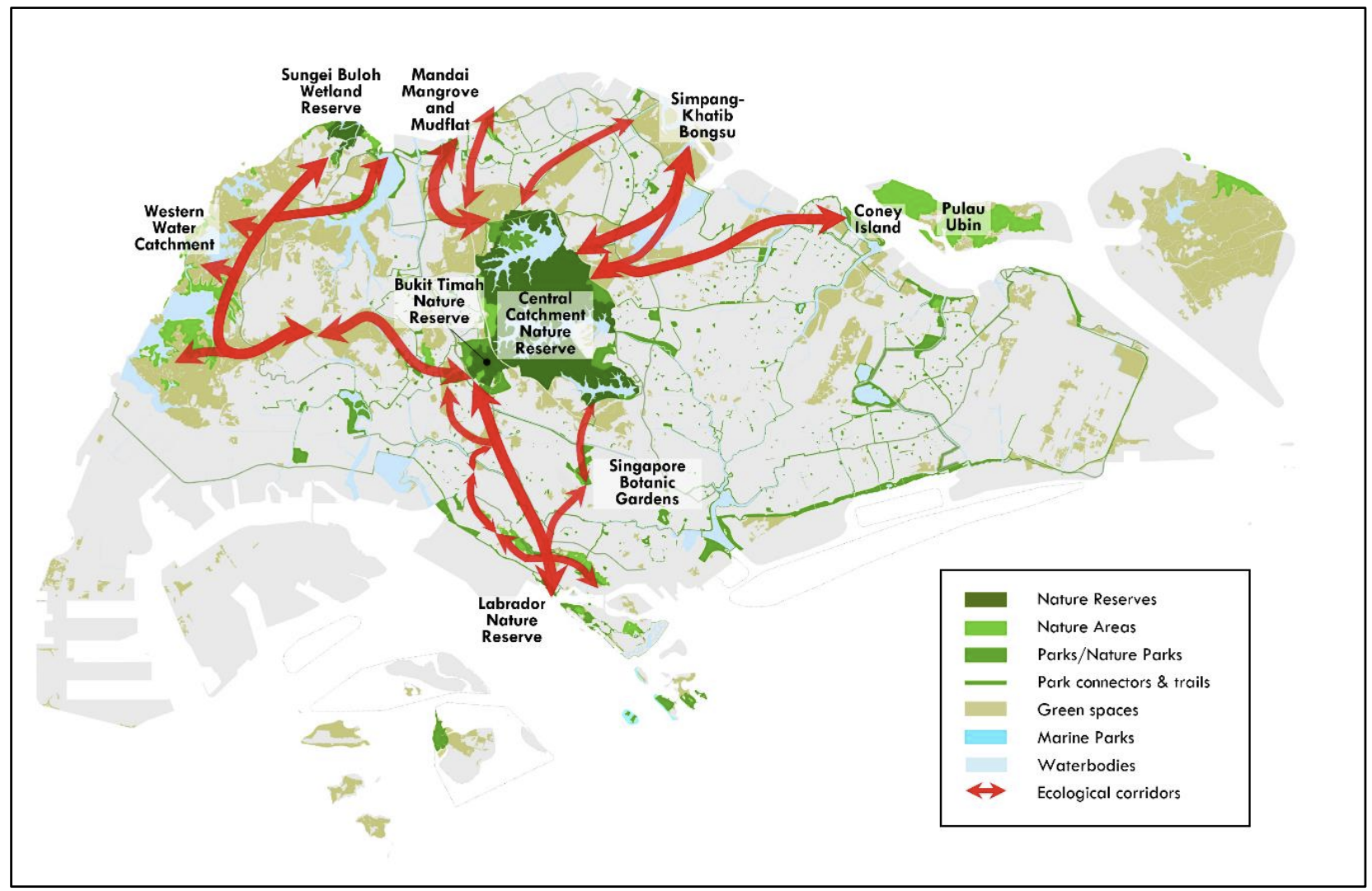
The connection that this essay focuses on spans Singapore’s central forests (Bukit Timah and Central Catchment) and our Western forests (the Western Water Catchment)—two of the largest and least disturbed forests on our island. The aforementioned Bahar and Bukit Batok developments will both encroach upon this central-western corridor.
The loss of Bukit Batok and Bahar on their own is already significant. Taken together, the future of the wildlife across our central and western forests—the island’s strongholds of terrestrial biodiversity—is subject to great uncertainty. It is possible that there will be complete loss of connectivity for some species, such as the critically endangered Sunda pangolin.
The ground-based and slow moving creature lives in undisturbed forested areas like, including those found in Bukit Timah Nature Reserve (near Bukit Batok) and Nanyang Technological University (near Bahar). As the pangolin traverses the terrain in search of resources and potential mates, it needs to move between multiple forests, especially if these forest patches are already quite small, as in Singapore. If the physical connection between forests is broken, there is a higher likelihood that pangolins won’t be able to move between forests safely. They will become increasingly isolated, decreasing the likelihood of their long-term survival through insufficient food, suitable mates, or road hazards.
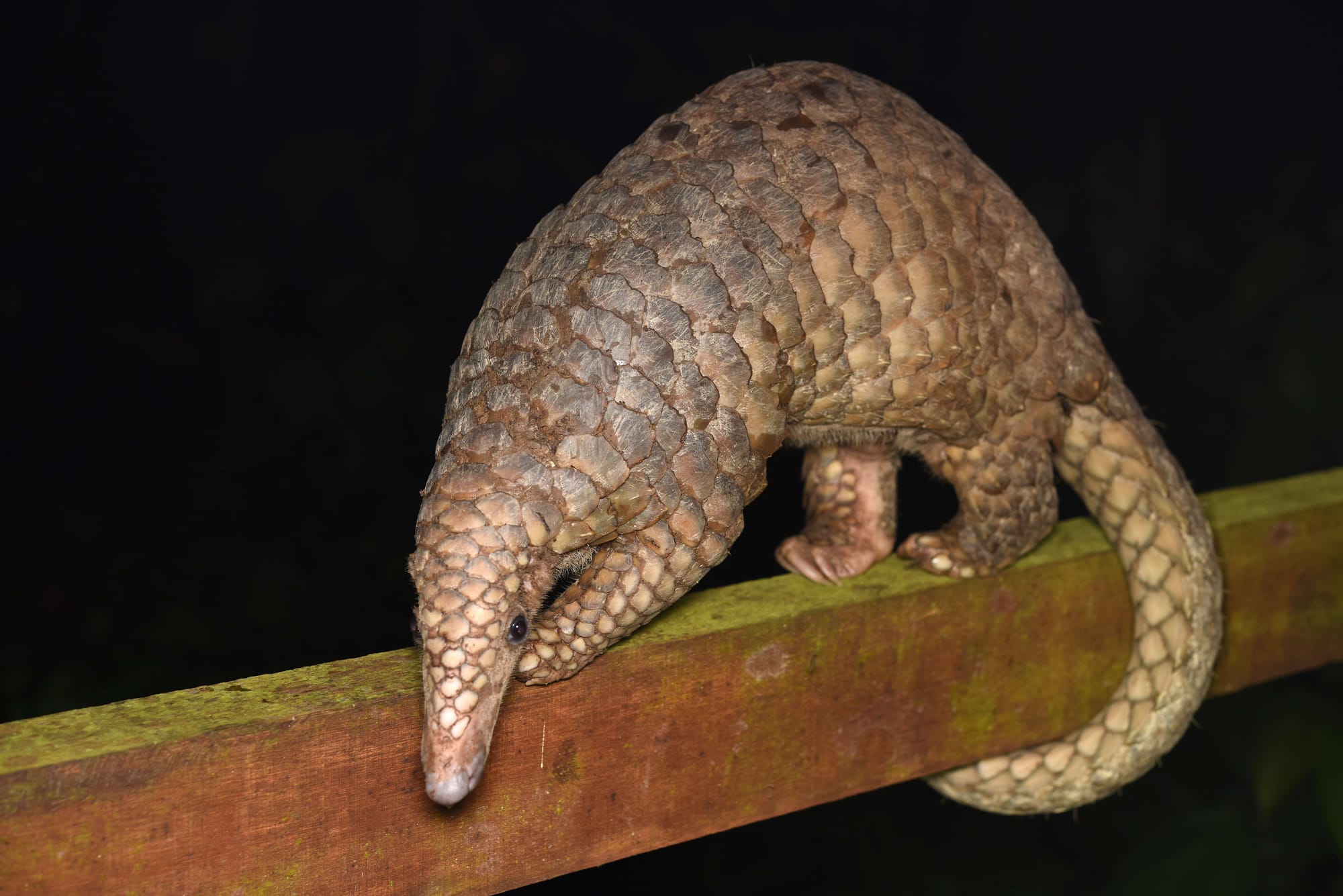
If ecological links are severed, then the isolated forests may not be enough to sustain populations, which might crash and cause the species to go completely extinct—a devastating loss for Singapore’s biodiversity. Similar processes are unravelling all over the world as a result of urbanisation and habitat fragmentation—such as the aforementioned elephants in Tanzania.
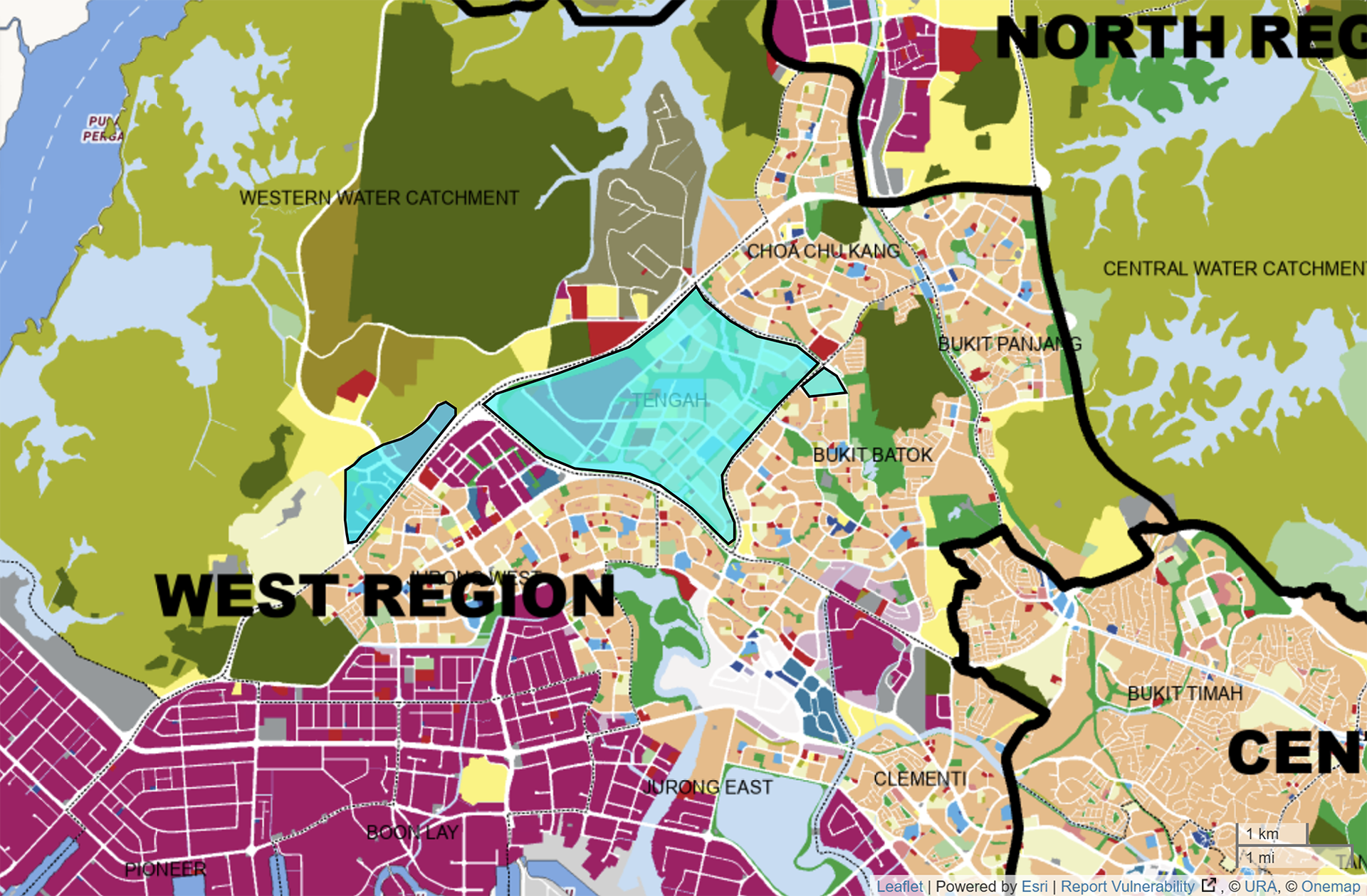
It is also worth discussing how the development of Tengah already planted yet another, sizeable footprint on the central-western corridor. In 2016, Tengah Forest Town was announced by Lawrence Wong, then-National Development Minister It involved the clearance of 700ha of forest, slightly more than half the total area of Changi Airport. Tengah forest was the largest patch of unprotected secondary forest left in Singapore and was a core component of the central-western corridor. The Nature Society Singapore (NSS) made public calls for more forest to be set aside—they went unheeded.
The Singapore government’s common retort against calls to scale back development plans to preserve nature is that it needs to prioritise economic interests. Responding to a parliamentary question by Andre Low, non-constituency member of Parliament in February this year, Gan Kim Yong, minister for Trade and Industry,stated that the removal of forests at Bahar and CleanTech will facilitate the development of Jurong Innovation District, a manufacturing hub that is expected to create some 95,000 jobs.
Gan further stated that the overseeing agency, JTC, had already commissioned an environmental impact assessment (EIA), and identified mitigation measures such as the retention of some forested areas, among others. Significantly, Gan added that these plans had been reviewed “in consultation with nature groups”. So, at least on paper, it seems like the government had already done its due diligence.
But it’s worth scrutinising the EIA process to understand how different interests and agendas are accommodated. An EIA is a complex, multi-stakeholder exercise that usually unfolds over several years before development works even begin. Its purpose is to determine the potential impact of any new development on the surroundings, and is typically carried out by an external partner known as an environmental consultant. The consultant may also suggest mitigation measures that can be taken to reduce this impact.
Throughout the EIA process, the commissioning agency may hold closed-door consultations with select members of the public, including academic experts and local nature groups. They may also invite inputs from other government organisations, such as PUB and NParks, where relevant—for example, if the development footprint includes a waterway or nature park.
The completed EIA report is gazetted and made available for the public. In some cases, such as Changi North, the report may only be available for viewing in-person due to sensitive information. After disclosure, there is a window of time (usually one month) when members of the public can submit feedback to the overseeing agency.
Conversations between government agencies and local nature groups, such as NSS, are held behind closed doors. The input of nature groups cannot be understated: they are involved in the EIA process from the initial scoping and baseline assessment, to planning, all the way through to monitoring and management of the project when construction works commence.
Some of these groups have individuals who are domain experts with doctorates and decades of specialised knowledge. Others are just regular people who’ve dedicated years of their own time and energy to documenting and raising awareness for our local biodiversity.
While it’s commendable that agencies engage nature groups, it is an imperfect solution to protecting our natural heritage. As mentioned previously, NSS made multiple public calls for the developments at Tengah to be curtailed, to no avail. Likewise with a representative of the nature group Singapore Youth Voices for Biodiversity (SYVB) in relation to HDB’s Bukit Batok project. That both groups went public with their criticisms suggests that the closed-door consultations between agencies and nature groups likely came to a dissatisfactory conclusion.
I spoke with two individuals—I’ll call them Sam and Alex—who have in-depth experience in working with government agencies on EIAs. From the very beginning of the EIA process, they told me, the agenda is set according to the perspective of the agencies, who favour technocratic knowledge. A nature group being consulted by agencies is contingent, first of all, on their members possessing the requisite knowledge on ecological science.
“Nature groups [in the government’s mind] are not people who care about nature, but people with nature expertise,” says Sam. “You have to earn your right to sit at the table. You have to prove that you have something to contribute.”
Not every person who is concerned for a particular forest patch will be well-versed in the kind of terminology and thinking that agencies are looking for during such engagements. Even within nature groups, there are members with varying degrees of experience and familiarity.
“Occasionally, their [the nature groups’] representative may not have any experience. They ask questions that show that they don’t know what’s going on. It makes [the agencies] feel like they don’t want to listen to these representatives,” Alex tells me.
Should only those whose knowledge of flora and fauna is on par with experts be heard? Despite their own relative expertise, both Sam and Alex disagree.
“For certain projects such as Dover Forest, members of the public will be interested. Maybe they’re just normal hikers and cyclists, but why aren’t they allowed to know more about the place? You can ask experts, but experts may not go there very often, and they can have very different values and experiences attached to that place,” says Alex.
In other words, restricting the bounds of public engagement to only those adept in scientific arguments erases the complex and intangible values that we attach to nature. A sense of connection to the land is deeply personal. Public involvement should not be mobilised solely around scientifically legible arguments. As a 2025 Lianhe Zaobao article by Chua Wei Qian argues, EIA should reflect diverse voices, and not be restricted to a top-down bureaucratic process.
A deeper problem with running public engagements this way is that it restricts the conversation to a highly limited group. Nature groups give their time and labour freely in accepting these engagements, and the work is not easy. “Some agencies will even give you reading materials beforehand. If need to, we will do more preparation. We may even organise a physical site visit,” says Sam. In a country where workers are spending an average of forty-five hours per week on the clock, only those with resources to spare can devote time to work on the side as citizen ecologists.
Lastly, because the engagement is happening by the grace of the authorities, that goodwill can be rescinded. “If you speak things that you shouldn’t speak in public spaces, then you will get blacklisted,” says Sam.
What this means is that the collaboration between nature groups and the government happens on a basis of mutual benefit: nature groups gain access to a privileged backdoor channel to voice their concerns directly to the relevant agencies. Undoubtedly, their views are taken into consideration on particular issues, for instance on EIA field survey design or species awareness. But in exchange, they either avoid making their criticisms public, or tamp them down, which helps agencies to maintain an image of credibility.
Sam tells me that “with some of the more high-profile developments, the main nature groups are not very vocal on it. When public petitions [to scale-back development plans] come out, we just sit and watch.”
Following the announcement of the development at Bahar and Cleantech Park, for instance, NSS did not publicly comment on the potential ecological damage of the project—likely because they attended closed-door engagements in April and November 2024 (a full 1.5 years before public disclosure) and had already had the opportunity to voice their concerns then (When contacted, NSS had no further comments). Other nature groups with a more notable social media presence, such as LepakinSG and SYVB, published educational posts illustrating the potential ecological damage that would arise from the loss of forests and forest streams and encouraged their followers to submit feedback to JTC.
The climate movement SG Climate Rally, on the other hand, has never been invited to closed-door engagements with agencies, and they were able to be much more vocal and critical, making explicit calls to action for JTC to fully scale back the Bahar development. Their stronger tone had the advantage of drawing online engagement and adding significant pressure on JTC.
The different responses from various groups across Singapore’s civil society demonstrate how the relationship between agencies and nature groups is underwritten by a power imbalance. On the one end are those whose privileged access is premised on them restraining their public criticisms and minimising reputational damage when the next forest needs to be uprooted. On the other are those excluded from official dialogues but who retain their ability to speak up and galvanise a wider public to support their causes.
The concept of mitigation measures has been brought up repeatedly as a bulwark against accusations that the government does not care about the ecological impacts of its projects. URA told me that in Tengah for instance, 20 percent of the developed area will be set aside for green spaces (inclusive of both retained vegetation and man-made parks). Jurong Innovation District, too, has been quick to flaunt its eco-credentials. Ahead of the loss of mature forests and forest streams in Bahar and CleanTech, the Potter’s Garden, a five-hectare park within the industrial estate was unveiled and touted for its rich biodiversity, and as a demonstration of the idea of “building industry in nature”. The Potter’s Garden was even mentioned by Gan in his parliamentary reply, as an example of how the retained forested areas in the Bahar development will be integrated with such green spaces.
It goes without saying that replanting trees over a bulldozed forest is about as meaningful as plugging a broken dam with twigs. “Reforestation will never be as good as conservation. Look at the OneMillionTrees movement,” says Alex, referencing the NParks initiative to plant one million additional young trees around Singapore between 2020 to 2030. “They are not disclosing where they plant the trees, they are not monitoring the health of the trees—we don’t know if the trees are going to be dead in the future. And as they are planting new trees, they are also cutting down trees in other areas.” When contacted, NParks directed me to their webpage with information on tree planting sites and maintenance of trees in parks.
“Instead of one million roadside trees, can you do more meaningful forest restoration?” concurs Sam. There is so much more to a thriving ecosystem than a crop of ornamental vegetation. There is the health of the soil and its microbes, the types of habitats and food sources that the flora can furnish for its animal inhabitants, and in turn, how those creatures support other species. It is far more valuable to keep an existing patch of forest that has already spent decades nurturing this intricate web of relationships with dozens and hundreds of species than it is to construct a recreational park that is managed according to the needs of only one: us.
The proposed mitigation measures for both Tengah and Bukit Batok are woefully inadequate. In Bukit Batok, one of the mitigation measures involved retaining a 0.48haarea of forest, smaller than a football field and representing only nine percent of the project footprint. In Tengah, the proposed retained area was 10 per cent (70ha) of the total project area. In their position paper, NSS recommended that a total of 220ha should have been retained across Tengah instead.
The case of Tengah is especially troubling. Because construction began some years ago and is already half finished, we get to see how felled forests are currently in the process of being resurrected and repackaged as fodder for what’s known as greenwashing: the practice of disseminating misleading or deceptive publicity with the aim of presenting an environmentally responsible public image.
To that tune, Tengah Forest Town has been marketed as a paragon of sustainability. The newly developed estate is set to feature a Forest Corridor, purported to connect nature reserves in the central and western regions of Singapore. This retelling conveniently retools Tengah Forest Town as a two-for-one: a residential estate and ecological corridor, when the unspoken reality is that it is an urban estate built upon the grave of a previously-existing ecological linkway, one that was buried under concrete and steel despite the concerns and protests of nature groups.
Media outlets were quick to seize upon the glitzy, utopian vision of humans and nature coexisting within this mythical forest town. An article in Sublime Magazine gushed: “a town such as Tengah holds the serious advantage of being built from scratch. That way, sustainability can be held at its core and prioritised at every stage of its development, woven into its infrastructure.” In other words, the mitigation measures incorporated into the Tengah development were not merely concessions by the government to the requests of nature lovers. They are also assets to embellish developments with fashionable and trendy eco-credentials.
But are these bold claims of sustainability backed up by the science? Environmental consultants—the external partners who bring technical expertise and help plan and execute EIAs—can assess the ecological fallout of a project and give their technical recommendations, but it is up to their clients, the developing agencies, whether or not they choose to accept them.
“When consultants recommend mitigation measures, they [developing agencies] may not care,” says Alex. “If the environmental consultants try to advocate for biodiversity, the client might say, ‘at the end of the day actually, you’re working for me.’”
Just like with nature groups, the relationship between environmental consultants and developing agencies is marked by a significant power imbalance: the environmental consultants provide technical expertise, but ultimately they are answerable to their client, not to nature or the public. Even if the ecological mitigation measures for a project have been assessed as inadequate on a technical level, agencies can choose to adopt them anyway, and then justify snazzy marketing claims that their developments are environmentally friendly.
There are genuinely positive outcomes when agencies choose to employ consultants, explore possibilities for mitigation and engage nature groups for their inputs. Yet at the same time, the exaggeration of their efforts for the sake of a public relations exercise brooks scepticism and corrodes trust between the government and the public.
So where does this leave us? Ecological connectivity across the island is thinning dangerously. Nature groups are being consulted by agencies, and yet their valuable insights are being ignored, their ability to mobilise public support curtailed by the carrot-and-stick of closed-door engagements. Mitigation measures, however inadequate, are used to shore up hyperbolic claims of sustainable development. When even the efforts of dedicated citizen ecologists and technical experts fail to slow the relentless churn of urban development, what can we do?
As it turns out, a lot.
“Public opinion matters,” says Sam, “and it matters more than people think. Agencies care about public feedback, and they follow what the public thinks and says a lot—especially agencies with public-facing roles like HDB and LTA.”
“With most projects, you are only answering to nature groups. When you have the public involved, you get people from all kinds of backgrounds,” adds Alex. “You have residents, people that used that place. They will be afraid to answer to a few thousand people.”
Singapore is often stereotyped as a nation of complainers, but there is a difference between complaining and speaking out. It is one matter to sit around a table in a kopitiam (or under the comments sections on social media) venting about the newest ruckus making headlines. It is quite a different matter to direct that energy and attention towards agencies whose job it is to serve public interests.
Of course, in an ideal world, criticism would come from those who not only feel strongly, but are well-informed on the relevant issues as well. In Sam and Alex’s experiences, public demands that are feasible (i.e less extreme) are more likely to be accepted by agencies. Yet, that does not discount the value of the more impassioned cries to protect our trees. “Even if the demands are not sensible, at least the agencies know that the heat is on them.”
Voicing our discontent is not simply a matter of venting and lambasting a bunch of poor, browbeaten civil servants. While we are used to seeing the government as a monolith, it is worth keeping in mind that different agencies can have diverse agendas and attitudes towards issues like deforestation. The National Parks Board is often seen as the official overseer of our green spaces. The work that they have put in managing our precious ecosystems has been valuable, and they have the expertise as a technical agency to advise on environmental impacts.
“The thing about NParks is they are usually our [nature groups’] ally, but their hands are tied because their priority in the government is not very high. They are unable to overthrow decisions from other agencies,” Sam tells me. Land development in Singapore is a multi-stakeholder exercise, and in a room full of stat boards, economic and political interests will often trump environmental ones. (For more on the housing and land demands fostered by an economic model dependent on high population growth, see “Affordability in the lion city: is Singapore’s public housing model built to last?”)
But the scales can tip if the public speaks up. The overseeing agency could start to see sense in the suggestions given to them by nature groups, by environmental consultants, and even by technical agencies such as NParks—that they reflect actual public sentiment, not just the do-gooder dreams of activists. Speaking up is not just about making noise for noise’s sake, it is about nudging the right levers within the bureaucratic machine.
One avenue for constructive noisemaking is the public feedback period. In the case of Bahar and CleanTech, JTC’s public feedback period was for a month in December 2025, immediately following public disclosure.
Capitalising on this window, multiple local nature groups including SG Climate Rally, SYVB Earthlink NTU, and LepakinSG published social media posts to rally their followers. This approach has the advantage of amassing numbers and bringing the heat, but social media algorithms are too fickle a means to spread the word; those who miss the announcements can do little once the public feedback window has closed.
“The better ask [towards agencies] is to announce your project at a proper timing and improve your communications. Improve channels for people to give feedback. Don’t just say ‘this project is out there’. Have a press release! Journalists need to do a good job of adding coverage to these pockets of development. You want good media coverage,” says Sam.
We cannot delegate the responsibility of protecting Singapore’s remaining wild spaces to the individuals working in environmental consultancies, nature groups, and technical agencies like NParks. We have to add our numbers and our voices.
“I don’t think green spaces in Singapore are necessarily safe. We all have this impression that nature reserves and parks are not going to be touched, but look what happened to Windsor Nature Park,” says Alex, referencing the gazetting of Windsor Nature Park for development. The park is part of Singapore’s Central Catchment Nature Reserve (alongside other iconic sites such as the Treetop Walk and MacRitchie Reservoir). Under the current URA Master Plan 2025, the entirety of Windsor Nature Park has been labelled as intended for residential land use, meaning all of its forests could be lost in the near future. The same applies for Tagore forest, north of Thomson Nature Park, as highlighted in a recent post by NSS. This forest patch is home to the Raffles’ Banded Langur, of which fewer than 80 remain in Singapore.
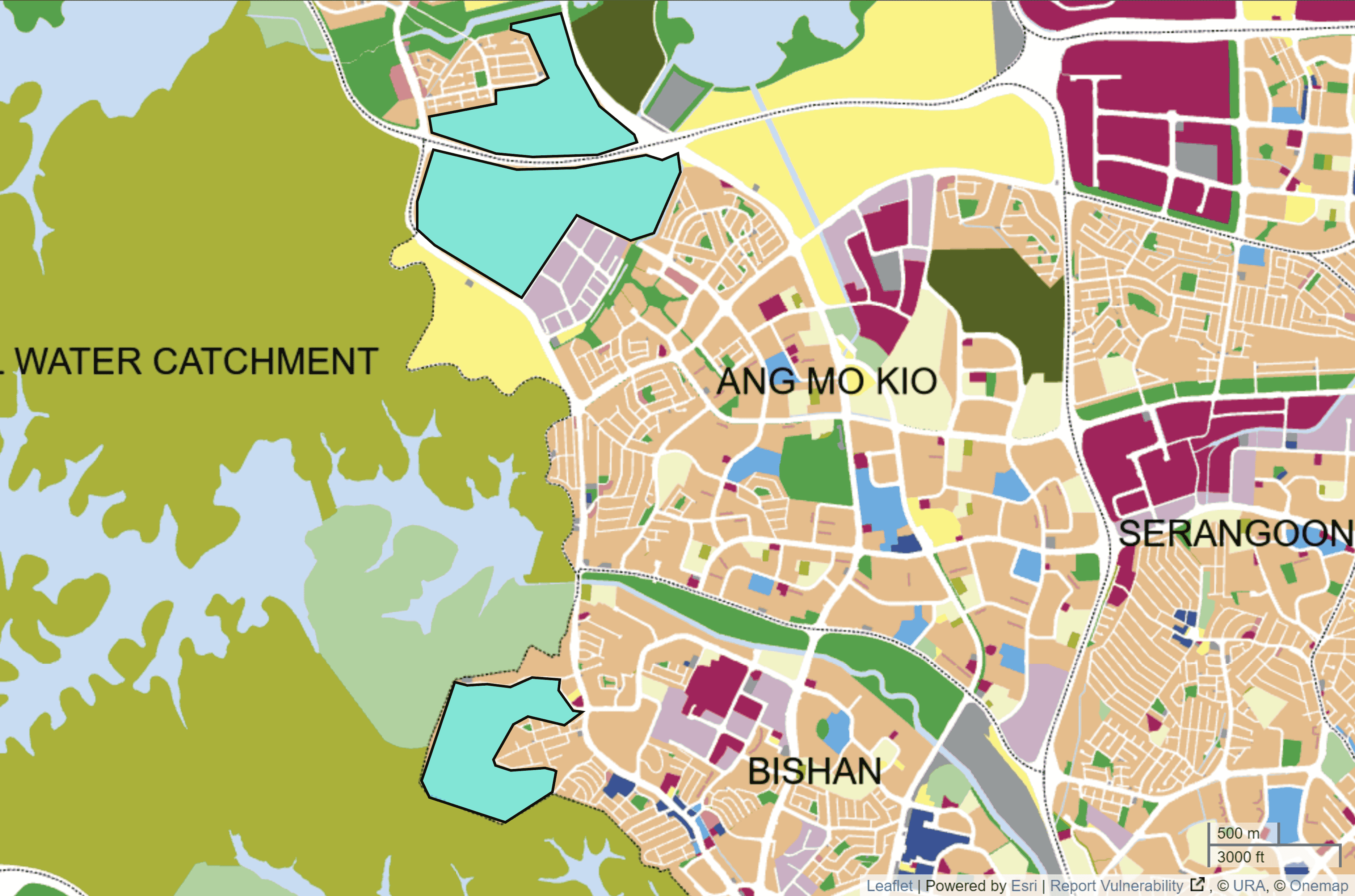
So, what can you do? Follow local nature groups, such as the Nature Society Singapore, Singapore Youth Voices for Biodiversity, LepakinSG, and SG Climate Rally, who will deliver timely updates on how to make your voice matter when the next project comes along. If a new development has been announced in your neighbourhood, write in to your MP, or speak to them at a Meet the People Session, to express your concern over the potential ecological fallout.
The trees in your neighbourhood carpark might not be the same as a forest, but what if owls have been nesting and raising their chicks in them, as birdwatchers have noticed in Pasir Ris? No issue is too small. Whether the government listens is beyond our control. But at the very least, we must speak up on behalf of those who cannot speak. Our forests and our seas are our natural heritage; they belong to all of us. We need to join the fight for Singapore’s last wild spaces.
Choo Yi Feng (he/him) is an intertidal explorer, climate activist, ecologist and fiction writer. The Waiting Room (2024) is his debut short story collection. Elsewhere, his writings have previously been published at Foglifter Journal, Anathema: Spec from the Margins and Bona Books. He is currently writing his debut novel, a queer romance set in a fantasy world inspired by pre-modern Southeast Asia.
Letters in response to this piece can be sent to sudhir@jom.media. All will be considered for publication on our “Letters to the editor” page.
If you enjoy Jom’s work, do get a paid subscription today to support independent journalism in Singapore.