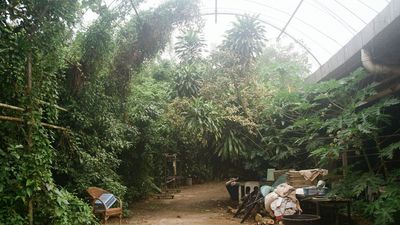


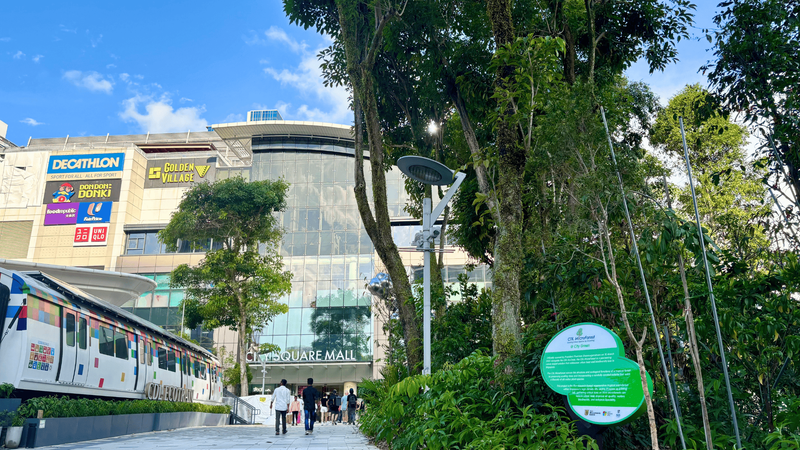
A gravel pathway snakes through a tiny forest. Along the way are freshly planted tongkat ali trees, their roots used for centuries as a male fertility tonic; young cherry blossom-like hidden flower trees; and spiky clusters of shrubs. A koel whoops from the canopy above and a lime butterfly settles on a sign promoting shopping vouchers.
Unveiled at a July ceremony graced by the foot and shovel of Tharman Shanmugaratnam, president, this is a “microforest”—a sliver of wilderness in a city with a predilection for order—that looms awkwardly over the forecourt of City Square Mall in Farrer Park, flanked by a construction site.
Temples of consumerism, shopping malls are unlikely places to seed Singapore’s latest experiment in urban greening. But the real estate giant behind the project, City Developments Limited (CDL), might argue that City Square Mall—which it claims is Singapore’s first “eco mall”—is the perfect location for the microforest, which is about the size of a tennis court. The company’s chief sustainability officer, Esther An, picked up the idea after speaking to Adrian Loo, formerly head of conservation at the National Parks Board (NParks), during last year’s COP climate talks in Baku. Four months later, she had 400 native flora species planted in a patch of soil carved out in front of the mall.
An urban reforestation technique developed by Japanese botanist Akira Miyawaki in the 1970s, microforests grow quickly as plants compete for light and nutrients in limited space, shooting upwards to form dense canopies. Miyawaki’s method became popular at a time when Japan was rapidly losing its native forests to urbanisation, and air and water pollution from heavy industry was so bad that illnesses were named after industrial cities—Yokkaichi asthma and Minamata disease, for instance. Greening solutions were urgently needed. Miyawaki was hired by Nippon Steel, and later by other industrial giants such as Tokyo Electric Power Company and Honda Motor Company to quickly greenify their factories. Today, Miyawaki’s method has taken root all over the world, from Toulouse, France to Hyderabad, India, to improve air, soil, and water quality.
The main motivation for CDL’s tropical microforest project is cooling. Singapore is heating at roughly twice the global average. The combination of climate change and the “urban heat island effect”—concrete trapping and radiating heat—is making the outdoors increasingly perilous. National University of Singapore (NUS) scientists warn that “heat stress”, when the human body cannot cool down by sweating, could sap US$1.68bn (S$2.18bn) annually from the local economy by 2035, while also lowering fertility rates in one of the world’s least fertile nations. When last week’s Formula One night race came with a “heat hazard” warning, it felt less like a precaution than a diagnosis of how stifling Singapore has become.
For An, the selling point of microforests is organic air-conditioning. Miyawaki-style forests can cool their immediate surroundings by several degrees once mature, usually in just two to three years. This cooling potential is considerably more than the ornamental trees and neatly trimmed shrubs that line our streets, housing estates, and shopping centres.
Microforests require far less water, fertiliser, and maintenance than the manicured greenery Singapore has historically favoured. They also clean the air, reduce noise, sequester carbon, abate flooding, and provide habitats for birds and insects. Crucially, they encourage people to slow down in a city forever in a hurry.
There are, perhaps, other motivations. For a company that builds on land once covered in forest, the launch of a microforest makes for good optics. (And a coincidental, welcome distraction from a leadership saga that critics have compared to the television drama “Succession”.)
And then there’s the matter of cost. According to CDL, the 260sqm patch cost S$69,000 to plant and prepare, excluding ongoing monitoring by NUS researchers. That sum does not include the opportunity cost of putting a forest where a building that makes money could sit.
Still, An wants to plant more—microforests are already planned for two other CDL properties. She is also applying for a grant through the government-backed SG Eco Fund, which supports local environmental projects. But An’s ambition goes further: she is quietly agitating for microforests to be written into Singapore’s building regulations. Developers are currently required to include greenery around new buildings, but they can choose what kind. Most opt for the cheapest: cow grass or green walls.
An envisions a future in which developers are compelled to plant microforests as they build. The Building and Construction Authority (BCA) told Jom that it supports the idea of microforests in principle, and already encourages wilder, native landscaping in its Green Mark awards scheme. If An’s ambition is realised, the look and feel of Singapore’s built environment could be completely transformed.
But will Singapore allow itself to get wilder? Veera Sekaran, a professor of nature-based solutions at NUS who helped develop the City Square Mall microforest, is not filled with confidence. According to him, the city’s obsession with ornamental neatness is “a hangover from colonial times.” The British planted clipped, box-gardens, and that aesthetic has remained. “We need to de-ornamentalise Singapore,” he argued. Rewilding, he added, could also help restore Singapore’s depleted soils.
Anuj Jain, co-founder of biophilic design firm Biosea, pointed out that while NParks launched the Landscape Excellence Assessment Framework (LEAF) in 2013 to reward developers for biodiversity-friendly landscaping, uptake has been slow. Developers, he said, prefer lower maintenance ornamental greenery. Wild landscapes are considered messy, unsightly and more difficult to manage.
Resistance isn’t just on economic or aesthetic grounds. Singaporeans are generally biophobic—uncomfortable with nature. Forests, even tiny ones, bring humidity, insects and snakes. Public education will be crucial, says Sekaran, if microforests are to take root.
Right now, public interest feels tepid. Directly opposite the forest at City Square Mall is the “Eco-Train,” a decommissioned MRT carriage turned education centre, complete with air-conditioning, fronted by science influencer Biogirl MJ (she promoted the microforest on her popular Instagram channel). CDL said that 42,000 people have visited it since March. But attendants reported that hardly anyone walks through the forest itself since it opened in July. Jom has visited the microforest on eight different occasions to date, and saw no one in it.
Comfort is obviously a factor. Forests are humid environments as trees transpire or “sweat”, and unless positioned where a breeze can flow through, they could feel stifling. “Tiny forests should be located in areas with strong windflow,” advised Lahiru Wijedasa, Asia forest coordinator at BirdLife International. Otherwise, people won’t use them.
Microforests might also come with social risks. Hanna Rauf, a PhD researcher who co-authored a paper on the potential of tiny forests in Singapore’s housing estates, warned of “green gentrification” if they were to be scaled beyond commercial zones. Greener neighbourhoods often lead to higher property prices, potentially pricing out lower-income families.
Rauf stressed that local communities must be involved in planning if An’s idea is to gain serious traction. Otherwise, microforests risk becoming just another top-down imposition. Elderly residents may resist the replacement of manicured lawns and pretty shrubs with what look like unruly thickets. For some, neatly managed greenery has long symbolised Singapore’s journey from kampong to gleaming city-state, she said.
Meanwhile, conservationists stress that microforests cannot substitute for the loss of larger forests. Jimmy Tan, a Grab delivery rider and local conservationist, told me he feels the difference when cycling past dense woodlands: the air is cooler, fresher. “But the cooling effect of the microforest in Farrer Park disappeared the moment I stepped a few metres away.”
Science backs him up. Research suggests that forests need to be at least 10 hectares to significantly cool surrounding areas. Dover, Maju and Clementi forests, each larger than that threshold, can cool the air by up to 1°C within 300m of their edges. By contrast, a tiny forest like CDL’s—which spans just 0.026 hectares—has negligible impact, according to Tan.
Secondary forests, which have grown over abandoned kampongs and plantations, have been disappearing at an alarming rate, according to Global Forest Watch data. Punggol, Lentor, Dover East, Tengah: all cleared for housing in recent years, while forests at Woodlands are to make way for an industrial park next year. Meanwhile, an area of forest larger than Singapore’s nature reserves and parks combined could vanish within the next decade under the Urban Redevelopment Authority’s masterplan.
Asked how much secondary forest Singapore could afford to lose before heat becomes a public health hazard, Emma Ramsay, an urban heating researcher at Nanyang Technological University, didn’t mince words at the AlterCOP conference last year. “None.”
The contradiction is awkward. On one hand, microforests are being promoted as symbols of climate adaptation. On the other, state planners continue to clear forests at scale to house a growing population, as the country swelters. Tan worried that microforests could become a form of greenwashing: a way to replace large forests with small patches tucked between concrete blocks. Unless they scale significantly, microforests aren’t much more than a fig leaf for ongoing urbanisation in a city that is getting increasingly unliveable for people vulnerable to the heat.
As Singapore struggles to balance new shopping malls, condos and housing blocks with the need for green spaces, the microforest at Farrer Park feels both hopeful and hollow—a reminder of what we’re losing, and what little we’re willing to replace it with.
Robin has lived in Asia Pacific since 2006, in Hong Kong and Australia, but mostly in Singapore. He has 20 years’ experience in journalism, writing about media, government, technology and sustainability. He has a particular interest in plastic pollution, deforestation, deep-sea mining, and South-east Asia’s energy transition. Robin has a degree in zoology and spends his weekends rescuing snakes, birds, monkeys, and lizards as a volunteer for Singapore animal welfare charity ACRES.
Letters in response to this piece can be sent to sudhir@jom.media. All will be considered for publication on our “Letters to the editor” page.