
“…the problem is rather to question space, or more exactly, to read space; for what we call everydayness is not the obvious, but opacity: a kind of blindness, or deafness, a sort of anesthesia.”
Georges Perec, Species of Spaces and Other Pieces
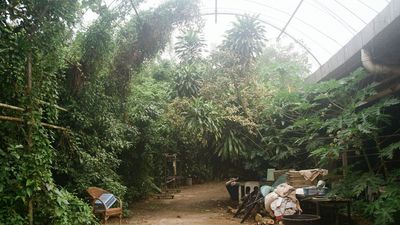
In the throes of the pandemic, a retired couple in their 70s lovingly nurtured a secret garden in the forest around Choa Chu Kang. Every day, the uncle, Wu, would cycle two hours from his house to tend to it. Over time, the garden blossomed with a lush array of crops: potato leaves, chilli padi, mint leaves, banana, papaya. It was their “solace after retirement”, Wu would later say. One day, a hiker came across their hidden Eden, posted about it in a Facebook group, and, citing concerns about wild boars and mosquitoes, led Singapore Land Authority (SLA) officers to it. Within a few weeks, the garden, the consolation, was gone.
The peer surveillance and the unfeeling bureaucracy behind the destruction filled me with a glowing rage, followed by profound grief. It felt like I had witnessed a banal act of violence, embedded in an overarching politics of control. Perhaps it was also the cabin fever of lockdown in a dense concrete environment that made me so acutely aware of the natural world, space and freedom.
The Wu case is hardly unique: around the same time, the authorities cleared a 30-year-old neighbourhood garden in Hougang. There are examples from as far back as 2008, with the removal of a collective herb garden in Yishun, and as recently as April 2024, with an 84-year-old aunty’s garden outside her flat in Choa Chu Kang cleared. A neighbour who wrote to the town council pleading the aunty’s case, unsuccessfully, was bewildered. “These little things are some things that are not affecting anybody, and she [was] so happy.” In almost all such cases, the “offenders” were seniors, for whom the gardens provided succour, joy and a sense of purpose. But they were treated as nuisances.
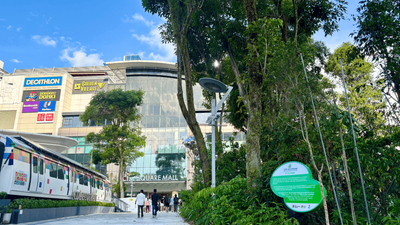
Simultaneously, almost as if in a parallel universe, Singapore has confected for itself an international reputation as a futuristic city in a garden; a sustainable role model for others to emulate. This image traces its origin back to 1967, when Lee Kwan Yew announced a two-stage plan to turn the island into a green paradise. “S’pore to become beautiful, clean city within three years”, The Straits Times informed its readers. The “City in a Garden” tagline has stuck. One government website, in a fit of self-admiration, calls Singapore “A bustling metropolis nestled in a lush mantle of tropical greenery”. Today, even as citizen-nurtured oases are torn down, the vision is realised in the extensive park connectors network, pruned greenery dotting highways and roads, community gardens (a concept of the state’s making) and massive projects like Gardens by the Bay, Jewel@Changi and Marina One. Some gardens, it seems, are more equal than others.
In a 2023 CNA documentary, Gary Chua, senior director of garden operations
and director of the design development department at Gardens by the Bay, was
interviewed about the Supertrees. “…It was the first time we brought sky-rise
greenery to such heights,” he said. “I think it is also symbolic of Singapore itself, in
the sense that with very limited resources, we were able to create something on a
site that was formerly reclaimed land.”
The British architectural firm responsible for the Supertrees, Grant Associates, claims that it was inspired by both nature and fiction—the 80 metres-tall Karri trees in southwestern Australia and the enchanted forest in the Japanese anime
Princess Mononoke. The perfect recipe for a perfectly futuristic, sci-fi “wonderland”.
After all, the creators of the dystopian drama Westworld chose to set their production in Singapore for a reason, even as they tiptoed around any mention of “dystopia” itself. As professor Joanne Leow writes in her essay, “‘This is Singapore’: On Watching Westworld in the Diaspora”, the showrunners “praised its soft curves, decadent delights, and were captivated by its orderly, well managed nature—yet part of the season stages a riot in a similar setting, hinting at the repressed impulses that run deep.” As though buying into its own techno-orientalist fantasy, the Singapore Tourism Board unironically endorsed Hollywood’s gaze, with a behind-the-scenes video promoting Singapore as a bug-free, in both the environmental and programming sense, destination for such forays.
I’m probably not alone in being unable to shake off the discomfiting feeling that there is a deep disjoint between the vision that the government has projected to the world, and ecological ways of being that feel intimate, relational and agentic. In early 2021, I was at Marina One for State of Motion: [Alternate/Opt] Realities, a science-fiction-themed film and exhibition programme during Singapore Art Week, organised by the Asian Film Archive. Located precisely where much of Westworld was filmed, the building is a joint venture between the sovereign wealth funds of Malaysia and Singapore. One of the artworks presented was “Safe Exit” by Ada Adhiyatma, Shawn Chua and Tay Ining. Its main feature is the audio tour where participants are invited to reflect on their data doubles—the discrete parts of themselves that have been collected and stored in databases and used to make determinations about their wellbeing—as they navigate a speculative disease registry. In a talk with the Asian Film Archive, Chua questions this logic, asking if we entered into these systems out of our own volition or if we were entered, instead. And even if there is a safe way in, is there a safe way out?
After the tour, with thoughts about individual agency still pinging around in my mind, I meandered towards the building’s centrepiece, the “Green Heart” of a manicured tropical garden. Within a few seconds, I realised that the bird sounds in the garden were artificial, presumably programmed to lull the visitor into thinking they were communing with nature. To anyone who has spent time in nature’s chaotic splendour though, this artifice was obvious. It occurred to me that this garden was a spectacle of perfection, meant merely to be admired, not a complex living organism to grow with, and alongside. It was a jarring realisation. Could this be analogous to how we, the inhabitants of this land, have come to understand nature?
Like much else in Singapore, ecology too appears to have become an artificial construct, a technological project. As professor Matthew Schneider-Mayerson writes, nature and technology here are tightly entwined as technonature. Even our national flower, the Vanda Miss Joaquim, is a carefully synthesised hybrid, a product of biology and technology. As a symbol of intentional manufacturing rather than indigeneity, it dovetails with Singapore’s Smart Nation initiative, launched in 2014. Its ambition is to drench us in digital technology. Whole neighbourhoods, such as the Punggol Smart Town and Tengah Eco Town, have been designated as models for future urban life. Proposed technologies include the everyday use of facial recognition, a Smart Energy Grid, and Open Digital Platform, a master operating system connecting everything from lift usage to parking facilities. Small wonder that Singapore is currently ranked the smartest city in Asia, and fifth in the world.
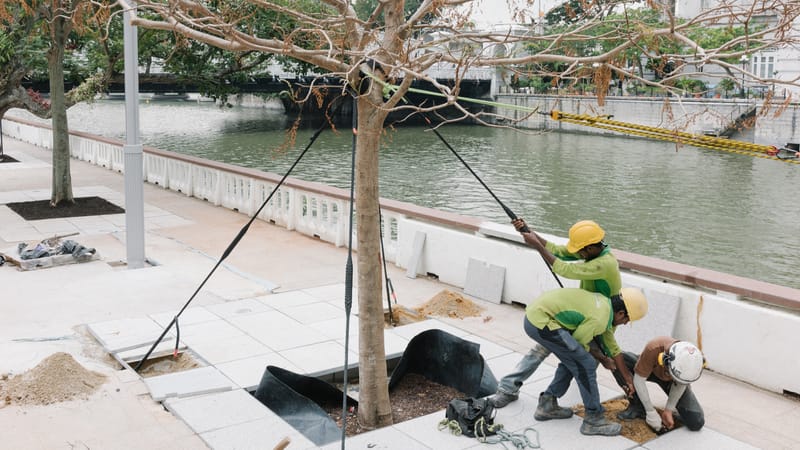
Not everyone is enamoured though. The /r/solarpunk subreddit is an online community dedicated to discussing a sustainable future (the “solar”) with an emphasis on communalism and a do-it-yourself credo (the “punk”). This utopian vision is presented as a counterweight to cyberpunk—a high-technology driven, corporate-controlled dystopia riven with social inequality. Singapore is one of the most contentious topics on the subreddit. Solarpunk enthusiasts frequently slam projects like Jewel@Changi, Parkroyal Collection Pickering and Gardens by the Bay as greenwashing. Take the last of these, for example: in the CNA documentary, horticulturalists working in the dome admit that they regularly remove the algae that insists on growing in this climate. Nature in Singapore is hardly wild nor does it flourish on its own, but is regularly and intentionally maintained in precise ways that require energy and migrant labour, which is, as Leow describes, “deemed by the state to be simultaneously human and nonhuman, at once essential yet disposable”.
It may not look like a neon-lit, smoky cyberpunk city from Blade Runner or the
dystopias that the writer William Gibson creates so terrifyingly well in novels like
Neuromancer, but its socio-economic stratification is reminiscent of the top-down
hierarchies so inherent in these bleak imaginings. As the Reddit critics may
say: solar, it may be, but punk, it is not.
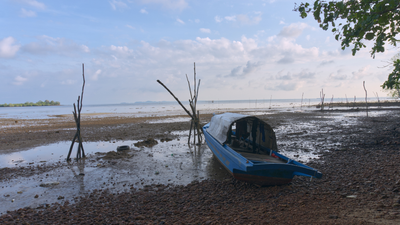
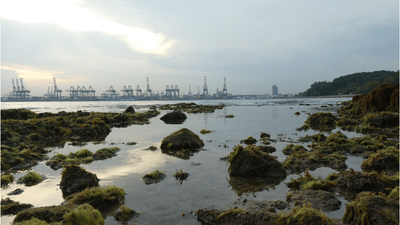
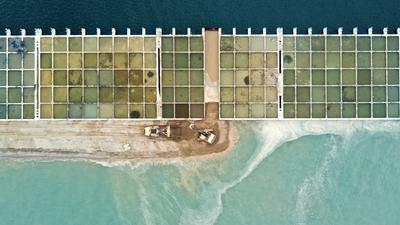
Land reclamation, another thing we take pride in, is also at odds with our claims of being ecologically mindful. In the last two decades, Singapore has grown 20 percent in size, a truly remarkable feat of engineering. However, what have we lost in the process? What have we not even had a chance to grieve over? To people out in nature during the pandemic, inter-tidal coastlines revealed the immense biodiversity along our shores. How many of these more-than-human lives have been destroyed without a thought since we started encroaching into the sea so many years ago?
Claiming land is a continuation of our colonial legacy. Colonialism’s extractive nature, manifested in plantations and industrial development, eliminated 95 percent of our indigenous flora. Reclamation retains the colonial spirit, except that a lot of the resultant devastation has now been “offshored”, for we grew in size by devouring sand from elsewhere in immense quantities. The most in the world, in fact.
In 2019, The Atlantic published a documentary that detailed how this insatiable hunger has devastated Cambodian mangroves. “Despite Singapore’s myth of self-reliance,” Aleithia Low writes in a Jom essay, “our reliance on sand reflects the inextricable nature of who we are. ‘Re-clamation’ is a misnomer that occludes the displaced destruction that land reclamation requires: the source of sand, where it is taken from, and what happens to the human and non-human beings who live on and around these sites.”
The argument can hardly be limited to sand. Singapore has a myriad of ecologically troubling connections—as a node for the petrochemical and palm oil industries, and as a major data hub that hosts 60 percent of the region’s data centres, to name just two. So, while our urban colour palette foregrounds green, the facts are heavy with greenhouse gases: Singapore has the highest per capita ecological footprint in Asia, and ranked the 21st highest globally in 2021.

Singapore Inc beams out techno-optimist and sustainability narratives, but its embrace of hypercapitalism and authoritarianism (some go so far as to call its approach to sustainability “eco-fascism”) are out of step with the philosophical foundations that underpin ecological ways of being. With the climate crisis more urgent than ever, it is imperative for its plucky-island-that-could narrative, long wielded to garner sympathy, to give way to one that acknowledges an interdependent ecosystem. Until then, our green facelifts and our eco proclamations will always carry a hint of the farcical.
In Hospicing Modernity, Vanessa Machado de Oliveira refers to modernity as modernity/coloniality. “This term functions as a reminder that the benefits we associate with modernity are created and maintained by historical, systemic, and ongoing processes that are inherently violent and unsustainable…in many stories of modernity these effects are considered the collateral damage of modernity rather than the necessary preconditions for modernity to exist.” The author also references Bruno Latour’s notion that we have never been modern, meaning that modernity’s assumptions of the nature/culture binary are superficial and impossible; we have always and will always be entangled with each other.
Perhaps this was why the callous removal of those small gardens shook my understanding of what it means to inhabit a place; and why triumphalist narratives about the success of our reclamation efforts ring hollow to my ears. If ecology is a network, then nature is a part of our immediate environment, embedded in
the quotidian and co-owned by its actors. It cannot, and must not, be relegated to tourist attractions or top-down infrastructure. But instead of communal decision-making that accounts for situational nuances, Singapore public policy in these matters often embraces eco-authoritarianism that applies a terrible moral binary to every action. In his book, Ways of Being; Animals, Plants, Machines: The Search for a Planetary Intelligence, James Bridle writes, “Imagine a system with clearly defined goals, sensors and effectors for reading and interacting with the world, the ability to recognize pleasure and pain as attractors and things to avoid, the resources to carry out its will, the legal and social standing to see that its needs are catered for, even respected. That’s a description of an AI—it’s also a description of a modern corporation.” Surely Singapore is not an AI. For all our sakes, it must not be.
How do we reshape our understanding and imaginations to celebrate, not erase, entanglements with nature? It may be useful to reconsider the philosophy of technology itself. The word’s etymology lies in the Greek “techne” and historically, it referred to the practical application of knowledge. Drawing from this, the Hong Kong philosopher Yuk Hui theorised “cosmotechnics”, a rethinking of technology such that it “unifies cosmic and moral orders” and is grounded in locality. His concepts open up questions about ways of being outside of Western technological singularity, ways that are intuitive and vibrant.
In other words, what if we saw technology not only as digital infrastructure, but in an expanded form of knowledge that enables ways of being which are harmonised,
localised and contextualised. Technology may increasingly be in charge of making
and remaking our worlds but, for now, we still retain the power to imbue it with the ethos we desire. What internal models are we building this City in a Garden on?
Singapore is not an AI simulation but a container of life itself, both human and
more-than-human, and must take life’s entanglements into account. Technology
can and should bring us closer to the world, not set us apart from it.
When I think about the ecologies I feel close to, it is not the Shiseido Forest Valley or the HSBC Rain Vortex that comes to mind, but the unnamed gardens lovingly tended to by the aunties and uncles in our neighbourhoods. These tiny rebellions, like weed growing through cracks in concrete, exist in the desire lines cutting across manicured grass, in guerilla initiatives like the Secret Rice Society, a tiny rice garden planted on the roof of an HDB block, and in people like Chua Chin Tat, the activist who worked tirelessly to conserve Dover forest, the eastern side of which has now been cleared for housing development.
There are others too, finding their way back to older, authentic ways of being outside the state’s grand designs. Firdaus Sani, for example, is a fourth-generation Orang Laut (Malay for “sea people”), the indigenous maritime community that lived around the straits of Singapore, Malaysia and the Riau-Lingga archipelago from at least the 14th century. Many consider Orang Laut to be Singapore’s original inhabitants. Firdaus runs Orang Laut SG, a platform that seeks to preserve his ancestors’ indigenous knowledge through digital storytelling, walking tours and meals prepared from seafood found in our waters. A small, but vital effort to build a more relational and participatory world.
It would be foolish to dismiss every state directive as misplaced. Just like the
entanglements of life itself, the answers to the questions surrounding our relationship with nature are not black-and-white.
In an episode of the National Parks Board (NParks) podcast, That’s Wild, Lim Jiang Jim, NParks group director of conservation, talks about how Singapore as a historical entrepôt has amassed many non-native invasive species that require interventions, without which Singapore’s native forests could be decimated. Through careful conservation efforts, Singapore is rewilding, but just how so requires a critical, continuous dialogue.
The philosopher Alexis Shotwell writes that our relationship with the natural world is a constant ongoing negotiation with “no predetermined answer”. It is in this very
liminal space that makes fewer assumptions about the net good of digital technologies that we can learn how to be better companions to one another, human and more-than-human.
Bridle echoes this towards the end of his book. He says, “active, practical care resists certitude and conclusions. Rather, this kind of solidarity with the more-than-human world consists in listening and working with, in mitigating, repairing, restoring and engendering new possibilities through collaboration and consensus. It is the result of encounters, not assumptions, and the repudiation of human exceptionalism and anthropocentrism…Placing solidarity at the heart of our relationship with technology is part of this shift in attitudes.”
In order to practise this care, we have to continually make room for all the entanglements of life. The knowledge systems of the neighbourhood elders who plant gardens, the moss and algae ceaselessly growing back, the indigenous communities and the migrant workers who have become so intimately acquainted with our city structures, are just as important in growing a flourishing ecology. If we welcome them, then perhaps Singapore will begin to move from being a City in Nature to being a City of Nature: drenched and enfolded in all that life can bring.
Charmaine Poh is Jom’s head of visual culture and media. Read her other essays for Jom here.
This essay was first published in Jom’s annual print magazine issue No. 2, released last year. Letters in response to it can be sent to sudhir@jom.media. All will be considered for publication on our “Letters to the editor” page.