
“You know, this is my grandfather being buried...
It’s not the laying of bricks for your HDB flats...
Let me remind you, sir, there are two hundred people standing and waiting there at the cemetery with my grandfather lying there in his big coffin without a hole to get into”
— excerpts from “The Coffin is Too Big for the Hole” (1984) by Kuo Pao Kun
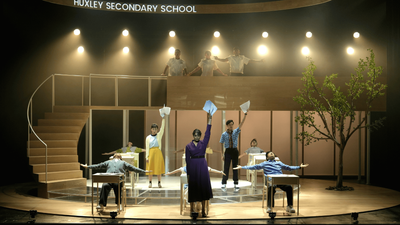
In Kuo Pao Kun’s seminal monologue, the protagonist wants to bury their grandfather, but can’t. The problem is with the late patriarch’s outsized coffin, leading Kuo’s character to draw a parallel between the standard-sized HDB flat and the standard-sized burial plot. The protagonist bemoans the monotony of a life lived through a series of rectangular confines, but a compliant, conformist life has been inevitable for some time now. To live in Singapore is to swap one rectangular box for another, hole to hole, cradle to grave. Over the past few months, I made my way through a litany of such block-like rooms at a major event on the local arts calendar: the Singapore Biennale 2025.
Decommissioned classrooms, declining shophouses, ageing malls, former colonial housing, and repurposed defence headquarters—the biennale, subtitled “pure intention”, unfolds over five months and five key neighbourhoods, each offering us varying configurations of the standardised box. We are invited to consider the aspirations that guided the city’s initial development and transformation, acquainting ourselves with the past as a way to re-encounter and appraise the present. The biennale gathers over 100 existing and newly commissioned artworks from over 80 artists and collaborators across the world. From domestic minutiae to site-specific spectacles, Singapore Art Museum (SAM) curators Duncan Bass, Hsu Fang-Tze, Ong Puay Khim, and Selene Yap have recontextualised these works in the urban sprawl of the boxy units that shape our everyday life.
As I walked between these blocks and boxes, it felt like I was doing a condensed walkthrough of my life in Singapore. These spaces were a representation of my years in school, the flat I’ve always lived in, the vicinity of my first full-time job, the mall I found my favourite jacket in. It was a jarring experience, both familiar and strange, making my way through the building blocks of an exhibition that could easily take the place of any box unit in the country. To accustom and acquaint myself with the artworks in these uncanny sites, I spent time lingering in, sometimes revisiting, these exhibits over the course of five months in order to make sense of art and its place in a city that prides itself on being ruthlessly, at times performatively, practical.
Where does cultural production and artistic excellence fit in this agenda? For decades, Lee Kuan Yew’s 1968 declaration that “poetry is a luxury we cannot afford” has shaped our cultural consciousness and scarcity mindset. It seems fair to take “poetry” as synonymous with “art” in general. Art, so the state assumed, would bring neither survival nor success. This dictum has long been a point of collective contention by local cultural workers, sparking numerous indignant essays, responses and at least two poetry anthologies. Art was condemned to an ever-belated arrival, constantly forced to justify its existence.
In 1989, it seemed that art’s time had come. One of the many catalysts was that the boxes of economic and national development had finally been checked. In his opening address for the Report of the Advisory Council on Culture and the Arts, then prime minister Goh Chok Tong declared that Singapore had “reached a stage...when we should devote greater attention and resources to culture and the arts”. Art, however, still needed to justify its existence: to build “social bond[s]”, to bring “vitality” and, ultimately, to create “a more congenial environment for investors and professionals to stay and tourists to visit Singapore”. The legitimacy and existence of the arts remained dependent on, and secondary to, economic growth and foreign investment.
Nonetheless, the advisory council’s inaugural report on the Singaporean arts landscape led to the formation of the National Arts Council, as well as a series of Renaissance City Plans. These five-year plans sought to establish Singapore as a “global arts city”—one that would welcome “knowledge-based industries and talent”—and also “strengthen national identity and belonging” among its citizens. A biennale was mooted as part of these plans to signal that Singapore now had the capacity to build cultural capital to attract and exhibit superstar artists. But, as it must, art follows commerce. The first Singapore Biennale was presented on the heels of an economic blockbuster hosted here in 2006: the International Monetary Fund and World Bank Annual Meeting.
This eighth biennale has come a long way from its baldly instrumentalist beginnings. Typically a vehicle for large-scale, public spectacles, the Singapore Biennale has previously been staged both on busy streets and cavernous halls. But for an event delivered as part of the SG60 celebrations, the 2025 edition often feels muted and self-contained. It largely sets aside self-congratulatory celebration to turn its gaze inward. As activity declines in the spaces it occupies, the biennale examines the veracity of claims that “non-essential” art-making can only find its place after the building blocks of society have been laid. What might our city look like if the development of art wasn’t regarded as secondary? I visited every site, thinking about how each expansive space and its artworks all came together; this essay is less a timesheet of my footprints than a thematic meditation on all my encounters. In weaving art into the fabric of daily life, the biennale reimagines art as persistent and perpetually developing, within and beside the country’s oldest industrial endeavours. “pure intention” proposes that art can be regarded as simply another block built into the foundations of the country, that encountering it should be regarded with as much wonder and awe as an economic miracle. Survival, after all, is a creative act.
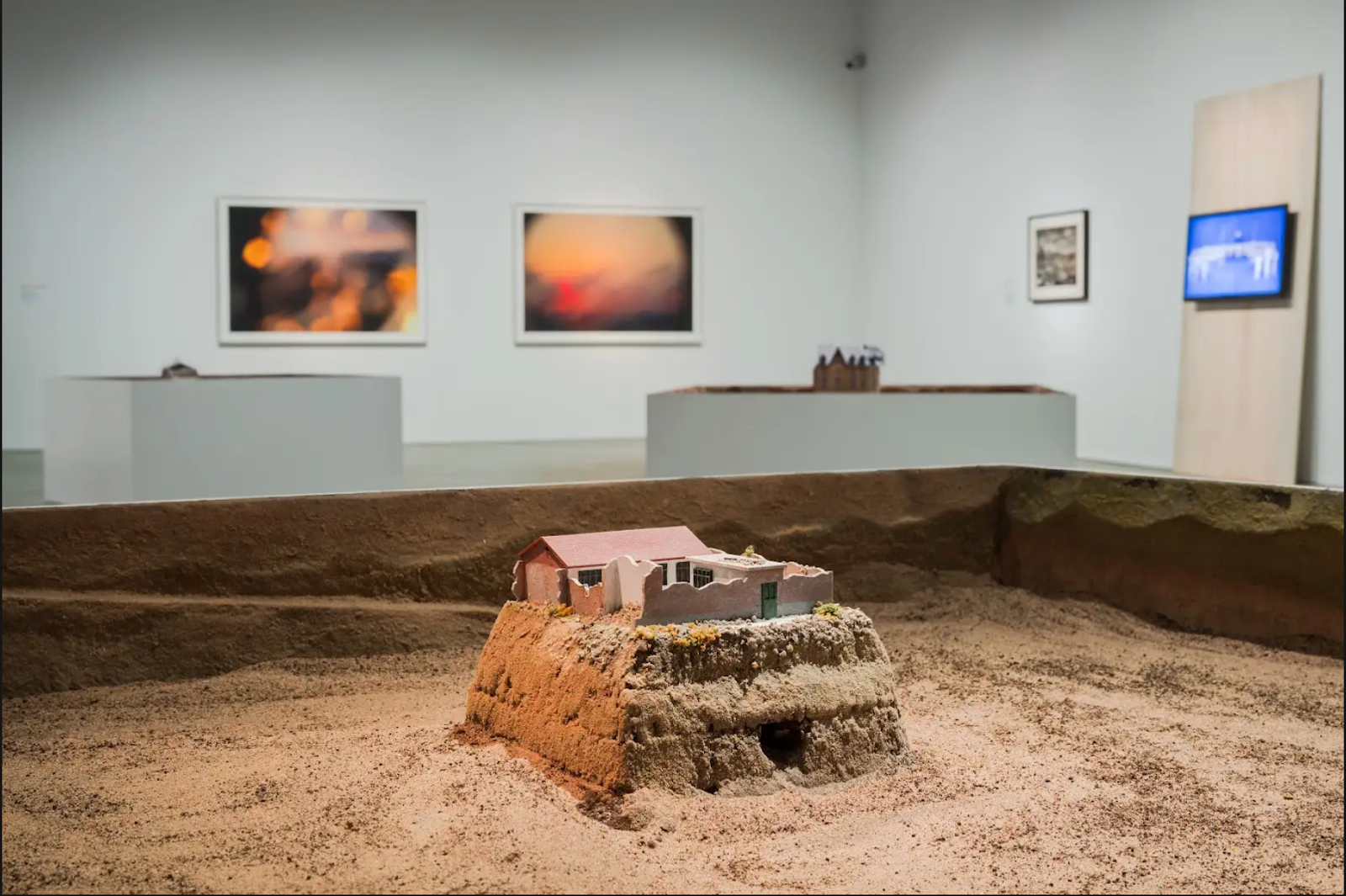
One of the boxes the biennale offers us is SAM’s Gallery 1 in the portside Tanjong Pagar Distripark. At the heart of its white, blank-slate space are three identical white square pedestals. Nestled in the hollow of these smaller white cubes are tiny, 1:100 scale miniatures of “nail houses”, the final holdouts of homeowners from Qingdao, Yichang, and Zurich who have refused to move despite seductive offers by real estate developers. Meticulously reconstructed by Kurdish artist Ahmet Öğüt, these dioramas of polystyrene and wood each feature a lone structure. Though the architectural aesthetic of each building differs between cities, the sentiment of devastation remains. Developers have razed everything else around the houses. If these tiny homeowners open their front doors, they risk tumbling into a steep valley of red sand and soil.
I paused to study the angled slopes and large vehicle track marks in each diorama, and thought I saw thin paths in the dirt around the houses. It was proof to me that these inhabitants had managed, time and again, to find their way up and down the sheer cliffs their houses sat on. In his presentation about “Pleasure Places of All Kinds” at SAM, Öğüt spoke about how the standoff in Zurich between resident and developer persisted for three years, despite electricity and water shutdowns. Many of the holdouts he studied were not politically motivated. Rather, the owners often had sentimental attachments to the places their families had been born in. I recalled Singapore’s own nail houses: the one at 54 Lorong 28 Geylang, which houses the lush private gardens of the owner, and at 337 Guillemard Road, which houses a Buddhist temple hall open only to family and friends.
I stepped out of this white cube and into a dark cave at the National Archives of Singapore for “Membrane”, a cave exploration conceived by The Observatory in collaboration with DuckUnit. This immersive Virtual Reality experience by one of Singapore’s most beloved experimental bands transforms a box office into a padded room, leading its viewers on a solitary exploration that begins with a palaeolithic handprint on a cave wall in Sulawesi, Indonesia, then descends through a tunnel in a freefall. I felt like I was in “noclip” mode in a video game, and tried to clutch at the pads on the wall to orient myself as large pieces of earth and rocks flitted by—before I realised that I was simply passing through these usually impenetrable objects. It was easier then to submit to the sensation of falling backwards, free of gravity. I noticed the tickling chirp of insects, the slow trickle of water, the extended roots of an ancient tree.
My disorienting descent ended in the home of an elderly woman preparing a meal. In just 15 minutes, I was catapulted 60,000 years from a prehistoric cave to a greenish kitchen. We didn’t seem to be in Singapore. Once she finished preparing the meal, the woman opened the back door, and seemed to call out to someone. It felt like the universe had re-arranged itself for 60 millennia just so that this woman, and I, could be here together.
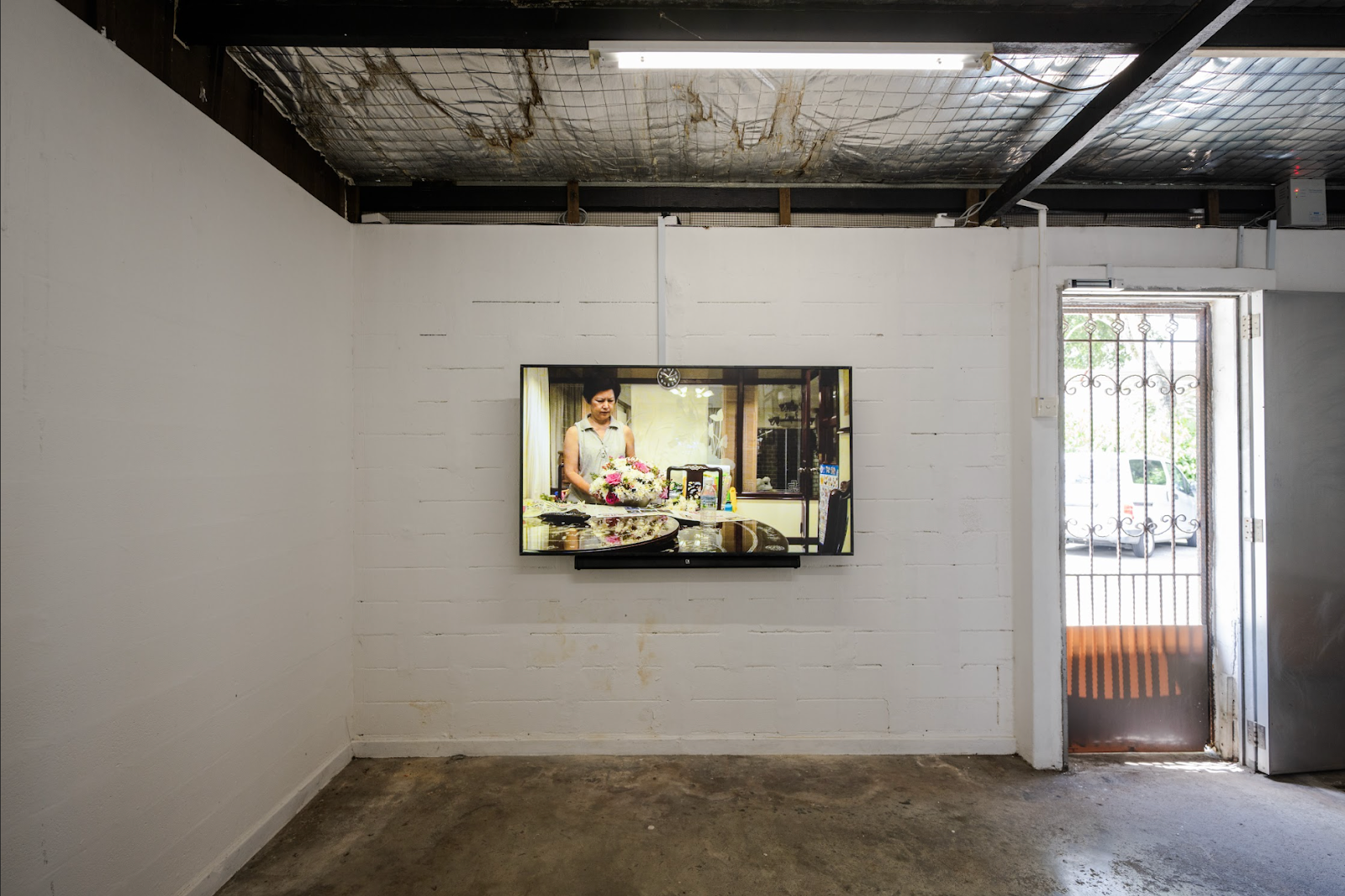
I ran into another older woman, this time a half-hour train ride westward of the National Archives. She was in a public housing estate in Tanglin Halt pending demolition, where a shophouse that once housed a Chinese medicine hall stands frozen in time. The hall has been converted into the site of Malaysian artist Kah Bee Chow’s work; I arrived here after spending an entire morning at another biennale exhibit and promptly walked past it. I retraced my steps to find a nondescript entrance framed by a laminated vinyl clock instead of a shop sign. Here, time dilates, and Kah insists that we pay attention to its passing.
I wandered into the back room, where the exhibit continues with “Effeminacy”, a single-channel video of Kah’s mother arranging flowers. I watched idly as she alternated her attention between the television and the salvaged blooms on the table, then realised I was also alternating my gaze between the screen, and the changing shadows and sunlight seeping in from the open back door. I finally noticed the clock above her head. For the next 14 minutes, I watched time tick by until the clock’s minute hand returned to its starting point. 10.10 is the moment the video loops. On my way out, I glanced at the vinyl clock and realised that it, too, was frozen at 10.10.
I spent many mornings and afternoons drifting through these boxes. Besides the gallery sitters I greeted at every exhibit, I was often the only visitor. I had the privilege of time to spend, to plot my journey through the biennale, but I wasn’t so sure if other viewers had the same currency I did. It’s hard to prioritise what to do with time off from work, picking between rest, family, entertainment, or culture. These time-based works demanded long investments of time: the years-long standoffs between residents and real estate developers, the fast-forwarded time from prehistory to the present day, the languor of time passing through the hands of a woman left to her own devices.
I was comforted by the presence of Kah’s mother as she contemplated what her flowers could look like. Her work felt effortless: she’d place a stalk in one place, then remove it if she felt it didn’t quite work. Time, in this instance, was not marked by the productivity that Singapore so often demands, but through the dignified solitude of a woman tending to her flowers. It felt like a meditation on the temporal regimes that govern us—which I’d briefly escaped.
In the 1970s and 1980s, Singapore saw a boom in strata-titled malls, which lowered the barrier to entry for small businesses looking to set up an office or storefront. Because each unit had its own landlord, this model was popular with developers because it allowed them to minimise financial risk. Today, some of these malls, such as Peninsula Plaza, remain well-frequented especially amongst migrant communities; others, like the former Golden Mile Complex, have been forced to shutter for redevelopment. These decaying malls have become popular sites for “demolition parties” like the recent 2024 takeover of the late Peace Centre, which took its last gasp as a hollowed-out playground for creative communities and arts groups to experiment with installations and projects before it’s replaced by shinier, trendier developments. The biennale similarly occupies a number of spaces in strata malls with artwork that completely reimagines the potential of a retail unit.
I went looking for the biennale units in Lucky Plaza, a higher-traffic strata mall best known for hosting Singapore’s substantial Filipino diaspora. They were all on the third floor, their entrances glazed with translucent film. I found Tan Pin Pin’s exhibit because the documentarian was standing right outside, greeting some visitors.
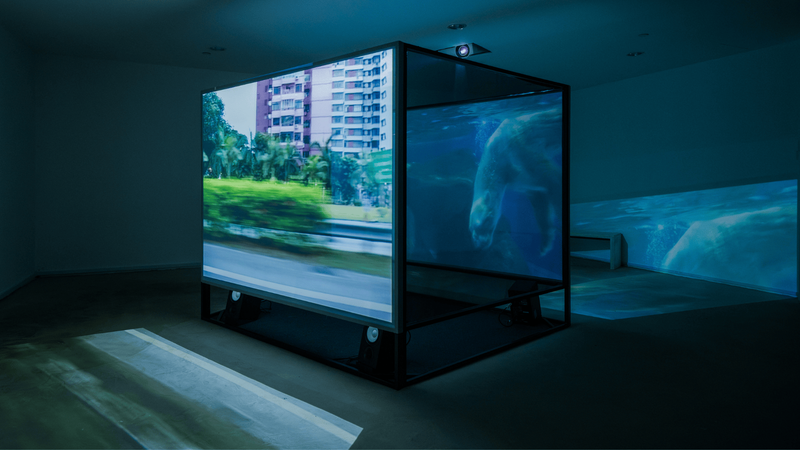
Tan is perhaps best known for her astute observational work. To step into “On a Clear Day You Can See Forever” is to submerge yourself in an aquatic zoo enclosure and seal yourself into your car for a long ride all at once. Two screens occupy the centre of the darkened shop. On one of them, Inuka, the first polar bear born in captivity here, does lazy laps around a man-made Arctic habitat. On the other, we see one long take from the passenger seat of a car zooming across the Pan Island Expressway at 80km/h. The translucent screens are positioned parallel to each other, creating a dreamy composite where Inuka appears to be swimming in slow, aimless circles along a busy, straight highway. Tan has long traced the shifting fortunes of spaces on this cramped island—where bodies are permitted to linger, and where they are exiled from. In this work, we’re standing at the intersection of timescales. To reduce the travel time from one point of a little red dot to another seemed, here, to merely refine the confines of an island enclosure not unlike the one Inuka circles around. All those minute tweaks and adjustments that this hyper-accelerated, hyper-efficient city does to make the cog run just a bit quicker: does it actually bring us where we want, or need, to go?
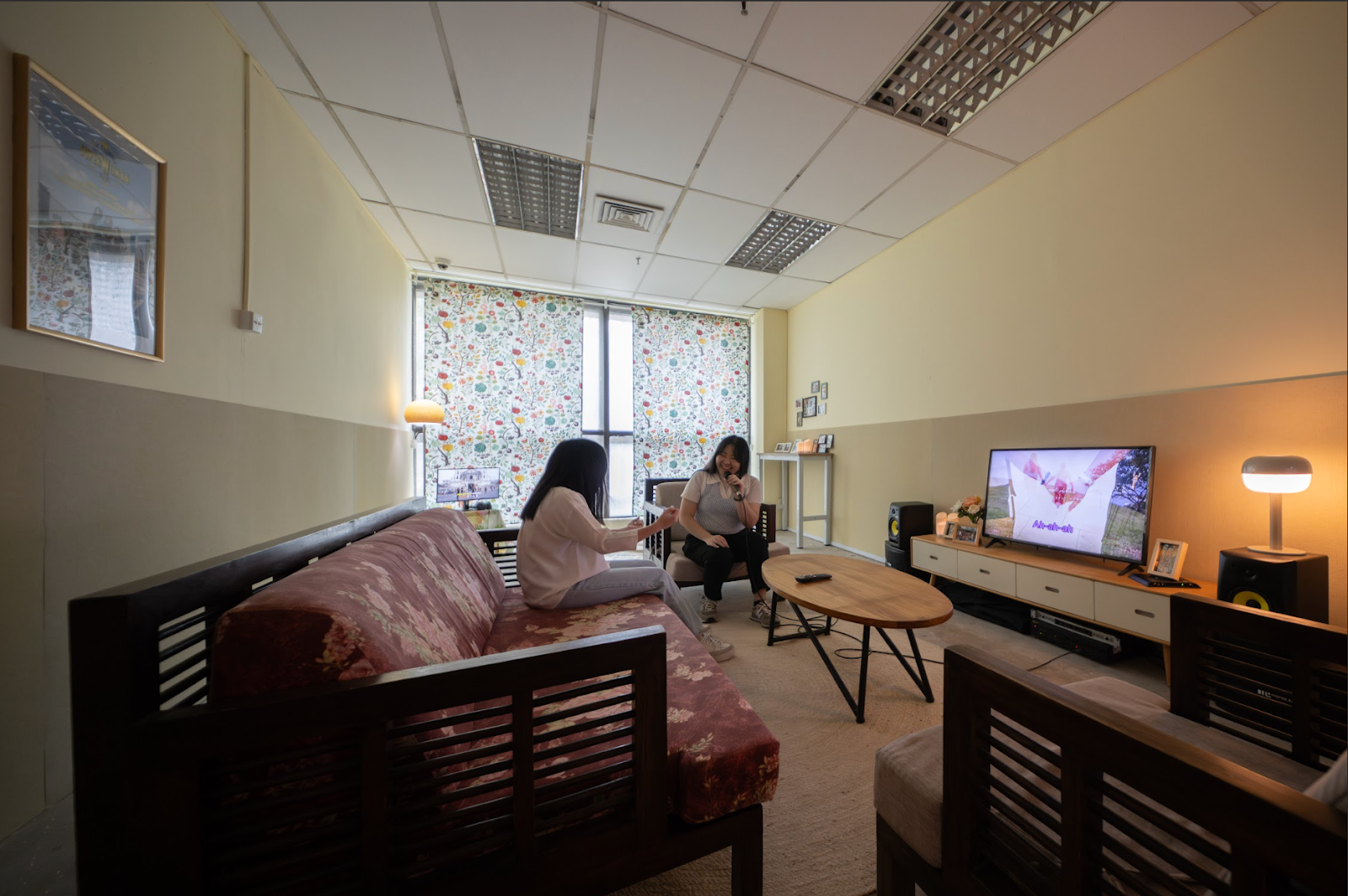
Just a few feet away, hidden behind a small entryway, was a living room for bidyoke (karaoke) sessions. This setup was conceived by the Filipino choreographer and visual artist Eisa Jocson in collaboration with the nonprofit Humanitarian Organisation for Migration Economics (better known as H.O.M.E.). Created with the Filipino enclave in mind, “The Filipino Superwoman X H.O.M.E. Karaoke Living Room” is a light-filled space furnished with a plush sofa, rattan mats, and cheerful floral blinds. Playing on the television and speaker are a series of karaoke videos shot, edited, and performed by foreign domestic workers. There’s also a microphone, should anyone be moved to break into a spontaneous singalong. The playlist is hard to resist: Journey’s “Don’t Stop Believin’”, Maymay Entrata’s “AMAKABOGERA” and Olivia Rodrigo’s “traitor”, each music video set in the public locales where these women spend their rest days.
The foreign domestic workforce in Singapore often has no “home” to retreat to, given that the houses they reside in are also their workplaces. I appreciated the transformation of a retail unit into something familiar and deeply embedded in Filipino culture, a striking way for art to bridge both our communities. At the same time, I wondered about the effectiveness of a sealed space, where one must pass through a heavy sliding door with a garish electronic lock—as opposed to the accessibility of another artwork on the same floor, Argentine artist Gabriela Golder’s “State of Assembly” exploring women’s collectivity. To enter this unit, one simply pushes past plastic flaps to watch her three-channel video. The cramped karaoke living room, especially with the close proximity of a gallery sitter, felt less like a space exploring the possibilities of gathering and rest, and more like an exhibit under constant surveillance.
I headed to the edge of Orchard Road, to a unit in a floundering strata mall: Far East Shopping Centre. There, The Packet, a Sri Lankan art collective, has transformed the space into an Internet cafe. Once ubiquitous, but now a post-smartphone relic of the 1990s and 2000s, the unit has been outfitted with dull tungsten lighting, cubicles of computer terminals, cute cartoon mousepads, and flimsy office chairs. “Water Under The Bridge / A Bridge Under Water” features the work of 12 artists on YouSurp, a video-hosting site that can only be accessed at this particular cafe. This airgapped platform presents the works of each artist as distinct playlists. Click on their intriguing one-sentence loglines, and you’ll see their work, a blend of archival footage and video recordings that uncover conspiracies, offer insight into, and critique their respective countries.
Finbarr Fallon, a London-born and Singapore-based architecture photographer, speculates on the possibility of National Day celebrations carried out by machines. Alana Hunt, Australian visual artist, returns to the scene of Western Australia’s forced displacement of First Nations peoples through footage found in the state archives. Whenever the government-sponsored commentary veers into a celebration of its achievements, Hunt intervenes with a black screen that quotes the offensive statement to highlight the hypocrisy of its sentiments, noting in a description box that this progress and prosperity was limited only to the settlers who colonised the land. Devadeep Gupta, an Indian multidisciplinary artist based in Assam, presents a series of episodes in a video essay consolidating his research into and fieldwork on illegal mining in Assam’s Dihing Patkai rainforest. In the sixth episode, as he descends into the mines, an interlocutor captures the intensity and danger of the experience: “You can’t stand. You can’t breathe. You just keep moving hoping the ceiling doesn’t cave in.” This is juxtaposed with an offhanded comment below the video saying that it reminded them of the video game Minecraft.
I visited this internet cafe multiple times—despite my initial frustration that I was making a journey all the way to Orchard Road, only to swap the laptop I’d been working on in my room for a computer in yet another room. Some videos I clicked on jammed the site, bringing it to a complete standstill. The bugs never seemed to have been resolved because every subsequent visit I made was marred by similar crashes. But the angst of not knowing if I could ever complete an entire series of videos in a given work eventually gave way to something else. I found myself appreciating the concept of a highly curated video hosting site that could only be accessed at one physical location. I’m an active consumer of endless YouTube shorts and videos, available to us at any time for mindless consumption. YouSurp, which demands that you make a pilgrimage to see its dystopic visions of the future, felt like a far more valuable way of observing and reckoning with the present.
After spending months with the sprawling entity of the biennale, I could admire its offerings, but not without an undercurrent of doubt. The exhibits in commercial spaces seem to blend into their everyday surroundings, evoking exciting possibilities for how we might encounter and interact with art on a day-to-day basis. But I often wondered who these works were for. Were they for Singaporeans, and marginal communities here? Or were they for the discerning in-crowd of the art elite? In the case of “The Filipino Superwoman X H.O.M.E. Karaoke Living Room”, I was able to appreciate the videos without the burden of having to reconcile what it means to be “at home” with a temporary “home” enacted under the auspices of an art exhibition. My life was comfortably separate from this display and performance. And the reason I could return over and over again to various exhibits was because I had the privileges of convenience, resources, and time. Many do not have the luxury of dodging the routines and obligations of the work box or the home box, whether these are offices, factories, construction sites, flats, or dorms. Even as the biennale encourages us to escape capitalist time, we remain governed by it.
Resisting the impositions of space and time in Singapore can feel almost impossible. So much of resistance in Singapore—to what is unjust, unethical, or unfair—has to take place elsewhere, or the protest and critique indirectly made. When holding up a piece of cardboard with a smiley face on it can be considered an illegal act, we seem to have to live vicariously through the lives of artists and activists elsewhere. Art spaces often have to curate outside the box to engage with anything perceived as contentious, to gesture at provocation rather than be explicitly provocative. I interpreted some of the curatorial choices as deploying space as a way to address power from a distance, while remaining vague and tenuous enough to evade policing.
Over at Blenheim Court, a colonial-era residence in Wessex Estate, the Puerto Rican artist duo Allora & Calzadilla critique American imperialism and weapons testing in “Returning a Sound” and “Under Discussion”. In the first short film, a young activist travels around the small Caribbean island of Vieques on a moped whose exhaust pipe has been fitted with a trumpet playing military reveilles. This is followed by a young man overturning a meeting table and using it as a makeshift boat to navigate the island’s perilous waters. In this fictive cinematic space, we are presented with tactics of subtle, untraceable, civil disobedience. I found “Mirage: Agape” by the Indonesian moving image artist Riar Rizaldi especially riotous. He’s created an animatronic decapitated head that bears a striking resemblance to Jan Pieterszoon Coen, a contentious governor of the Dutch East Indies, which has been placed next to a single-channel video work that looks at Sufi mysticism as a rich vein of knowledge production. To exhibit a work like this at the former Raffles’ Girls School, the elite institution bearing the namesake of the British colonialist Sir Stamford Raffles, is to provoke an immediate projection of Raffles’ head on the table.
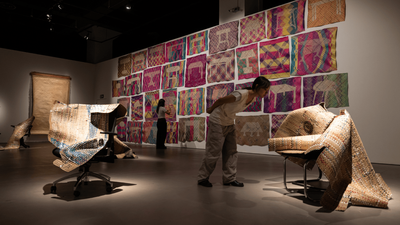
Taken together, all of these works seem to build upon each other, a woven tapestry of themes and meanings. In that vein, Presiden Tidore’s “Koleksi tenun (Collection of weavings)” is a particularly evocative image to end with. The hip hop artist and dedicated collector of textiles has, for over 15 years, been compiling an ever-expanding collection of weavings, from his grandmother’s house to other encounters with traditional weavers across Indonesia. The biennale describes these woven relationships as “acts of diplomacy”. A piece of fabric doesn’t displace previous pieces or squares of fabric; rather, the newer arrivals are sewn into a much larger network of encounters. Perhaps we, as spectators, aren’t simply swapping one standard-sized box for the next as we make our way through the biennale—or in life. Each of our encounters with artwork is a building block for the constellation of spaces and durations that shape this biennale and inform what is yet to come.
Sasha Han is a film writer and programmer interested in the circulation of images and its potential for resistance. Her writing has been published by the Asian Film Archive, Documentary Magazine, Film Comment, MARG1N Magazine, Mekong Review and Queer East. In 2025, she co-founded CORRESPONDENCE, a film publication based in Singapore.
The Singapore Biennale runs till March 29th. Admission is free.
Letters in response to this piece can be sent to arts@jom.media. All will be considered for publication on our “Letters to the editor” page.