
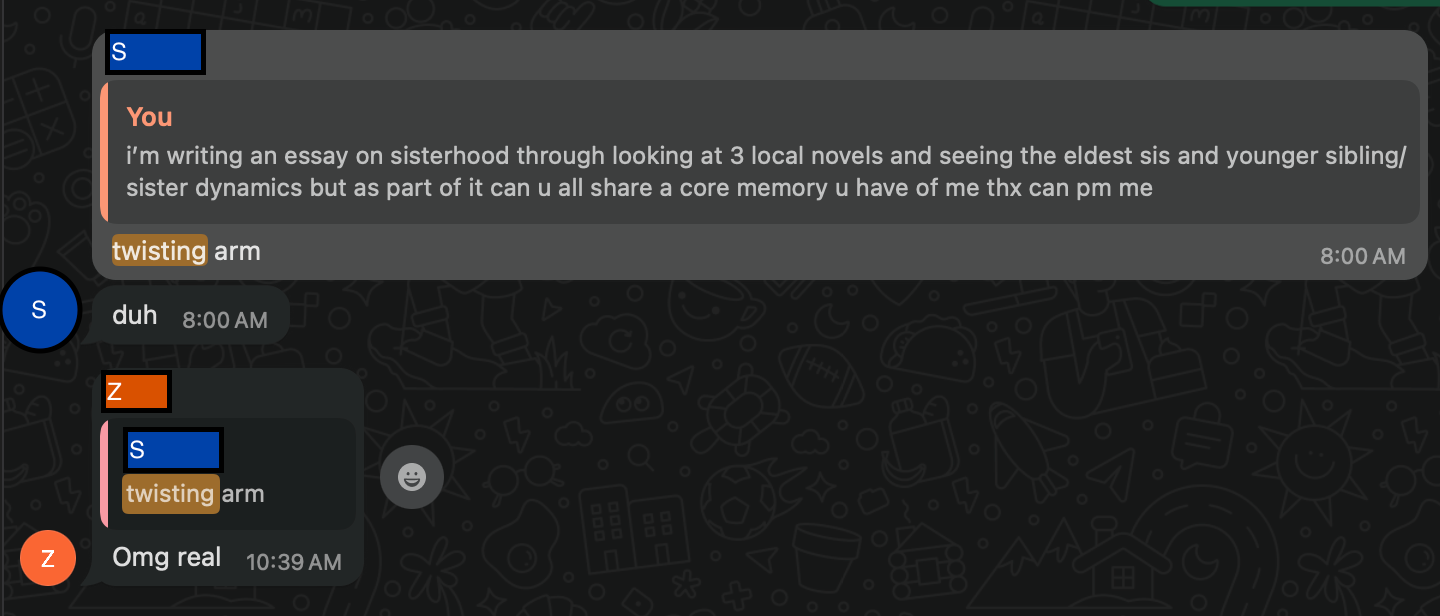
In preparation for this essay, I asked my three younger siblings for their strongest memory of me growing up. The immediate response? “Arm-twisting.”
When we were children, I’d literally twist my sisters’ arms—never hard enough to actually injure anyone, I promise—if they did not follow my parents’ instructions (or mine). My brother, the youngest child, shrugged. “You take responsibility for a lot of things,” went his offhand interpretation of my minor abuses of power.
This, for me, perfectly encapsulates the experience of being an eldest daughter. She’s a demi-maternal figure who protects her younger siblings, shows them the way and, occasionally, strong-arms them into submission.
Much has been said about the “eldest daughter syndrome” in popular discourse, describing a set of recurring behaviours and burdens faced by eldest daughters across families and cultures. The Straits Times called it an “invisible ailment”. Some familiar scenarios: being tasked with childcare, mediating conflict, or setting an example for younger siblings.
Beyond the anecdotal, there has been increasing interest in how birth order has longer-term implications for an eldest daughter’s personality and sense of self. A study led by UCLA researchers revealed that stress experienced by pregnant mothers was linked to earlier physical maturation in firstborn daughters, perhaps, they postulate, so that daughter can sooner help mother care for subsequent siblings.
Yet, it’s certainly not all nature. A 2023 article in The Atlantic highlighted that eldest daughters are not naturally endowed with caregiving and perfectionist tendencies. Instead, caregiving responsibilities are imposed upon them by a culture that presumes how girls and eldest children should behave.
Regardless of whether you’re looking at peer-reviewed research or anecdotes floating around online, it’s worth remembering that there’s no singular experience of being the eldest daughter. Consequently, the term “eldest daughter syndrome” might not resonate the same way with every firstborn daughter, if at all.
It’s this ambiguity that has influenced the literature I’ve been drawn to over the past year. And what are the odds: we have three new books by young Singaporean women writers who, independently of each other, decided to do deep dives into eldest daughter dynamics—and also chose to carve new territory for themselves in the western literary world.
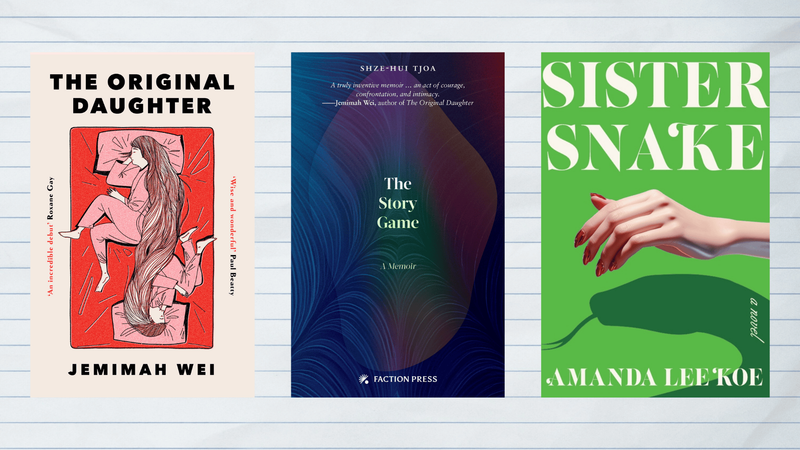
Jemimah Wei’s The Original Daughter amassed mainstream literary acclaim in the US when it was published in May. The novel counts rockstar essayist Roxane Gay among its fans, and was a Good Morning America Book Club pick. The episodic novel follows Gen and Arin, two girls from low-income families in Singapore and Malaysia who are forced to become sisters overnight when their parents shake on an adoption transaction perhaps more commonplace in postwar Singapore, though not unheard of today. Through their warm, heart-wrenching story, Wei explores class, coming-of-age, and the trope of the found family.
In Sister Snake, Amanda Lee Koe offers a maximalist, genre-blurring tale of the mythical snake spirits Emerald and Su, sworn sisters who also happen to have diametrically opposing personalities. The immortal and itinerant sisters live lifetime after lifetime in locale after locale. Here, Lee Koe has each sister find belonging in another pair of diametrically opposing cities as a way to compare and critique state and societal impositions on gender and sexual freedoms: the fetishisation of East Asian bodies in New York, and the policing of queer rights in Singapore, particularly in secondary schools.
And in The Story Game, Shze-Hui Tjoa’s experimental memoir deploys autoethnography and self-reflexive introspection to excavate her own family trauma and a severed relationship with her sister, Nin. Released in South-east Asia in June after a successful debut in North America last year, it’s a compelling narrative that navigates the nuance and messiness of complex post-traumatic stress disorder with care and precision.
These books deal with diaspora, class, sexuality, and structural inequality, among other themes, but it is their handling of sisterly dynamics that I found myself returning to. And each of them has allowed me to reflect on my own daughterly and sisterly experiences with greater clarity.
To be the eldest daughter is to be a parent twice—once to yourself, and again to your siblings. Gen, the titular “original daughter” of Jemimah Wei’s book, takes on this burden of surrogate parenthood when she’s just eight. Arin, her cousin-turned-sister, is transported from across the Causeway and deposited on the family doorstep. Arin’s father, an uncle Gen never knew she had, can no longer afford to care for the younger girl. In that moment, Gen is thrust into a position of not just eldest daughter and older sister, but also reluctant caregiver and manager of her household’s emotions.
This shows up most explicitly in her relationship with her mother. Gen watches her stoic, avoidant and over-protective mum—so intelligent, yet so trapped—hold herself to impossibly high standards, then punish herself for failing to achieve them. For one, she’s constantly applying for roles in academia despite lacking a university degree, thus facing an endless string of rejections. While it can be tempting to disparage her self-deception, Wei persuades us to empathise with her, presenting these repeated attempts at upward mobility, including the pipe dream of a prestigious job in academia, as a kind of “cruel optimism”. This term was coined by literary theorist Lauren Berlant to describe how something you desire might actually become “an obstacle to your flourishing”.
Gen internalises, then succumbs to her mother’s toxic cocktail of ambition, helplessness and rage. Gen’s role of “affective administrator” for her family means that everything else takes a back seat. She does poorly in her A-level examinations and is condemned to the purgatory of the university waitlist. Crushed by Singapore’s pressure-cooker education system and a string of unfulfilling jobs, she begins to resent her younger sister for succeeding where she’d failed—by her own impossible standards. “She [Gen] is really mad at herself, and she’s mad at the world, and she’s mad at the fact that she’s so young,” said Wei on the literary podcast Poured Over. “It’s probably an eldest daughter thing.”
Wei was right about that. After my O-levels, I told my dad I was keen on a mass communications programme at Ngee Ann Polytechnic, then mentioned I’d kept a junior college—his alma mater—as a backup. He lit up at the latter, and I quietly nudged my plans in that direction. Even in a supportive family I, too, felt the internalised and unspoken pressures that Gen did as she balanced duty and disappointment: to lead by example, to forge a path my siblings would be proud to follow.
In The Story Game, Tjoa betrays a similar desire to parent Nin, her younger sister. She alternates between chapters that read more like a conventional memoir and chapters in which she conjures up an imaginary room, independent of chronological time, where she might converse with her sibling. Here, an adult “Hui”, Tjoa’s avatar, also conjures up a child-like Nin, who speaks with the “pitch and tone of a little girl.” As the adult in the room, Hui is the de facto parent-caregiver figure. She takes on a distinctly maternal tone: soothing, prescriptive and, at times, pedantic. In these conversations, Hui talks at, rather than with, her sister, using a malleable Nin as a means to reframe her past. The power dynamic is unmissable. One can’t help but wonder about Tjoa’s decision to cast Nin as a little girl—a child “too young” to comprehend “the real world of grown-ups”. Why not meet her sister as she is now? This narrative choice suggests a longing not just to reconnect, but to reassert control over a story and a sisterly relationship that has slipped out of Tjoa’s hands.
This control often passes for protectiveness. Eldest daughters are often expected to protect younger siblings, pretty much from the moment they’re born. In Lee Koe’s Sister Snake, we see older sister Su ready to give up any—even all—of her vital, life-sustaining qi for younger sister Emerald’s sake. No small sacrifice for an ancient snake spirit from the Tang Dynasty who would otherwise be immortal. Su, straight-laced and by-the-book, couldn’t be more different than Emerald, who’s filled with a joie de vivre that would put Amélie to shame.
Su’s hypervigilance and Emerald’s hedonism are the source of a perpetual rift. But Su goes to great lengths to keep her—their—serpentine secret safe. She endures aesthetic treatments that score wrinkles onto her preternaturally smooth face; refuses to moult; agonises over Emerald’s forked tongue and slithery, snake-like walk. But the moment she learns Emerald is in danger (in true eldest daughter fashion, she’s set a Google alert for her sister), she takes the first flight from Singapore to New York in search of her wayward kin and, unbeknownst to Emerald, exacts venomous snake vengeance on anyone who might dare endanger her beloved sibling.
Su’s yearning for order colours her view of New York, whose chaos threatens to unmask her creaturehood at any moment. She sees Times Square as a “gladiator arena”, where the survival of the fittest is the rule. She keeps her interactions with locals to a minimum, slipping quietly into crowds and playing the role of a graceful upper-class woman to avoid suspicion. Emerald, by contrast, sails through the city with a reckless glamour, carousing with strangers on sugar dating apps to savour their qi. Su relishes the manicured order of her chosen home of Singapore. The city-state tames desire, but it also calms her anxious hypervigilance. These twin settings function as sister cities, mapped onto the internal conflicts and polarities of the characters themselves.
Like Su, I tend to anticipate all worst case scenarios, rehearsing for harm so I might keep others (and myself) from it. I remember countless nights as a young girl spent sitting by the phone, dialling my parents whenever I felt they’d been out for too long. What if they’d decided to abandon us? Or had an accident? I would not be placated, no matter my parents’ reassurances. My siblings somehow always trusted they’d return. But how?
In The Original Daughter, Gen and Arin take a different path towards protector and protectee. Gen recognises her grandmother’s “oceanic cruelty” towards Arin when the acerbic matriarch calls her adopted sister a “half-wit” and “daughter of a coward”. She decides to help Arin devise an elaborate escape to her home in Malaysia. The plan falls through, but not her fierce instinct to protect her younger sister. When their troubled relationship with their grandmother reaches a tipping point, Gen flushes her grandfather’s ashes down the toilet. This sends their grandmother into a fit of insurmountable grief. She soon dies, heartbroken. To protect Arin from pain, Gen inadvertently inflicts it on someone else—reminding us eldest daughters that our fiercest instincts can have unintended and irreparable consequences.
Whether we’re the surrogate parent or an over-protective protector, and regardless of whether these roles were imposed on us explicitly or internalised by us subconsciously, there’s one more role to rule them all. We eldest daughters are consistently expected to be role models for our younger siblings. Yet neither “role” nor “model” are well-defined. It’s hard to develop a strong sense of self worth and identity, when both are tightly bound to meeting our families’ needs.
Tjoa uses her inventive memoir as a means to deconstruct her role as a model sister and daughter, particularly when it comes to her fraught relationship with the younger Nin. Tjoa takes an ethnographic approach, casting a critical gaze on her personal and familial identity like an anthropologist examining a subject; except the subject is her. As both participant in and observer of her own life, Tjoa has a unique vantage point from which to probe the intersections of ethnicity, kinship, nationality, and sexual desire. Clifford Geertz, the godfather of contemporary cultural anthropology, makes an appearance in an early chapter on Bali, where she reflects on her travels through the island as a half-Indonesian woman. She also interrogates her racial preferences in a chapter on dating a white man, which echoes the racialised fetishisation of East Asian bodies that Amanda Lee Koe explores in Sister Snake.
But this memoir’s spine is the cumulative conversation between Hui and Nin. When she’s eight, in a borderline abusive turn, Hui’s parents force her into a punishing purgatory of piano studios, believing they can somehow turn her into a prodigy. Nin, meanwhile, is allowed to be the party kid. Their relationship eventually goes dark. Throughout her teen and young adult life, Hui struggles with all the roles she believes she must inhabit: dutiful daughter, moral compass, emotional translator. Her hatred for her sister grows. She believes her sister has abandoned her.
Tjoa structures their imagined dialogues to reflect this sisterly asymmetry: Hui often dominates these conversations, positioning herself as both narrator of the memoir and interpreter of both sisters’ experiences, while Nin—rendered in the voice of a much younger self—is reduced to a sounding board and a foil. Nin becomes the very thing anthropologists scrupulously avoid: a narrative device through which the ethnographer interrogates herself. In this imaginary room, Hui tries to model success, intellect, stability, and moral clarity for her sister. But she’s ultimately forced to confront the extent to which she has also been shaped by her sister’s presence, absence, and resistance. The result is an eldest daughter figure who attempts to perform the role model, but whose authority is as unreliable as the slippery stories she’s trying to make sense of.
It’s become an archetype, this cycle of the eldest sister attempting too much, then resenting it. This also appears in Sister Snake. Su, in human form, assumes the role of eldest sister and protector during their centuries spent on earth; she does her best to rein the unruly Emerald in, and demonstrate the material benefits of living a conservative human life. But we come to find that in their more-than-human, serpentine forms, neither actually conforms to the conventions of these human roles. The pair are biologically unrelated—Emerald’s a green viper, Su’s a white krait—and become sworn sisters serendipitously, when the younger rescues the older from a vicious gang of male snakes. Emerald tenderly nurses Su back to health. It’s only when they inhabit human bodies that Su flips the script.
Like Hui and Su, I’ve come to realise that the expectations I’ve so intensely felt the need to fulfil aren’t imposed by others, but are my own. My whole life, I’ve made assumptions about what it means to be a “good” older sister and eldest daughter. There have been times where I’ve felt overwhelmed by the responsibilities I’ve set for myself—doing the laundry, cleaning up after others, spending time with my parents for lengthy stretches—and then I panic when I detect the slightest hint of resentment towards my family members. On more than one occasion, I’ve texted my sister to vent, only to have her graciously remind me that I’m allowed to say no, and refuse to fill a role no one has forced me to take on.
Perhaps it’s time for us eldest daughters to unlearn the myth that being the eldest means knowing what’s “best”, or having to do the most.
If the myth of the eldest daughter is that we must always lead, protect and endure, then perhaps the most radical thing we can do is to be cared for—by our younger siblings.
In each of these books, it’s the role reversal, the subversion of the elder-younger sister dynamic, that brings redemption and resolution to each relationship. Arin drops everything to travel to New Zealand when she hears that Gen’s been assaulted, providing her with a safe space to heal. Emerald protects Su from a fatal injury in a climactic standoff in Singapore’s Parliament, then spirits her back to their home in China’s West Lake, where she becomes her sister’s patient caregiver. And by willing herself to engage with a real-life Nin, Hui finds herself ready to rediscover the “old magic” of their relationship, this time on a more equal footing.
As we’ve entered adulthood, my younger siblings have also protected and guided me when I’ve least expected it. Last year, I endured a tense conversation with an older cousin. For almost a year, he’d refused to speak to me after I’d refused to help him with something that I felt was unethical. But I wanted to mend the fissures in our relationship, and agreed to meet him, assuming he felt the same way. He did not. I sat, shocked, as he let loose a heated tirade against my siblings and me.
In that moment, I felt both chained to my role as the eldest child—struggling to defend my siblings and myself from this vitriol—and “duty” bound to repair this familial relationship. In the end, it was my younger sisters who rescued me. I called one of them, in tears. Calmly, but firmly, she told me to leave. My other sister immediately hopped into a cab, located me, picked me up and brought me home.
I’m reminded that our younger siblings do grow up and can stand on their own two feet. It would be remiss of us eldest sisters to continue operating on the assumption that they will, always and forever, require and benefit from our assistance, our protectiveness and our many unsolicited opinions. I only realised much later on that I wasn’t trying to dominate my siblings so much as manage myself, with the limited means of a child imitating adult authority. It’s only now, in hindsight, that I see how eldest daughters are often caught—or feel like we’re caught—in a double bind: we’re given power and responsibility as our parents’ proxies, but without any kind of preparation. That my siblings recall these demonstrations of dominance with affection rather than resentment is both comforting and revealing; we’ve all come to read our shared past with more generosity than judgment.
In an interview with The Adroit Journal, Tjoa revealed that she and her sister were, in fact, never that close, and that she had structured her memoir to best represent her estranged sister’s contrasting version of events. Yet, I choose to think of the ambiguous endings to The Story Game, The Original Daughter and Sister Snake as hopeful. While tensions remain in the relationships between the three sets of sisters, the silver lining lies in the courage and maturity the eldest daughters have demonstrated in confronting the punishing narratives they’ve constructed for themselves. In doing so, they begin to liberate themselves from the expectations that have so often diminished their joy and sense of self. And they allow the rest of us a way forward in learning how to be the eldest daughter, on our own terms.
Like Tjoa, I’m struck by how my siblings and I have lived through the same set of events, but have emerged with different perspectives and conclusions. There always exists a possibility, no matter how slight, where I feel I’ve done my best as their eldest sister, while they feel otherwise. That might be the hardest thing about understanding my role as an eldest sister and reconciling it with who I want to be as an individual. Like Su, Gen and Hui, I now see that eldest daughters aren’t always meant to be the ones holding everything together. Sometimes, we just need to be held.
Cherry is a full-time bookworm and lover of films. A writer by vocation, she has written about topics such as books, relationships and sustainability. She also writes short book reviews on her Instagram, @cherryreadsbooks. This is her third essay for Jom. Read the others here.
Letters in response to this piece can be sent to arts@jom.media. All will be considered for publication on our “Letters to the editor” page.