
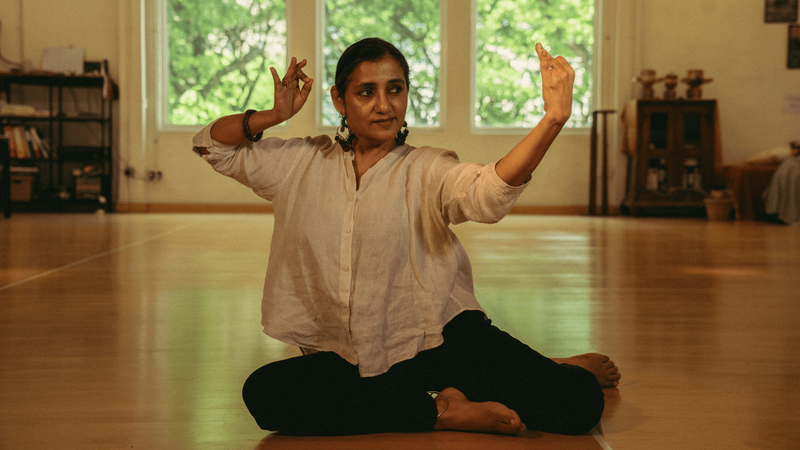
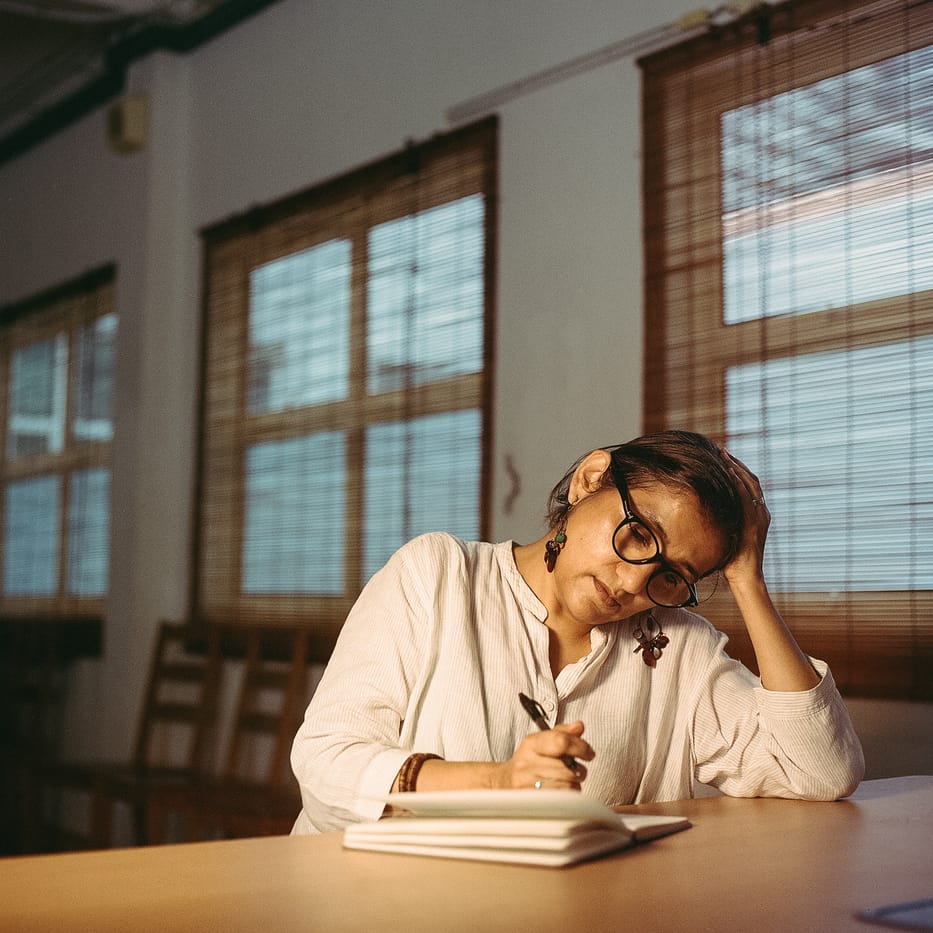
It seems like I’ve met Raka Maitra at a very particular time in her life. For nearly two decades, she had kept up the same 10am-9pm daily schedule of practising and teaching odissi, the dance form she’s spent her life with, at the studio. Now, at 54, she’s just embarked on a new season of half-days. With a new colleague teaching in the evenings, she’s freed up time for herself. “Now I can read. I can think…think of networking, setting up meetings and trying to raise funds,” she said excitedly at the Yakun Kaya Toast near Aliwal Arts Centre, where Chowk, the dance company she founded, is based, and where she comes for breakfast every morning. It’s hardly a sabbatical, but for someone who has lived along the lines of a strict regimen, having a flexible schedule is new.
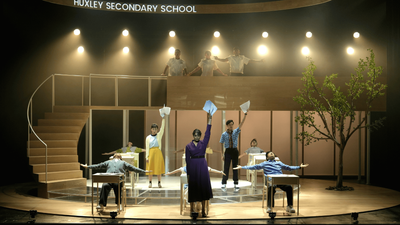
Yet flexibility and liminality are key to the very ethos of Chowk. The dance company defies categorisation: though rooted in classical Indian traditions like odissi, it intersects with a variety of contemporary forms. Its name itself is a Hindi word for square or plaza, a cross-section of different cultures, as well as one of the two basic stances in odissi. Over the years, Chowk has collaborated with the mediums of clowning, Nanyin, and even bubble performers: hardly the expected route for a company whose artistic director trained under the classical guru Madhavi Mudgal.
Then again, ever since she embarked on a career as an independent dancer, Raka has taken risks that have clearly questioned the confines of tradition. Early on in her practice, while still living in India, she and her classical dance peer, Shagun Butani, founded The Dancing People, a sort of prelude to Chowk. By then, Raka’s career was already a lauded success. In her 20s, she received a national level young artist award, the Shringarmani, for classical odissi dance. The path seemed clear. Yet her hunger for experimentation drove her to shed safety in the search for one’s craft.
The Dancing People put on a performance entitled The Masks of God that utilised a mix of chhau, a dance form with roots in martial arts and folk traditions, odissi, and modern dance, influenced by Butani’s time in New York, where the modern dance movement emerged. Other practitioners ridiculed her departure from tradition. Like many classical traditions, Indian classical dance is made up of a tight network of elite performers, critics, and producers. To veer away from decorum that has been built up over centuries is to position oneself as different, suspiciously so. After that, the two friends diverged in their paths, with Butani reverting to tradition and Raka hurtling towards where she stands today.
For her desire to contemporise the form, she became a pariah: no one would continue working with her. “It was very very hard, because I’m getting cancelled everywhere. So the best thing is to move,” she said.
This attunement to the sensitivities in India and the possibilities of re-interpretation in Singapore have led Raka to become a protagonist in what seems to be a classic Singapore migration story. At first glance, it appears like she was a trailing spouse, following her husband who worked in finance when he got a job in Singapore. But Raka rejects this trope: “I moved here because I wanted to,” she insists.
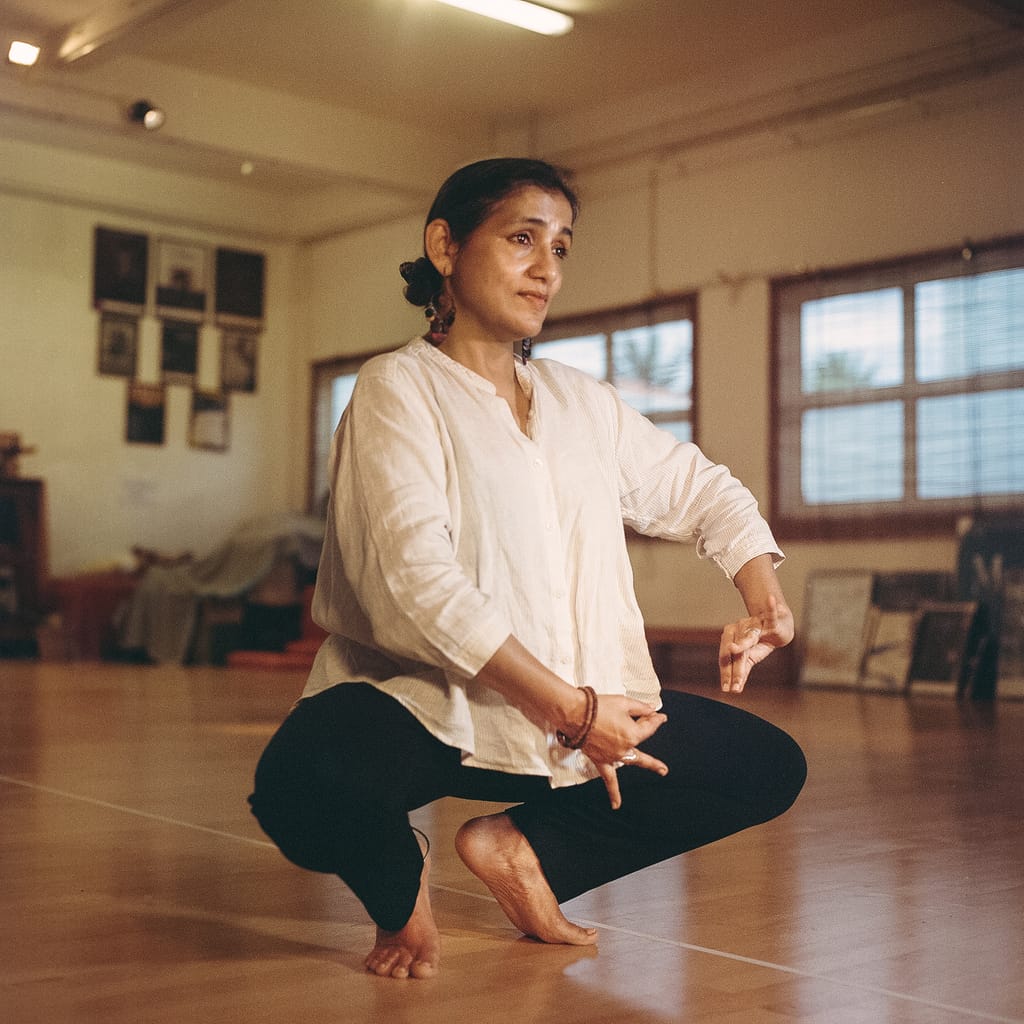
Odissi, considered to be the oldest classical Indian dance, originated as a temple dance of devotion, and was often performed by women. Its movements are based on the principles of the Natya Shastra, an ancient Sanskrit text dated between 200 BCE and 200 CE, and haven’t changed much since. British colonialists mocked the form, its sensuousness considered scandalous by Christian missionaries, and eventually banned it in 1910. After independence, the dance grew again in popularity. Like many classical forms, skills were passed down from guru to disciple.
Although Raka underwent a system of traditional mentorship, another foundational element in her life perhaps explains her proclivity towards experimentation. Her grandfather, Samar Chatterjee, was the founder of the Children’s Little Theatre (CLT), a renowned performing arts school for children in Kolkata that encouraged the joy of play rather than the prevalent rote learning. It was befitting that such an organisation seeded itself in Kolkata, often considered the cultural capital of India, where Bengali polymath Rabindranath Tagore and novelist Sarat Chandra Chattopadhyay were born. Set up in 1952, CLT’s students could pick up puppetry, theatre, and dance; Raka couldn’t decide on one, and hopped between the forms.
“He told me not to touch the feet of the elders unless I really respected them,” she said, a significant deviation from the performance of hierarchy that continues to be present today in the classical dance world. It’s a practice she has also gotten rid of at Chowk, in addition to the need to wear specific traditional attire to rehearsals. Raka spent her entire childhood at CLT. “He is the biggest influence in my life. He taught us to think differently, more than 75 years ago he thought of deconstructing how dance and theatre was taught, he believed art should be fun for kids and has the ability to create community beyond class, caste and religion,” Raka said.
When Raka turned 16 and started classical dance classes in Bharatanatyam, she began to feel like an outsider, constantly chafing against authority. “I grew up in that environment. So when I went to specialise in classical and suddenly I had to touch feet, that was like, what the hell am I doing?” she said.
Chatterjee was an influential figure who was well-acquainted with the literati of the day, academics, artists, and politicians alike, including Ravi Shankar, renowned sitarist, and Jawaharlal Nehru, India’s first prime minister. Indira Gandhi, Nehru’s daughter, third prime minister and Chatterjee’s close friend, had asked him to join politics. He declined, saying that he just wanted to be in the arts. It’s a purist restraint that seems to have trickled down generations to Raka. “I’m not a very ambitious person,” she said. “I just want to do my work well. I don’t need to be anywhere. I don’t need any awards or any big accolades. I’m very happy in this space.”
As such, Raka had “never imagined” starting a company. When she came to Singapore in 2004, she first found spiritual comrades. “When I discovered The Substation, I said, ‘okay, this is an interesting place.’” The interdisciplinary arts space, founded by Chinese theatre practitioner Kuo Pao Kun, was known for incubating new works that challenged forms. There, Raka met people from dance, music, theatre—among them artists like Zai Kuning, Bani Haykal, and Zul Mahmod—who would become lifelong friends and collaborators.
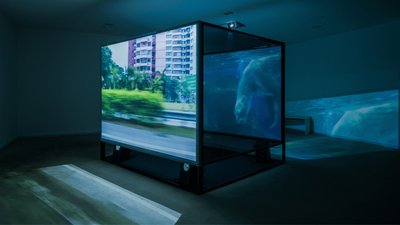
Filmmaker Tan Pin Pin, who until recently shared a studio at Aliwal Arts Centre, described The Substation as a meeting point of disciplines. “You would be crossing paths with a sound artist, a short filmmaker, then a punk rocker. Cheek by jowl.”
Raka began teaching classes at Lasalle and the Nanyang Academy of Fine Arts, and staging her own solo work. People watched her perform; and people wanted to learn. Audrey Wong, then artistic co-director of The Substation, offered Raka an associate artist position in 2007, enabling her to have the space to practice and teach. It was this exposure to Singapore’s avant-garde arts scene, as well as its regional collaborations, that opened up her practice. At The Substation, artist Lin Shiyun encouraged her to apply for the National Arts Council’s seed grant, meant to kick-start new not-for-profit arts organisations’ projects. She got it in 2014, and Chowk was born. “I was just applying by chance,” she said. “And then everything from there, it got formalised. And I had a bunch of students who were very enthusiastic.”
It was during this period that Raka started to find her feet in Singapore. In 2007, she directed the first edition of Grey Festival, Singapore’s first Indian contemporary dance festival, demonstrating her already existent vision for contemporary Asian dance, bringing together dancers from all over South and Southeast Asia.
That year, she also made The Hungry Stones, based on a short story by Rabindranath Tagore, in which she focused on the expressions of a harem that once inhabited a palace. Audiences in India, many of whom would have grown up sensitive to the implications of classical gestures, were offended by the sensuousness on stage, even as Singaporean audiences hardly batted an eyelid, unable to interpret the gestural metaphors. “Because there was no text, I didn’t get censored. But the programmers did say, ‘What is happening? What is the scene about?’ I said, ‘No no, it’s about friendship, friendship amongst women.’” Even early on, she had already understood the necessity of such deftness.
She began to work with deconstructing the basic vocabulary of odissi. In her iconic Pallavi series (2016-21), she eschewed narratives and characters, choosing to focus instead on the details of physicality, such as slowing down movements, and isolating some body parts while accentuating others. It was a series made through the eyes of someone whose entire attention was focused on the pureness of movement.
By the time I met Raka at the Yakun, she had begun work on a staging of One Part Woman. The Tamil novel by Perumal Murugan looks at the social stigma facing a childless couple who seeks blessings in a controversial ritual, in which the wife is impregnated by another man who assumes the mantle of a god. The novel itself was banned at one point, having offended factions in Tamil Nadu, before having the ruling overturned in what was considered a victory for free speech in India.
As she was slowly shaping her practice, at one point her mother asked her to return to India to take over the management of CLT, now a shadow of its former self. Channelling her grandfather’s own singular focus, Raka said no, citing that such work would distract her from her artistic practice. “I’m just crazy. I love dance. I love dance. And, you know, this form is so beautiful,” she said.
This devotion is behind the intensity of her practice. Rehearsals in Raka’s studio are physically rigorous, often starting with an hour and a half of physical conditioning, consisting of sets such as stylised walks and spinal exercises, before choreography even begins. Aparna Nambiar, a professor of dance at Davidson College and Chowk board member, has been working with Raka for 15 years, and still returns every academic break. She’s seen the consistency of such a routine, how, over years, one’s body is shaped by it. “She’s [Raka’s] really in search of a form and what she wants is the dancer’s body to speak the language of odissi and chhau really well so that one can make poetry out of it,” Aparna said.
Pin Pin said she never asked herself what her practice was until she saw Raka in the studio. “I just watched her rehearse and in the process of watching her I thought, ‘Oh wow mind blown.’ Because it’s quite pure, it is the daily practice of a craft. Because you know people talk about art practice and this is literally an art practice, by its intensity and also the dailiness of it.”
She continues, “that space was so life-giving, precisely because people were just not thinking beyond what is further. You’re just doing what you do and when you start thinking about what it is, ‘What does an artist do? What is art?’ And then very often times, you have these really highfalutin ideas, very grand gestures. It might just really be every day just showing up and practising. No more, no less.”
For a company like Chowk, which was built on the spaces in between tradition and contemporary, risk is its DNA. But festivals seem to have trouble categorising and marketing it. According to Raka, it is neither traditional enough for the conservative, classical crowd nor conceptual enough for the contemporary circuit, which considers it too ‘ethnic’. But, Raka said, “All dance is ethnic. Ballet is ethnic.” She went on. “We don’t make ‘smart’ work. I start from the body.”
Odissi itself has 108 basic dance units, comprising belis (body positions), mudras (hand movements), pada bhedas (foot movements) and bhavas (facial expressions), the combination of which depict specific abhinaya, an expression of feeling. Repertoires then consist of various sequences which would symbolise invocations, offerings, mythologies, epics, and dramas in Hinduism. For Chowk to then combine these choreographies with other forms would be a conceptual gesture unto itself. ‘Smart’ hardly suffices.
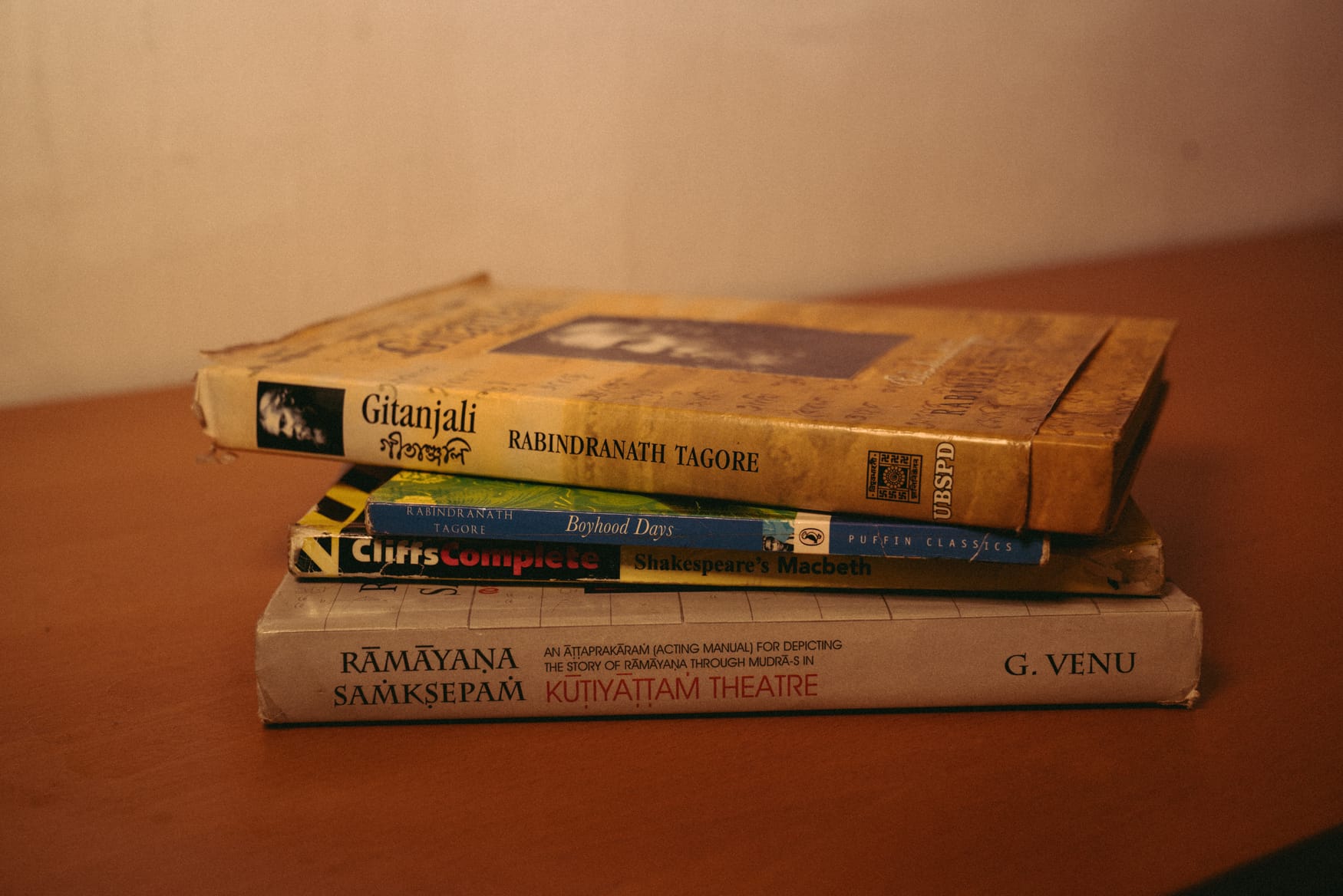
Rather than cite key figures in contemporary dance, such as Merce Cunningham or Martha Graham, or Western postmodernist and critical theories that have greatly influenced contemporary performance, most of Raka’s sources are of the Indian modern literary canon from the 20th century onwards. Neither does she look to the classical Sanskritic texts for inspiration. Such a research approach places her in her own sphere of knowledge.
“She chose to localise and regionalise rather than to continue to throw a line back to the Indian classical dance world,” said Aparna. “She goes towards theatre, folk performers, rural performers…all those links are important to her because I think she really believes in the kind of richness of the ground, like working from the ground up rather than continuing to just create networks that are from one elite stage to another elite stage…She’s not making the networks that will get her the buy-in of the classical dance scene.”
When asked about her thoughts on how Chowk, and odissi by extension, can evolve, Raka similarly insists on a rooted locality that focuses on the present. Referring to Indian dance practitioners in Singapore, she said, “They have to stop looking towards India for inspiration. It’s not there. What we have is here.” She relates it to her own migration story, “I moved here. I don’t belong there anymore, and maybe I don’t belong here. So you are kind of in limbo. I’m okay with that because I’m not a person who is very nostalgic. You know, if I’m here, I’m here.”
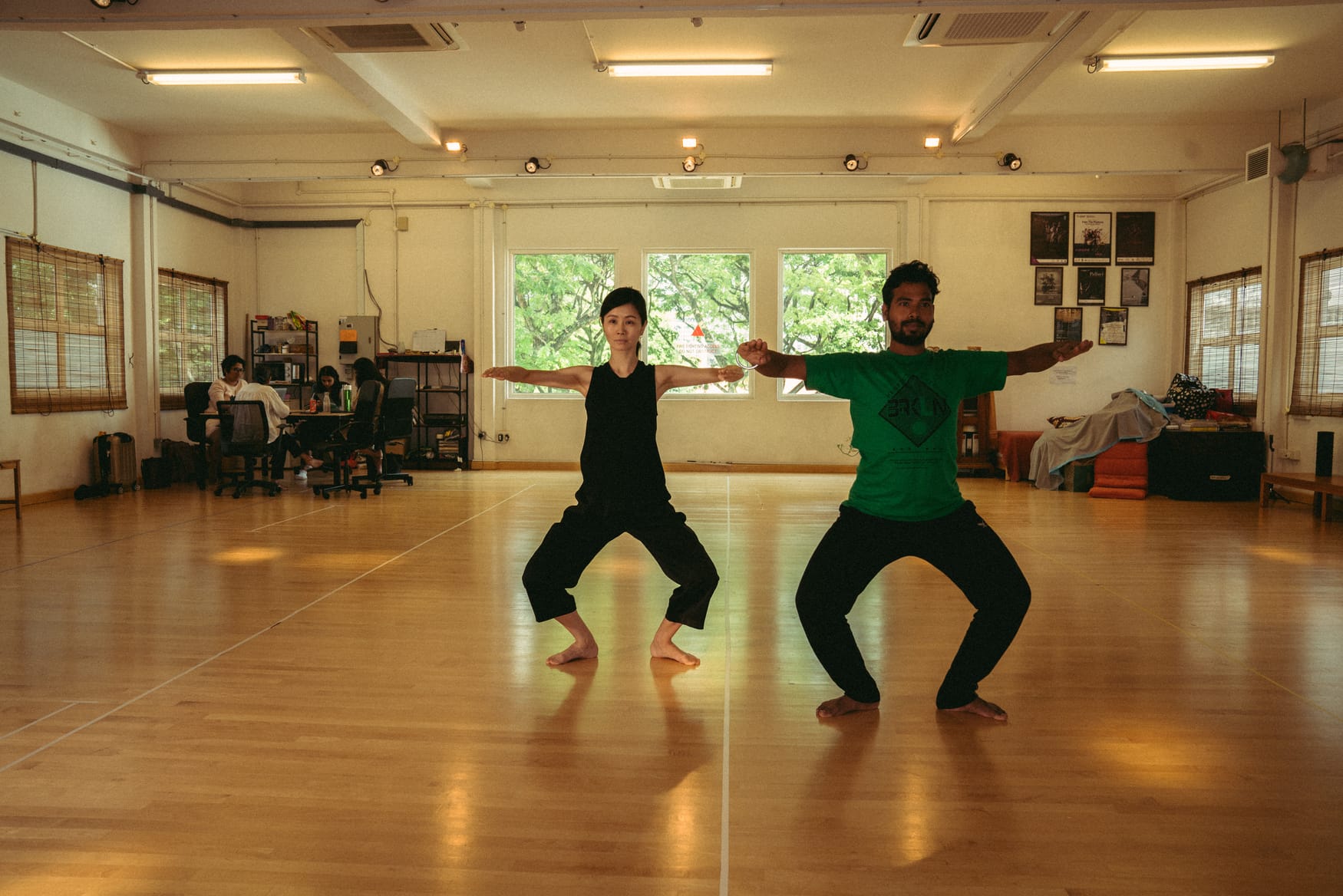
Here she may be, but after 21 years, and now with a Singapore passport, the notions of home and belonging remain complex. As a relatively newer migrant, Raka faces the conundrum of feeling not Singaporean Indian enough for those who were born and raised here, thus facing barriers to acceptance. While her work has gained the loyal support of institutions such as the Esplanade, she said the Singapore-born classical Indian dancers treat her differently, and patrons are difficult to find. Odissi also has a much newer history in Singapore, while forms like bharatanatyam have had a long legacy of connection to Tamil culture.
“I speak English in an Indian way,” she also said, hinting at how her linguistic foreignness makes her stick out among locally-born practitioners. In an article published on Academia SG, Laavanya Kathiravelu writes, “the lack of interaction and palpable tensions between local-born and ‘new’ migrants are due in part to the sense that an older, local-born, predominantly Tamil and South Indian community with working-class roots is being displaced by the higher caste, wealthier North Indians with fewer loyalties to a nation that they did not help build.” It’s a troubling situation reflective of the racial inequalities that Singaporean Indians have historically endured, their experiences rendering the need to prove their belonging as separate from new members of the diaspora.
The Bengali Brahmin Chatterjee surname itself is a source of prestige. It is believed to be derived from the Sanskrit word Chattopadhyaya, meaning “assistant teacher or priest of Chatta”, where chatta is the name of a village. Maitra, the surname of Raka’s husband, is also a signifier of a Bengali Brahmin caste. While caste consciousness in Singapore is less pronounced than in India, Raka’s background differentiates her from the majority of the older diaspora.
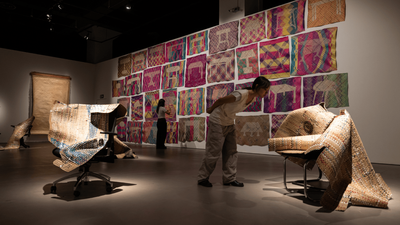
Even as her ‘Indianness’ would remain a contested part of her identity, Raka continued to win plaudits for her work. From 2020 to 2021, she returned to The Substation as co-artistic director alongside Woon Tien Wei, a clear indication of the trust that the arts community has in her, just as the pandemic ground everything to a halt. Under her tenure, she curated In the Margins, “taking a closer look at the stories of the marginalised, displaced and forgotten communities who are often out of sight.” (Disclosure: my first performance work, Where You Move Me Most, was programmed then.) She would oversee the beloved arts centre returning its venue to the government and taking on a new, limpid form, existing in name, but without the black-box theatre and rehearsal spaces that were crucial to artists who were trying something new.
“I really miss a place like The Substation, where it was really necessary for experimentation,” she said. “I don’t think an Esplanade can take the risks because it’s big. It needs bums on seats. It’s an expensive space, so they can’t take the risk that a small space can.”
After 18 years in Singapore, and having converted to Singapore citizenship, Raka is more than well-acquainted with the challenges of being in the arts in Singapore. Considering the high cost of living, the sheer cost of failing is astronomical, which affects the ability of companies to take artistic risks. “Even dancers don’t want to take risks,” she said softly, as though this harsh reality is dawning upon her. No matter their love of the craft, the pressures of earning a livelihood, especially one dependent on the financial success of the dance company they were employed under, mean that experimentation can be forgoed for the sake of pragmatism. Odissi classes remain Chowk’s main source of income, even with its National Arts Council Major Company grant, which grants significant financial support and recognition. Still, Raka does not reject students who are unable to afford fees, asking them to “just come and learn the form” anyway.
The tension between artistic purity and market demands is ever-present in her life. When Chowk was struggling a number of years ago, another dance company’s head suggested that she close the company and join them. She flatly rejected that idea. “No, no way,” she said.
When I first met Raka, she shared how she had just decided not to attend a networking event. “I’m not going to suck up to programmers. I’ll just do my own thing. If I get work, I get work. If I don’t get work, I’ll just make work in the studio. And I’m sure, you know, I'll be able to get money from somewhere. I don’t need them.” So even in this new season of half-days, she’ll remain selective about networking opportunities.
It is a stoicism and stubbornness that has characterised many of her decisions. Her parents didn’t want to have anything to do with the arts, but she persisted. Raka’s two sons are forging their own paths as well. One is an entrepreneur, and the other writes about political crimes and the marginalised in India, a profession not without its dangers. “I’m scared for him but there’s nothing I can do. This is what he wants to do, right? I can’t stop him. No one could stop me.”
She has also resisted the strategy of mixing genres that would appeal to the National Arts Council grant assessments, sticking to her belief that if the work is good, people will come. She winces at the thought of “doing something that’s not me.”
But she isn’t militant. “If anyone invites me for a show, I’ll surely come”, she said. And she’s recently hired a marketing and business development manager, Saumya Bhargava, acknowledging that Chowk needs to evolve economically. “I always had this principle that if you do work, you don’t need to network, you don’t need to meet people, your work will speak. But the world has changed.”
This is perhaps the most apparent struggle that Raka is wrestling with, that belies any hint of contradiction; in every other way, her composure is self-possessed, serene, and warm. Aparna cites Raka as her mentor: “There’s this conviction of her abilities and her vision and practice that it would lead her somewhere. She’s not a person who tries to force things to meet a particular end. So that makes her relaxed and that is something I really try to emulate. She’s not hellbent on success at all costs. She’s really about everyday practice, building relationships, letting things come, letting things go, but consistently continuing to hold the space and continue to build the practice. And I feel like that is a calm and collected attitude that I really want in my life.”
Even as Chowk is unable to employ full-time dancers, or keep them in Singapore, Raka constantly encourages them to leave to explore their own ambitions. “What she really wants is for everyone who comes in to bring their own vision and make their own work, use the space, to really create a community that is [centred around] embodied movement,” said Aparna. Raka invites me, too, to hold a screening of my films at Chowk. It’s a generosity and curiosity that keeps her spirit buoyant.
“I felt there was an optimism, a very optimistic approach to life in the sense of you don’t get the sense that she’s jaded,” described Pin Pin. “Even though she’s been doing this for so long. She’s danced her whole life since she was six, right? There’s always something to try, a certain approach to take, a certain excitement of something she discovered…for her I sense that art is life, I dance therefore I am. I have that feeling about her so what’s there not to be happy about. It’s quite simple in that way…What did we talk about in our recent makan? We talked about how it is impossible for people like us to retire. If dance is life then you dance until you’re no longer there.”
For many artists, their craft goes beyond professionalism; it is a calling that brings them to new heights, and at times, new lands. Some artists move to Singapore, liberated from the traditions of old, while others, like me, leave for newer ways of being. Like peering into a kaleidoscope, such movement, and its accompanying contradictory forces of people, energies and ideas, engender singular artistic practices at the faultlines of time and place. Raka’s journey seems emblematic of that.
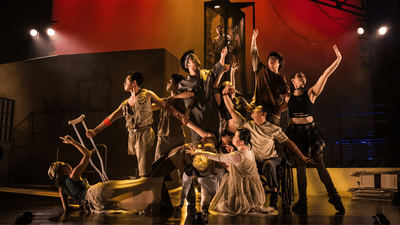
In Chowk’s recent performance, Migration of Form, Raka is only on stage for the first 15 minutes of the choreography, said dancer and Chowk board member Meera Gurumurthy. “15 years since Raka started ensemble choreography, all those ensembles grew to this perfect ensemble…one from which she could retreat, sit back, direct, while her presence is felt throughout.”
“When I came to Singapore in 2004,” Raka said, addressing the production in a video posted on Chowk’s Instagram profile, “I came here with 20 odissi steps. And then from there how did I build the vocabulary that I have for contemporary work?…When we move to a country, we bring our culture—I brought odissi with me. What I find very interesting is how odissi sits in different bodies from different cultures. And how each body tells a different story. So I think this work is about that.”
Charmaine Poh is Jom’s co-founder, and its head of visual culture and media. This piece was first published in Jom’s annual print magazine issue No. 3, released last year.
Letters in response to this piece can be sent to sudhir@jom.media. All will be considered for publication on our “Letters to the editor” page.