
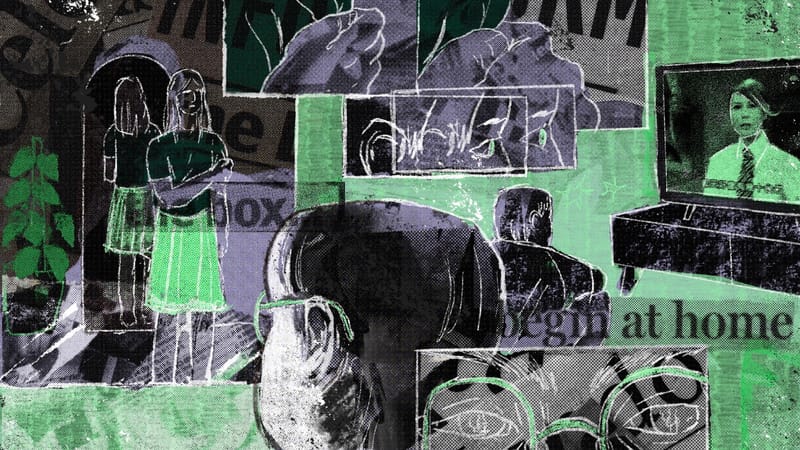
“Did you know that Elon Musk’s son…is just like you?” It’s a rainy Sunday afternoon when my dad springs this question on me. We’re waiting in the car as my sisters head to the wet market. For the past few minutes, we’d each been on our phones. He was scrolling TikTok; I was texting my partner, or browsing Reddit or Tumblr. In these quiet moments, I tend to assume my dad doesn’t want to talk. His statement feels like a bolt out of the blue.
“Well, it’s weird that there’s more transgender people now.”
I pause, and ponder what he means. A strange courage wells up within me; I will not let him misgender Vivian Jenna Wilson, even though he still calls me his son or 弟 (di).
“Daughter,” I say.
“Son.”
“Daughter,” I repeat.
“Child.”
The compromise lands awkwardly as my sisters return with fresh fruit. I put the car into drive, and we make our way to the temple to pay respects to our mother on her death anniversary. The topic is dropped. Our media consumption habits have shifted since my three sisters and I graduated university. Gone are the days when I would watch Channel 8 news with him at 10pm, or Parliament highlights with my late mother as a way to negotiate past my bedtime. The erratic hours at my first job made watching TV together impossible, and when my eldest sister moved out after the pandemic, we cancelled our cable TV plan.
Now, my father relies on the millions of hours of free content on social media. Everything is at his fingertips, something he continually marvels at. Videos featuring Chinese living in the countryside. Videos teaching him English. Videos showing how things are made. Videos telling him about unidentified aerial phenomena. Endless streams and clips that he—and I—swipe up for hours at a time, as the attention economy sucks us in.
I share very little with my father. I don’t share his ambition for money. I was pushed to a non-combat unit in National Service (NS) when he expected me to follow in his footsteps, at least as an infantry sniper. I don’t share his desire to prolong the family lineage. The two of us are stuck in our own bubbles, only occasionally popping out when something significant happens. This disparate media diet adds dissonance to realities that don’t quite match. And in this world, the language we use—to refer to ourselves and to communicate with others—has now been displaced.
Debates over the nuances of language aren’t new. In 1981, an article in The Straits Times (ST) predicted that “they” and “their” would replace the gendered pronouns “he/she”, saying that “in a few decades’ time, this will be felt to be acceptable if not accurate English”. An English teacher argued in 1980 on ST’s Forum pages that there should be a decisive authority to rule on the singular, gender-neutral “they”. All this had been set off by a global movement to make English less sexist. In 1975, the UK National Council of Teachers of English published a set of guidelines, declaring that “the sexist usage of language aids in the arbitrary assignation of roles to both men and women, and would be better omitted.” People now use “firefighter” instead of “fireman”, “police” rather than “policeman”, “journalists” instead of “newsmen”.
Language determines how the media frames stories, and how facts are contextualised and presented. And word choices stand at the centre of this influence. There’s often an asymmetry in how professional achievements are described, with articles about “mumpreneurs” frequently portraying entrepreneurship as a means to pursue personal ambition while experiencing the emotional rewards of motherhood. The media have continued to use certain terms that, knowingly or not, reinforce stigma against marginalised women, like “maid” to refer to migrant domestic workers. News reports from the 1990s often blamed women for provoking or causing domestic and sexual violence, narratives that we notably baulk at today.
But as the media landscape has continued to splinter, this asymmetry and inequality have become even more pronounced. The sensational has even greater appeal in our fragmented digital world. As news outlets compete for clicks, trans people like me have been continually paraded as an exotic few.
In short, my very existence feels like clickbait.
In 2023, Shin Min Daily News published a headline that contained a slur for transgender sex workers. The tabloid later repeatedly misgendered a trans woman who’d been arrested for trying to pry open the doors of a moving MRT train. The same misgendering occurred at major English-language news outlets when crime reporters covered the woman’s court case. The examples are legion. The victim of an upskirt video was described as “a man in a dress” in coverage about their court case; a person in lingerie running away from the police was called a “Thai man” and “alleged crossdresser”.
In the world of digital capitalism, it’s views and clicks that sell.
It’s an art that I took part in, as a former reporter for Mothership and ex-audience growth specialist at ST. You word headlines so people will click and comment; in my early years at Mothership, when the publication was still a tiny outfit, our chief editor would give a small award to writers of the most popular pieces. At ST, a giant board ranks the stories people are reading at the moment; it updates every minute.
This thirst for advertising revenue has led to a gradual polarisation as news media position their articles to boost retweet and share numbers. “There’s a structural aspect to this, and a cultural and affective aspect to it, and the two come together in our social media space,” said Shobha Avadhani, senior lecturer in digital media cultures at the Department of Communications and New Media, National University of Singapore. “The scale of polarisation that we see now is very much technologically enabled.” And it’s this polarisation that has made discussions around language and how we define ourselves more important than ever before. And so is the need to help audiences like my father who, flooded with options, is unable to know who, or what, to believe.
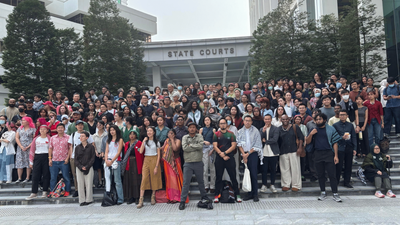
In November last year, my media colleagues—Avadhani, Leong Wai Kit, Tan Hui Yee, Deborah Wong, Melissa Zhu, and Gilles Demptos—and I unveiled a stylebook for gender-sensitive reporting for the Asian-American Journalists’ Association’s Asia-Pacific (AAJA-Asia) chapter. It was a culmination of a year spent compiling, editing and localising guides and word choices for a Singaporean audience. We wanted to address these structural issues through the stylebook, and remind our fellow journalists that the words we write and publish have an impact. Just as photographers have to understand how lenses work, reporters, too, have to understand the limitations and advantages of viewing the world through their lenses, in order to give our audiences the full picture.
Our guide relied on model recommendations, including those from WAN-IFRA’s Women in News (WIN) initiative, Inqlusive Newsrooms, and the Transgender Journalists Association. But it sought to include distinctly Singaporean recommendations, such as a list of terms used to refer to LGBTQ+ people here: acronyms like PLU (People Like Us) or outdated terms like “muffadet” (hermaphrodite). It contextualises them, rating them for suitability in a newsroom setting. It also has an expansive list of gender-sensitive language, and general principles for newsrooms to ensure balanced gender coverage.
“Putting forward a style guide like ours is a kind of statement in a way, that there is something good about this, that it is representing people who have, until now, not had a say in how they are represented,” Avadhani said. “It’s putting your hat in the game and saying: ‘No, I would like to change this’.”
Naturally, the process of defining this language is an ongoing dialogue.
More than four decades after ST suggested that the gender-neutral, singular “they” be included in instances of acceptable English, the paper quietly announced a long-awaited update to its style guide, modernising language practices that have been in place for decades, and replacing outdated, often ableist, concepts with more inclusive and gender-sensitive ones. (These changes were done in parallel with our work at AAJA-Asia, and not in response to it.)
“It is a work in progress,” said Jaime Ho, ST’s chief editor. “We’re trying our best to at least maintain a certain degree of mainstream and accepted pace of what we’re trying to do.” The paper will continue to review its style guide through the years as it considers feedback from readers and newsmakers, he added. Ho’s candour has been refreshing, as the paper of record has always positioned itself as a reflection of Singapore society. It’s a notable change from the indifference and rejection in the years following 1971, when the first sex reassignment surgery in Singapore was done on a trans woman. Headlines featuring trans and gender-diverse people have since ranged from celebratory to indifferent or even discriminatory; most of them using terms and narratives that were ill-informed.
We no longer call it a “sex change surgery”; it’s now called “transition” or “gender-affirming care”. “Transsexual” is outdated, as is “transgenderism”. The narrative that we only become men or women after we go through surgery feels awkward, as many of us live our lives as men or women before surgery, sometimes for decades. And we are no longer merely people trapped in our bodies, trapped by our circumstance of birth, but artists, journalists, novelists, entrepreneurs, engineers, friends, lovers, and family.
I came out as a non-binary transfeminine person in early 2022, two years after Gina Chua, then executive editor at Reuters, where I used to work, did. She had been so high up on the organisational ladder, and such a visible figure that it felt natural to be myself with the colleagues I worked with every day.
I remember an e-mail conversation with Gina, shortly after I sought her advice on transitioning within my workplace. She pointed out that she had a mug with her new name on it; when someone deadnamed (used her old name) or misgendered her during meetings, she would take a sip out of it as a subtle reminder.
Misgendering and deadnaming can be a very scary thing for a trans person. It means that your past—one that has trapped you—is still fresh in someone’s mind. And in newspapers, places of public record, being deadnamed can mean that your past can be easily unravelled with a quick Google search. The internet holds on to inconvenient things.
It’s not that hard to find out who I used to be. After all, my byline is a matter of public record, and a huge part of my career—as a freelancer and intern with multiple other news outlets, and later visual verification producer at Reuters—happened when I was still a boy. This piece, when it is published, will likely add to the growing pile of proof that one can look up to see if I was ever born a girl.
And as the world becomes more dangerous for trans people, being misgendered and deadnamed can even feel deadly. In February this year, I found myself in the unique position of writing a travel advisory for fellow trans people in Singapore, warning those intending to travel to the US to exercise caution when applying for travel authorisation or a visa.
Trans travellers to the US now face new hurdles with stricter visa requirements demanding birth certificates if passport gender differs from previous records. And the orders of Donald Trump, US president, have limited military service, healthcare access, and passport options for transgender people in the US.
It’s a systemic erasure of transgender people from the public eye.
Ever the optimist, Gina predicted at a Splice festival in 2023 that we journalists will soon all be using non-binary pronouns in our English work. I don’t think the world is set to change that way. For many years, our gender has been shorthand for our social statuses; now, gender has also become shorthand for our inner realities and the lives that we lead. Sure, a person’s gender doesn’t really matter for a story about, say, new nuclear fusion power plants or rising COE prices or the ever-rising tide of inflation. But in a world where our existence can be erased by decree, my chosen name and pronouns have become the only bulwark. It has served to define me and who I am, and will probably continue to do so in a society where we have yet to abolish gender.
The first thing I learnt as a journalist, one month into my internship at The Online Citizen 12 years ago, was that our experiences as journalists vary across class, ethnicity, gender and sexuality. The things we have seen and the lives that we have led all provide a lens through which we view the world. And as long as we have gender roles—as long as my name, pronouns and presentation define how I am seen as a person in this society—we will have to be aware of how we see the world, so our audiences, and society, can benefit.
One of the first luxuries that my Chinese-educated father bought when I was a child was a cable TV subscription. It was on cable that I first saw a transgender person—Li Jing, Taiwan’s first mainstream transgender entertainer—on screen. She was poised, comfortable, confident, herself. These were things that were never shown on local TV; our strict Broadcasting Codes of Practice have meant that any form of positive, or even normal, queer representations have been non-existent. But yet, when my father caught a glimpse of me in a skirt, I couldn’t say anything. I knew the words to describe myself in Mandarin. I knew how to explain what I was doing in Mandarin. I even had a resource on hand to tell him that I was transgender—in Mandarin. But I couldn’t say anything. Afterwards, he’d gone on a rant about how weird I was as a kid; pulling out the fine details of strange things I used to do in my childhood that I barely remember.
Over Zoom, I tell Avadhani about the encounter with my dad that rainy August afternoon. She tells me that a generational divide, exacerbated by the culture wars that rage beyond our borders, does not heal overnight. “Especially for LGBTQ+ people, their relationship with their parents is one of those things where the media has exacerbated the difference,” Avadhani said.
I’ve quietly brought up Lianhe Zaobao articles about trans people to my dad, sharing them on the family WhatsApp—pieces about TransBefrienders, the trans youth peer support service, and The T Project, the trans shelter. He’s told me about people like me who he’s seen on TikTok and mainstream media. We often use the media to distance ourselves from the real, personal conversations that we want to have, said Avadhani. “It’s not just a matter of ‘as a father, I don’t accept my trans daughter’, or ‘as a mother, I don’t accept my lesbian daughter’,” she added. “Part of that healing comes from accepting that your parents’ love might be conditional. It’s a painful realisation.”
And as we seek a common language and a common worldview, Avadhani suggested I’ve sidestepped that very personal conversation that ultimately, my wish was for him to love me for who I am, and for him to believe me when I tell him who I am. Thousands of these personal conversations will have to take place, in order for this divide to close.
And perhaps, eventually, future generations will share a common language for these conversations.
The author is a journalist and copywriter, and the social media lead for trans community group TransgenderSG.
Letters in response to this piece can be sent to sudhir@jom.media. All will be considered for publication on our “Letters to the editor” page.
Correction notice: An earlier version omitted Deborah Wong and Melissa Zhu from the list of people who authored the AAJA-Asia stylebook for gender-sensitive reporting.