


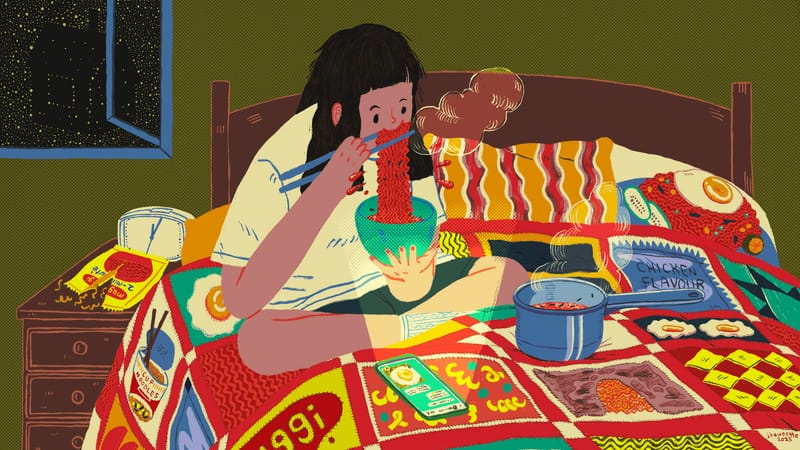
Maggi has followed me across oceans. At New York University in Abu Dhabi, where the dining hall rotated between pasta, shawarma, and paneer, it was the one thing that still tasted of home. I’d stash packets of curry Maggi in my suitcase after each trip back to Malaysia, guarding them like treasure. On nights when the city outside felt too foreign and the dorm too sterile, I’d tear open a packet, boil it on the tiny hot plate we weren’t supposed to have, and watch the steam fog up my dorm window. I’d eat it crouched by the bed, texting my sister a photo of the yolk set just right, feeling—for a moment—like I was back in my mother’s kitchen.
That packet wasn’t just a meal. It was a product of global capitalism, brilliant branding, and just the right amount of monosodium glutamate (MSG). Invented in late-19th century Switzerland as a cheap, hearty meal for working-class women, it arrived in Singapore in 1969 through Nestlé’s global expansion. Hardly a product born of the kampung—yet by the 1970s, it was being produced in Jurong. In 1980, Nestlé opened its first Asian research and development centre in Singapore to fine-tune its flavours for South-east Asian palates. Through aggressive localisation and marketing campaigns that blended familiarity with aspiration, Maggi rewrote its origin story. Today, it’s not sold as a Swiss invention, it’s sold as a taste of home.
The slogan, “Fast to Cook, Good to Eat,” was not just a promise, but a perfect pitch for a country hurtling towards modernity. This was a moment when industrialisation, food convenience, and mass media operated in lockstep—where factory lines fed dinner tables and advertising reshaped appetites. Maggi didn’t follow the rhythm of modern life; it set it.
Around the world, industrialisation reshaped not just work, but food. Processed meals emerged to feed a world too busy to cook. In Europe, Knorr—founded in 1838—pioneered dehydrated soups and stock cubes designed for postwar recovery. In the United States, Campbell’s canned soup, Kellogg’s boxed cereals, and Swanson’s TV dinners became staples during the second industrial wave. In Japan, Nissin’s Instant Ramen (1958) similarly responded to postwar food insecurity, hailed as “magic ramen” for transforming boiling water into a meal. Its true breakthrough came with Cup Noodles (1971), which swapped bowls for disposable cups and plastic forks. Portable and self-contained, it redefined not just convenience, but the act of eating itself.
Portable meals, of course, were nothing new. Sri Lankan lamprais or Malaysian nasi lemak wrapped in banana leaf, had long sustained workers on the move. The difference was that industrialisation now produced meals designed not to be shared, but to be eaten quickly, often alone. Instant noodles slotted neatly into the rhythms of Singapore’s urbanising society: smaller households, rushed schedules, and meals increasingly stripped of communal ritual.
After separation from Malaysia in 1965, Lee Kuan Yew and the People’s Action Party moved swiftly to court foreign capital. Multinational firms arrived, factories multiplied, and household incomes rose. Labour-intensive industries boomed, drawing women into the workforce and restructuring domestic life. Cooking became a constraint. Maggi offered no radical innovation—just speed. Its “2-Minute Noodles” campaign, like its previous ones, targeted overstretched households, staging noodles beside fresh produce and boasting of “the best wheat flour”, “freshest good things”, and oil “gently fried” to lock in flavour. By dressing industrial production in the language of home cooking, Maggi positioned itself as a proper dinner—part of a wider trend of convenience food, from boxed pasta to frozen pizzas. It sold relief: two-minutes, shrink-wrapped.
Maggi was never local—but it worked hard to become indispensable. In 1963, it was still advertised as “Swiss Soup,” flaunting its foreign pedigree. Rather than conceal its origins, Maggi pursued dominance through innovation—most notably the 1980 wrapper redemption scheme, which turned empty packets into instant rewards at sundry shops. By the 1990s, the Maggi Exchange Card had scaled into a gamified loyalty system, converting routine consumption into reward. Maggi didn’t just adapt, it infiltrated; localising not just flavours, but language. Adverts in 1991 pushed Maggi Mee Poh and Bihoon Segera Ayam, mimicking beloved hawker dishes to simulate belonging. By collapsing cultural distance through repetition and recognition, Maggi made itself familiar—not because it was ours, but because it was everywhere. It didn’t earn loyalty; it engineered it.
It started with a packet of curry Maggi and ended with a pimple the size of a 10-cent coin blooming on my chin. One Friday night, my siblings and I were left to prepare our own meal. We knew the routine: boil water, toss in freezer-burnt corn for balance, and slurp straight from the pot in front of the TV. It felt like freedom. By morning, a red crater had colonised my face. “That’s the MSG,” my mother announced, with the clairvoyant certainty of an Asian parent. At the time, I dismissed it as superstition. But looking back, that tiny eruption was a sign—if not of MSG, then of something brewing. Instant noodles promised ease, but their costs simmered quietly, surfacing in small and unexpected ways.
In 2015, that simmer reached a boil. Nearly 38,000 tonnes of Maggi noodles were pulled from shelves in India after tests revealed dangerous levels of lead and MSG. India’s Food Safety and Standards Authority deemed Maggi “unsafe and hazardous”, prompting a nationwide recall. Its market share crashed from 80 percent to zero, exposing cracks in both consumer confidence and food regulation. Although Maggi returned after safety tests, the episode left a lingering aftertaste.
Beyond this scandal, nutritional concerns around Maggi continue to mount. Instant noodles are high in fat, salt, and additives, but low in fibre, calcium, and iron. A study in the Journal of Renal Nutrition links frequent consumption of ultra-processed foods to long-term kidney decline. Another review flagged Maggi noodles as notably low in calcium, crucial for bone development, raising concerns for younger consumers. In response, Singapore plans to introduce a mandatory Nutri-Grade labelling by mid-2027 for high-sodium products. If they receive the lowest grade, D, Maggi cannot advertise its instant noodles. This decision is part of a broader effort to address chronic disease through more transparent food labelling.
Beyond its health risks, Maggi’s rise marked a cultural shift: its “2-Minute Noodles” campaign sold a new conceptualising of food, rebranding cooking as a race for speed, not a ritual of tradition. Why grind spices for hours when a sachet promises a flavour that tastes close enough? Why simmer broth when boiling water suffices? Heritage wasn’t discarded, but diluted—repackaged for efficiency. In reducing meals into minutes, Maggi also compressed the care, knowledge, and skill that once shaped them.
As food anthropologist Sidney Mintz reminded us that food is a culture, shaped by history and habit, “a vivid marker of difference, symbols both of belonging and of being excluded.” Instant meals like Maggi flatten that difference. When speed becomes the standard, those who still grind rempah or build layered Peranakan dishes are cast aside—not just as outdated, but inconvenient. This isn’t merely a shift in taste, but a rupture in how culinary knowledge is passed on. As cooking is reduced to convenience, the textures of tradition begin to fade. The result isn’t just cultural loss, but quiet erasure: of taste, of memory, of the hands that once shaped home through time and care.
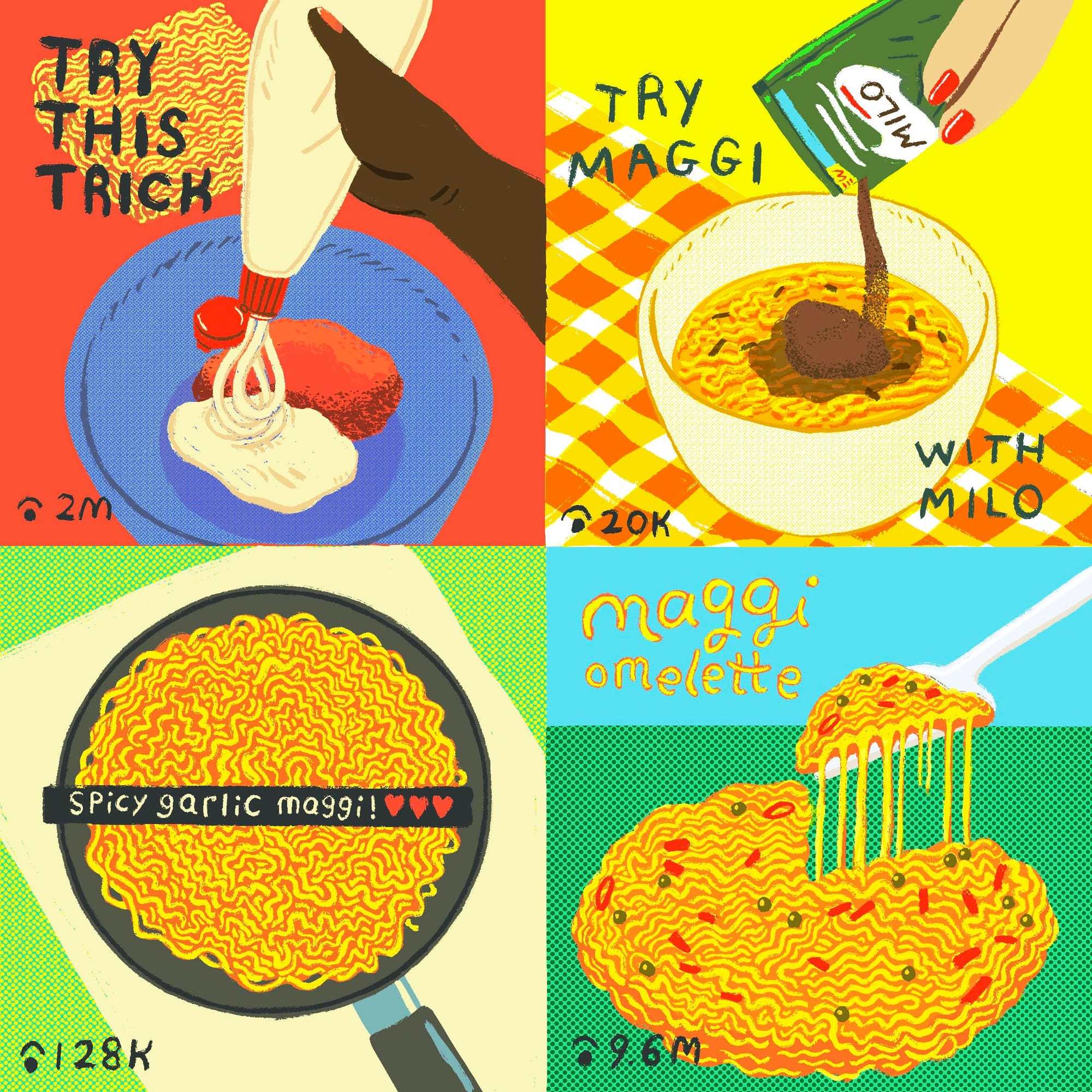
So as traditional foodways recede, Maggi scripts new rituals—driven by muscle, screen, and sentiment. Its digital campaigns operate through affect—tapping into feeling, habit, and memory in ways print ads cannot. While print constructs a polished fiction of “naturalness”—often omitting the foil seasoning packet—digital storytelling leans into emotion, nostalgia, and lived experience.
Take the #MyMaggi with Chef Eric campaign. Rather than selling speed or perfection, the commercial recalls his National Service days—cooking Maggi in a battered mess tin as quiet survival. Intercut with present-day scenes of him plating noodles for his family, the narrative reframes Maggi as continuity, identity, improvisation. French essayist Roland Barthes might have called these “insignificant notations”, but it’s through such textures—the cracked egg, oily broth, soft yolk—that Maggi lodges itself in everyday life. The product remains processed, yet the experience is meticulously coded to feel authentic. It promises speed, but also trades in sentiments: domestic intimacy, nostalgia, care. Emotion comes packaged, commodified to keep the appetite for consumption alive.
Recently, my sister sent me a TikTok of Maggi’s new “Taste the Shiok!” campaign. The advert glistened with the sheen of “Aglio Olio” (garlic and oil) slicked over Maggi noodles, intercut with slow pans of the thick “Kari-Kaw” broth. “They’re going atas now,” she messaged, half-joking—but she wasn’t wrong. These new flavours and stylised visuals mark Maggi’s shift from humble staple to fashionable fast food. Yet for all my skepticism about its glossy Thai rebrand, Maggi has long outgrown its status as mere convenience. It’s become a cultural ingredient, reimagined by the hands of everyday cooks—from home kitchens to mamak stalls. Maggi goreng, Maggi sup—these hawker staples remix the instant noodle into something versatile, inventive, and distinctly local.
This isn’t innovation—it’s the ongoing hawker culture’s legacy of improvisation. Long before franchises packaged nostalgia in ceramic bowls, street vendors were the original fast-food artists—crafting bold, affordable meals from whatever was on hand. They fed labourers, migrants, entire communities on the move. These dishes weren’t vacuum-sealed; they were messy, communal, alive with place. As cities modernised, hawkers were pushed to the margins, dismissed as unsanitary, unruly.
Today, the pressure takes a different form: rising costs and widening inequality strain Singapore’s food culture, even as figures like Khir Johari and Orang Laut SG call for slower, more communal ways of eating. Yet, instant noodles cut across these divides. Fast but flexible, humble yet fashionable, a staple that survives across the income ladder.
Now, with a tinge of irony, that same DIY, make-do ethic of hawker culture is being aestheticised and resold in corporate cafés and viral marketing campaigns. Grit into gloss. Slurp Mee, Singapore’s first self-service instant noodle café, now defunct, let customers pick from a curated wall of 70 packets and cook their own ramen in sleek machines: hawker-style efficiency repackaged for the Instagram age. Across the world, instant noodles have been rebranded and localised—Asam Laksa Maggi in Malaysia, jjajangmyeon cups in Korea, udon and dandan variants sliding into the mix.
Celebrity chefs and food influencers fuel Maggi’s ubiquity. Across social media, fine-dining chefs stage a self-aware humility—doctoring Shin Ramen and Chapagetti on YouTube and blind-tasting instant noodles—to prove they are still “of the people.” These performances aren’t really about the noodles, but about authenticity and play. Maggi becomes shorthand: not dinner, but a cultural reference everyone shares. In Singapore, this spirit of reinvention comes alive in dishes like Maggi prata: a strange and wonderful hybrid where factory-made noodles are wrapped in roti prata, blending Swiss factory food with South Indian flatbread and East Asian seasoning.
Social media trends—#MaggiHacks, TikTok ramen upgrades with kimchi, garlic, even peanut butter—show how younger generations continue to claim it as their own. In college dorms, Maggi remains a staple of frugal ingenuity, with students swapping seasoning packets and debating cooking hacks. “Your food, your style” isn’t just branding. It’s proof that even a mass-produced product can become deeply personal.
When my family relocated to Shanghai, my parents wedged packets of Maggi into our suitcases: curry for them, chicken for us kids. A small taste of home, carefully preserved. Years later, in college, my brother and I would hunch over steaming bowls in our apartments, slurping the same familiar noodles we grew up with, a quiet ritual that moored us to home. Now back in Malaysia, I still catch myself craving a plate of Maggi goreng tanpa telur in the dead of night, surrendering to its greasy, MSG-laden comfort over my grandmother’s slow-cooked meals. Each time, there’s a flicker of guilt, as if I’m trading something rooted and irreplaceable for something quick and solitary. I brush it off as habit. But maybe that framing is too simple. It’s not a choice between tradition and convenience, but a reflection of how both coexist in modern life. One offers speed, control, and familiarity; the other memory, labour, and love. Today, “comfort” often lives in the blur between them. A fusion of the inherited and the improvised.
Shumin Tan is an educator who enjoys writing on the side. She writes personal essays and poetry that wander through questions of home, language, and identity. A third-culture kid at heart, she studied Literature and Theater at New York University Abu Dhabi, and her work has found homes in Singapore Unbound, Exit 11, and even at the European Cultural Centre.
Letters in response to this piece can be sent to sudhir@jom.media. All will be considered for publication on our “Letters to the editor” page.