
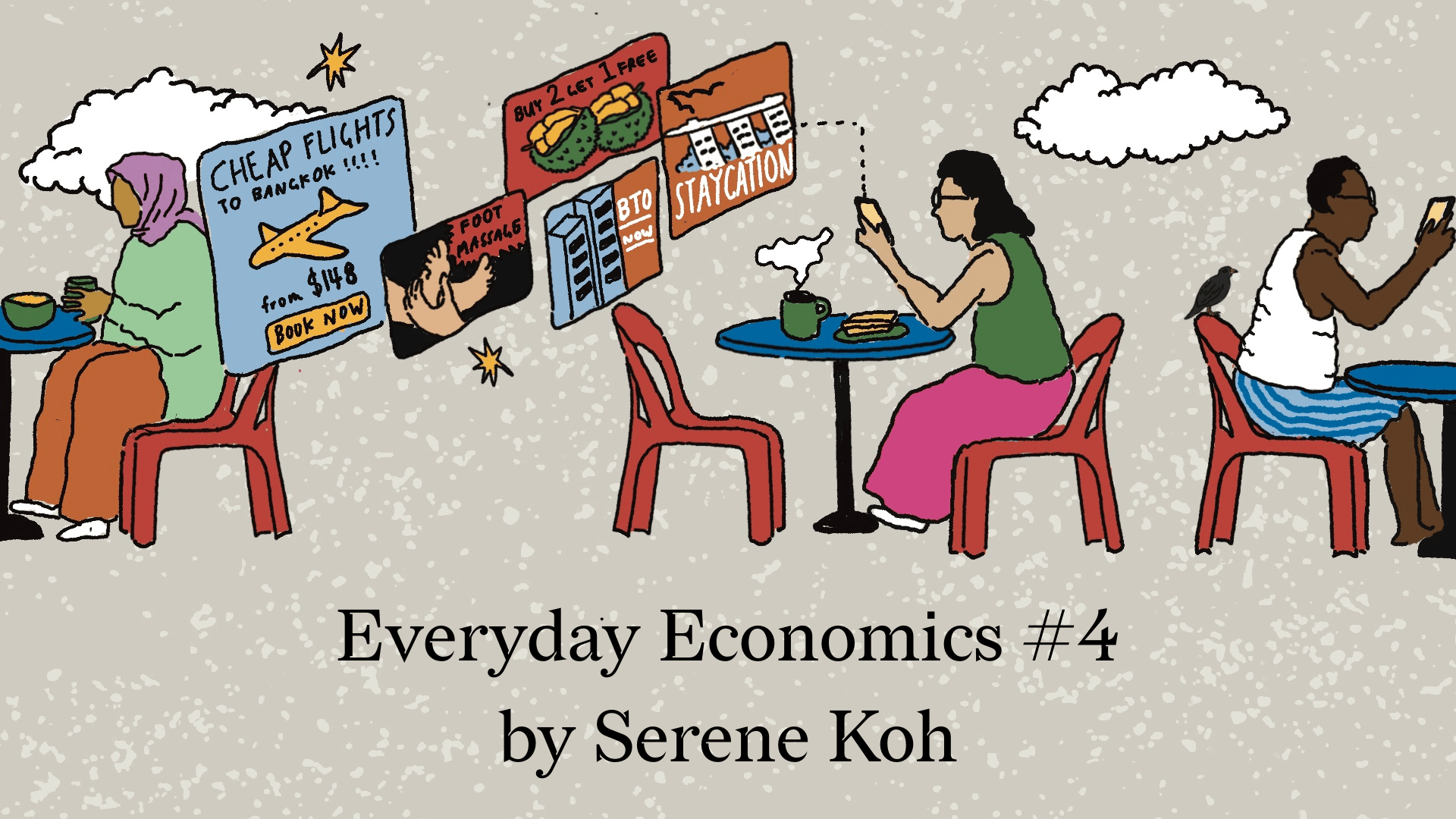
Singapore is one of the most expensive cities in the world. And yet every day, just for a while, a small piece of it can be claimed, for the price of a packet of tissue. Welcome to the hawker center.
As I was thinking about this week’s column, I asked a few friends what they do when they go to a hawker centre on their own. Do they chope a seat first, or queue for food first? How do they decide where to sit, and what to buy? Unsurprisingly, there was no single answer.
“Chope first. Always.”
“It depends on the time—if it’s early and still empty, I’ll get mee pok first. Otherwise I chope, because the anxiety of not getting a seat would be too great.”
Others were more relaxed: if tables were full, they’d buy food first and ask to share a table later.
Chope-ing, for the uninitiated, is the practice of marking an empty table—often with a packet of tissues or something equally small—to signal that it is temporarily taken while you queue for food. It isn’t written anywhere; it simply functions as an unspoken rule.
This practice works not because of the tissue packet itself, of course, but because everyone understands what the tissue represents—that, for a short while, the table is taken. Nothing is physically stopping anyone else from sitting down, and yet most people don’t. In a busy hawker centre, this small act creates a momentary sense of ownership, upheld by a norm that people tend to follow but don’t think too hard about.
People also chope because it helps them avert a very specific kind of discomfort. Behavioural scientists call this anticipated regret: imagining an unpleasant outcome and taking pains to avoid it. We’ve all been there: returning from the stall, precariously balancing a tray of piping hot fish soup, only to realise there’s nowhere to sit. You’re hungry, awkward, and trying not to make eye contact with anyone. Chope-ing is partly about sparing yourself that exact moment (If I’m alone, I chope. I don’t trust my ability to carry fish soup with dignity…).
By securing a seat first, the rest of the hawker centre experience often feels easier. You can join a longer queue, buy your prawn noodles AND a drink, or change your mind without that low-grade anxiety about where you’ll eventually sit.
To be fair, on some level, chope-ing is inefficient. Seats sit empty while their chope-rs are still in line—someone else could be sitting there instead. It can feel like a poor use of scarce space, especially when you’re roaming around with a tray, eyeing that unoccupied but very clearly chope-d table with mild disappointment.
If you enjoy Jom’s work, do get a paid subscription today to support independent journalism in Singapore.
Some people will simply sit down if a seat is empty, chope-d or not. From that perspective, an unused seat is a wasted one—a scarce resource that should be used, not symbolically reserved. And in a moment-by-moment sense, they’re not wrong.
The tension is really about what we’re trying to prioritise: perfect seat utilisation or a system where thousands of people can move through lunch with slightly less stress.
Chope-ing persists not because it’s ideal, but because it smooths over the more immediate anxiety of not knowing where you’ll end up, and all the awkward hovering (hot soup on tray). It accepts a bit of slack up front in exchange for a lunch that feels calmer, more predictable, and less stressful.
That said, the tissue packet buys you the right to sit, but it doesn't help you decide what to eat. For that, you need something more instructive than a packet of Kleenex: the wisdom of the queue.
Imagine this: it’s noon on a Tuesday and you’ve just walked into a hawker center. You were fully intending to get that exact combination of economy rice you’ve been thinking about all morning. Then you see the queue, and suddenly you’re not so sure anymore.
At that point, the queue is so much more than just a line of people. It’s information.
Sometimes it makes you hesitate. You might have arrived with your mind made up, but a thirty-minute wait (if you’re lucky) suddenly makes you question if you really want that bowl of bak chor mee today. The more effort a choice requires, the less attractive it becomes in the moment.
Other times, it pulls you in. A long queue draws you toward a stall you hadn’t even considered (sure, I could totally eat matcha waffles for lunch…). You simply trust that the twelve people ahead of you can’t be wrong. When we see others willing to wait, we treat their patience as proof. The longer the queue, the stronger the signal.
In other words, what you end up eating is influenced not only by what you wanted when you arrived, but also by what you see others willing to endure.
Of course, queues aren’t perfect signals. People queue for all sorts of reasons– habit, nostalgia, or a viral TikTok. And the food ends up being just… fine (like those matcha waffles).
But when time, attention, and patience are limited—which, let’s be honest, they almost always are at lunchtime—we end up relying on cues like queues and chope-ing to help us decide. We watch one another, infer intention, and adjust.
All of this happens before you buy and eat your meal. What happens after is a little more complicated.
Tray return sits at the end of the hawker centre experience—when people are full and ready to leave. Unlike chope-ing or queueing, the benefits are less immediate and less personal. Returning your tray doesn’t immediately help you very much; it helps the next person, the cleaner, the system as a whole. And without clear norms and signals to respond to, the informal rules that worked so well earlier start to fray.
For a long time, the system tried to rely on informal norms to encourage tray returns—signs mentioned pigeons and pests; campaigns appealed to shared responsibility; once in a while, the cleaner auntie would glare meaningfully in your direction. And sometimes that worked. But unlike chope-ing or queueing, tray return demands effort without offering much in return. The inconvenience was yours, the benefit belonged to someone else. A case of misaligned incentives, some might say.
This isn’t unique to hawker centres. Elinor Ostrom—the first woman to win the Nobel Prize in Economics—spent her career studying how communities manage shared resources like forests, fisheries, irrigation systems. She found that cooperation becomes fragile when the effort is immediate and obvious, but the benefits are delayed or shared with people you’ll never meet.
Ostrom herself was careful not to romanticise people. “Humans are neither all angels nor all devils,” she once said. What mattered, she argued, was context—the rules, signals, and expectations that make it easier to trust one another without feeling like a sucker. In the right setting, reciprocity becomes possible not because people are better, but because the situation enables it.
So tray return eventually became mandatory in Singapore, not because people suddenly became less considerate, but because informal understanding has limits. This isn’t a story about people being selfish; it’s about when shared understanding is enough and when it isn’t. Sometimes, when the costs are immediate and the benefits diffuse, the nudge needs to be more of a shove.
Hawker centres function not because people are unusually disciplined or constantly thinking about the common good, but because the unspoken rules within them make some choices easier than others. Nobody designed chope-ing. Nobody mandated the queue. They persisted because they solved real problems for real people.
But norms only take you so far. They rely on the people who show up every day to keep the system running—the hawkers behind the woks absorbing rising costs with shrinking margins, and the cleaners working hours that many of us would struggle to sustain.
A packet of tissue, a long queue, or a returned tray don’t feel like much on their own. But together, carried by that human effort, they allow thousands of strangers to share space, time, and attention with surprisingly little friction.
Most days, we don’t think about any of this, of course. We’re just there for the chicken rice.
Serene Koh is a behavioural scientist and director of the Behavioural Insights Team in Singapore. She also teaches behavioural science at the National University of Singapore.
Letters in response to this piece can be sent to sudhir@jom.media. All will be considered for publication on our “Letters to the editor” page.
If you enjoy Jom’s work, do get a paid subscription today to support independent journalism in Singapore.
Editor’s addendum: the Singlish word “chope” likely evolved from the Malay cap or English chop, denoting a chop/stamp/mark, both in turn from the Hindi छाप ćhāp (stamp). Jom’s name and logo has a symbolic representation in Jawi, which is known as a cap mohor, as Faris Joraimi, our history editor, explains in “What's in a logo?”