
Perhaps his finest hour was amongst the Chinese in Sandakan, the breezy, briny-aired port and eco-tourist gateway on Borneo’s north-eastern tip, where Sabahan flags fly high, dried mackerels dangle from raffia, and primates hang off branches. In 2007, Yong Vui Kong, a 22-year-old Malaysian man, had been lured into carrying drugs into Singapore, and was later sentenced to death. Aware of the Singapore government’s zero-tolerance approach towards drugs, Sandakan society had likely given up hope for their homeboy.
Surely nobody from Singapore, that money-obsessed, navel-gazing neighbour, would help? Wrong. In he stormed, or maybe sashayed: charming politicians and community leaders, even those not against the death penalty; roping them in to gather signatures for the petition; speaking to hundreds on the streets, in wet markets, at a food centre; and singing to Yong’s depressed, silent mother in her tiny flat. He reframed the devil incarnate perspective that his gleaming city-state so gleefully pushed: Yong was, like so many other mules, “a victim of poverty, misguided youth and social conditions”.
The Tamil Singaporean “Kampong boy”, as his autobiography would later be titled, had, with his cherubic smile, infectious laugh, and deep compassion, brought succour to a despondent, fellow Malayan community. Legal and societal machinations followed, including amendments to Singapore’s Misuse of Drugs Act—all in concert with, if not necessarily in response to, his actions. And in 2013, Yong’s sentence was commuted to life imprisonment. It was an unprecedented outcome, even miraculous. Yong’s mother greeted him with a big smile on his second visit to Sandakan.
In the annals of Singaporean legal practice, it is the high priests of corporate law, all swish suits and bookish manners, who garner plaudits. Arguably the most enduring contribution of Madasamy Ravi, better known as M Ravi, was the public fashioning of a wholly different breed: the activist, community-organising, hard-scrabbling, take-no-prisoners, cause lawyer of underdogs.
This chapter of his life began in 2003, just six years after he was called to the bar. JB Jeyaretnam, Workers’ Party politician and an idol of his, asked Ravi to represent another Malaysian mule just weeks from the gallows. Ravi couldn’t save Vignes Mourti, but the emotional contortion of the experience—indignation, hope, grief, anguish—presaged a career representing the destitute and the damned. He founded the Singapore Anti-Death Penalty Campaign in 2005, inciting a movement that’s grown progressively, and defiantly, in a still largely conservative society.
Ravi wasn’t Singapore’s first cause lawyer, but maybe was the first to so expertly marshal the new, liberating technologies of our time. Even as narratives from the government and its mouthpieces sought to demonise him, counter-narratives emanated from Facebook and indie outfits like The Online Citizen and Rice Media. Ravision World, a human-rights-centred media channel named for its enigmatic lead, was mooted in 2019 but never got off the ground.
As Ravi’s stature grew so did his remit, for it was not just mules who had trouble finding representation in our “democratic society based on justice and equality”. A writer charged for criminal defamation. Opposition politicians. Falun Gong members. A young couple hounded by the police for—gasp!—wearing anti-death-penalty t-shirts during a Yellow Ribbon Prison Run. Five SBS Transit bus drivers who sued their employer for breach of contract (following Singapore’s first strike in 25 years). The Indian “auntie” who took on the government in the Hougang by-election case. And of course, appellants in a landmark constitutional challenge to S377A, which criminalised sex between men (and was finally repealed in 2022).
One of several laudatory comments about Ravi’s work, in a 2013 journal article on cause lawyering, was that it’s “arguable that at least some of these [politically-sensitive] cases may not have resulted in litigation if Ravi had not been willing to act as counsel.” His larger contributions to jurisprudence, and to fostering a more humane society, are also clear.
Still, the lawyer of last resort’s irrepressible urge to defend all would at times cause consternation in his fans. In 2021, Ravi represented Iris Koh, friend and vaccine skeptic, in her legal battle with the Singapore government over removal of her anti-vaccination content. With her at his side, and with the pandemic still a worry, he used Facebook Live to regurgitate vaccine misinformation and conspiracies. Mandatory covid vaccination is “cruel and inhuman punishment and degrading treatment”, Ravi said, and an assault on human rights.
An assault on decorum, proprieties, and standards, instead, is how authorities long perceived Ravi, that bumptious insurgent. His public struggles with bipolar disorder, first diagnosed in 2006, would become a secondary cause célèbre in a society where mental health was (and mostly still is) a taboo topic. The Law Society said it impaired his ability to practise. A slew of attacks on the government and criminal justice system led to a suspension, and in 2024, disbarment. (The judges said that after more than 10 instances of improper conduct, dishonesty “crossed the line”.)
Elsewhere, an assault on a fellow lawyer led to an 18-month mandatory treatment order. Other violence prompted other punishments. It sometimes felt like one person’s descent to hell was being played out in front of jaded eyes, as those same digital technologies, and the attention spans they’d shortened, flattened him through sensationalist headlines into a cardboard villain. M Ravi again? Even for many fans, creeping bewilderment and paranoia ultimately vanquished empathy. As we all, Ravi too, grasped for some semblance of societal “normalcy”, we simply demonstrated how constraining neuronormativity is—and how lonely the struggle can be.
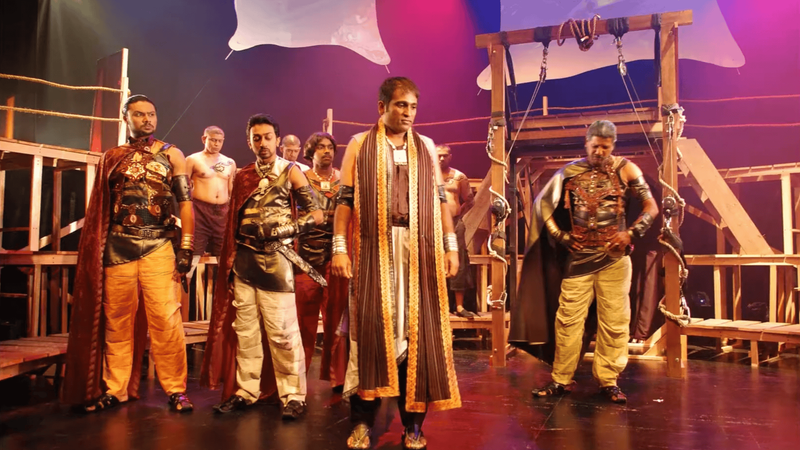
Ravi himself might have been stunned to see how many friends he had in death. Some reminded us of the man before the myth. His were actual humble beginnings. The sixth of seven children grew up amidst poverty and violence. His father, when he wasn’t in jail, beat the rest, once ripping Ravi’s uniform breast pocket to get at his pocket money. His mother, an “intensely gentle soul”, took her own life in 2000 after battling clinical depression. By then Ravi had graduated from NUS with a degree in Political Science and Sociology, raised money from friends, mentors, and former teachers for a law degree at Cardiff, and began practising. Interspersed are flashes of all the other Ravis so beloved: underaged fire walker; jacketed, moustachioed comedy script writer at NUS; on stage in Thondan, an adaptation of Shakespeare’s Titus Andronicus. (Like other totemic bald men, it’s easy to forget that he once had hair.)
Even as his loved ones sent him off in style—lorry-turned-golden chariot, trumpets, drums—his critics danced on his grave. They found the irony of an anti-death-penalty crusader dying (apparently) because of drugs too delicious to ignore. Validates Singapore’s tough approach, they concluded, presumably unaware that a shift from punitive action to harm reduction might save lives. If emergency medical care without criminalisation was available, might Ravi still be around? We’ll never know, though in their blithe haste to judge, one can feel the necropolitics of a Darwinian society, some lives worth more than others. Misunderstood locally, Ravi was celebrated internationally, working with lawyers and activists from West Papua to Tanzania. In 2023, he won the International Bar Association’s Human Rights Award.
What would Ravi himself have made of it all? In the digital blizzard of his life, one video stands out. Ravi is dressed in saffron, while dancing barefoot on the tarmac with another man, who’s in a polo shirt, jeans and sandals. They’re celebrating some Indian festival, Singapore style: yellow barricades cordoning them off from regular society, as yet another gigantic condo advertisement beams down on them from across the road. Ravi and partner are oblivious to the suffocating state and market, their jabbing hands and gyrating, pelvic thrusts a portrait of wild abandon.
At one point, Ravi’s saffron scarf falls to the ground. He swoops down, picks it up, waves it like a banner from left to right above his head as if it were all part of the act, and then attempts to wrap it around his neck, blinding himself instead.
Through it all, he keeps dancing.
This editorial is from Jom’s team.
For our research, we are indebted to the writings of the following people: Sophie Chew (in Rice Media), Remy Choo, Lucy Davis, Kirsten Han, Lynn Lee, Andrew Loh, Ng Yi-Sheng and Ariffin Sha. We have hyperlinked those sections where we drew directly from their observations and testimonials.
Letters in response to this piece can be sent to sudhir@jom.media. All will be considered for publication on our “Letters to the editor” page.