
Dear Jomrade,
Today we’ve published:
- “Singapore This Week”, by Jom
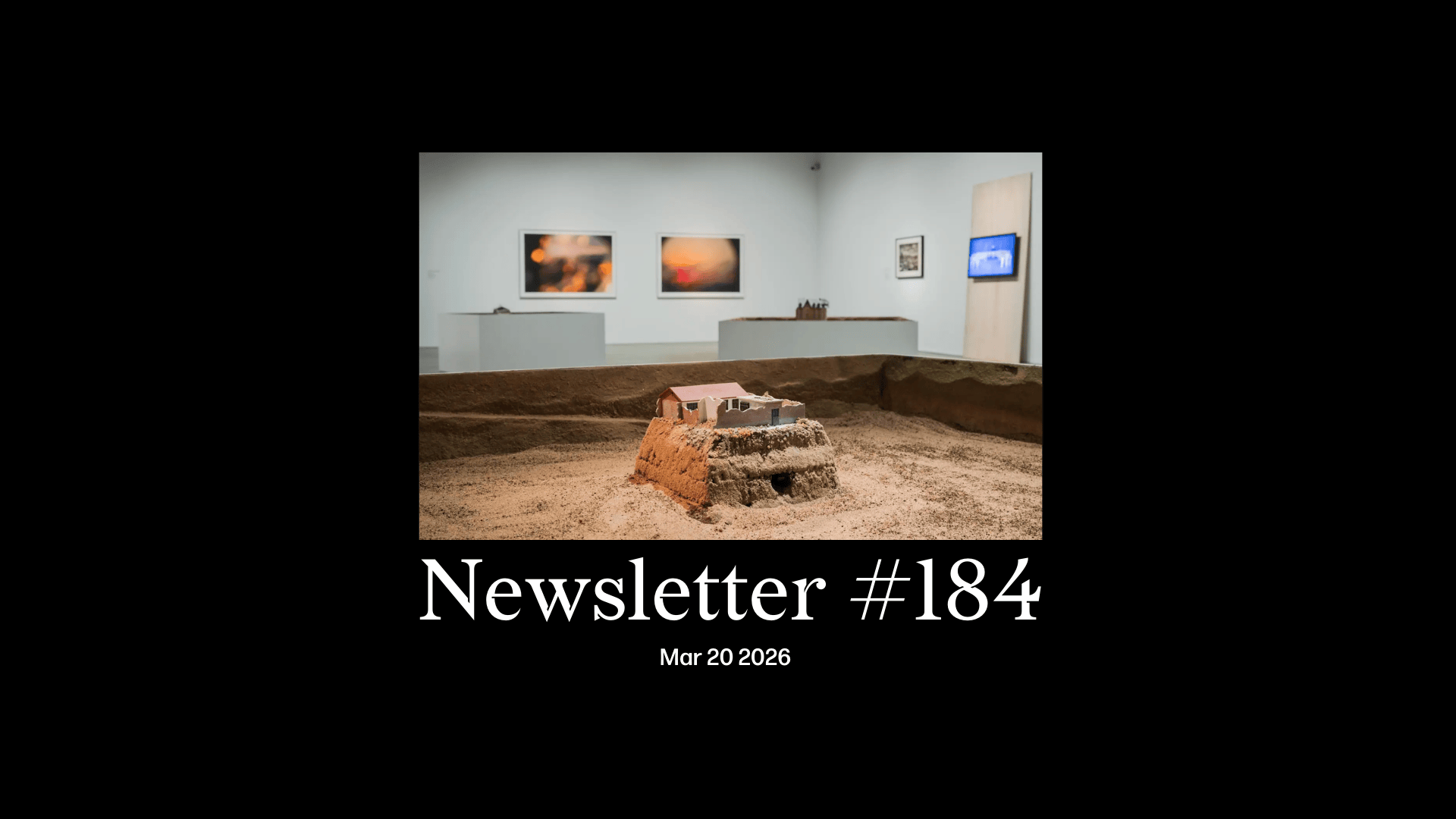
- “Building Blocks: space, time and the Singapore Biennale”, by Sasha Han
This is Abhishek by the way, subbing in for Sudhir, who’s enjoying a well-deserved rest. Normally, I would have ribbed him for this—minions toiling while the boss suns himself by the beach yada yada—but seeing as how I’ve just returned from a short break myself, conscience objects.
It’s difficult, too, to summon much frivolity as death and devastation in the Middle East continues apace (here’s one of the more interesting interviews about the war I read this past week); expectedly, the effects are now being felt here too, with higher fuel prices driving up transportation costs, and warnings that food could become dearer. Still, we’ve been spared the worst thus far. As Ramadan ends with Hari Raya tomorrow—festive greetings to Muslim Jomrades, and all others celebrating—perhaps that is something to be grateful for, even as we wish peace, safety, and a return to normalcy for those caught in the war’s epicentre.
I’m thankful as well that the past few days have been frenetic at Jom, keeping more sombre thoughts at bay. Sudhir mentioned Jomfest last week (in case you missed it, you can read that newsletter here). We’re finalising speakers, discussing logistics, and figuring out ways to put together as intellectually nourishing an event as possible. What was a mere blueprint just weeks ago has taken concrete shape. Very exciting, and a bit unnerving too since it’s the first time we’ll be attempting something at this scale. More details soon. And as ever, thank you for the support.
- Why is there a shortage of mental health professionals in Singapore, and what’s being done about it?
- More men are stepping up as full-time caregivers, but the good news is not unvarnished
- Can we stop fining the elderly already, for feeding pigeons, and indulge in a little more creative problem-solving, something we’re supposedly world-beaters at?
- Obituary of Dhoraisingam Stephen Samuel, among our first citizen-historians
- Remembering Jessie Wee, who made an entire generation fall in love with her creation, Mooty the mouse
Above are the issues we chose to explore in more depth.
Other news this week included: Lawrence Wong visits Japan amidst global turmoil; Singapore’s bristling response to Australia’s national broadcaster for having the temerity to suggest unfairness in our political system where, it is known, of course, that no party is more equal than others; POFMA orders issued to activist Han Hui Hui; the struggles of older children leaving the care system; uncertainty about the future of Komala Vilas, beloved Indian joint; multi-day disruptions in Singtel’s services; Singaporean of the Year gong for doctor helping the intellectually disabled; higher likelihood of autism symptoms in toddlers given more screen time; Amos Yee deported back to these shores.
Join 2,000 members keeping Jom independent. From S$10/month—full access, no compromises.
I may have misled you slightly about subbing in for Sudhir. Corrie, Jom’s arts editor, and I are both on duty. Corrie worked with Sasha, the writer of this week’s essay, over the past few months and the result is why I feel Jom’s writing on Singapore’s arts scene goes beyond mere coverage. I’ll let Corrie take over from here.
“Building Blocks: space, time and the Singapore Biennale”, by Sasha Han
I’m in a popular pasar bulat, or round market, scanning the crowd for any signs of an impending dance performance. I don’t quite know what to expect; it also looks like no one here is expecting anything in the steady din of hundreds of patrons chiding children, clattering trays, clinking glasses.
We don’t see them at first, but here they are, the dancers emerging from the lunchtime thicket. They feel like the market’s playful guardian spirits, pushing little trolleys studded with fairy lights, grinning at rapt kids, then performing stylised movements based on the everyday gestures of hawker labour.
It’s a charming idea: pop-up performances in our public housing estates to broker more intimate encounters with art in daily life. The National Arts Council titled this scheme “Arts in your Neighbourhood”. As I skirted the market with my teh c peng to find a seat, I was confronted by enormous posters and standees emblazoned with the council logo. Was it crucial that we all recognise this as a state-sponsored community project? “More like Arts in your Face!” an artist friend tells me later.
The ongoing Singapore Biennale has faced, well, just the opposite kind of criticism: some media outlets complained that it simply could not be found, and therefore should be shut down. Which, if you think about it, is perhaps the most Singaporean critique one might make about art: signage over substance.
We often associate the art biennale with its Venice incarnation: a sprawling spectacle showing off the who’s who of the international art circuit. Wend your way through the canal city and you’ll see art peacocking everywhere, occupying stately halls and lush gardens.
This week’s essay, by first-time Jom contributor Sasha Han, contemplates the opposite:
“Typically a vehicle for large-scale, public spectacles, the Singapore Biennale has previously been staged both on busy streets and cavernous halls. But for an event delivered as part of the SG60 celebrations, the 2025 edition often feels muted and self-contained. It largely sets aside self-congratulatory celebration to turn its gaze inward. As activity declines in the spaces it occupies, the biennale examines the veracity of claims that ‘non-essential’ art-making can only find its place after the building blocks of society have been laid. What might our city look like if the development of art wasn’t regarded as secondary?”
Sasha, a film writer and programmer, spent months visiting every single Singapore Biennale site, sometimes making multiple visits to better understand the art. She haunts the five neighbourhoods that contain over 100 artworks, displayed in repurposed colonial housing, former defense HQs, sleepy neighbourhoods and sleepier strata malls. Her essay considers the shoebox spaces we occupy as the foundational units of Singaporean life—“To live in Singapore is to swap one rectangular box for another, hole to hole, cradle to grave”—and how the biennale deploys these building blocks in different ways.
Another question Sasha asks is one of time. If space and art are luxuries in Singapore, then perhaps time is an even more precious resource. Many of the Biennale works demand the close and sustained attention of the viewer. “I had the privilege of time to spend, to plot my journey through the biennale,” she writes, “but I wasn’t so sure if other viewers had the same currency I did.”
The Biennale is in its final week (and admission is free!), so you do in fact have a little bit of time to check the boxes it offers, and draw your own conclusions about how it speaks to the Singaporean experience. Sasha’s done some wayfinding for you, but your wayfaring may bring you on an entirely different journey.
Jom fikir,
Abhishek Mehrotra and Corrie Tan
Jom
Jom on space and time in Singapore
 Toh Ee Ming
 Corrie Tan
 Pamela Ng
 Zachary Hourihane
Singapore This Week
Society: A dearth of mental health professionals

Getting mental health support in Singapore can be almost as daunting as the struggles that make help necessary in the first place. Stigma and workplace discrimination still deter many from seeking help. But even for those who do, a persistent shortage of mental health professionals makes care difficult to access. In 2021, the Ministry of Health noted there were 8.9 psychologists and 4.5 psychiatrists per 100,000 people here, and “no international consensus” on the ideal ratio. Just as a comparison though, Australia and Korea have 19 and 9 psychiatrists per 100,000 population respectively. Although the ranks of psychologists, psychiatrists, and counsellors have grown in recent years—amid rising awareness and a stronger national focus on mental health and well-being—they haven’t grown fast enough to meet demand.
The reasons are structural. Training pathways are long and costly, typically taking about seven years and requiring postgraduate qualifications, with expenses rising further for those who study overseas. Limited clinical placements and a lack of qualified supervisors further constrict the pipeline. At the same time, clients are often reluctant to see interns or psychologists-in-training, making it harder for trainees to log the practical hours they need to qualify. “[W]e’re caught in the middle,” one aspiring psychologist told CNA: “[I]f we don't have opportunities to gain the experience effectively, then we'll just be stuck.” Some efforts have been made to ease the bottleneck. The National University of Singapore has, among other actions, shortened training to five years by compressing its undergraduate programme and removed the requirement for a year of work experience before a master’s degree.
Elsewhere, the government’s mental health and well-being strategy, launched in 2023, has begun to improve access and quality of services. Measures include expanding capacity across acute, primary, community, and long-term care; training over 160,000 frontline personnel and volunteers to identify people in distress and to help them get support; educating parents on how to respond to their children’s mental health needs; and strengthening workplace mental health provisions. Since last year, psychologists have also been required to register in order to practise, a move aimed at improving patient safety.
In the meantime, some who cannot afford the support they need are turning to AI chatbots—an unregulated option that professionals warn carry real risks. Accessibility will remain crucial if people are to get the care they need without fear or delay. Experts have called for better insurance coverage, stronger regulation, and wider use of digital tools for early intervention.
Still, these measures are, at best, reactive. Without addressing the root causes of poor mental health, they can only help people manage distress, not prevent it. Well-being is shaped not only in clinics, but by the conditions in which people live; lifestyle factors and the broader social determinants of health remain among its strongest drivers. That requires a broader shift away from a model that’s centred on clinical intervention, towards one that prioritises environmental and behavioural change. It means, for instance, reducing social isolation, improving nutrition, and reducing stressful living and working conditions. Until then, the system will remain focused on managing the fallout; relying on therapy and medication to solve problems that are, in many cases, also social and structural.
Some further reading: In “Therapising queerness, navigating the mental health system in Singapore”, Charmaine Poh discusses the challenges queer people face when seeking mental health help here.
In “The AI will see you now”, Nicole Chan contends with the many benefits and pitfalls of getting mental health advice from generative AI.
Other stuff we like
Threads of Resilience by AWARE. An International Women’s Day event in Singapore celebrating the tenacity of the female spirit through art, storytelling, and talks, highlighting feminism, healing, and how shared creative expression builds solidarity and resilience.
No Uniforms. An Assembly for Queer Studies convenes speakers and participants to explore queer perspectives on gender and sexuality, fostering dialogue, connection, and collaboration through diverse panels, presentations, and discussions.
A flavour of Jom. Occasionally, Jom publishes essays outside the paywall. These are on issues we think are in the public interest, and deserve a wider airing. In the past two years, we have published nearly 50 such pieces. Read some of these if you’d like to see samples of our work. We hope they’ll convince you to subscribe. And even if you’re here with no intention of doing so, we hope you’ll enjoy these offerings and consider it time well spent!