
A memory of Houston is a memory of the sprawl. Most days we are on the road. The sun’s glare filters through the windshield. Trucks hurtle around us. From Westheimer and Gessner onto the I-10, the Katy Freeway, the Sam Houston Tollway. The air is hot and dry in the summers, cool and pollen-rich in the fall. The Greater Houston area is 35 times the size of Singapore and contains seven million people. Texas is 27 times the size of Greater Houston. Before, our view of the city had been confined to the trappings of suburbia by my father’s mental geography. It was only after I left the army and learned to navigate that new destinations availed themselves. The Rothko Chapel. Rice University. Me sitting in the front seat telling my Dad when to bear left or turn right. He curses, intimidated by the 4-wheelers careening around him.
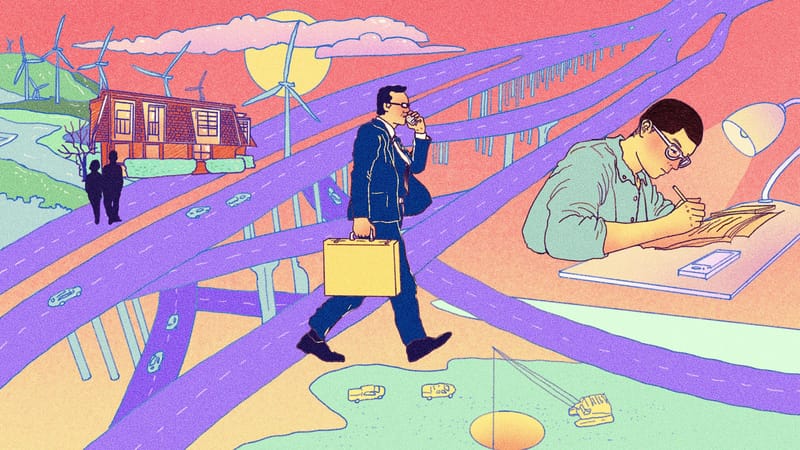
A memory of Houston is a memory of the freeway: how it stretches beyond a line of sight, curbing and snaking into a complex of tangles. The spaghetti highways that confound perception. The circulatory system of an auto-commuter economy. The freeway is the first and last thing you see in this city: the mass of cars escaping the congestion of the airport, the roads connecting neighbourhoods to elsewhere.
Houston may not seem an intuitive choice for a Malaysian Chinese family looking to migrate to America. The other potential destinations on my Yeh Yeh’s list were Portland, Oregon, and Los Angeles, California. The decision to leave is not uncommon to those of the Malaysian Chinese diaspora. Unusual, however, is the fact that my Yeh Yeh migrated in his retirement, after a substantial career as a civil engineer in Kuala Lumpur. Plaza Sentul, for example, is one of his projects that still stands today.
In the 1980s, Houston was a rapidly evolving business and finance hub, ideal for my Yeh Yeh’s sons to launch their careers. Another stop in a life of movement. My grandfather had been educated in Glasgow, as had his brother. They’d had sojourns in Singapore and Cambridge, England, for work. He’d sent his children to schools in Australia and the UK—marks of Malaysian wealth and a distrust of the local education system. Yeh Yeh had been active in his church and secondary school alumni association, being appointed Ahli Mangku Negara, or a Member of the Order of the Defender of the Realm, by the Yang di-Pertuan Agong for his community service.
Multiple events conspired to solidify my Yeh Yeh’s decision to leave. One was when the government bailed out a Malaysian royal from debts he’d accrued in Vegas, drawing conclusive disgust from my grandparents. Another theory is that my great-grandfather’s passing let him leave, the loosening of responsibility for an eldest son. A friend helped him secure land in Houston’s Memorial area. When they arrived in 1981, the city seemed a world away from London, where my father was in university, and Kuala Lumpur. Cosmopolitanism was swapped for the mores of white Southern etiquette. It demanded an experience of double consciousness, to borrow from sociologist W E B Du Bois, as the only Asians in their neighbourhood—a consciousness of themselves as Asian but also consciousness of being perceived as such by their white neighbours.
Growing up, I had never known Malaysia to bear the same kind of ancestral pull that it does for many Singaporeans. I learned quickly to live with the dissonance of having grandparents who were always at least a 24-hour journey away. It had once been 12 hours to Moscow then 12 hours to Houston, though now the transit is via Manchester. I remember my Dad’s disgruntlement at rigid Muscovite airport staff, the lines of fatigue on my Mom’s face as she dragged her three sons along. The flight cabin, always shrouded in dimmed lights, the glimmer of blue screens vivid to a restless child. The eventual landing in Houston would see us gathered and whisked away by our cousin. Singapore, Moscow, Houston, Manchester, all usual stops along the refinery circuit, one familiar to oil families who have followed its routes. The journalist Tilak Doshi wrote of Singapore’s role in providing petroleum refining, blending, and storage services in a book published in 1989. Its title? Houston of Asia.
My grandparents’ home in Tealwood North is built of red and brown brick, with tall windows, an open lawn, and a garage filled with gardening tools. Its interior reveals memories that remained beyond a passage across the Pacific: a grandfather clock with a calligraphic note of gratitude to my Yeh Yeh, my Mah Mah’s wushu swords hung above the television in the living room, ink paintings of storks, pictures of my grandparents in Kuala Lumpur. Beside the piano there is an angklung, and across the room are the organ and accordion my Yeh Yeh taught himself to play. Houston makes itself known in the waste collection schedule stuck to the fridge, the growing pile of newspapers and coupons, the photos of grandkids with Santa or eating lobster and corn.
My grandparents settled into a diasporic community at the Chinese Baptist Church, as is common for many Asian communities across the US. They devoted themselves to service, as elders and teachers and choir members. It was this church’s pastor who furnished my generation with a common Chinese character for our names: yee (義) for the sons and yi (儀) for the daughters. There were not many churchgoers of Malaysian origin. Some could trace their roots to Hong Kong, Taiwan, Singapore, or mainland China; others had been in Texas for generations. An imbrication in Asian America. I’ll never forget the shock of being greeted by an aunty with a thick Texan drawl. The Cantonese and Mandarin services shrank over time, as the church’s children and grandchildren preferred to listen and pray in English. They might go to college in Houston or Dallas, Austin or College Station, for Texas is vast and its options are plenty. The state is a world unto itself.
The city of Houston was named for Sam Houston, the first and third president of the Republic of Texas. After serving in Tennessee politics, Houston arrived in Texas in 1832, when it was part of Mexico. He belonged to a wave of new settlers from the United States permitted by the Mexican government to settle the vast, sparse Texan lands. Three years later, these settlers, Anglos, as they were known, would wage war against the Mexican government over immigration rights and against the Mexican abolition of slavery. Houston, a slaveholder himself, was appointed a major general in the Texan Army and led it to victory over the Mexicans. Texas declared independence in 1836.
That same year, the brothers Augustus and John Allen, newly rich from the inheritance of Augustus’s wife Charlotte, purchased 6,600 acres of land for US$5,000 with the intent of establishing a new city. They named the townsite after the hero of the hour, General Sam Houston. Texas would accede to the US in 1845, only to join the Confederate States of America in 1861, when the Civil War broke out. Houston, though, refused to swear an oath of loyalty to the Confederacy, steadfastly claiming that Texas was again an independent republic. Ostracised by Texas’ political elite and suffering from poor health, he died in 1863.
I am unsure of the extent to which my grandparents knew anything of the namesake of the city they had come to call home. The sparse, intermittently populated Houston of the 1830s was a far cry from the oil- and cash-rich Houston of the 1980s. The discovery of a petroleum reserve near Beaumont, Texas in 1901, unparalleled in its size globally, would lead to incredibly swift industrialisation and urbanisation, leading Texas to dominate oil production in the US by the 1940s. In 1962, the National Aeronautics and Space Administration (NASA) would open a centre for human spaceflight, renamed for President Lyndon B Johnson in 1973. As it dug deep into the earth, so too would Texas reach far into the cosmos.
The Houston area remains host to the highest concentration of oil refineries and petrochemical plants in the world. Second to it is Singapore. When Lee Kuan Yew visited Houston in 1998, it was, as Jia Tolentino described, enjoying the “dominance of Southern evangelicals and the spoils of extractive Texan empires—Halliburton, Enron, Exxon, Bush.” At Rice University’s James Baker Institute, senior minister Lee spoke of the fallout from the Asian Financial Crisis and looming recession. My grandparents attended his talk, enticed by the opportunity to see him in person, though my Mah Mah does not recall much of what he said.
Singapore has long sought cosmopolitan kinship through the notion of the “global city”. Its veneer of wealth and multiculturalism has invited comparisons to New York, Zurich, London, and Hong Kong, as has its high cost of living. The comparison with Houston seems to evade popular perception.
Owing to its location and a natural deepwater port, Singapore was the preeminent petroleum storage, trans-shipment, and distribution centre in Asia from 1892 to 1960, under the auspices of the British Empire. After independence, its socio-political stability, and proximity to crude oil producers like Malaysia and Brunei, as well as markets such as India, Japan and the rest of Southeast Asia, attracted heavy investment from multinational oil and petroleum companies.
In his introduction to Tilak Doshi’s 1989 study of Singapore’s petroleum industry, Fereidun Fesharaki writes that “Houston of Asia” is an apt metaphor that captures Singapore’s dominant regional role as a provider of petroleum refining, blending, and storage services. Just as Houston’s ascent was buttressed by oil money, so too was Singapore’s catapult to wealth undergirded by its careful cultivation of the petroleum industry.
This enabled rapid urbanisation, the substantial transformation of areas such as Tuas and Jurong, and the establishment of strong banking, legal, accounting, and logistics networks. Government officials in Singapore once spoke of creating a “total oil business centre”, where interested parties could purchase, refine, store, and trade the commodity. A careful elision of the oil industry in the public imagination led Doshi to describe it as “an almost mythical creature”, of which a thorough understanding seems the “special province of an elite of expatriate oilmen ‘who deal in the stuff’ and some senior officials in government”. It is this that has drawn petroleum professionals from across the world, including Houston, to Singapore.
The Houston of the 1990s was not, perhaps, the Houston I knew with any intimacy. A Houston of corporate greed and accounting scandals and megachurches and the prosperity gospel. A Houston of gated suburban neighbourhoods multiplying across the city. Our days would be filled with a kind of domestic languor: hours spent at shopping malls, meandering through smoothie stores and coffee shops, book and sneaker outlets, steakhouses and Tex-Mex joints. Sprawling, expansive, and usually spread across a single floor, those malls felt like labyrinths of commerce.
A trip to Houston, privilege as it was, was rarely marked by the excitement of a distant vacation. It meant falling into the rhythms of another kind of docility while remaining bewildered by the excess. Steaks that seemed to hang over the edges of their plates. Tacos and sizzling fajita platters. Glistening, moist brisket and succulent pork ribs. Hot dogs and pizza slices at Costco. Bowls of gumbo and plates of catfish and crawfish. The retreat to familiar Chinese restaurants for crispy noodles or Vietnamese joints for phở.
The clearest articulation of American-ness I saw growing up was of conspicuous consumption, of excess. It provided a gloss over the complexities of Texan history, cuisines reflecting the shifting shape of Texan allegiance between Mexico and the United States, and the successive waves of Asian migration, both willing or coerced, that would alter the character of the city. Today, my Mah Mah is hardly the only Asian in her neighbourhood. A Japanese family moved into the neighbourhood a decade after their arrival. Just last year, a new family moved in next door. The family’s mother, originally from China, had lived for many years in Singapore.
The spectacle of a city’s wealth in the US can best be expressed through its sports franchises. In Houston, the first sign of a big game is the line of cars inching to get off the freeway. The Houston Rockets, the city’s basketball team, usually play their at-home games downtown at the Toyota Centre, which doubles as a concert venue. Carparks surround it in concentric circles. Moving through a metal detector gets you into the strips of walkway surrounding the arena, lined with an eye-watering number of food stalls and back-to-back merchandise stores. The first view of the stadium is a brilliant wall of red, lights flashing, players drilling shots, agility and musculature overpowered by the rumbling voice of an announcer and the blare of pop music. At every time out or pause, there is a segment ready to go: dancers, free throw games for fans, Clutch, the Rockets’ bear, shooting t-shirts into the crowd with his cannon. It is sheer orchestration of affect, bolstered by stomachs full of junk food and the smooth run of each play. Entertainment in its purest form.
On a recent trip, I watched the Houston Texans, the city’s football team, for the first time at NRG Stadium. If I’d thought the spectacle of basketball was excessive, I could hardly have imagined what I’d see at the football game. The entire area surrounding the stadium is one enormous car park, rows and rows of trucks and cars beyond what the eye can comprehend. The stadium can fit more than 80,000 and the crowd’s roar with every completed pass would reverberate in my head. Seeing the crowds and the lights and the cars, all I could think about was the decadence that sustains sports at this scale, the derangement of living as if the climate crisis is immaterial.
If there is an inverse image of Houston’s wealth, it may fall uneasily, and not always exactly, along racial lines. Economic precarity manifests itself in different communities, often in neighbourhoods in unfolding rings from the city’s centre. Those who live, as writer Colin Grant described, “only one missed paycheck away from ruin”, are in areas distant from the comfortable environs of my grandparents’ Tealwood home. This is the Houston that was home to George Floyd, whose murder at the hands of Minneapolis police galvanised a global rally against structural racism and police brutality in the US. Before he moved to Minnesota, Floyd had been active in community service in Houston’s Third Ward housing projects, driven by a desire to break the cycle of violence that had beleaguered youth in the community. The heart of white wealth is premised on the continued marginalisation and uncertainty faced by many of the city’s lower-income residents. A lack of affordable housing and growing income gaps have become matters of key concern.
When my grandparents arrived in Houston, they became ardent supporters of the Republican Party. This was Reagan’s America, pulsing with renewed national confidence and dog whistles and Star Wars and a refreshed social conservatism and cutbacks on welfare. I’d always found it curious that my grandparents were politically apathetic in Malaysia. In Texas, perhaps it was the intoxicating feeling of being part of the city’s religious majority, proximate as it was to the enmeshed centres of power: whiteness and wealth. My grandfather’s staunch support of Reagan would continue on to Bush Sr and Bush Jr, as well as persist in his distaste for Clinton and Obama. It is an oft-quoted adage that Asian Americans are activated in the US national imagination as a wedge between white and Black communities, and material and urban forces have made it such that there are rarely opportunities to interact across ethnic lines.
The first time I felt like I perceived, with some intimacy, the lives of those who lived far away from us in the city was in Bryan Washington’s 2019 short story collection Lot. The bulk of the stories centre on Nicolás, a young, gay, male narrator who is “too dark for the blancos, too Latin for the blacks.” Washington’s eye captures the sheer diversity of Houston’s denizens, explored through the city’s various neighbourhoods. Each story is set in a different district, from opulent gated communities to harsher, more punishing locales, where most of the collection is grounded.
Houston, through Washington’s hand, is changing constantly, and rapidly, from the encroachments of gentrification to the dislocations of hurricanes to the demographic shifts engendered by white flight. This creates a particular melancholy; Washington describes in an interview that his stories function as “time capsules” for the neighbourhoods on the cusp of change. Something about his prose seemed to lacerate the memories of Houston I’d held and of the lives lived by my family.
I have two memories of attempting to reach beyond the Houston I’d known. The first was in the summer of 2017, my first time back since enlistment. On a whim, one of my friends from primary school, then an undergrad at Rice, asked if I wanted to volunteer at Houston’s chapter of World Refugee Day. It was the first time I observed and properly understood the diversity of Houston’s refugee population. Beyond members of the Vietnamese community, who’d arrived decades earlier, there were members from the Nepalese, Rohingya, and Ethiopian communities. Sitting on the lawns at the centre of the city, having injera for the first time, I listened to Sylvester Turner, the city’s 62nd mayor, a Democrat, and an African American, speak about the city’s commitment to welcoming displaced people.
The second time I ventured out to see a different side of Houston was in the winter of 2018, when my brother mooted the idea of watching the rapper Aminé perform at the Warehouse in Downtown Houston. The crowd was different from any of the places we’d been used to: young, hip, predominantly Black. This was the Houston that had produced Beyoncé and Travis Scott and the iconic hip hop genre chopped and screwed. At Aminé’s gig, a couple of local rappers came out to open, doing their best to get the crowd going. Aminé came out about an hour in, spry and animated. Soon, the warehouse was bouncing as he performed song after song, from “Spice Girl” to “Reel It In”. My brothers, growing in their love of hip hop, bopped along and rapped. As we streamed out after, a sudden downpour assailed us. Cars were backed up for blocks. We pulled up our hoods and walked and walked until it felt clear enough to call an Uber.
It has been about 13 years since my Yeh Yeh passed away. The dream of his sons starting fruitful careers in Houston would not come to pass. Settling in New York and then in Singapore, my father never lived long-term in Houston. My uncle would spend most of his professional life in Malaysia. Houston would, however, become home to my aunt and my cousins, some growing up there and experiencing a daily intimacy I never had with my grandparents; others arriving for high school or college and becoming embedded in Asian American communities. Now spread across Houston, Dallas, Kuala Lumpur, and Singapore, it is a state of being that reflects the various choices that have defined, or riven, my family over the years.
In 2020, the escalating rhetoric of the “China virus” created a pit of terror in my stomach. The spate of violence against elders in the US was especially alarming—brutal videos of elderly Asian men and women getting pushed, stomped, harassed. I feared the worst, but those disillusions never came to pass: my Mah Mah remained resolutely at home, going out only to run errands or pick up my cousins. My grandparents would surely not have been able to foresee Sinophobia poking its head in this new soil, in their party. My Dad used to say that Trump has made my grandfather turn in his grave.
Nor, perhaps, could they have anticipated the major power crisis that would hit Texas in 2021. The state officials originally attributed this to frozen wind turbines and solar panels, a distraction from the reality that the state had failed to adequately prepare its energy infrastructure, principally based on natural gas, for winter storms. The energy capital of the world crippled by a two-week outage. Seeing videos from my Mah Mah on WhatsApp of her cooking on a gas stove outside because her electric stoves were not working, I could only wonder if this was the life she and my Yeh Yeh imagined when they first set off for the US in the 1980s. Some detritus from an American dream.
For all the ways that Texas has distinguished itself as a centre for oil and gas, it has somehow become the US’s biggest producer of wind and solar energy. Professor Michael Webber of the University of Texas described how it is “not unusual for Texas to do all the right things for all the wrong reasons, and the rise of renewables is one of those examples”. The state’s plentiful sun and wind have brought renewable energy prices down drastically. The US Energy Information Administration observed that Texas added more wind and solar capacity in 2023 than all other states combined. Nuclear, wind, and solar energy now generate almost 40 percent of the state’s energy needs.
Despite the politicisation of the climate crisis in the United States, renewables have remained surprisingly resilient in Texas. Democrats like them as clean energy, rural Republicans like how they enable economic development. The state’s clean energy boom has absorbed workers and entrepreneurs from its oil and gas industry. And yet, it is this energy that is helping generate the power Texas needs for its extraction and refining sectors.
As the “Houston of Asia”, Singapore too has been a beneficiary of Texas’ expertise, absorbing professionals who have helped build the country’s position as a leading source of petroleum-related services in Asia. Environmental activist Aidan Mock has written that “[t]he development of Singapore’s fossil fuel industry was not a malicious undertaking but a pragmatic step to ensure that our island nation survived. Anyone looking to challenge the oil and gas industry must understand the reason for its existence.” The developmental imperatives behind the courting of petroleum conglomerates have shifted somewhat, though they continue to play a substantial role in Singapore’s economy.
Mock writes that those who imagine a fossil-free future “must bring compassion and grace towards our targets”. Decarbonisation calls must be couched not only in ethics and existence, but also economic sense. The influence of affect and the imagination must be brought in to help envision new ways in which we can exist with the natural world. Technical expertise will be required to transform and create infrastructure that can enable this shift, while innovative financing mechanisms will be crucial in ensuring these projects can be delivered and implemented.
Establishing Singapore as a hub for green finance and services has become a core part of the government’s agenda, with conferences such as Ecosperity and policies ranging from the adoption of sustainable aviation fuels to the rollout of mandatory climate disclosures for companies. These moves do not affect the core legitimacy of the People’s Action Party. New ways to manage resources and ensure food and energy security have always been consonant with the image of resource-poor Singapore, while the concentration of green finance in Singapore will help assuage anxieties about potential lurches toward irrelevance.
Singapore’s oil and gas industries, in the meantime, hum along although occasionally, their quiet, spectral presence spills into full view. In June 2024, a dredger lost steering control, colliding with a bunker vessel at Pasir Panjang Terminal. 400 tonnes of low-sulphur fuel poured into the sea. Images of thick, viscous fuel seeping into the coastlines, dousing kingfishers, and choking marine life proliferated on social media.
In both Houston and Singapore, it seems that the symbiosis of the fossil fuel and renewable energy industries may yet continue.
In the summer before I returned to Singapore from graduate school in the US, I went on a manic tour of the South, making stops in Nashville, Atlanta, and New Orleans before visiting my Mah Mah in Houston. Most of our trips to Houston have happened and continue to happen around Thanksgiving. Occasions to eat carved turkey and cornbread, green bean casserole and mashed potatoes slathered in gravy, slices of ham and pecan pie. Occasions when my Mah Mah has shed a tear at seeing four generations gathered under her roof. This time there was no agenda; I would sit with my Mah Mah and uncle and go through old family albums, catching glimpses of Kuala Lumpur, Cambridge, London, and even Singapore in weathered and faded photographs.
The day before I left, I pulled out my crumpled graduation gown and cap from the bottom of my rucksack. We went to my Yeh Yeh’s grave, a way of presenting all I had learned and done in my year of American higher education. It put to rest, however momentarily, the notions of identity I had long pondered, the ways I had yet to factor in Houston into how I had grown up and made sense of myself, first as an American then as a Singaporean. It was an act of homegoing, shorn of the anti-diasporic cynicism I had trained myself to hold. It was a way to honour the choices that my family has made and the lives those choices have made possible.
My Mah Mah and I took a photo at the Memorial Oaks Funeral Home & Cemetery, sun shining, fountains gushing, robe damp from the summer’s humidity. All I could think of was the whisper of my Yeh Yeh’s favourite hymn:
“Great Is Thy Faithfulness, Lord unto me.”
homage
Houston, Texas
after Li-Young Lee
i was tired, so i laid my head.
i was summoned, so i rose from my bed.
his voice rang from the room at the end of the hallway.
his voice rang from the music he played.
his organ and accordion remained hidden in their cases.
just as his voice rang from the music he played
in a quartet riding across the Malayan peninsula,
proclamations over motorcycles from sea to shining sea.
just as it rang with volume,
with vigour stern and strong, firm, unrelenting.
or that was how i dreamt it to be,
as is how all hardened fathers sound,
until the tubing was laid
through his neck to his stomach.
a blockage of plastic, of phlegm.
this morning Mah Mah remembers a dream.
she remembers it as we ladle our porridge.
she remembers how he was in the other room
body laid against his armchair,
breaths laboured and slow
and how he knew he was being spoken of
and how she had heard his voice in the other room.
how his presence was diffuse like light.
how his presence rushed like water.
we go to his grave on black friday.
white flowers mark a november birthday.
white flowers mark ten years past.
white flowers rest in his plot.
my nephew asks if he is in heaven.
my father says it’s been a while since we’ve seen him.
my cousin strolls by the fountain gushing for the bereaved.
his son waddles through his arms.
the tombs of the wealthy are beside the lake.
the tombs beside his are incomplete.
their engravings are yet to be etched.
i was tired, so i laid my head.
i was waiting, so i could remember
how he used to call my name.
Jonathan Chan is a writer and editor of poems and essays. Educated at Cambridge and Yale, he is the author of the poetry collection “going home” (Singapore: Landmark, 2022) and managing editor at poetry.sg. More of his writing can be found here.
Correction: An earlier version of the essay indicated the author's grandparents were considering moving to San Francisco. The author has informed us that it was actually Los Angeles. The essay has been emended to reflect the same.
Letters in response to this piece can be sent to sudhir@jom.media. All will be considered for publication on our “Letters to the editor” page.