
Nature may be returning. This could come as a surprise to many Singaporeans. On the one hand, we hear about how secondary forest after forest is razed for development, with land use announcements an endless elegy to nature, and simultaneous paean to all in real estate. On the other hand, less visible at an individual level, is the growing desire to plant, to see plants, to be around plants, to create space for fungi and animals, even in the unlikeliest places.
The proliferation of urban farming is all the more dramatic given how bifurcated Singapore’s land use was until the mid 1900s: a congested municipal area surrounded by a sparse rural one. Separate government initiatives, including the modified ring plan of 1971, pushed housing and commercial development to outlying areas like Jurong and Woodlands. Singapore was slowly blanketed with public housing estates. What’s happened in recent years is a reversal of that colonial government bifurcation. Now, there are urban farms popping up near, if not quite within, that same municipal area. Indeed, one might argue that any farm in Singapore today is, by definition, an urban farm. Even as we sadly, desperately, lose farms in the north, we create new ones elsewhere.
In 2019, City Sprouts, run as a social enterprise, opened in the grounds of the former Henderson Secondary School. The plot-share urban farms sit alongside a shared compost pile; a repurposed school canteen, which allows for F&B experimentation and concepts; a traditional wayang stage; and a fitness space. City Sprouts has since expanded to four sites across Singapore, and works with partners as varied as Wildlings Forest School; St Luke’s ElderCare; and Orang Laut SG, a collective that seeks to preserve the memory and ways of our sea people.
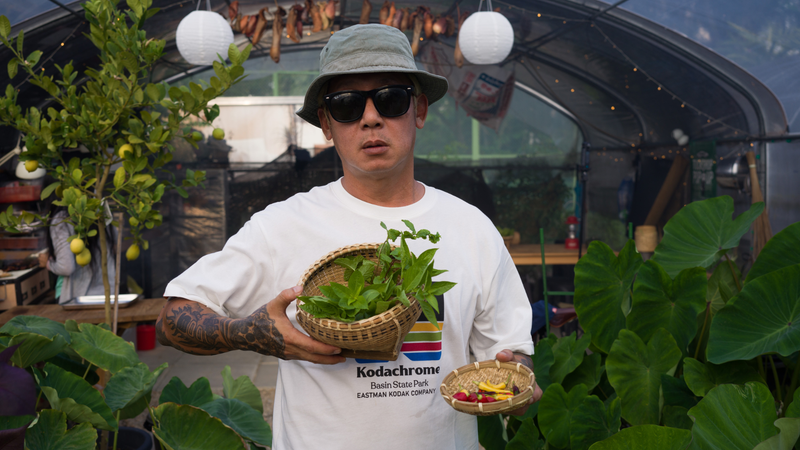
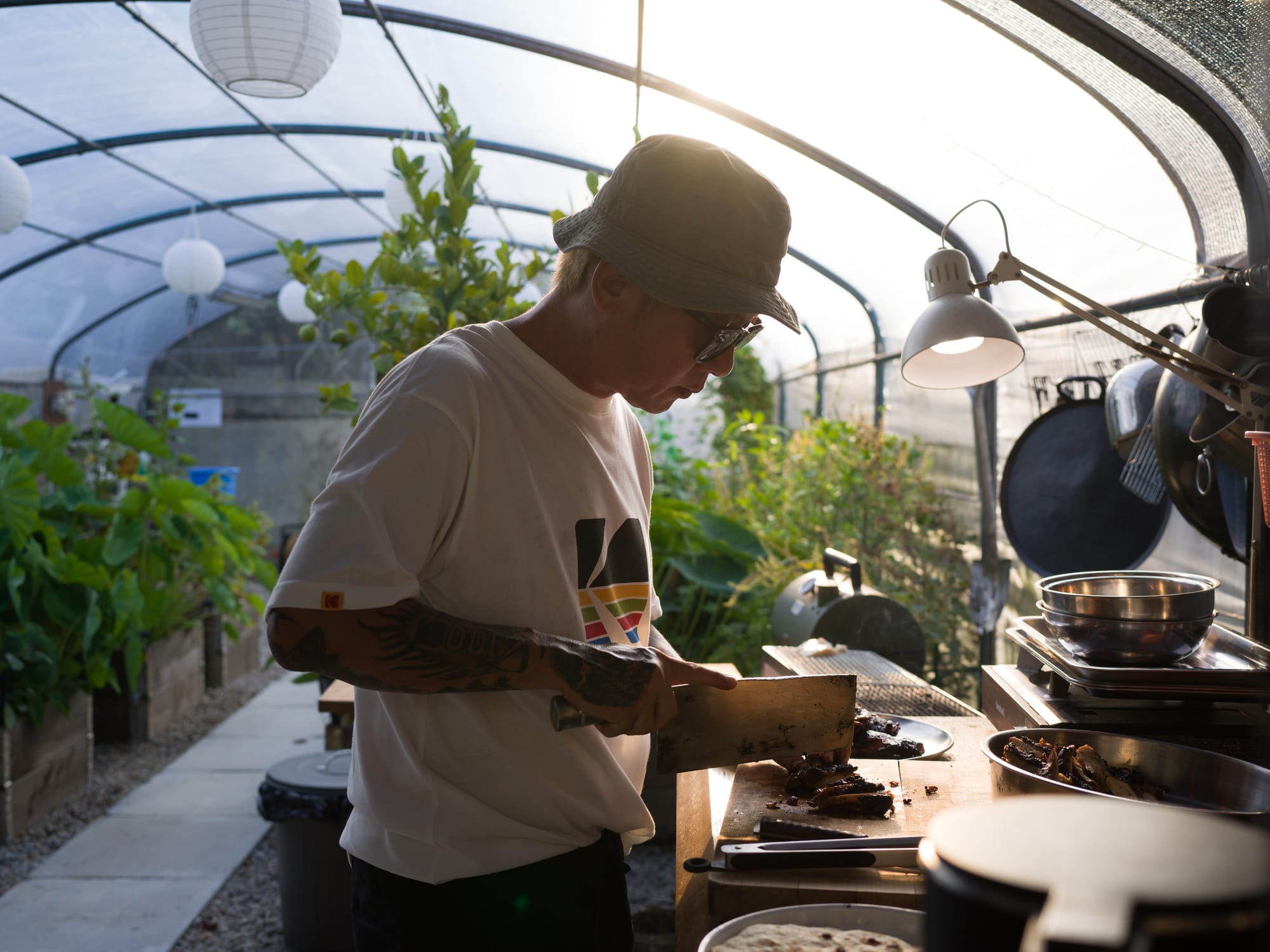
A few Saturdays ago at City Sprouts Henderson, my nose was led by the smell of burning coals and grilled meat. I walked into a plot that had highly manicured vegetable patches in its front two-thirds, and a dining kitchen set up in the rear. Flipping quails over the fire was a middle-aged Chinese man with a shock of yellow hair and tattoos all over his body. From some angles he could pass for a K-Pop star; from others, an uncle who doesn’t realise he’s no longer fashionable at Zouk.
The shape-shifting, time-warping aura Kevin Lee exudes is matched by the reality of his personal and professional journey. A Cantonese Fijian who migrated to Singapore in the early 2000s, he first made his name in creative design. His photography took him around Asia, including to the Maha Kumbh Mela, the massive pilgrimage and festival in India. He also founded Invisible Photographer Asia, a platform that helped open doors for photographers around the region, and is also behind @publicnoticesg, the popular Instagram account that documents humorously paggro, self-made notices found in public spaces.
In 2019, he published Hundred Daughters Hundred Patience Hundred Meals in honour of his late dad, who owned a Chinese restaurant in Fiji. The remarkable project, which combines family memoir and recipes, is essentially a meditation on migration and diasporic life: “from the rice farms of Kaiping in South China, to the sugar cane fields of Fiji in the South Pacific, to the HDBs of Singapore in Southeast Asia.” It also, somewhat unexpectedly, served as a pivot into a culinary career, which he’s now pursuing as obsessively as he did his previous endeavours. Kevin runs a private dining kitchen, Poon’s—named after his dad’s restaurant in Fiji—selling out bookings months in advance. He’s the host of CNA’s In Search of Heat documentary, about chillies. And he is, in his own right, a prolific culinary content creator. Kevin’s demeanour mixes the easy-going nature of an island boy with the fastidiousness of an experienced producer, and it’s never quite clear how he does so much.
When City Sprouts started in 2019, just 10 minutes from Kevin’s home, he applied for a plot, without any plans for it—probably just one of many ideas buzzing around his effervescent mind. This past January, some five years later, one became available. He signed in February, paid a friend to set it up, and by May was harvesting his own crops. So nascent are the shoots that when I visited, he started showing me around like an expectant parent, only to surprise himself. “See this chilli [plant] I grew…oh, fuck! There’s a chilli!...I saw little ones over there, oh fuck, I didn’t realise that one. That’s my first chilli [from seeds].” It was a special moment for the chilli fiend. He also pointed out basil, honey dew and zucchini. When we got to the curry tree, I recognised its leaves, so common in South Asian cuisine.
“Have you had curry fruit before?”
“Curry leaves? Ya.”
“Fruit.”
“Oh, the fruit, no.”
Kevin plucked off a purple berry and popped it in my mouth. That distinctive aroma filled my mouth in a new way. “Teaching an Indian about curry,” Kevin laughed. He then swivelled to go check on a “root crop leaves soup” that was bubbling in a stunning, blue-glazed Japanese ceramic pot, set over a portable gas burner. He was expecting guests for his Mai Kana Omakase. “In Fijian, mai is come, kana is eat. So I call it mai kana because it kind of sounds a bit like makan or khaana.” [To eat, respectively, in Malay and Hindi.] The experience he once dished out in his three-room HDB flat is now, thanks to City Sprouts, also available in a farm.
Kevin rationalised the over S$10,000 investment as a fast-track to the farming life, because it would otherwise have taken him far longer to do, all while paying rent. He’s quickly learned how to farm from an expert; he’s become connected to the wider farming community; he’s now got a new source of content for his social media platforms; and it’s an intriguing twist to his five-year-old private dining business. “It didn’t feel forced. Started, within three months, boom! I had crops, and on my profiles, I’m saying ‘farm-to-table’.”
Farm-to-table refers to a direct connection between a food source and a restaurant’s prepared meal. The movement took root in the early 2000s in northern California, championed by chefs like Alice Waters of Chez Panisse and Thomas Keller of The French Laundry. It was partly a rebuke to the many perceived ills of industrialised agriculture, from mono cropping and tasteless commoditised tomatoes to the grotesque food miles clocked up, as global supply chains allowed consumers in the rich world to demand year-round access to food from everywhere. Food safety, traceability and seasonality grew ever more important, as did broader ideals about the food ecosystem, such as ensuring smallholder farms’ financial sustainability and heirloom crops’ survival. Over time, what was popularised by high-brow Napa Valley kitchens was democratised across the world.
One of Singapore’s more notable, affordable farm-to-table experiences in recent years was the lei cha, “thunder tea” rice, by Thunder Tree. Lei cha, in its most basic form, consists of a carbohydrate base, five to seven different types of finely cut vegetables, various toppings like chye poh (preserved radish), tofu or peanuts, and most importantly, a tea-based soup made from a combination of ground nuts and herbs like basil leaves, mint, coriander, mugwort and green tea leaves. Thunder Tree assembled its lei cha using vegetables grown on the family’s Fireflies Health Farm in Lim Chu Kang. In 2022–23, Fireflies was one of 70 farms in north-west Singapore that the government evicted after it redesignated all that farmland for military use. I remember eating their lei cha at their table in VivoCity, some 30km from their farm in Lim Chu Kang.
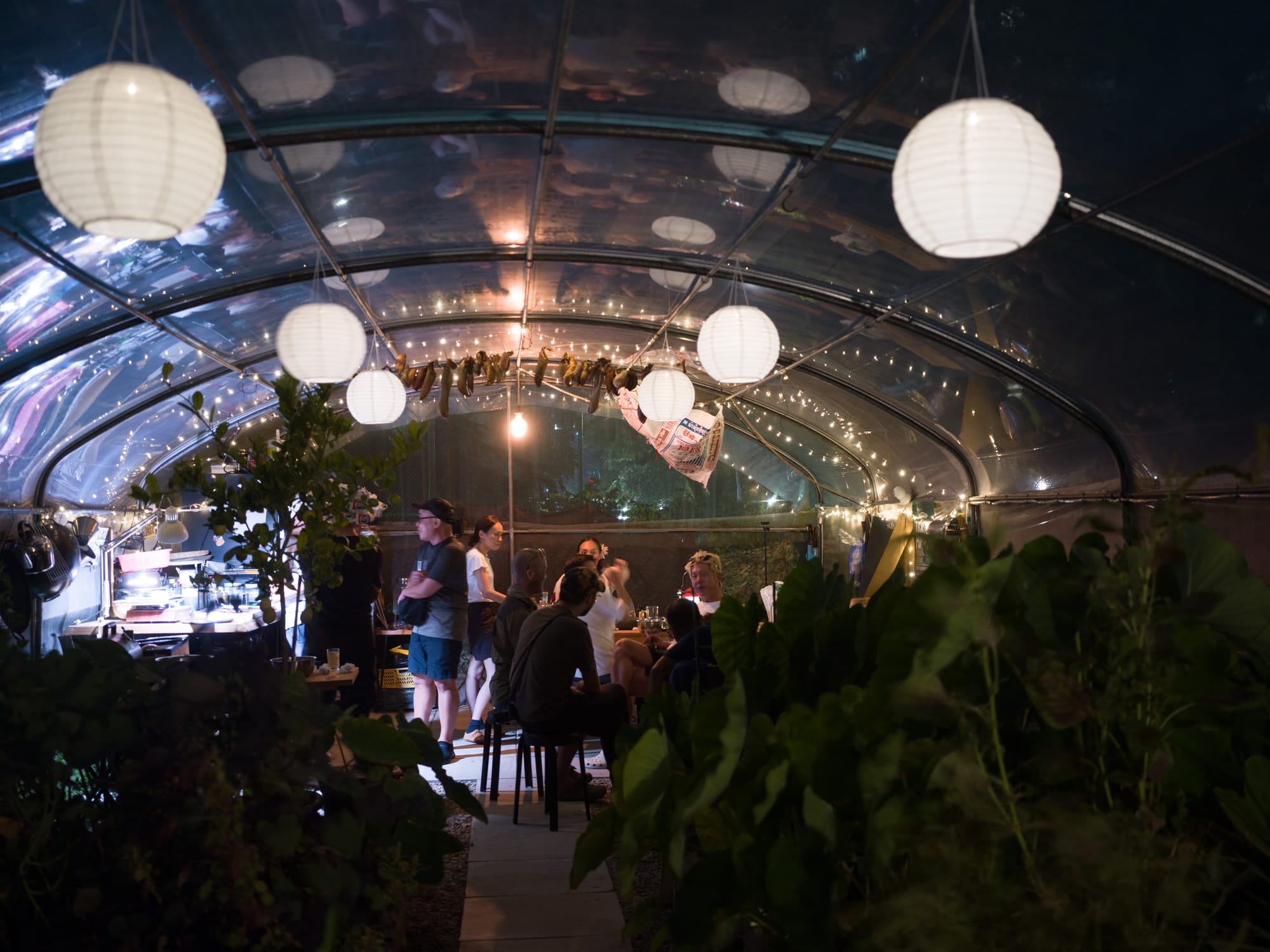
Kevin’s farm-to-table experience, though pricey, is wholly unlike any other I’ve seen. The physical distance from “farm” to “table” is a few metres. As diners eat freshly plucked leaves they do not just see the stems from where they came, but are actually, at a more elemental level, sharing the very space of the living creature that produced them—human and plant alive, growing, breathing, bobbing in the same fan-blown breeze, with the universe’s energy flowing from sun through chlorophyll to mouth and digestive system. The other novelty is that Kevin is both farmer and chef. The farm-to-table labour transmission occurs through the same hands. “So I’m the guy that literally made this dish from scratch, from dirt.” He can improvise meals in seconds—once, as guests were chomping on grilled meats, he walked over and cut some Brazilian spinach as a complement. Maintenance isn’t too onerous, with the automated watering system. He pops in once every other day. “It’s an organic farm, I’m not using chemical pesticides, right? That’s probably the biggest issue—pest control.”
But hang on. Isn’t Kevin ultimately just cooking a meal using stuff from the garden, like people do every day around the world? A sceptic might wonder if “farm-to-table” is just marketing fluff for him to justify higher prices. This perhaps misses the point. In a land-starved, urban jungle where only a minority walk through an actual garden daily, he’s offering diners a rarified culinary experience—and in the process, perhaps inspiring other would-be farmer-chefs trapped by the confines of space, wondering how they might break out and innovate. There is a communality to his work, not only in the neighbourly sharing of resources at City Sprouts, formal and informal, but also in the platform he offers to others. “The whole sessions I’m doing here is not just about farm-to-table. It’s about local, made in Singapore.” The mustard greens I’d just eaten were from Natsuki’s Garden, a small commercial farm on a nearby plot. The lion’s mane mushrooms were from Mushroom Buddies, another neighbour, though he mostly buys from Bewilder’s Ng Sze Kiat, old friend and arguably Singapore’s pre-eminent grower, who cultivates local varieties too.
And given that Singapore is, after all, merely one island in the world’s most diverse region, Kevin also spontaneously tosses into the mix random Southeast Asian ingredients that he’s gathered on his travels. He showed me a mah kwan pepper from Chiang Mai, with brownish circular shells and black seeds reminiscent of its more famous relative, the red Sichuanese hua jiao. Mah kwan is less numbing and has a slight citrusy twist. Kevin toasted, ground, salted and served it with slices of kedongdong fruit (from a tree growing on communal land in City Sprouts). It was intriguing, though I’m not convinced it was the best use of either ingredient. Perhaps more ambitiously, Kevin also brings back culinary approaches and techniques. He let me taste a dip made from his own taro leaves that was also inspired by Chiang Mai. “[T]hey actually had a taro leaf paste that I tasted so, wow, I never thought of making a paste dip from the taro leaves. So I came back and whipped it up.” The intense green paste was a piquant triumph. He served it with radishes from another neighbour’s plot.
For sure, Kevin’s not dogmatic about being locavore: that day he also served a silver hill Irish duck—“the wagyu of ducks”—with Xinjiang spices. “Nothing is forced. I'm not trying to put on new clothes.” He said that there’s a common perception that farm-to-table cuisine must necessarily be heavy on vegetables. ”But that’s not what I eat. Yeah, I’ve been to [a vegan] one and I like it. But if I were to make it, I’m not gonna suddenly become a vegan overnight and just make that.”
Taro, such a vital part of the Fijian diet, symbolises another important aspect of Kevin’s farm-to-table effort: recreating diasporic food experimentation in 21st century Singapore. Many beloved Malayan dishes, such as Hainanese curry rice, roti John, and sotong masak hitam, are the products of the intense, rich multicultural migrant mash of the 19th–20th centuries. Yes, culinary innovation still occurs today, whether with the tandoori turkey in atas Indian restaurants, savoured by Americans and others from Thanksgiving to Christmas, or salted egg [fill in the blank]. But these are often market-driven pivots that involve small ingredient substitutes. By contrast, it’s quite rare to observe a genuine, organic melding of foreign foods with local flavours.
Kevin’s palusami is one example. The dish, typically made with corned beef, taro leaves and coconut milk, is a favourite of Fiji and other South Pacific islands. The ingredients are combined, wrapped in the leaves, covered with foil and traditionally smoked in a pit. The end result is a stewy, soggy, fork-tender comfort food that can somehow feel both wholesome and decadent. Kevin’s version uses the taro leaves he grows, an ingredient not readily available here, and arguably the crop he’s most proud of. “Taro is said to have originated in Taiwan, then spread to Fiji and the South Pacific as a crop with the Austronesian migration via Southeast Asia,” he wrote on Facebook when he harvested his first batch. For his palusami, he’s also swapped the corned beef for haam yu, a dried, salted, fermented Cantonese fish. This switch both broadens access—some diners eat fish but not beef—and also, said Kevin, gins up the dish’s umami. Finally, his novel technique is to gently poach the fish-stuffed taro parcels in coconut milk. Is the taro a migrant to Singapore from Taiwan or a reverse migrant from Fiji? Is the haam yu something Malayan or straight from Guangdong? Does it really matter? It’s palusami, Singapura style. A dish that might typically take 15 minutes to prepare took him, if one considers the organic taro leaves grown there, some three months.
“I think the way I do it, what I’m interested in, is also stories. Because whatever I’m cooking, it kind of talks about the idea of migration. Because that’s where I come from, my family are migrants. And although I’m Cantonese, I cook spicy food. I love my chillies. And that’s from my upbringing, with Indians, surrounded by Indians. And now, I love Southeast Asia as well. And I have friends all over the place in Southeast Asia. And then, of course, coming back with these ingredients that I find allows me to talk about my surroundings now in Singapore. Which is the region, right?”
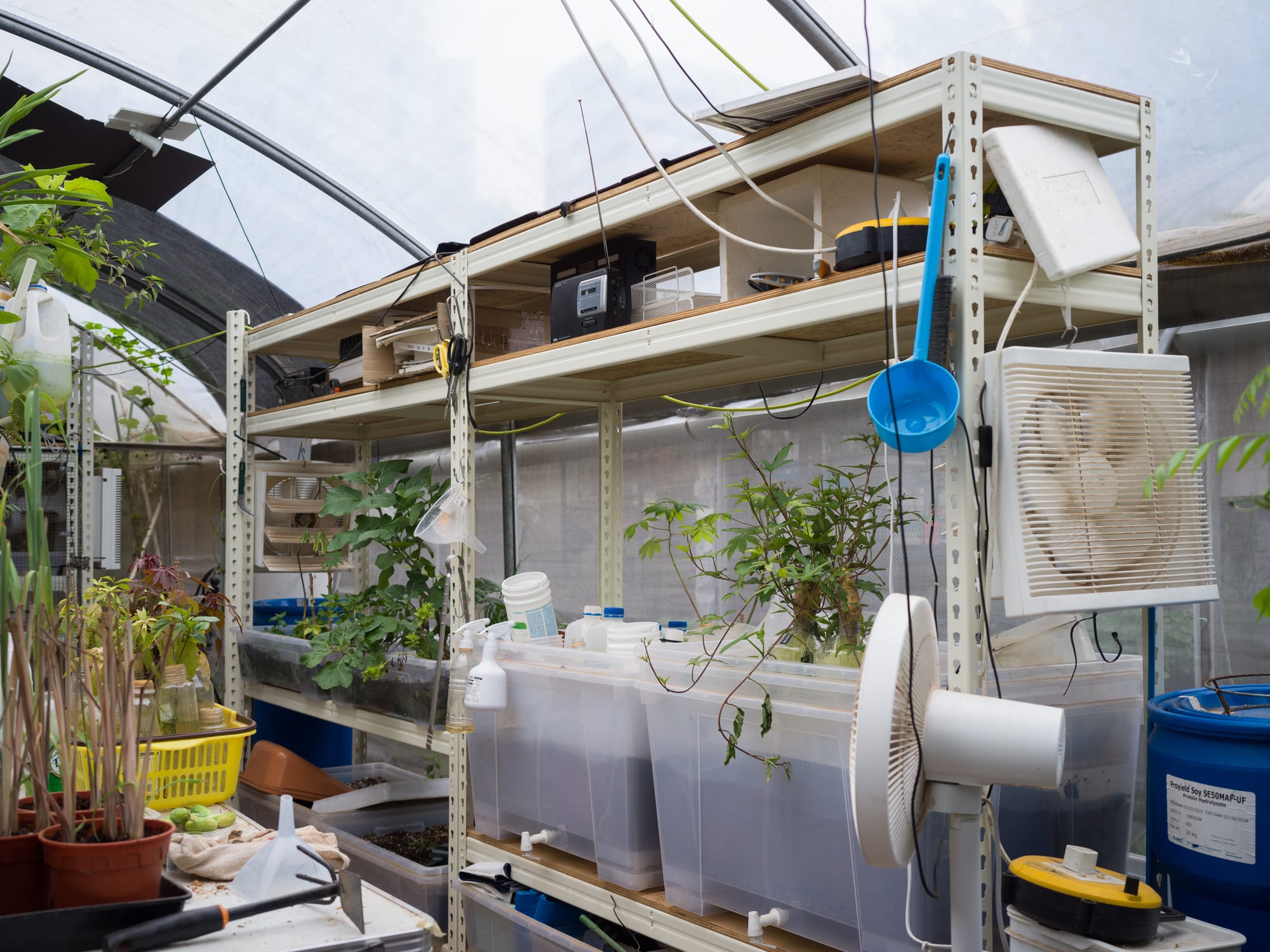
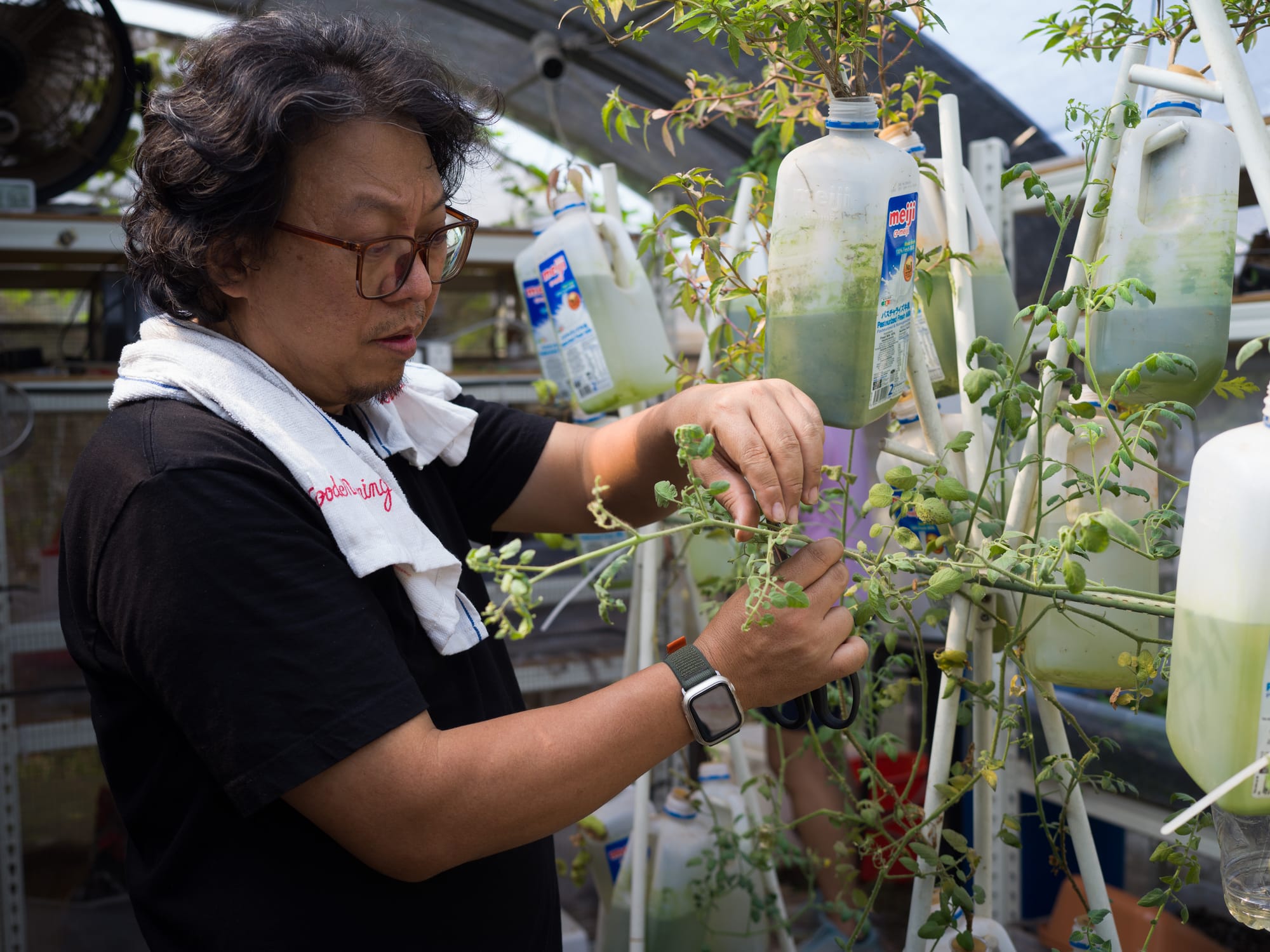
A one-minute walk across City Sprouts took me from Kevin’s symphony of abundance to a clarion call for survival. As I entered a nearby plot, CCTV cameras stared at me and chickens started screaming. Everywhere I looked there were boxes and containers and bins. A woodworking station in one corner; a car battery and tupperwares of neatly coiled wires and other electrical equipment in another; a chicken roost at the far end; and in the middle, almost a centrepiece, a series of IKEA clothing racks that were holding repurposed Meiji milk bottles with plants sprouting from them. It felt like the sort of post-apocalyptic greenhouse one might encounter in The Last of Us or Mad Max.
Yet no reclusive meanies here, just partners, Nicholas Chee (Nic) and Chng Ying Tong (YT), ever ready to host. I was drawn to the Meiji bottles, having never seen such a jerry-rigged hydroponics set up. The racks cost S$10 on Carousell or S$39 new, Nic told me. “It’s a nine-plant solution in an 80cm2 space.” There was mugwort, Thai basil, Holy basil, Java tea (cat’s whiskers) and pandan. They’ve also been experimenting with tomatoes, “what everybody seems to want to grow”; and “wartime foods” like tapioca and sweet potatoes. It was my first time seeing one growing in water, outside of the ground, the sweet potato somehow balanced in the bottle’s mouth, its leaves reaching for the sky, and its thread-like roots swaying gleefully in plain water. If Kevin’s experiments are geared towards creating a rarified experience in a specific location, Nic and YT’s are aimed at imparting knowledge that can be applied ubiquitously. “Our objective is to be able to build solutions that communities can utilise. If it cannot be replicated or sustainable, then the solution is no use. We’re not doing research at the academic level.”
Nic and YT are co-founders of The Interchange, which calls itself “a multidisciplinary social enterprise that combines research, design and fabrication to develop accessible and replicable solutions for communities, based on sustainable circular economy principles”. Their professional backgrounds are in film production. When the Covid-19 pandemic hit, they started exploring other business opportunities, including stickers, 3D printing, and laser-cutting and engraving. Building from their previous experience observing film sets, they started to realise just how much waste humans generate. Inspired by the Ellen MacArthur Foundation’s work on the circular economy, they founded The Interchange. “One of the key pillars is that there’s a component of regenerating nature, and that’s something that we were not familiar with,” said YT.
Early efforts in their journey of understanding waste included a month last year of keeping every single bit of plastic waste they consumed and collecting wooden plywood from an instructor in pyrography who had to stop teaching during Covid, without any real plan for what to do with it. The wood found its way into multiple uses, including coasters and structural support in their farm. It also just helped spark ideas, for instance how to combine the 3D printed waste and wood bits to create something new. “So two waste streams converge to become a usable product,” said Nic.
Last year, they moved into a new office space in 153 Mei Ling Street, just 3km away, which serves as The Interchange’s research lab. Their neighbours had already put some plants on a concrete platform in front of the office. “I love the space, and great light,” said YT. “So that’s when we first started growing our own plants.” The first few weeks were “miserable”, however. “Everything didn’t work.” With neighbourly advice, some of which was useful, and their own tinkering, they got there. But they also outgrew the space. The “Kampy”, the City Sprouts plot we were standing in, is an outgrowth of that. They moved in early this year. “We reached the limit of what you can achieve under an HDB block,” said Nic.
They started paying more attention to nature’s irrepressible forces, like “accidental bird droppings” seeding a papaya tree and a rose balsam plant. “You learn that nature will give you rare, wonderful stuff,” Nic said. They dug up the rose balsam, which was growing by a drain outside the Mei Ling space. They tried to grow two cuttings in soil, and the third in plain water. Only the last survived, blooming a few times. While acknowledging that they may have made mistakes with the soil, the experiment at least validated the viability of their simple water set-up.
They built slowly from there with a deliberate research methodology: the wisdom of crowds, as told by TikTok’s algorithm. Instead of any formal course, they chose to simply see what people were saying and doing online. “We can tell people that we learnt how to do gardening and farming via TikTok,” Nic said. “Even the chickens,” YT added. They spent six to eight hours a day over 100 days. Not everything was easily translatable, obviously, due to Singapore’s unique climate. “So we have to test and see what exactly is the best information or knowledge that you can absorb,” said YT. Finally, Nic said: “We got the results, until all the [Mei Ling] neighbours couldn’t say anything.” The upstarts had eclipsed their former advisors, with the wisdom of social media influencers seemingly more relevant than the wisdom of HDB uncles.
That’s not to suggest they weren’t reliant on those around. Early planting adventures were courtesy of farming blocks from One Kind House, a private dining and farming family collective. Lions Befrienders, an active ageing organisation, lent The Interchange some equipment early on, and was impressed enough to get them to organise a workshop for seniors, in which they learned how to make their own self-watering planters using water bottles. The upgrade to Meiji water planters began with another instance of “hoard first, use later”. An auntie who lives above Tiong Hoe coffee shop would regularly walk by with empty milk bottles that the store had gone through. Nic and YT took them, and later realised they could use them to grow plants vertically in a limited space.
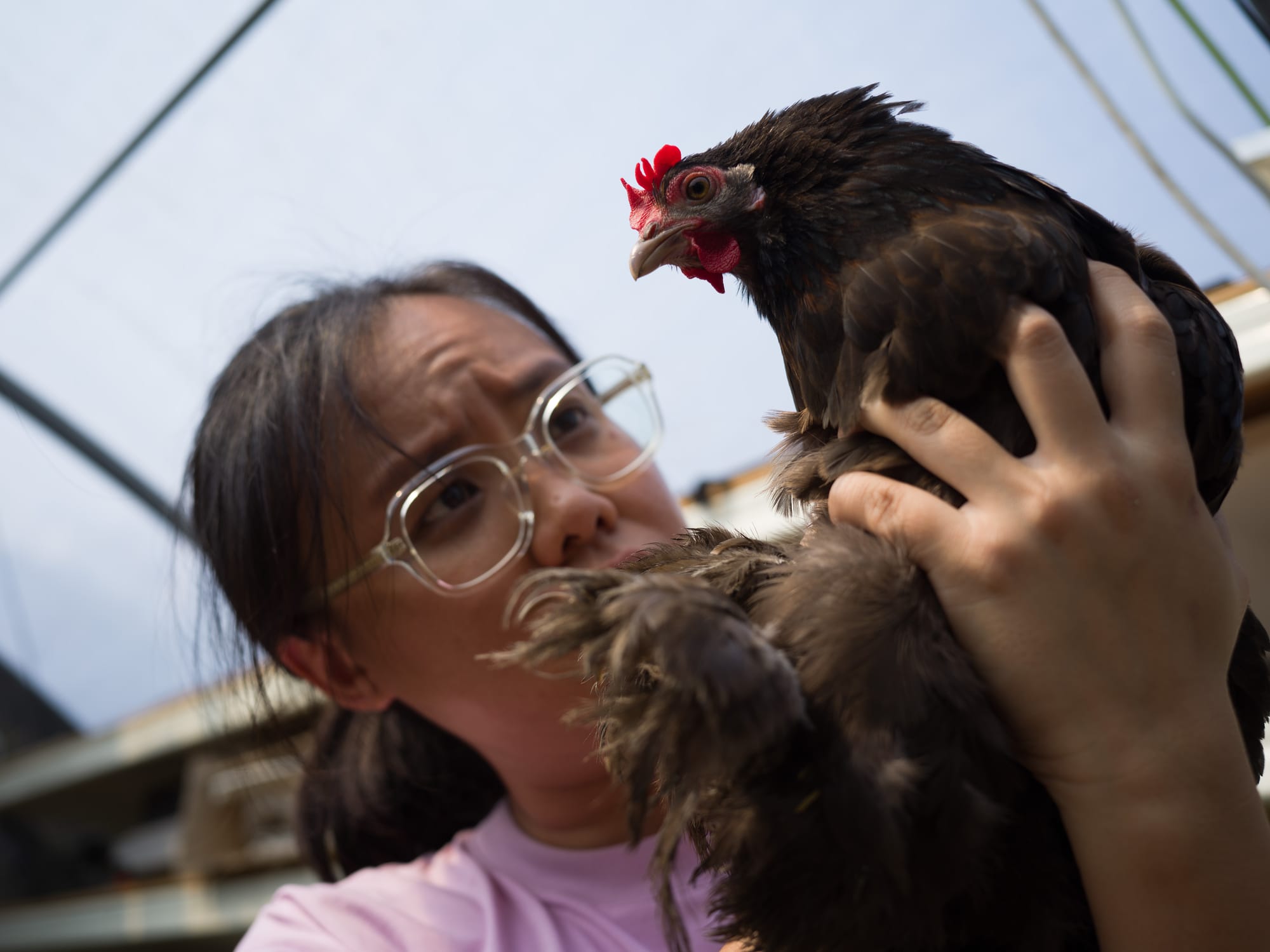
As we were talking, a message, “Pet detected”, flashed on their phones. The cameras are partly to monitor the pests, like the civet cat who once tried to rip through the chicken’s cage but managed only to pluck off some feathers. (A neighbours’ entire flock was ravaged by one; they returned to find carcasses and heads.) But YT uses the technology to also just enhance her overall parenting. “I always track who laid the egg, so I know who’s fertile, who’s not fertile, who’s not feeling well. I can also track if they have eating problems, whether they’re sleeping well, who’s been bullied.”
Her journey with pets began just a year ago. Another uncle passed her the tiny abandoned egg of a zebra dove, warning her that it probably had some problem if its parent left it. YT still wanted to try. She bought an incubator off Carousell, and after some 20 odd days it hatched. “It died within the next three hours. But it hatched.” Despite being so new to this, YT already has an intimate connection with their chickens. She chides them when they make too much noise, and can tell from their reactions if they’ve detected a child nearby—which often puts them in a foul mood. Near the roost is a box of sieved out rice husks, with a fair bit of chicken poop removed, that forms a natural compost, which can eventually be turned into fertiliser. Another box has more pure poop, “rich for plants”.
That nitrogen cycle in the plot is complemented by the water and energy ones. A dehumidifier nearby produces water for the chickens and plants, and Nic hopes that it’s one day wholly reliant on renewable energy. Kampy currently relies on both grid and solar energy. He showed me one renewable loop: solar panels powering a fan, with an old car battery sitting in the middle of the circuit as storage. Nic walks around with a Good Morning towel draped over his shoulders, and is often holding a plier or screwdriver or some other tool, as if in a perpetual state of tinkering.
One of his mottos is “socialisation”. He reiterates that it’s terribly important for Singaporean society to focus on the socialisation of important ideas, behaviours and philosophies, whether concerning the circular economy or otherwise. Nic’s thoughts have been shaped by his experiences in the film industry. In 2006, after noticing interesting local work that wasn’t getting enough prominence, he and some others set up sinema.sg, a portal for local film. From 2007–12 it had a physical space, Sinema Old School, which branded itself as the first high definition community theatre in Singapore. “We did a free programme called ‘Sinema Showoff!’ It was designed for anybody, independent short filmmakers, to have a place to showcase to everyone in a cinema platform.” Nic started to understand how the seeding of community, and the subsequent collaborations across society could engender change. A partnership with Singapore Polytechnic, for instance, took Sinema Showoff! to students. “[They asked] can we run this as part of the diploma programmes? Great, because that becomes a community thing with the school. So it was socialised, like the idea was not something that was immediately [meant] to be commercialised.”
But, Nic said, they could never figure out commercial viability. He detects a similar struggle now with many circular economy innovators. Like the indie filmmakers of yesteryear, many are perhaps too trapped in their own silos. “They have really, really good ideas and good products. The ‘circularity’ is there. But the ‘economy’ part is something that escapes everybody, in the pursuit of finessing the idea and the product.” Nic believes that there is a more fundamental cultural issue at play. Singapore’s long-standing emphasis on individual responsibility, and its fiercely competitive education system, has perhaps nurtured a narrow individualism.
“[Innovators] do not look at the bigger picture of the economy. You can either struggle yourself or you struggle together, and struggling together will always bring us better results in the long term. But why is it that in Singapore, we tend to like to struggle ourselves? You see, because we don’t believe in our fellow men, women. I think that is the case. If you go back to our education system, it’s very telling that there’s no space for us to develop our ideas with someone else. It’s always going to be our grades versus your grades.”
He observes this “fragmentation” and “fracture” in the film and creative industries, and believes this is why national initiatives, like the desire to create a media hub, are often underwhelming. “Based on the way we try, at a national level, to achieve something, versus what is the reality on the ground. The disconnect, they call it. But it’s not as simple as that. I think really a lot of ideas have not been socialised.”
With Singapore’s 30 by 30 drive, meanwhile, to produce 30 percent of our nutritional needs by 2030, Nic said that the urgency has forced innovators to look for quick results, which then leads to poor decisions. “That’s why a lot of urban vertical farms shut down, right?” Singapore has focused on the production of food, Nic said, without cultivating the knowledge of an agricultural society. Even basic agricultural questions, like why duck eggs aren’t easily available in Singapore, or the differences between brown and white chicken eggs, are simply not things that interest Singaporeans. In Taiwan, by comparison, he met people who knew the difference: white eggs had a stronger smell. “When they eat brown eggs, it’s special.” Without inculcating this base knowledge and interest in agriculture, Nic said, large-scale efforts will flounder. “Now government wants you to do production immediately. Just say, and it happens? I think that’s why a lot of schemes won’t last very long.” He gave another example. Some Singaporeans have said that if a restaurant has insects on their menu, they’ll never eat there anymore. A misunderstanding of insect consumption, based on limited agricultural knowledge, has thus hampered commercial take-up, he believes.
Nic thinks that every school should have a farm setup and dedicated time for students to familiarise themselves with agricultural practices. “Socialising also means that you need to make it the norm. You need to normalise the situation. So it’s not strange.” He has numerous other ideas for how to better socialise ideas, from infusing socialist principles within organisations—like implementing team, rather than individual, goals and awards—to getting kids to wash their own plates and bowls in school, which will improve their perception of manual service jobs. “We need to change the way Singaporeans are being brought up,” Nic said, noting that Lawrence Wong, new prime minister, has been hinting at similar things. “I’ll give him a chance.”
Nic said that the convivial, gotong-royong spirit of City Sprouts is unique. As soon as they moved in, their neighbours immediately offered help with anything. “I think growers have different mindsets.”
In a society obsessed with objectives and outcomes and optimisation, City Sprouts is an oddity. Its greenhouses are not meant to be newfangled, technology-driven spaces to maximise yield or productivity, but rather, buzzing plots that serve as the nexus for a broader effort to re-establish our connections to land, and our relationships with other people and communities.
Behind the farming itself then, is often a higher social purpose: whether, as in Kevin’s case, reminding Singaporeans that “eating is an agricultural act”, in Wendell Berry’s famous formulation; or in Nic and YT’s case, enabling society to be ready for futures both abundant and scarce. Perhaps most encouraging is the lack of judgement and snobbery with what a “farm” should be. Anybody is welcome, anybody can do it, and everybody appears to be learning communally.
If nothing else, the agricultural journeys of Kevin, Nic, and YT, newbies in new plots in a disused school in the middle of one of the world’s densest cities, should be proof that anybody can farm. Maybe an economy doesn’t have to necessarily transform from primary (agriculture) to secondary (manufacturing) to tertiary (services), maybe that’s just an outmoded way of conceptualising industrial and societal change, of thinking about how we labour and make our way through this world. Maybe we need to think not of a society with space for those who want to farm, but a society where everybody farms a bit. No, we should never accept the relentless destruction of nature, of our outlying farms, and the success of places like City Sprouts should not be used to justify ever more urban development. But still, it’s worth contemplating what’s going on there—precisely because it may be seeding cultural shifts that may one day lead to more widespread green attitudes, policies and land use. The urban farms are creeping not only into public space but consciousness too.
One might think of hydroponics, vertical farms and cultivated meat as the leading edge of Singapore’s ambitious 30-by-30 drive. By contrast, the works of Kevin, Nic and YT perhaps represent the soft-skill complement, the means for a society to reacquaint itself with a rural life lost, to resuscitate old-and-also-new ways of simply be-ing—with ourselves, with others and with the earth.
Sudhir Vadaketh is Jom’s editor-in-chief. This essay, first published in Jom’s annual print magazine issue No. 2, was written with contributions from Corrie Tan. Sudhir is also grateful to Neo Xiaoyun, Ore Huiying and Charmaine Poh.
Read Sudhir’s other essays for Jom here.
Letters in response to this piece can be sent to sudhir@jom.media. All will be considered for publication on our “Letters to the editor” page.