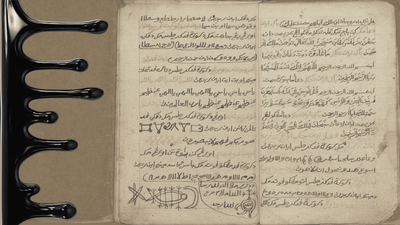

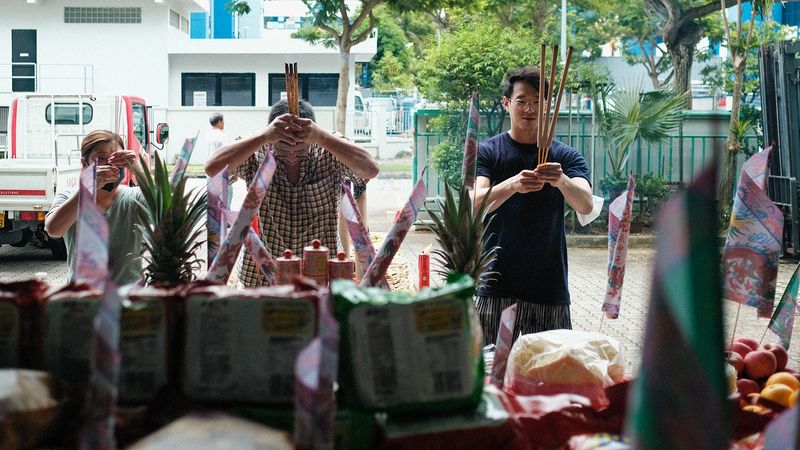
Every year, in the seventh month of the lunar calendar, my mother finds an auspicious day to perform the rite of appeasing the dead. We do this at the company she built, bequeathing munificence to placate the hungry, angry, lost spirits roaming our yards, or those returning home to visit. In exchange, we ask for their blessings and pardons as they feast on our offerings.
Have you always done this? I ask.
No leh. We never had the practice, she says.
Then why did you start?
According to her, it started when an employee who had wanted to do a simple ceremony at the office brought back an incense holder. They placed the holder at an altar, lit the incense sticks, stuffed them into the holder, and the incense suddenly caught fire. Isn’t that normal? I ask. No, it went ablaze. There was something else in the holder, a small incense block, the kind that reveals four numbers when it burns away. And as the Chinese are wont to do when they see an extraordinary phenomenon, or a car crash, they bought a lottery ticket with that number.
Everyone who bought the number won. It had never happened before, and to my mother, it was a sign to begin paying her respects to the dead that month.
宁可信其有,不可信其无 - better to believe than not to. No harm what, if it’s just a little bit more effort, just do lor. Maybe if we help them, they’ll help us also. You never know when it comes to these things.
We both grew up surrounded by superstitions about the seventh lunar month—don’t step on the ashes of the offerings, don’t stay out past midnight, don’t swim at night, don’t kill insects, don’t take photos at night, don’t talk to yourself, don’t look back when you hear a voice calling you, don’t talk about ghosts because they like stories about themselves. Her mother passed these to her; she passed them on to me.
My mother inhabits a deeply historical world where stories are passed from one generation to the next, and she is the obliging, obedient conduit for these stories. In these, death is merely a passage between realms and humans move through them—we become deities, or spirits, or we get reborn, or if we’re lucky, we leave the cycle of reincarnation and attain Nirvana. It is humanistic. We perpetually exist, coming back, living our myriad lives over and over again, to right wrongs, to atone, to forgive.
How do you know that there are these other realms? I ask. 都是听老人家说的—it’s what the older people say, she tells me, I just follow, as if divesting herself of any responsibility.
Who are these older people? My grandmother, her grandmother and the grandmother before that; reaching back further and further to their indeterminate beginnings. But my mother is not reneging on responsibility—the older person is both specific and mythic, it is her elders that came before her, and the story that travels along time. I ask her if she knows that her beliefs are confused, a Gordian knot of folklore, religion and superstition. My mother says that the truth of the universe is so much more than we can perceive, and that these are stories which have tenaciously persisted, they have become truth—who are we in our finite lifespan and knowledge to say they are not true? As long as it harms no one, what’s wrong?
When I was younger, I followed the seventh-month injunctions because that’s what children who don’t know better do. But the generation before sends us to school, wants us to learn more, do better, and then you find out that matter is only made up of more matter, that the human body is really just one complex machine concealing flesh, bone, cells, compounds, chemicals, atoms, protons, electrons, quarks and maybe even just vibrating strings; or that the sun is shared by seven other planets, that there are bigger suns than this, gargantuan galaxies, that in the centre of the galaxies are supermassive blackholes, that even if we travelled at the speed of light to the end of the observable universe, it would still take billions of years to reach. It’s almost irresponsible not to think that we are a coincidence and life is merely material. Where are the realms? Where is the spirit that resides in us and leaves when we die? Why are we still perpetuating such myths? The education my mother wanted me to have convinced me that when we die, that’s just it, a lifeless body that decomposes—no soul leaves, no consciousness is displaced, the person just ceases to be. We become food for the earth before it nourishes the next human, and the cycle repeats itself until the universe collapses and we are all returned to the stars.
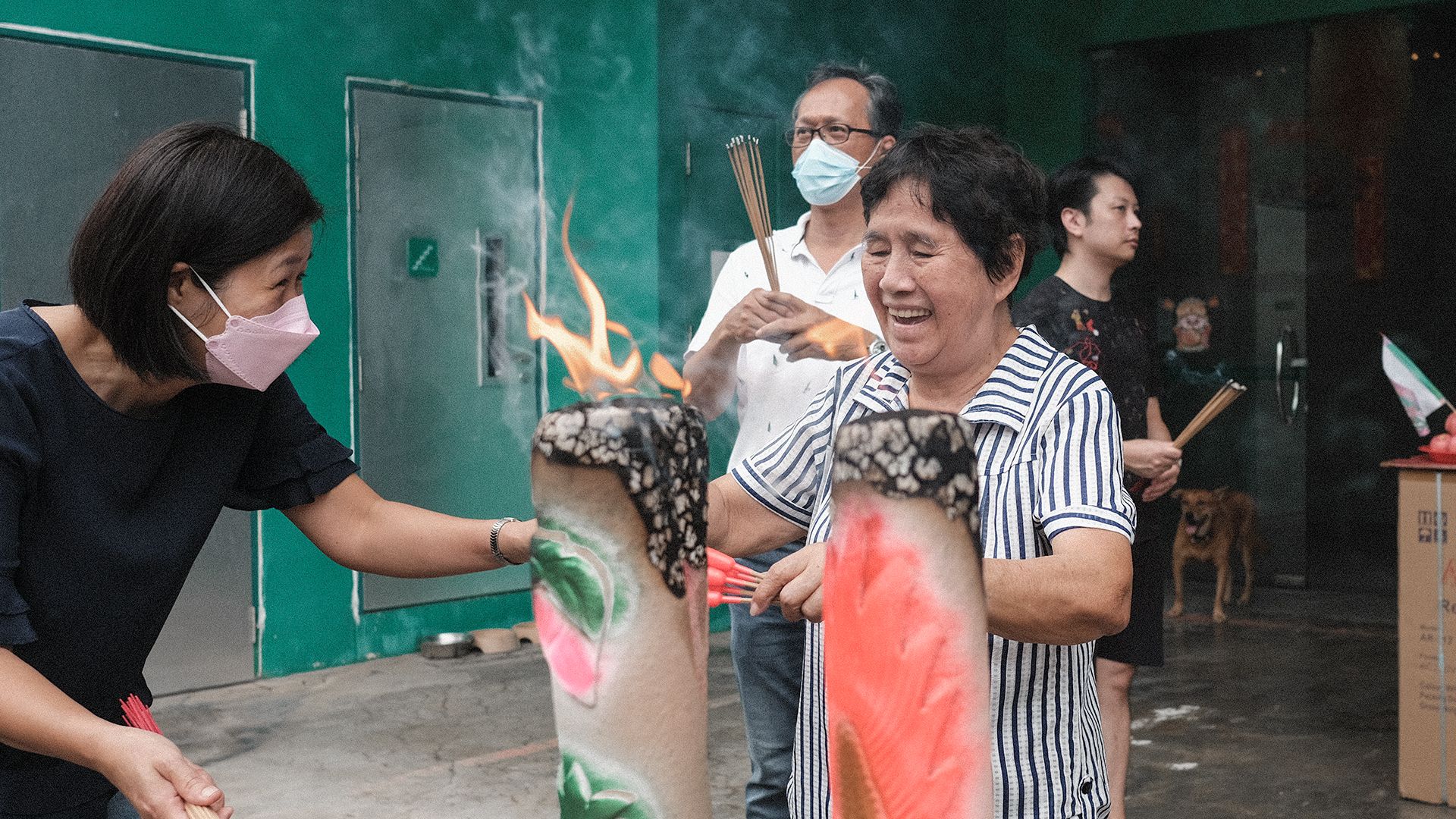
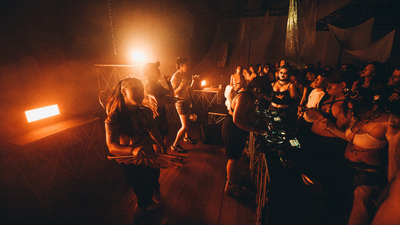
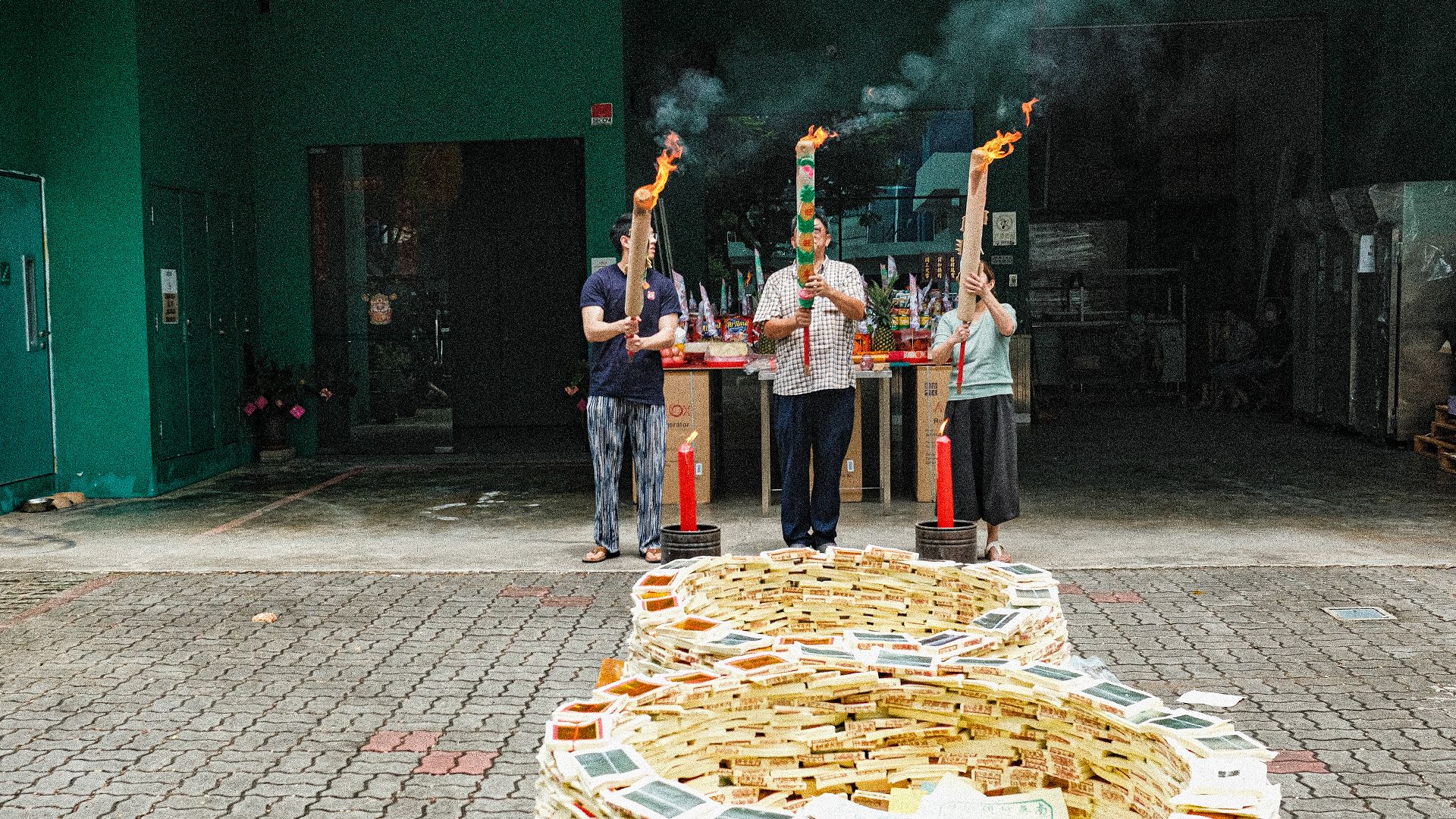
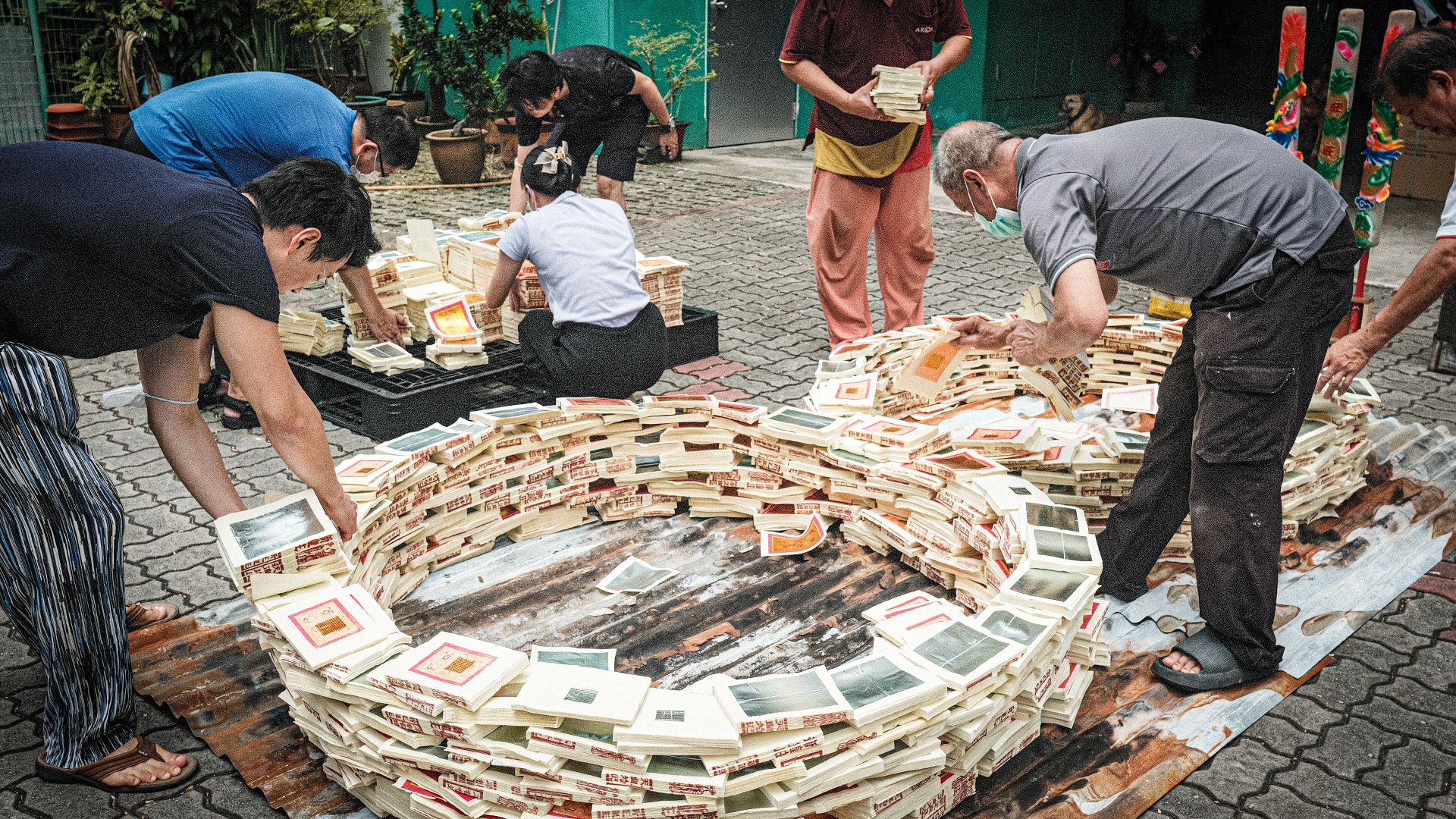
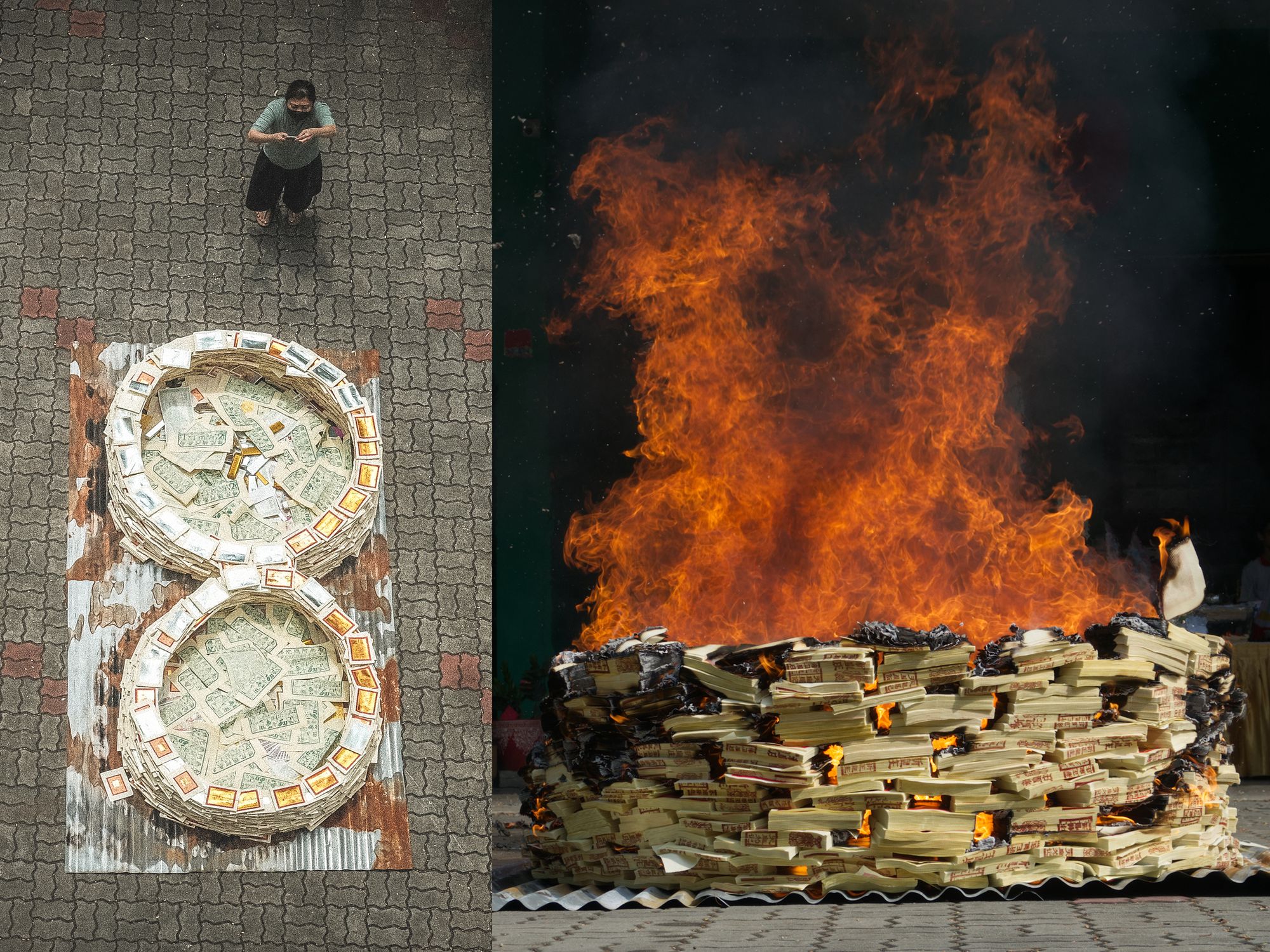
On that auspicious day every year at my mum’s company, we set up an elaborate altar—rice piled into a large incense holder, unlit candles, tea cups, incense sticks, golden suckling pig, bronzed roast duck, silky soy chicken, sticky char siew, fruits, huat kuehs (‘prosperity cakes’ in Chinese). It’s a sumptuous buffet spread, alongside a cornucopia of everyday goods—rice, oil, salt, sugar, oyster sauce, coffee powder, biscuits and packet drinks. Before the altar is an assembled stack of paper money, clothes, ingots, and scriptural enchantments to help those trapped wandering in the mortal world to cross over to the afterlife—all piled in the shape of an eight, which turns into a glorious bonfire. As Chinese, we try to cram our rituals full of symbols—colours, numbers, shapes, time of day, the moment of light up. The more elaborate the ritual, the more the returns. We get the ultimate bang for our symbolic buck.
Before the bonfire is lit, every member of the staff, in order of seniority, takes turns to light a bundle of incense sticks and pray at the altar.
How many? I ask.
It doesn’t matter. 随缘. Just grab a bundle. The number in that bundle is the number you’re meant to have.
What do I ask for?
Up to you.
Money?
Never ask for that. Don’t ask for windfalls. What you get without hard work is meaningless. Easily lost.
What do you ask for?
Always the same la.
Which is?
For everyone to be at peace, for the spirits to be less angry, to find their way home, to be with their family. I only want people to be happy.
My mother raises her smoking incense to the heavens, then bows to the ground. She does this three times. She puts five sticks from her bundle into the incense holder. The rest of us each put three. We insert the remaining ones into pots of plants, or directly into the earth, always grouped in odd numbers—one, three or five—because even numbers are for the living. As everyone else goes around the compound, planting their smouldering stalks into the ground, I see them focused, lips quivering, incantating entreaties with a kind of conviction that I cannot have. Instead, I mumble the entreaties, the thoughts and words jumbled—a vague intention. Who is listening to me?
Later, my uncle cradles two red wooden crescent moons between his palms at his forehead. His eyes are closed, his lips move. He releases the moon blocks and they clatter on the floor. One up, one down. This means ‘yes’. He repeats this. This time, both face up, like curls of smiles. He grins:
他们在笑我, they are laughing at me. It means ‘no’, he says, it’s not yet time to light the pyre.
But didn’t they say ‘yes’ the first time, when one block was up and the other down? I ask.
Oh, my first question was just to ask if they had arrived.
Why were they laughing?
I don’t know. We can only guess. But at least they are happy.
So why won’t they let us start?
Maybe not all are here yet.
One cigarette later, my uncle tries a third time. The moon blocks fall and face opposite sides, one up, one down. Ok, let’s light up. Each of us takes a hell banknote or a paper ingot and lights it with the burning incense. Then we throw the starters into the giant pyre of infinity-shaped paper offerings. The pyre catches fire and the fire spreads, first horizontally, then slowly the small fiery spires converge into one towering conflagration.
My mother loves to say I’m not pantang one except she appears incredibly otherwise. When I was depressed, she suggested I see a medium. When she sold her apartment at a loss, she said it’s because sometimes the apartment reeked of cigarettes even though no one smokes. When I was looking for an apartment, the main door had to be south-facing (the direction of warmth and life), the kitchen’s sink and stove couldn’t face each other, and the apartment couldn’t be near any religious sites because good energy would flow there instead of your home. There were things I could or could not do, ways I had to conduct myself, specific times when plans could be executed.
All these inconveniences were often amusing, but sometimes at their worst, they tested my patience. When restructuring the office, she brought in a spiritual master to design the office space. He also inspected the grounds for vicious spirits (his actual specialty). It turned out that he could scry a person’s life very well too and he read mine, and said I would eventually have a wife and children. My mother already knew I was gay and had come to terms with my sexuality. Suddenly, a stranger in my life had raised doubts and hopes in her and thwarted that acceptance. She’d rather listen to a dishevelled man in a wife beater, wrist ringed with multi-coloured energy beads, with an imp-like sidekick in tow than the son she had paid through her nose to have educated? Master said this, master said that. When she implored that I be respectful to him and have an open mind about his ways, I exploded.
You know what the funny thing is? I told her. You think he’s bringing you good luck. But see what is happening? He is ruining our relationship. He is making us fight.
But this wasn’t the first time I chastised her for her beliefs. As long as it harms no one, what’s wrong? What’s wrong are the peddling of mistruths and false hopes, the wasting of resources, the polluting of the air, the fear-mongering, and the spreading of superstitions, which should long ago have been snuffed out. In Chinese, there’s a saying, 长江后浪推前浪—the younger, stronger waves push the waning ones forward. I thought my mother sent me to study so that I could become a beacon of modernity; that when I returned, I could tell her what the world was really made of, what life really meant. My one function as a son was to rectify her misunderstandings, to teach her what I knew to be real and true.
Humanity is well past the time when we thought the placement of celestial bodies caused natural disasters, when we used divination for national policies, when we believed that if you pointed your finger at the moon, the moon goddess would come down and clip your ear. We have been to the moon and there is nothing there but dirt. Everything has changed, and is still changing, giving way to modernity—and I was and am part of that wave. Truth is only what you can see, smell, taste, hear and feel. There is a second, tongue-in-cheek, ominous part to the saying, 前浪死在沙滩上—the older waves die on the shore. Eventually, there is only the modern, the old must give way to the new.
The fire is blazing now, rising higher and higher. The concentric space between fire and humans grows wider as the heat pushes us away. This is the moment when we move around the fire, into the building, finding interesting angles to capture this phenomenon. Later, I will look through the photos to see if I’ve been lucky enough to capture a passing spirit. Usually, I find nothing extraordinary but my mother says there have been a few times when the sky appeared preternaturally brilliant on these days—a blue she’d never seen before, and the sun had a golden ring around it. She says she took a photo of it. Where is it? I ask. Oh, very long ago already, somewhere deep in my phone. Have to find. I look at the sky. It does not look extraordinary to me today but I do not contest her.
It was only in the middle of the Yuan Dynasty (1271-1368) that the idea of hell’s gates gained traction. Before that, the Taoist festival was less about dead souls and more the celebration of the birthday of one of the deities in the Taoist pantheon and all that he represents—the Earth God. The Earth God also absolves the sins of the deceased. In the Taoist text Book of Changes, the number seven is an auspicious number that represents renewal, rebirth. It is a month of promise and potential, a time for forgiveness and reconciliation.
The same sentiment appears in Ullambana, a Buddhist festival named after its eponymous sutra. The scripture’s story is about a monastic disciple of the Buddha named Maudgalyayana, who, after achieving Abhijna (supernormal knowledge), travels to the other Buddhist realms to look for his parents. He finds his starving mother in the Hungry Ghost realm and offers rice to her but the rice turns into a burning coal. He returns to the Buddha, who explains that she has sinned much in her life and is paying for it now. It is only through the Sangha (the Buddhist community) that the sins of the departed may be exonerated. Maudgalyayana’s concern is not the transgressions of his mother but the alleviation of her privations. It is a festival of compassion for all beings regardless of where they come from, where they are, and where they are going.
Actually even before the company’s Seventh Month celebration, I never really did any of the rituals. It was only when your ah-gong and ah-ma died that we started doing it at your uncle’s place.
But don’t we already have Qing Ming to visit ah-gong and ah-ma?
That one is different. That one is for spirits with homes. This one is for all spirits. You never know where ah-gong and ah-ma have gone. We hope they go somewhere nice of course. But you never know.
The flames are abating and the smoke is twirling into the sky. On the blurry edges of fire is the warping of space, like a mirage, and in that moment, two worlds merge. Here my mother explains the phenomenon to me: she points to the fumes that spiral away from the burning heap—look, that is where the spirits are collecting our offerings. She says a distortion in space is where it happens.
You know all the supernatural things that you describe can be explained by science right? I say.
Yes, but so what?
So, why do you still believe in these?
Paul, the two can both be true. And maybe there are ghosts, and maybe there aren’t. But if there are, aren’t we helping them?
The pyre continues to smoke, the tendrils are thinner, wispier now. We are waiting to eat. Let them eat first. I imagine them, human silhouettes—are they standing around or hovering above the food—grabbing at the trays of food, picking apart the roast meats or sniffing their essence? Did they bring cutlery along? Or bags to gather their burnt treasures? What are they wearing? What are the actual mechanics of it all?
When it is our turn to eat, my mother will ask rhetorically whether we find that the food has become bland. I’ve stopped saying “no, the food tastes fine.” My uncle picks up a hulk of duck and chops it meanly into chunky pieces, then the chicken, then the suckling pig. I eat the salty, succulent meat and its fat. It is delicious. As I devour the offerings, I am perspiring. Partly from the heat of the bonfire, partly from the sun. I realise it has never rained in all the years when we’ve done this. Once or twice, the sky might have turned threateningly grey, but it always cleared. Perhaps it is the coincidence of seasons; perhaps the propitiation from the other side.
I’m almost 40 now and my mother sometimes still frets about me like I am a young boy unaccustomed to the world. Have you arrived in Bangkok? Are you settled in? Does your stomach still hurt? Better see Dr Lau if you need to. Don’t say I’m being lor soh but please be careful when you’re in New York. I read the news, I get scared you know. My early annoyance has given way to curiosity about why she remains inexorably so, and I have discovered that mothers will always think about their children as vulnerable creatures who need protection. They eventually learn to let go but never fully. And perhaps that attachment extends into the afterlife, even if imagined.
Being able to come back means being able to watch over the living and make sure all is well. We say even if someone is dead that person lives on in our memory. But memories are intangible things, just like the thought of food cannot sate hunger, neither can the memory of a person satisfy our longing for that person, or ameliorate our continual grief over the dead. So we put them in photo frames, we keep their belongings, and sometimes we extend that into rituals—an altar, a good-morning, a plateful of dinner in front of an empty seat—and in these rituals, we perform stories of the people who are no longer here, whom we once loved.
There was a time when I was certain I would never be the vessel of these traditions, that when my mother is gone these rituals will die. But I am not so sure anymore. I imagine myself, much older, perhaps the set-up is no longer as grand, most of the offerings are symbolic, gestural replication. I am performing this in my yard, maybe the corridor of my HDB flat, or in front of an altar at home where my parents’ tablets are. I am no longer exactly sure how the entire ritual begins and ends. Every step I perform comes from a memory, a scene that is fading. But I remember the people, what they meant, and still mean. When I hold the incense sticks, I look to the heavens and the earth; my arms are tracing arcs in the air like my mother once did, and we are wishing for the same thing.
Paul Ng’s choice of a final meal is steamed uonuma koshihikari rice, sunny-side-up eggs drizzled with slow-rendered pork lard, kicap cair dark soya sauce with a side of gribenes, and a bowl of uni. He begins his MFA in Creative Writing at Sarah Lawrence College in 2023.