
It may seem quaint, but there was a time when local television dominated home entertainment in Singapore. I grew up at the tail-end of the era, which was, all things considered, a simpler time. This was the 1990s, when the multi-gadget household comprised principally, out of the kitchen, a fixed-line telephone, a radio, and a television. Computers only really made their way into homes towards the end of the decade, and smaller, portable devices hadn’t quite achieved their subsequent ubiquity. (It was a moment of considerable pride in the Yuan household when Pa brought home, first a pager, then an Ericsson handphone, the GH 388, at the time of its release the very apex of technology.)
Entertainment on demand was some years yet from becoming a thing, though some measure of it was possible through the tape recorder and VCDs. For those who sought greater diversity, there was the option of a cable subscription via Singapore Cable Vision. Pa resolutely resisted its introduction into the house, and we felt little need for it anyway, since Channel 8 began broadcasting 24 hours a day from September 1st 1995. In my home, and the part of the heartlands where I grew up, Caldecott Hill held firmly sway. The likes of Zoe Tay, Li Nan Xing and Xie Shao Guang graced our screens, and to be alive and watching them was very heaven.
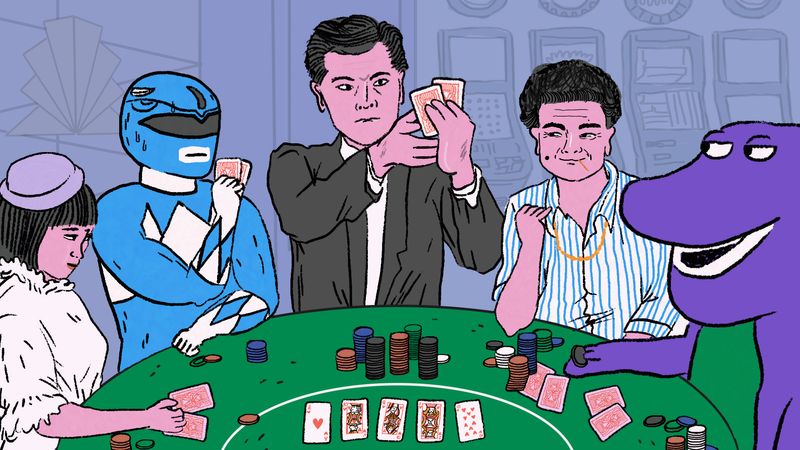
As a child in kindergarten, however, the programmes that I watched and cared most about were children’s shows from abroad—“Barney & Friends” and the “Mighty Morphin Power Rangers”; the latter in particular gripped my imagination every Saturday morning. My favourite was the Blue Ranger, because blue was my favourite colour and because I liked Billy best, a shy, bespectacled, somewhat gawky teenager who nonetheless was capable of heroism when he summoned the spirit of the triceratops and morphed into a Ranger. It helped as well that his girlfriend, Kimberly, the Pink Ranger, my sister’s favourite, was pretty. A childhood highlight was a weekday afternoon, when my mother brought my sister and me to Northpoint Shopping Centre (now Northpoint City), where there was to be a photo-taking session with the Power Rangers.
As it transpired, the Blue Ranger was not present, so I had to make do with a photo with the White Ranger (formerly Green), which still became one of my most treasured possessions, together with my large Blue Ranger action figure, the smaller Ranger figurines that came with the McDonald’s Happy Meals and a Charlie Brown soft toy. In this otherwise sunlit period of my life, a slight shadow was briefly cast in K2 (year two kindergarten), when my half-year report card was deemed less than satisfactory. In the car, Pa announced that I was to be grounded, and not allowed to watch "Power Rangers" for a week. Disconsolate, with an uncertain grasp of the concept of time, and desperate to understand the exact magnitude of my punishment, I had to quietly ask my mother as we left the car, “Is one week one month?”
If the Power Rangers chiefly preoccupied my mind in kindergarten, constantly in the background were the Channel 8 drama series that Ma watched religiously. My sister and I didn’t always understand what was going on in these dramas. Although, one didn’t need to understand the plot to be thrilled by, for instance, the casino confrontations in “The Unbeatables I” and “II” (双天至尊, 1993 and 1996), where fierce battles were waged between Zoe Tay, Li Nan Xing and Zhu Hou Ren involving mahjong tiles and playing cards as weapons.
Our preference was, however, for the gentler school dramas that aired frequently on Channel 8. There was “Good Morning, Sir!” (早安老师!), produced in 1989, starring Chen Liping as a bubbly teacher, whose catchphrase Ai Yo Yo! became, before the term was coined, viral among TV audiences. (Chen was an especial favourite of my mother and the Yuan children, because people said that my mother looked like her.) There was also “Morning Express” (阳光列车), first aired in 1995, in which Chen Han Wei, the floppy-haired heart-throb, played Mr Fang, the inspirational form teacher of the bottom secondary four class at Yang Guang Secondary School, and Fann Wong, then at the beginning of her inexorable ascent to Caldecott Hill royalty status, took on the role of Ye Xingping, his spunky love interest. “Morning Express” also featured the first Channel 8 theme song to stay with me: 海阔天空, sung by Emil Chau, its uplifting melody set to an opening sequence featuring scenes of kite-flying set against the sky, cloudless blue, dusky gold, and of Mr Fang’s reformed student triumphing against adversity during Sports Day, cheered on by his now tightly knit classmates.
My love affair with local television properly began in primary school. The Channel 8 drama series that aired from 7-8pm formed the centrepiece of weekday evenings. The run-up to this timeslot differed according to the school session that I was in. When I was in the afternoon session, it was marked by an acute sense and savour of the close of day: the queue in the bus bay at 6pm after school had ended, the ride back home during which we played hand-games of ji gu pa, zha and chopsticks, and occasionally engaged in the barter trade of snacks; and then the bus would stop at the corner bend of Jalan Pelikat, where Ma would be waiting. After her customary short, cheery banter with the bus driver (“Hello, why today so late ah?”) we would make the short way home to Lorong Ah Soo, cutting across Maplewood Park, the air agreeably warm after the time in the air-conditioned bus, the evening light now intensely gold, in a last burst of concentrated glow before shading into blue as we passed into night. We would get home not long before 7pm, just in time to quickly move the dining table into the living room right in front of the television, while Ma brought from the kitchen the rice and dishes that she had already prepared.
When I was in the morning session, the lead-up to 7pm was a rather more languorous affair. On days when my sister and I had no CCAs (co-curricular activities), we were home by 2pm. Ahead of us stretched long, lazy afternoons sprawled on the living room floor reading or doing our homework, as Ma might put on some music. It was almost always Mandopop from her youth, with a marked preference for Teresa Teng and Liu Wen Zhen, while she ironed the clothes, or watched taped recordings of favourite TV shows, notably “Music Camp” (音乐大本营) hosted by Jack Neo, where singers famous in the 70s and 80s were invited to reprise their greatest hits and reflect on their careers.
For the Yuan children, as compensation for having to wake up at an unearthly hour for school, we had the opportunity to watch afternoon reruns on Channel 8: the half-hour comedies like “Right Frequency” (波音人) and the 5.30-6.30pm slot where old drama series were aired. After which, we would leisurely set the dining table for dinner in front of the television at 7pm.
Channel 8 dramas at 7pm varied in genre and had some excellent theme songs. Period dramas set in Singapore before the 1970s featured prominently. There was “Stepping Out” (出路,1999), a vast historical drama spanning three decades from the 1920s to 50s, centring the lives of Chinese immigrants in Singapore after having fled the Chinese Civil War in the 1920s. We loved the show for its absorbing storyline and its rousing theme song by Power Station, which included the lyrics, “Crossing the ocean, I can endure hardship, I believe that there is always a road that can be taken.” (“漂洋过海, 我吃得起苦, 相信天无绝人之路.”) “The Price of Peace” (和平的代价, 1997), set during the Japanese Occupation, was heavier, with some scenes too distressing for my seven-year old self. These dramas were, possibly, my first lessons in Singapore history, and filled the imagination more than social studies classes and the interminable recollections that had to be recited at annual National Day ceremonies (“They had no rights, they had no say. And they longed to be free one day.”)
There were also dramas drawn from Chinese legends and folklore. Following on from the success of the 1996 series “The Legends of Ji Gong” (济公托佛), in which Xie Shao Guang brilliantly played Ji Gong, the mad monk and Taming Dragon Arhat. The then Television Corporation of Singapore co-produced, in collaboration with mainland Chinese production companies, “The Legends of the Eight Immortals” (八仙过海, 1998). While the show aired, there was an active family discussion at the dinner table as to who our favourite Immortal was. Lü Dong Bin, the leader of the Eight Immortals, was certainly dashing, while Tie Guaili and Han Zhongli, the more elderly members of the group, were endearing for the comic moments that they provided; my sister and I settled finally for Han Xiangzi, a shy retiring scholar, because he played the dizi like we did.
Dramas set in contemporary Singapore were also staples. The storylines tended to focus on family tensions and love affairs that resolved themselves over the course of around 30 episodes. They were not short of melodrama, and could regularly lead to Ma tearing at the dinner table. For instance, during the latter episodes of “Stand by Me” (家人有约, 1998) in which Du Hanmin, a supercilious surgeon and unfaithful husband prior to his car accident, tries to make amends with his devoted and heartbroken wife—played superbly by Huang Biren—and wider family.
My sister and I did not quite reach the same pitch of emotional intensity when watching these dramas, touching though they were. But we loved them for the happy endings that reassuringly closed each series, and the slice of Singaporean life—in coffeeshops, HDB flats, wet markets—that were recognisable to us, even if the plots could challenge credulity, like the beautiful singer, blind from crying so hard at the age of four after being abandoned by her half-drunk mother (“Fantasy”, 星梦情真, 2002).
The one hour from 7pm, as we sat down to dinner while watching the Channel 8 series that was airing at the time, was a period of pure bliss. The best evenings were when there was a particularly good episode. For example, the time in “Immortal Love” (不老传说, 1998) when the leads finally professed their love for each other over a stick of satay, and Ma prepared a dish that I liked best (potato soup or herbal chicken soup).
If it seems as if television was an affair concerning principally Ma and the children, that was because Pa was in the office during the day, and came home only around 7.20pm, when he would join us mid-dinner. Unlike us, he wasn’t overly fussed about missing a part of a Channel 8 drama series—having been educated in an English-medium school in Malaysia, Pa understood little Chinese. Still, he good-naturedly accompanied us in watching the shows, and his presence at the dinner table was instrumental in the children’s enjoyment of them.
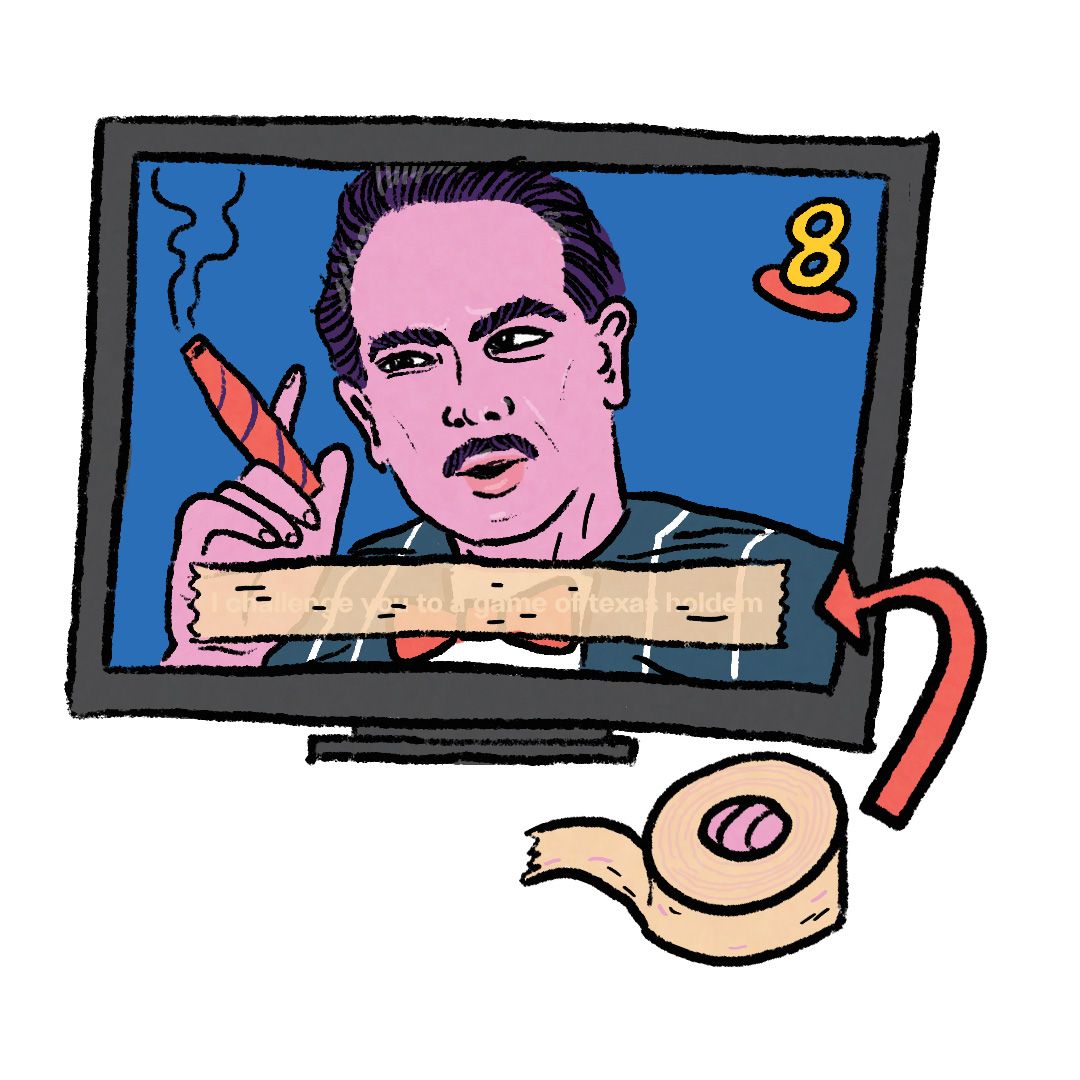
There was a certain point in time when Ma attempted to improve our Chinese by sticking tape over the bottom of the television screen, where the English subtitles, on which we depended to follow the characters’ dialogue, would appear. The collective protest, joined by Pa, who needed the subtitles in order to understand the shows at all, put paid to this quixotic plan. It was one of the few battles Ma lost in the house, along with her periodic and ultimately doomed efforts to introduce brown rice into the family diet.
At 8pm, after the closing credits (“Subtitles: Lilian Sim”) and the preview of the next day’s episode, the children would regretfully leave the dining table. The hour between 8pm and 9pm was customarily reserved for homework or reading. An exception however was made for days when “Under One Roof” or “Phua Chu Kang” was airing for a half hour from 8pm.
Indeed, perhaps strangely for an English-speaking household, these were the rare moments when the family tuned into Channel 5, apart from when Pa would try to catch the news from 9.30pm during the commercial breaks for the Channel 8 drama, before being nagged by Ma into switching channels (“Aiyah faster, show starting already.”) We never quite got into the local dramas that were broadcast on Channel 5 at the time—they seemed to us to be somehow off, the characters tended to speak in a way that Singaporeans did not, in a manner that felt faintly alienating.
“Under One Roof” and “Phua Chu Kang” were different. In the Yuan household, they were required viewing. I had plenty of affection for the former, having watched it from the time that it first aired in 1995. The show, with the Tan family and its various squabbles, the neighbours Yusof and Rosnah, as well as Daisy and her brother Michael, radiated warmth and homeliness. Its cutaway shots of the Bishan (HDB) Housing Development Board blocks, and the scenes set in the Tan apartment were a fond and constant reminder of Singapore's heartlands.
It was “Phua Chu Kang” however that made the family laugh the hardest. Here, the humour was more raucous, its use of Singlish more unbridled, and the constant dynamic of Phua Chu Kang and Rosie puncturing the pretensions of Margaret was highly enjoyable. My sister and I delighted in copying the various mispronunciations of Phua Chu Kang, referring for a long time to parquet as “parquack”, and in repeating bits of dialogue that might at present seem indelicate (“When a man touch a woman, it’s call morest [sic]. But when a woman touch a man, it’s call shiok man! Tio bo?”)
While the love for “Phua Chu Kang” was unanimous in the Yuan household, it wasn’t always shared elsewhere. Mrs Katherine Wong, my primary 2 English and form teacher, took to task my classmate Bryan for having chosen to decorate the front of his English file with a newspaper cut-out of a beaming Phua Chu Kang, replete with curly hair, facial mole and his unmistakable yellow boots: “Why did you choose this?”
For a time, it seemed as if then prime minister Goh Chok Tong also shared Mrs Wong’s sentiments. In his 1999 National Day Rally speech, he called out Phua Chu Kang:
“Teachers complain[ed] that students are picking up catchphrases like 'Don't play play'...The students may think that it is acceptable, and even fashionable, to speak like Phua Chu Kang...Gurmit Singh can speak many languages, but Phua Chu Kang speaks only Singlish. If our children learn Singlish from Phua Chu Kang, they will not become as talented as Gurmit Singh.”
Goh’s critique caused a stir, and reflected a longstanding ambivalence of the state towards Singlish; it was concerned that Singlish might undercut the general standard of English in Singapore, thereby undermining the country’s competitiveness on the international stage. It was also of a piece with the government policy in the late 70s that discouraged the use of Chinese dialects, to allow for the learning of Mandarin by Singaporean Chinese to proceed unencumbered.
While too young at the time to fully grasp the different arguments provoked by Goh’s address, I instinctively disagreed with Goh’s position on Singlish. It seemed mistakenly zero-sum, and did not square with my daily experience, shared by most people I knew, where there was a constant and natural switching between languages according to context: Chinese to the uncle at the dessert stall in the hawker centre, Singlish with family at home and friends during recess, halting Teochew with my grandparents, and English at school during lessons. Singlish was just another language, and one that felt most like ours.
There were doubts within the “Phua Chu Kang” production team about whether they would be able to continue the show past season two (Gurmit Singh recently confessed that he was ready to emigrate following the rally speech). Thankfully, any prospective cancellation didn’t come to pass, and the show carried on for five more seasons. The writers ingeniously marked a tweak in the show’s use of Singlish from season three onwards, by centring the storyline of the first episode on Phua Chu Kang’s completion of an English course. Comedy was harvested from an uncomfortable situation through an opening dream sequence in which Phua Chu Kang and Rosie spoke the Queen’s English with a British accent.
If the use of Singlish was not quite as unrestrained as before, “Phua Chu Kang” remained undiminished in quality. Its enduring popularity amongst Singaporeans also meant that the government would eventually recruit it in its public health campaigns: with the SARS rap in 2003 during the virus outbreak, featuring a catchy tune and uncertain rhymes (“Some say leh, some say lah, Uncle Phua says time to fight SARS…”), and the 2020 “Singapore Be Steady” disco rap reminding Singaporeans to vaccinate.
I gradually stopped watching local television as I entered secondary school. The last Channel 8 drama series that I actively watched at 7pm with the family was “Holland Village” (荷兰村, 2003), revolving around the Mo family, led by the de-facto matriarch and nasi lemak restaurant owner Mo Wanwan (played by Chen Liping). The series was notable for a few reasons. It was, at the time of its release, the longest-running local series, clocking 125 episodes; it also swept the 2003 Star Awards, winning the four major acting categories, with Xie Shaoguang, in his penultimate TV role before retiring from acting, clinching Best Actor.
Jeff Wang, who played the series villain Ying Tiancheng (finally killed after being struck by lightning while on the brink of committing yet another act of pure turpitude), had to be defended by co-stars, who assured the public that he was a genuinely nice person, and nothing like his character in real life. (There is something to be said about doing one’s job too well.)
There were several reasons for the drift away from the TV channels that I had watched so religiously for such a long time. We finally had cable television in the house, which opened up new vistas, such as football and wrestling programmes on the dedicated sports channels, and American comedies on Starworld. School also took up more time, with CCA (co-curricular activities) commitments meaning that I regularly returned home after the family had finished dinner.
Evenings at home were also spent almost exclusively in front of the computer, while the family, now increased in size with the arrival of a baby brother, watched television. This was ostensibly for school work, but also for chats on MSN Messenger and Championship Manager. I developed a crippling addiction to the latter, spending hours scouring online forums for bespoke training programmes and wonderkids, and reflecting on transfers and formations.
My interest in local television had been reduced to the occasional S$2 purchase of the 8 DAYS magazine, mainly for the weekly synopsis of the Channel 8 drama episodes that were airing at the time. With the family, I continued to watch a few of the annual Star Awards, though no longer with the fervour that had seen my sister and I, in our younger years, plead with our parents to allow us to phone in to vote for our favourite stars. More time passed. I entered junior college and definitively stopped watching any local programmes.
I am now abroad. It’s been more than a decade since I left Singapore for my studies. The most recent Channel 8 drama series that I've viewed is “How Are You?” (好世谋, 2018), a Teochew dialect drama that I watched on YouTube while on a visit back home last year, upon the vigorous recommendation of Ma and my younger brother (“It’s very cute. And Chen Liping’s Teochew is very good.”)
Recently, in a fit of nostalgia, I began watching the old Channel 8 dramas that I had followed as a child, on Mediacorp's meWATCH platform. It’s been a constant pleasure, though friends learning about this have reacted with bewilderment: “Why sia? You got no Netflix meh?”
Why sia indeed. Revisiting these shows from a distance of two decades, I now see the reasons for the familiar criticisms often levied against local programmes: the exaggerated acting; frequent melodrama, set to emotional music that leaves the viewer in no doubt as to what they should feel; the storyline can oscillate between being derivative and far-fetched, sometimes within a single episode. Why watch them then, when there is an abundance of other, often better, television programmes on streaming platforms?
Well, the heart has its reasons. Watching old Channel 8 dramas again has been like encountering an old love. I remember and see why they meant so much to me, and am grateful for how they've shaped me. Dramas like “Around People’s Park” (珍珠街坊, 1998), “Four Walls and Ceiling” (我爱黄金屋, 2000) and “Home in Toa Payoh” (家在大巴窑, 2003) gave me an abiding love for the heartlands—the lines of shops at town centres, where a bakery might be next to a Chinese medical hall adjacent to an econ minimart, the HDB blocks, the playground in front of the HDB blocks, the nearby coffeeshops. These scenes come to mind when I think of Singapore, and are what I miss most about the country, along with the sound of Singlish.
The dramas set in the time when I was growing up, as well as the period pieces, from “Bukit Ho Swee” (河水山, 2000) to “Wok of Life” (福满人间, 1999), are also precious reminders of Singapore in the past, of places that have changed beyond recognition. It may seem preternaturally old to be speaking in such a fashion while at the start of the third decade of my life; yet it's difficult to avoid feeling this way when discussing a country so at ease with constant evolution, so relentlessly focused on upgrading and renovating.
I find irresistible as well, despite a discussion that could be had about aesthetic merit, the stories told in the dramas. From the transformation of the unsubtly named Ke Lian, a timid and put-upon baking factory worker who finds her true love and appreciation from her overbearing mother in “Beautiful Connection” (九层糕, 2002) to the various squabbles and reconciliations of the stallholders at Da Si Mei coffeeshop in “Kopi-O II” (浓浓咖啡乌, 2002)—these are stories of Singaporean lives, our lives, that find their echo in the lived experiences of those I grew up around, and that, to more directly address my friends’ question, resonate with me in ways that foreign dramas cannot.
As a people, we have perhaps become accustomed to looking outwards for our cultural influences and inspiration—and are certainly the richer for it. Yet, it would be a shame if we lost sight of the fact that we too have our own stories, uniquely ours to tell, with many still waiting to be told, that are just as beautiful and strange, if we cared to pay attention to them.
But above all, I watch old Channel 8 dramas and feel a strong attachment to them, because of their indelible association with my childhood. This is why the question posed—“Why watch local programmes when better alternatives might exist?”—seems to me wrongheaded. The food at Din Tai Fung and Brotzeit may be good, but so too are sausages, egg and rice, served with a bowl of peanut soup. There is a time and place for both. The time for the latter? Seven in the evening, when the sky is about to fade to blue. The place? The living room in a flat at Lorong Ah Soo, where Ma and my sister are at the dining table in front of the television, and Pa is just now coming home.
Tak Meng is the pen name of a Singaporean who lives in Paris. His favourite actor is Chew Chor Meng.