


News this week included: SG and Sweden to expand cooperation in emerging tech, sustainable energy; Lee Hsien Loong worries about rival port cities; CPF maintains A grade in global pension ranking; Singtel fined S$1m (less than 0.1 percent of annual profits) for three-day outage; dance, shelters, and other ways South-east Asians are turning haze anger into action; construction firms protecting workers from haze; ST multimedia piece on the pros and cons of work friendships; taxi and ride-hailing fares up 50 percent in five years; food delivery riders torn between health and income during haze; personalised treatment for medication-resistant depression now offered in SG; mental health practitioners call for lower or no parental consent as more youth seek help; more people in their 30s-40s seeking help with credit card debt; the lost railway line on Lazarus island; hawkers worried about unhappy customers if they cut salt; bodybuilder died at 20 from illicit weight-loss substance; risks when Botox and fillers become routine maintenance; Orang Laut SG opens its first pop-up cafe; and haze relief for our animals.
Below are the issues we explore in depth:
Our picks
International: Haze blame game
Last Friday, with regards to cross-border action on the haze, Jom poked fun at “those chummy patriarchs at batik-wearing ASEAN jamborees, promising to forever save each other’s faces”. Today we eat our words. Politicians in Indonesia, Malaysia, and Singapore have taken aim at each other this week. The most blistering attack was in a viral video by Mohammad Lutfi, a former Indonesian trade minister. “Don’t write letters just to make your constituents and voters happy,” he said in response to Singapore’s issuance of haze prevention notices to seven companies in Indonesia. (Thereafter increased to 10.) In a video filled with sensationalist graphics depicting a money-obsessed city preying on its neighbour, he said Singapore should instead go after the SGX-listed conglomerates such as First Resources and Bumitama Agri, who buy from them.
Not content with skewering Grace Fu, environment minister, Lutfi then named Tharman Shanmugaratnam, president; Lawrence Wong, prime minister; and K Shanmugam, “the architect of Singapore’s legal enforcement”, in questioning alleged double standards. “Why is Singapore’s law deployed so ruthlessly against the have-nots…yet never deployed against the haves, especially the billionaires running family offices.” Clearly aware of societal raw nerves here, Lutfi interrogated the spiderweb capitalism that partly enables MNCs to shift profits to low-tax jurisdictions—in this case transfer pricing involving palm oil. In another video he claimed that GIC and Temasek were behind MSCI’s proposal to downgrade Indonesia’s stock exchange (IDX), which caused it to plummet last Friday. “The goal was one: create market panic so that prices correct sharply, then scoop up our strategic assets at discounted prices.” (GIC and Temasek rejected this, IDX’s president defended MSCI, and Mothership expounded on Lutfi’s own controversies.)
Shanmugam was measured in his Monday doorstop interview about the “really unacceptable” haze. While criticising comments by the head of the Indonesian Communications Agency—that Singapore’s oxygen “comes from [their] forests”—he also praised the “unprecedented” response by Prabowo Subianto, president. Shanmugam, citing seven agri companies listed here, also said that Singapore “will use every legal and regulatory lever at our disposal to exert pressure where it matters—including on their bottom-lines, including on their access to financing, and including on their standing with investors.” Through the Transboundary Haze Act, the government can fine firms up to S$2m—a pittance. Once the evidence is assessed and any necessary action taken—only then will we know if Lutfi was right about Singapore coddling our own companies.
Yesterday, Prabowo’s energy minister threatened to halt exports to countries “that do not respect Indonesia”. (It’s one of Singapore’s main natural gas suppliers.) “Don’t come begging when you need something, but when there is another issue that can actually be discussed, behave like a relative who has no manners.”
Lutfi also picked a fight with Malaysian MP Syed Saddiq for apparently suggesting that ASEAN should treat Indonesia as an “outcast” because of the haze. In his own impassioned video rebuttal—the haze is certainly helping social media profiles—Syed claimed he’d been quoted out of context, and that he supports action against all bad actors, regardless of nationality. “Anak Malaysia sesak nafas [breathing difficulties]. Anak Indonesia pun sesak nafas,” (Children of Malaysia have breathing difficulties. Children of Indonesia too have breathing difficulties) Syed said, one of numerous allusions to our common humanity.
Meanwhile, the supranational organisation came under fire from one of its previous secretary-generals, Singaporean Ong Keng Yong, in “The Haze Is a Shared Problem. ASEAN Already Holds the Tools to Fix It”, an RSIS commentary co-authored with Malaysian doctor Jemilah Mahmood. Their ending: “The fires will return next year; they always do. What ministers decide in November is whether the Agreement [on Transboundary Haze Pollution] returns with them or sits uselessly on the shelf for a twenty-fifth year. Consensus is the ASEAN way. It was meant to be a road to action, not a place to hide.”
International: Smoke and mirrors
Even as politicians take potshots at each other, the most vulnerable across South-east Asia continue to suffer the worst effects of the haze. In Johor, the worst-hit Malaysian state, delivery riders are being forced into a stark choice: stay indoors and take a financial hit they can ill afford or step out and risk short- and long-term health. A consolation, albeit scant, is that presumably more people are ordering in, allowing food delivery riders, at least, to make a bit more if they so choose. Those running drink stalls and other small-scale eateries that dot the Malaysian landscape face the double whammy of reduced income and poor health.
“I’m considering laying off staff and cutting operating hours to keep the cafe running,” said the owner of a Chinese Muslim restaurant, that has seen sales plunge by a third since the haze season began, to The Straits Times (ST). But there’s enough misery to go around without having to apportion or rank it.
Farmers contemplating poor yields due to a lack of sunlight; small enterprises reliant on outdoor expos now cancelled; theme park workers facing precarity because few children are coming through the gates; parents miserable because said children have to be entertained at home instead—the costs of rapacious capitalism feeding rising Asia’s addiction to a versatile ingredient.
“August 20,” said Central Kalimantan resident Natanel Undas, when asked the last time he saw a blue sky. As Jom wrote last week, Indonesians have borne the brunt of the crisis, with the country reporting some 300,000 respiratory infections since the haze began—with children under five making up a fourth of those. People have taken to the streets in protest across the country. Greenpeace Indonesia’s action in Jakarta was striking. “Tangani Krisis, Bukan Bungkam Kritik” (Address the crisis, don’t silence criticism) read one poster, held by an activist atop the capital’s Selamat Datang monument; “Haze & Prabowo’s regime = National Disaster” chastised another. The president’s office, on his second anniversary as leader, responded with restraint—“The government respects Greenpeace’s action this morning as a form of freedom of expression”—belying the intense and mounting strain causing ruptures within the establishment.
As Prabowo steps up pressure on local administrators to better contain the disaster, some are pushing back. In September, Central Kalimantan’s environment chief publicly complained that Jakarta issues forest-concession permits and then expects the provinces to deal with the consequences. Agustiar Sabran, governor, recently echoed these concerns. Before 2020, the provinces were the issuing authorities, ostensibly allowing for better oversight of companies violating their mandates. Observers agree that the disconnect between Jakarta babudom and distant provinces is a problem but point out that regional authorities still retain significant autonomy. Besides, permits were handed out freely before 2020 too, with similarly terrible outcomes.
The increasingly desperate blame game is matched only by the increasingly desperate solutions to the conflagration. Earlier this week, the authorities dumped 2.4 tonnes of dry ice over South Sumatra. That may bring fleeting relief but isn’t “going to be a permanent fix in any way,” said a University of New South Wales ecologist. Other approaches being trialled include a suppressant made from cassava flour and a powder that transforms into a fire-suppressing gel when mixed with water. We’d gag if we weren’t already choking.
Society: It’s about what you can do, not the brands on your CV
Is our educational system fit for purpose? Does it prepare Singaporeans for the future of work? How do we nurture creativity? Ruminations over potential inadequacies in a meritocratic, paper-based system are now decades old. In 2001’s “Is meritocracy outmoded in a knowledge-based economy?”, sociologist Stephen Appold posited that “meritocratic institutions for selecting and grooming elite labor will become increasingly counter-productive.” Among other issues he identified were the early sorting of potentially valuable workers out of the system, the dulling of creativity, and the disjoint between meritocratic assessment and actual job performance.
The supposed silver-spoon generation, born into a rich Singapore, received their dues in 2012: apparently not as hungry as Singapore’s swashbuckling pioneers or the hardscrabbling youth of China and India, according to discussants at an SMU forum led by then education minister Heng Swee Keat. One CEO compared the responses of a European worker and a Singaporean worker when given a different role with new responsibilities. “What sort of training will I get, how will you help me succeed, what will I do, and so on,” said the European. By contrast, the Singaporean focused on the risks. “What if I fail? Do I still have a job? Is there a support system, and do I get retrenchment benefits?”
Today these characterisations can sound a little trite, particularly given countless examples to the contrary: Razer’s Min-Liang Tan, who parlayed his video-gaming hobby—what a waste of time!—into a billion dollar company; Tan Su Shan, who rose through the ranks to replace India-born Piyush Gupta as DBS’s CEO; Chua Choong Tze and Leow Kah Shin, who in 20 years grew Quantedge to become one of Asia’s most respected and high-performing hedge funds; and the numerous artists and sportspeople making waves everywhere. In his interview with Jom, Suhaimi Zainul-Abidin, Quantedge’s CEO, effectively rebuffed that “hungry” canard by praising youthful enlightenment. By persistently lobbying for better work-life balance, he said, they’re helping to ensure that people can have “longer and more fulfilling” careers.
All this brings us to the defining education-training-job challenge of our generation: reskilling and/or repositioning workers for new careers amid longer life spans and unprecedented upheavals in the job market driven by AI and other technological disruptions. To address it, employers must start looking beyond degrees and job titles, said Jasmin Lau, acting minister for manpower, at the launch of the Skills-First Framework for Action by the Institute for Adult Learning. That’s a backward-looking orientation, she argued—“more about where someone has been, rather than where that someone can go”—whereas a “skills-first” approach is forward looking.
Among the report’s case studies: OVOL Singapore, a paper, print media, and visual communications firm, which sent its workers for a digital workplace course, enabling them to change processes and fill new roles; the Centre for Healthcare Innovation, which allowed its frontline nurses and allied health staff to deconstruct and redesign their roles, which liberated them from tasks that could be automated, so they could focus on clinical work; and Muhammad Khalid, who realised that what he’d learnt in sales—“listen carefully, understand people’s needs, manage expectations and respond calmly when problems arose”—would serve him well in his new career in patient care at the National Cancer Centre.
Encouraging, though it’ll take a lot more to shift mindsets in a society that’s long been primed on eugenics and the belief in a natural aristocracy. Especially if the government, the largest employer, still worships brand-name institutions. Lau herself is one of a new crop of politicians with decorated CVs to be plucked from the civil service. Will the elite Administrative Service also now start looking beyond grades, degrees, and job titles when it hires? Now that would send a real signal.
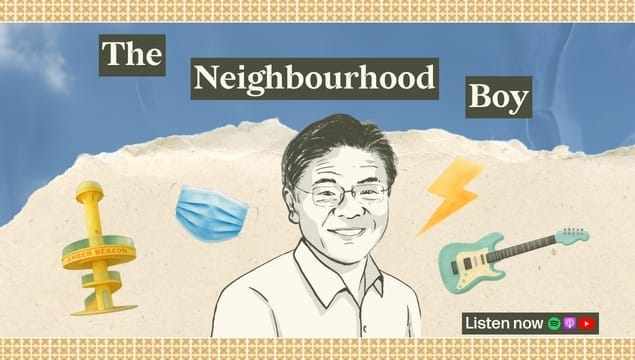
Some further listening: “The Neighbourhood Boy”, Jom’s podcast about Lawrence Wong, Singapore’s fourth prime minister and the first to come from a so-called neighbourhood school.
Society: It pays to be alert
Jostling into a crowded bus, you extend your arm to tap your phone to the fare payment reader. “Beep” and a green light. Transaction approved. (TIL: two “beeps” are for concession cards and five “beeps” are for declined payment.) Paying for lunch? Making a purchase? Tap your card. “Ding”. Transaction approved. Rinse and repeat. Contactless payment, or “payWave”, has become the preferred payment method here, with more than four in five Singapore consumers using contactless cards and around 52 percent using mobile contactless payments. The payment method uses near-field communication (NFC) where the card’s embedded integrated circuit chip and an invisible antenna allows a reader to detect it. For digital wallets like Apple or Google Pay, the card’s details are stored within the mobile phone through tokenization.
Cybercriminals exploit this technology with “ghost tapping”—cashing out stolen payment cards linked to a mobile contactless payment system. The scam unfolds in stages. First, criminals use malware or phishing to steal card information, often by setting up a fake e-commerce site. As the victim enters their info, criminals simultaneously add it to a mobile wallet on a burner phone. At this point, the bank sends a one-time password to the victim’s phone. The fake site prompts them to enter this to complete the pseudo purchase; once they do, the criminal uses it to authorise the card being added to the burner phone’s e-wallet. The phones are then sold to syndicates who use mules to conduct in-person retail fraud, purchasing goods that are resold. In 2024 alone, there were at least 656 reports involving phished card credentials linked to mobile wallets, with losses amounting to at least S$1.2m. Of these, at least 502 involved cards linked to Apple Pay.
This week, a man was found with a bag containing an electronic device with NFC function close to shoppers’ pockets and wallets at Mustafa Centre, allegedly a contactless card skimming attempt. Contactless skimming can obtain a card’s number, expiry date, and for older cards, the cardholder’s name. Some e-commerce sites allow purchases without the need for a CVV number, although cybercriminals typically avoid online buys because of the higher risks associated with a digital footprint and the need for a delivery address. It’s not clear yet whether this particular case is part of a ghost tapping syndicate.
Consumers can proactively safeguard their cards by not putting them in backpockets, lowering spending limits, activating digital tokens for banking apps, enabling alerts for new system links and transactions. As paying becomes more convenient, it pays to be vigilant.
Some further watching: Veritasium, a science and engineering YouTube channel, showed how US$10,000 can be taken from a locked iPhone. The demonstration builds on research from the universities of Birmingham and Surrey, which found that a Visa and Apple Pay weakness exposes iPhone users to payment fraud.
History weekly by Faris Joraimi
Australian archaeologists recently found the oldest-known evidence of “drug use” by humans, right here in South-east Asia. On the island of Sulawesi, now part of Indonesia, researchers investigated a pair of skeletal remains: one of which was 7,000 years old, while the other was at least 16,000 years old. Both had teeth ground down so much that the gums were exposed, “like someone had a drill head shaped like a gobstopper and wore away the inner part of the tooth,” said Adam Brumm of Griffiths University, Brisbane. A paper he co-authored containing these findings was published last month in the “Science Advances” journal. Were these ancient foragers chewing stones? Analysis of their teeth detected traces of arecoline, a psychoactive compound that induces a state of relaxation and reduced anxiety when consumed; in other words, a high. It’s almost certain they would’ve been sucking on the nuts of the areca palm tree (Areca catechu), which is endemic to South-east Asia and where arecoline naturally occurs.
Sucking on areca nuts will release some arecoline and cause numbness in the mouth, but not enough to induce an intense, recreational high. That requires mixing the areca nut with slaked lime, and wrapping them in betel leaf (Piper betle) to form a bundle called paan in South Asia, and sirih in the Malay world. Chewing paan or sirih was done by a vast swathe of humanity for hundreds of years: South Asians, South-east Asians, and Pacific Islanders. European explorers were disgusted at how almost everyone beyond a certain longitude of the planet incessantly chewed and chewed this thing which stained their teeth blood-red. The Scottish merchant Alexander Hamilton wrote that every trader who visited the sultan of Kedah had to chew sirih that the sultan himself had chewed before, and “it is very dangerous to refuse the royal morsel.” Whatever these squeamish outsiders felt, it was a practice that unified all strata of society, whether peasants needing relief from labour or princes freshening their breath. Elaborate traditions grew around chewing betel, and ornamental boxes built to contain and transport its ingredients are among the most stunning works of South-east Asian art. After the introduction of tobacco and rolled cigarettes, betel-chewing became unfashionable in many places, yet the habit survives in Myanmar, Taiwan, and much of South Asia. Even in Malaya the practice endured until quite recently among old women: my great-grandmother still chewed betel till late in her years. But today, you can more readily find a paanwala in New York City than a sirih-chewer in Tanjung Pinang.
If the ancient foragers couldn’t have gotten high enough from areca nuts to do it for fun, why did they chew them? Though the journal article calls it the “earliest recorded evidence for the habitual use of a neuroactive plant drug,” they were not really “addicts” in the contemporary sense, to borrow the pejorative term governments use to demonise everybody from recreational users to those with substance use disorders. The researchers think the ancients needed pain relief for toothaches, but the areca nuts just damaged their teeth more over time, leading them to use it again. The constant cycle of self-soothing and self-injury is also invoked in the discourse around addiction today, but it is framed as a moral issue rather than one of available resources and robust systems of social support.
Arts: The beginning of an era
How did one of our country’s finest documentarians train her eye? She took her time. Tan Pin Pin returned to Singapore in 1991 with an Oxford law degree under her belt, and a camera slung around her shoulders. “I had been a school girl when I left, and came back as a young adult, and I wanted to be in those spaces to see what Singapore was like for myself,” she told Art & Market. The decorated filmmaker had no formal photography education, so she decided to build a curriculum for herself: an index of the Singapore she’d missed. She haunted open houses and swim meets, weddings and funerals, the Istana and the void deck, the bus stop and the beauty pageant. Two years and 2,800 photographs later, she’d learnt how to lift a lens a foot from a subject’s face, confident that she wouldn’t get a slap on her own. Since then, our reticent country and its taciturn people have always let her come close, whether they’re exhuming family bones or exiled from home.
Tan’s streamlined selection of 67 black-and-white stills from the early 1990s is one of the headliners at the ongoing Singapore International Photography Festival. (Note: which also features work by Charmaine Poh, Jom’s co-founder.) “Singapore Index” documents a country getting more sure of itself—and an artist finding her photographic footing. A woman, skin dewy and hair slick in the equatorial heat, sweeps her fringe behind her sunglasses, seemingly oblivious to the sea of people milling behind her. Another woman charts a course through the crowded Istana lawn with her stroller, sizing up sprawling children and preoccupied picnickers—while a man on the far right, arms folded, glares directly into the camera. “I was trying out all kinds of things, I was so absorbent,” she told Jom at the festival preview. “Here I was just trying to practice not holding [the camera] on my chest...then of course, over time you find your eyes gravitating towards certain patterns, a certain kind of people.” She gestured to a wall dedicated to her attempt to “taxonomise the different kinds of Singaporeans...your civil servant, your retiree, your office worker...your funeral musician, your ma jie and, of course, your shopgirls”. She took inspiration from August Sander, the pioneering German photographer and portraitist of the late 19th and early 20th century, whose decades-long (and unfinished) project, “People of the Twentieth Century”, meticulously sorted his countrymen into categories from The Farmer to The Skilled Tradesman. Tan isn’t quite sure yet what she’ll do with her repository of thousands of negatives, but this index is a start.
The months-long photography festival also encourages you to wander the busy streets and back alleys of Singapore, as Tan did. “Passing by Paradise” is a photo-audio walk conceived by the Swiss-Hong Kong artist duo of Benjamin Ryser and Dorothy Wong in collaboration with Geylang residents, where you’ll linger in lorongs heavy with the funk of ripe durians and piquant sting of fried garlic. The walk takes you to a contemporary cafe stacked with vinyls, then back in time to a traditional Chinese goods store, its racks sagging with instruments and tapestries; the artist pair bring a fresh eye to a familiar neighbourhood more associated with late nights and the red light district. They aren’t the only photographers pushing us towards new ways of seeing, as is the genre’s remit. It’s the festival’s 10th edition, and also the last to be helmed by its long-time director, Gwen Lee. The search will begin soon for new leadership, so perhaps it’s apt that the festival takes its subtitle from the final line of TS Eliot’s East Coker: “in my end is my beginning.”
Arts: The end of an era
Just shy of a decade ago, Kathy Rowland and Jenny Daneels sat down and decided they’d start an arts and culture media platform in and about South-east Asia. This wasn’t their first flirtation with the medium; they’d had substantial success in Malaysia, where Rowland was born and Daneels had spent much of her life. They co-founded the Malaysian arts website Kakiseni in 1996, which led to long-running Boh Cameronian Arts Awards: the duo persuaded the nation’s premier tea company to spill its teh on the theatre. The women had big dreams for their new Singapore-based venture, born in November 2016. They named it ArtsEquator. They were adamant that South-east Asian artmaking should be seen as part of, rather than adjacent to, global contemporary arts, and that the platform would be committed to developing arts writing and criticism. They reached out to a young critic, who’d just turned 30, to be its inaugural editor. She took some convincing, having recently left the mainstream media disillusioned by arts journalism and discouraged by the state of criticism in Singapore. Eventually, she said yes. That young woman is now Jom’s arts editor.
ArtsEquator became the critical connective tissue for a region accustomed to having artistic conversations in silos. Lonely writers, journalists, and critics from a sprawling archipelago, once splintered by language and parted by sea, came together for summits such as the Asian Arts Media Roundtable. They found not just shared conversations, but the solidarity of each other’s company: whether they were a husband-wife couple running an online criticism platform from their home office in Yogyakarta, an activist-critic shouldering a small indie press in Manila, or an emerging curator from Myanmar raring to develop her voice. ArtsEquator also planted reading groups, seeded mentorship programmes, tended to a long-running podcast on the arts and strove to translate as much of its English-language work as possible: “We consider it a badge of honour that there are bootleg translations of some of our articles in Mandarin, Thai, and Japanese.”
But those translations haven’t translated into sustained support for critical writing. Just a few days ago, ArtsEquator announced that it would be closing down. The platform had been struggling for some time. Its regional remit meant that it didn’t have access to grants that were often nationally focussed. A few years ago, it pivoted away from arts reportage and cultural commentary, and concentrated its energies on two projects where it perceived a lack of infrastructure and insight: a fellowship for mid-career arts writers to develop their craft; and an ambitious database on arts censorship across South-east Asia. The latter will continue, housed by Five Arts Centre in Kuala Lumpur. And Singapore’s Centre 42, a theatre development and documentation space, will be custodian of the 1,300 pieces of content—essays, reviews, podcasts, videos and more—produced by ArtsEquator and its contributors over the past 10 years.
There was an outpouring of grief from South-east Asian cultural workers, who spoke of ArtsEquator’s “remarkable run” as an independent organisation, the opportunities it afforded under-resourced artists in terms of funding and mobility, but mostly the relationships it brokered. What is the legacy of a media outlet? It often isn’t immediately felt. The investment in young writers may only pay dividends a decade later when they, now established, may nurture other emergent writers in turn. ArtsEquator set a new tone for arts criticism: that it could be communal, creative, convivial. Rowland thanked all the writers and critics they’d worked with, perhaps aptly, in a campur of the Malay Archipelago’s lingua franca: “I am so grateful to be in this creative, questioning, nak cari sampai puas tapi pasti tak puas space with all of you.” You might search until you’re satisfied, but you’ll never be truly satisfied. We’re grateful too. May we never be satisfied.
Some further reading: Several of Corrie Tan’s arts essays for Jom were supported by the 2024 ArtsEquator Fellowship, including “The death of the critic, or why it’s really hard to write a bad review in Singapore today” and “A National Day baby reviews ‘National Day Charade’”.
Faris Joraimi, Abhishek Mehrotra, Sakinah Safiee, Corrie Tan, and Sudhir Vadaketh wrote this week’s issue.
Letters in response to any blurb can be sent to sudhir@jom.media. All will be considered for publication on our “Letters to the editor” page.
If you enjoy Jom’s work, do get a paid subscription today to support independent journalism in Singapore.