
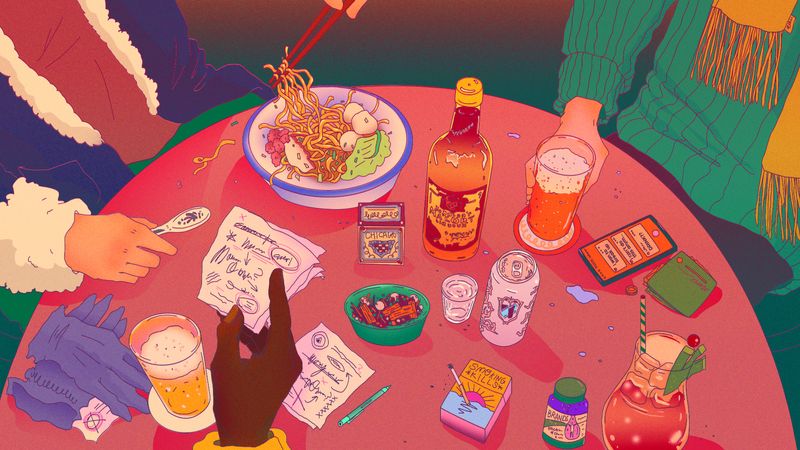
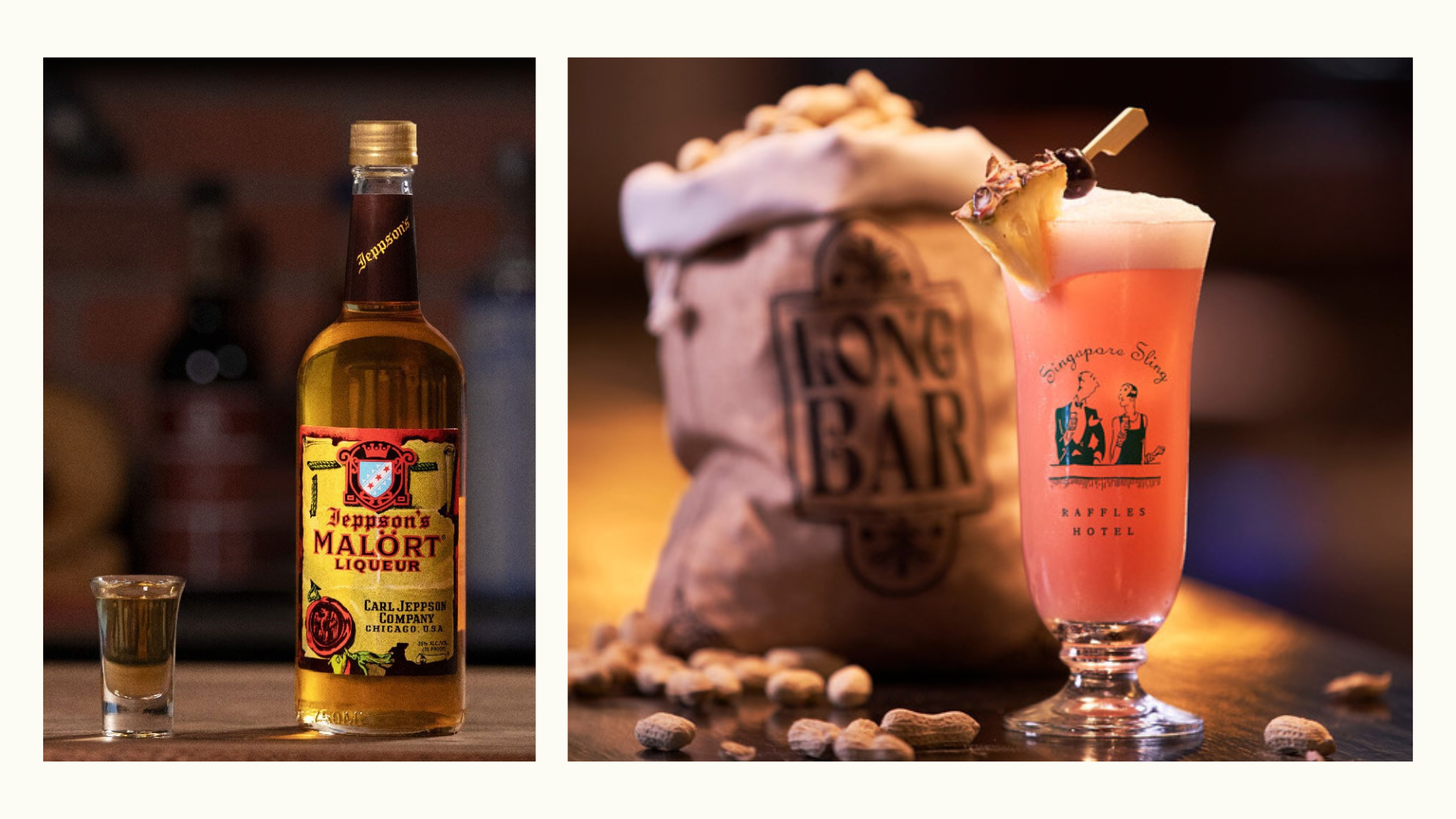
A Chicago Handshake is a shot of Malört, followed by an Old Style, preferably a tallboy. It’s the classic welcome gift, the first drink for visitors fresh off a plane from O’Hare, or an Amtrak from Union Station, or a car that’s entered the city limits. “You haven’t had Malört yet?” a Chicagoan will say, gobsmacked that you’ve managed to make it 24 hours in the city without someone thrusting into your hand this thin, clear shot and its pale, grainy chaser.
Some 90 percent of Malört is sold in Cook County, Illinois, which contains Chicago and its many suburbs. The alcohol was crafted by a Swedish immigrant in the 1930s. He sold his homebrew door to door until an attorney purchased the recipe and started selling it himself as both a medicinal and recreational beverage. In Swedish, Malört literally means “moth herb” and is the name for wormwood, the plant also used in absinthe.
The Singapore Sling is a tad more refined: a mixture of gin, cherry liqueur, lime juice, bitters, pineapple juice, and club soda. It was crafted in the Raffles Hotel in 1915 by a Hainanese bartender, a pink drink for imperialists and colonialists alike, a soothing beverage to ease the heat as they wound down their days. Today, people can drink Singapore Slings in cocktail bars all over the world and from premade mixtures sold at Changi Airport.
I’ve never had a Singapore sling. I’ve had three Chicago handshakes in the last year, grimaced three times as the Malört oozed down my throat, its texture light, its aftertaste bitter. “Our liquor is rugged and unrelenting (even brutal) to the palate,” its original label read. I describe it as herbal without the ‘h’ to which my Midwestern friends ask if that’s how we too say the word in Singapore. It isn’t. That’s an American thing, skipping the ‘h’ for convenience. But I like saying the word that way, especially to describe my preferred type of bak kut teh. ‘Erbal Bak Kut Teh. Like skipping over continents with a missing fricative.
Those same friends described Malört as a floral cough syrup. Close, but not quite there. The actual flavour neighbour to Malört is the only time I ever had Brand’s Essence of Chicken, the little jar oddly coming free with a random food delivery during “circuit breaker” (Singapore’s pandemic lockdown). I didn’t know what to do with it. My parents never prescribed it to me because they, unlike other exam-focused Singaporeans, didn’t believe in performance-enhancing drugs (that’s how I’ve chosen to interpret their actions). People online said that it’s best drunk warm. I put it in the microwave for two minutes, unaware of its potent rate of heat transfer. The jar came out burning to the touch. I waited for it to cool, its pungent aroma filling our kitchen. I waited. I took a sip. I burnt my tongue. I hated the taste, even more bitter perhaps because I accidentally cooked it. But it was undeniably ‘erbal. Like Malört. So, if you want to have a Chicago Handshake but live in Singapore (or anywhere outside of Cook County, Illinois), try overheating a jar of Brand’s Essence of Chicken, taking a sip, letting the liquid slide down your gullet, and chasing it with a sip of Tiger Beer. That’s a Singaporean Chicago Handshake.
In Singapore, I often get asked about what Chicago is like, typically in reference to our own city. How many gunshots have you heard? Is it really that windy? On gunshots: far less than I heard in the Army and also, coincidentally, zero. On wind: I’ve seen people walking backwards or leaning like Michael Jackson in the “Smooth Criminal” video to fight the city’s roaring gusts. Those are the big questions, the questions that pervade people’s overall understanding of “the Windy City” (also named for the hot air billowing out of its politicians’ mouths). But it’s not the difference I really think about. Not the one that spends the most time on my mind, the one that lurks behind almost every social gathering, not the one I remain most vigilant about. It isn’t crime or the weather. It’s alcohol. It’s rum, vodka, often beer, gin, tequila sometimes, whisky, spiked seltzers, ciders, and occasionally, when a visitor is in town, Malört.
I have learnt over the past year in Chicago that when someone says they’re not drinking, to not pursue the issue. Sitting behind the polite refusal isn’t a scheduled gym appointment or a morning Zoom call, as is often the case in Singapore. Instead, therein lies an array of regrets, of bad memories, or worse still, the lack thereof. Friends avoid alcohol in Singapore so that they can be productive. Friends avoid alcohol in Chicago because they’ve already done their tour of rock bottom.
They drank in high school, in college, at work, inebriated to the point of unconsciousness, a blackout where the memories of a party, a bar, a club, their own home should have been. They are recovering now and will continue recovering for as long as they’re in the city.
Rarely does anyone say “I don’t drink anymore.” Or “I’m six years sober.” That’s too sombre for the rest of the table, who would then have to each contend with their own histories. Bringing up alcoholism when the gang’s gone out to drink is a sure-fire way to end the night early. So instead, the teetotaller says, “I’ll just have a seltzer.”
The minimum legal drinking age in the US is 21. That’s probably part of the problem. The forbidden nature of alcohol draws teenagers and college kids, drinking clandestinely in unregulated environments, without guidance, no one watching your back, counting your drinks, ferrying you home if you’ve had one too many because the friend you came with is just as drunk as you are.
I didn’t start drinking until I was 26, not because I was abiding by Singapore law but because my tongue was repulsed by the taste of alcohol. A bad break-up and a pandemic changed that. When I moved to Chicago, grabbing a drink was the easiest thing to do with new friends. A beer, or two, made the conversation flow easier. But the nights could get expensive, they often degraded into infighting between people I hardly knew, and on one instance, our party was shoved out of a club onto freezing streets. I started avoiding that group after realising that I never saw them sober. They would go out to drink. They would stay in to drink. I am the same, but I can’t choose to spend less time with myself.
They say alcohol warms you. That’s a mighty promise in the bitterness of a Chicago winter. A liquid heat in a season that persists, unrelenting, where the wind chill keeps your doors closed and you inside, alone. I’ve discovered the warmth is temporary. It’s a burst of energy that dissipates quickly and requires a prolonged repetition to maintain the stopgap. They also claim it’s conducive to creativity. To release some pent-up, artistic energy.
I came to Chicago to study creative writing. The very first question one professor asks students seeking advice is whether they drink when they write. If they say yes, she urges them to reconsider. A different professor visited my classroom last week and said: “I write best when I’m drunk.” He’s approaching 70 and uses his ex-wives as markers of time (“I wrote that short story maybe four wives ago or so.”).
During my first semester, with my first Chicago winter looming over the horizon, my classroom started talking about drinking. We were in the good room on the Writing floor, the one that actually gets sunlight, from where we can see Millennium Park and Lake Michigan in the distance. One of my classmates, spurred on by a text we read, told us of alcohol’s role in his past career. He and his colleagues would leave the office early to brainstorm their advertisement concepts in the bar down the street. They would drink beers, shots, perhaps Malört, he never specified, until they had a single napkin that held a Golden Goose—a slogan or an idea that would one day be aired during the Super Bowl commercial breaks. He didn’t tell us this to brag. The story wasn’t triumphant: “It was a total waste of time.” It inculcated bad habits that, years on, he’s still trying to outgrow. A different student, having just graduated from college, became defensive. A glass of wine was part of her ritual: “It helps me unlock something.” That might be the case now, the former ad executive said, but in time, it would be two glasses, then three, then you’ll forget what you sat down to do in the first place. But no. Not her. One glass. Hemingway wrote drunk and edited sober. He didn’t, not really. But it’s fine. One glass. It won’t always be.
Months later, a Singaporean friend and I were exiting that first Chicago winter, sitting at a small bar near his place. He told me that, over the icy days of winter, he would help himself to a glass of whisky in the evening. A nightcap. But then the night kept drifting as the sun set earlier. One glass. Two. Three. The entire night, gone. His drinking wasn’t that of the rambunctious frat brothers pounding down beers in their DePaul, UChicago, or Northwestern dorms. Nor of ad-men doing shots to write a commercial, soon to be seen by millions. It was simply an encroaching dark, a liquid companion on an empty stretching night. He realised that he had a problem when his first waking instinct was to have a sip. “No more whisky in the daytime,” he told me. We toasted our pints of beer, celebrating his semi-sobriety.
I was in a two-floor apartment, high windows, sun streaming onto the dining table: eggs, sausages, toast, pancakes, granola, more pancakes if you want them, they’re already cooking. “You’re going to need the fuel,” she said. “She” being the sister of my friend’s brother-in-law’s best friend. The five of us were about to go on a bar crawl across Wrigleyville for TBOX, an annual autumn tradition in Chicago, where hundreds, if not thousands of drunken Chicagoans spill out from one bar to the next, rotating around Wrigley Stadium, like a carousel of tipsy toddlers. TBOX; the Twelve Bars of Christmas, started in 1996. Now it’s over 50 bars, all hiking their prices for this most manufactured of holidays. It’s always on one of the last nice days out in Chicago, before the frigidity of winter sets in.
The drinking starts at nine in the morning. The others warned my friend, her boyfriend, and me of the many follies of TBOX: going too hard too early, not drinking enough water, sticking to one bar for too long, or shifting too frequently. I ate another pancake, prepping for my ethnographic survey of inebriation in Chicago. By 1pm, I had seen three people fall from standing positions. By 4pm, drunken Santas, Power Rangers, Teletubbies, and one bumbling, if not well-costumed pair, of Fred and Wilma Flintstone, walking in-step, elbow hooked on elbow. The drunker my friend’s boyfriend became, the more outwardly loving he got. He leaned on me and pointed at her across the bar: “I love that girl, man. I love her more than anything.”
By 5pm, the mood started to change. Gone were the cackles, the guffaws, the cheers of recognition when two groups of strangers re-encounter each other three bars later. The sun had slid away from Wrigleyville, taking with it the joy of the reckless abandon of the morning mimosas. Near 7pm, my friend got into a drunken fight with her boyfriend over a slice of pizza.
He yells when he’s drunk. I didn’t know that when I accidentally hustled him in a game of foosball (the one special skill I acquired during National Service). The bet was a double shot of tequila. Within two hours, he was screaming at my friend about the slice of pepperoni pizza that she hadn’t ordered for him. I was standing beside them, agog, much like the other customers trying to order a slice. They turned to stare lazily, most of them smashed out of their minds. She started shouting back. He threw his pizza in the trash and stormed out. When the door slammed behind him, everyone pretended the rupture never took place, including my friend who went back to her slice. The city was fully submerged in darkness. He came back later, saying to her, “Sometimes girl, you drive me crazy.” They agreed that they wanted the night to keep going. I told them I’m tired. They whined. I said I’m too drunk. I had eight shots of tequila that day. But I waited an hour and drank three glasses of water before each shot. I was almost entirely sober. They walked me to the train before finding the next bar. I took the Red Line to the nearest cinema and watched the remake of “West Side Story.” That night, my friend’s boyfriend flew back to Pittsburgh for an exam he had the following Monday, leaving without a goodbye. The two of them broke up within the week. They entered the Chicago winter alone, and separate.
The closest I’ve seen to TBOX in Singapore were the months after circuit breaker, when bars had to close by 10pm. We’d start at 6pm to make it worth our while, leave when the bars closed, and take the bus home. My head would spin as the bus pulled up to each stop. I’d get home, crawl into bed, and it’d only be 11:30pm, a stupor of that level usually saved for 4am or later. The 10pm rule was meant to curb social gatherings. Rather, it just made us drink earlier and more frequently to compensate for the isolation of the months prior. We would sometimes drink on evening Zoom calls or Discords, but it was never the same. Even when bars extended their hours, we kept starting early. A habit solidifying.
In those early months, if you were out and not drinking, the half an hour after 10pm became a danger zone, subjected to the din and mess of those kicked out from the places that wouldn’t serve them anymore. I was once eating at a mee pok place with two friends, when five men came in, red-faced, stumbling, skin glistening with sweat. They had gone drinking straight after work. I could tell because they were still in their bright blue shirts from G2000 and their pointed black shoes. They were a bumbling chorus of incomplete stories, bursting guffaws, and fuck sias. One of them, though, was completely silent. He couldn’t stop leering at my friend. He barely kept the noodles in his mouth, the minced meat eviscerating again dripping from his lip. His friends brayed around him, recounting a night over before it began: “10pm too early lah.” “Way too early.” He remained silent, staring, undeterred by me glaring back at him. I don’t think he even noticed me there. If he even remembered his friends. He had tunnel vision of the highest order, a lonely predator, clumsily stalking his prey. We left early, his head swivelling to follow our exit onto the sweaty streets.
Singapore doesn’t have the seasons to be alcoholic. This doesn’t mean we don’t drink. We may just not realise how dependent on it we are. In Chicago, the winter forces people to be by themselves, to slow down, as the cold steals the motion from their molecules. That can send them to the bottom of a bottle. But it also gives them little excuse to look away from their reflection. Our sultry city’s constant pace blocks us from that final step. We make the time to drink, but not enough to think about the drink.
I sometimes have a glass of wine at night when I’m stuck on a project. Inexpensive wine, the cheapest one from Trader Joe’s, sipped from a ceramic mug poured from a bottle improperly sealed—me devoid of taste and full of frugality. It also helps that the headache manifests almost as soon as I finish the glass, preventing me from pouring a second. Sometimes the wine helps; sometimes it doesn’t. But every time, I hear my former classmates. “It’s only one glass.” “It won’t always be.”
And as I write this, I’m sipping from one of those white mugs stained with tannin. An arctic blast is about to sweep the northern edge of the United States. It will be a cold weekend, a weekend where Chicago will stay indoors, away from bars, away from Wrigleyville. But that only makes them closer to their bottles. I will be among them. And as the polar gusts encase the city, sealing it in its icy glare, the moth herb’s wings will flutter towards the flame, seeking kinship in the warmness of the light.
Myle Yan Tay writes essays, plays, fiction, comic books, and reviews. His works have appeared in The Bangalore Review, Drunk Monkeys, and New Naratif. His play, “Brown Boys Don’t Tell Jokes” is being staged this month by Checkpoint Theatre and his debut novel catskull will be published by Ethos Books in June. You can find more of his work here. He does not enjoy the taste of Malört.