
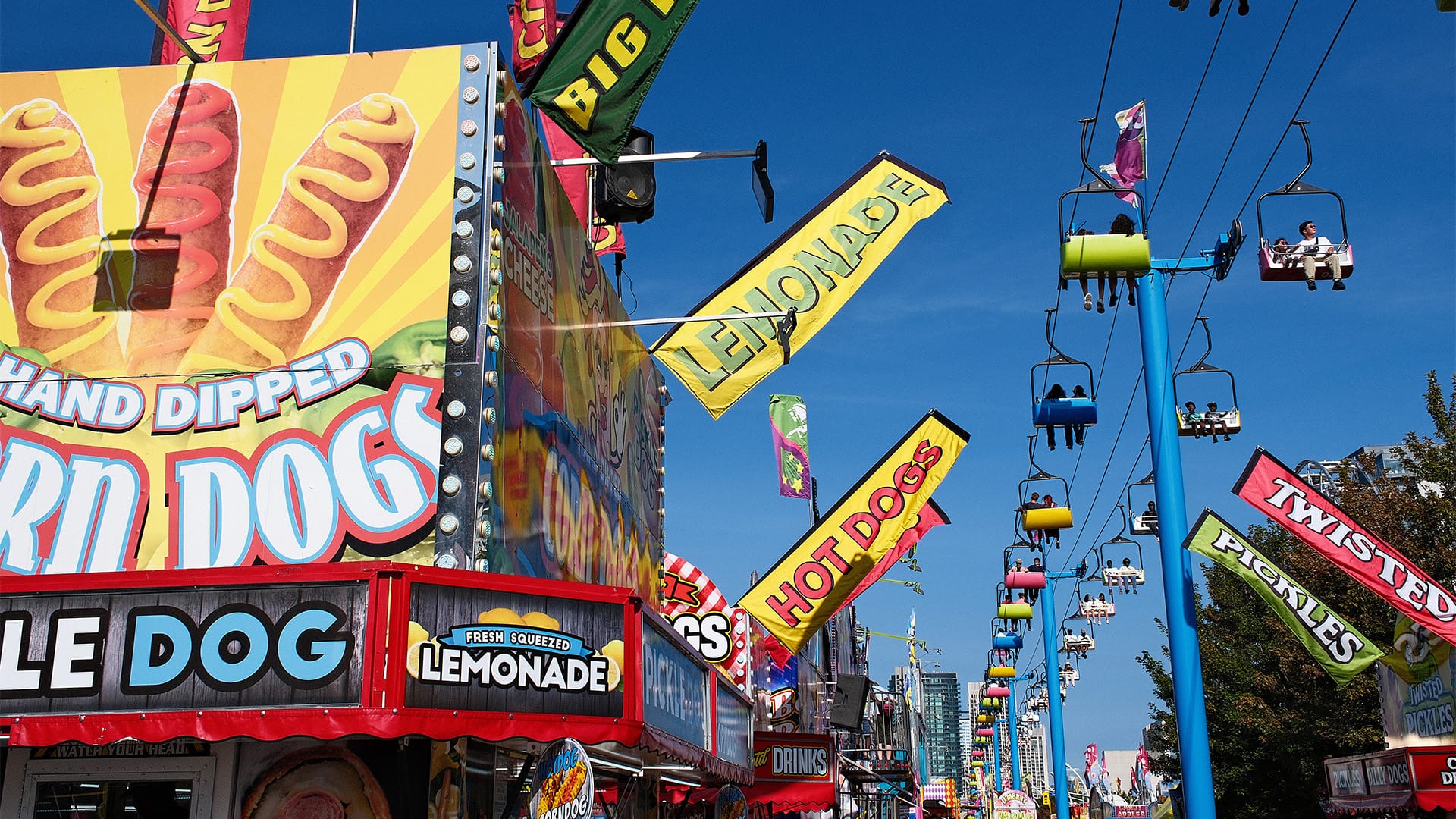
It took us 30 minutes to cycle from our apartment in Junction Triangle to the Canadian National Exhibition (CNE), Canada’s largest fair with a history of almost 150 years and counting. It has its own exhibition grounds on the shore of Lake Ontario. On our way, we stopped along the Martin Goodman Trail by the lakefront to watch an aerial performance of jet fighters swooping just above the water, above the masts of idling yachts.
It was a bright, warm day at the end of August, and the grounds, over 200 acres of land, were heaving. Held since 1879, CNE has historically been a showcase for Canada’s agricultural and technological advancements. Today, it is replete with rides, areas cordoned off for alcohol consumption, a range of overpriced fun fair snacks and even a casino.
Long queues were par for the course at the more popular rides. The livestock expo was particularly popular with kids. The fire station that was part of the grounds was open to the public, the fire engine proving a palpable hit for photos. Small stages everywhere provided opportunities for lesser-known bands to strut their stuff. They were mostly older white men in their 60s rocking out to a crowd that mirrored their demographic. We signed up for a free walking tour of the grounds, with a focus on the historical buildings. It was marginalia at its finest, with small factoids that gave brief glimpses into longer histories.
For new arrivals such as us, the CNE seemed to be a best-of presentation of the glories of Canada; from its robust agricultural pedigree to its artisanal produce and pop-culture cuisine. But it felt a bit too commercialised—and not “real”. It even felt a little tired, almost as if the same things were on display every year, and people went out of habit and a sense of duty rather than in anticipation of something new.
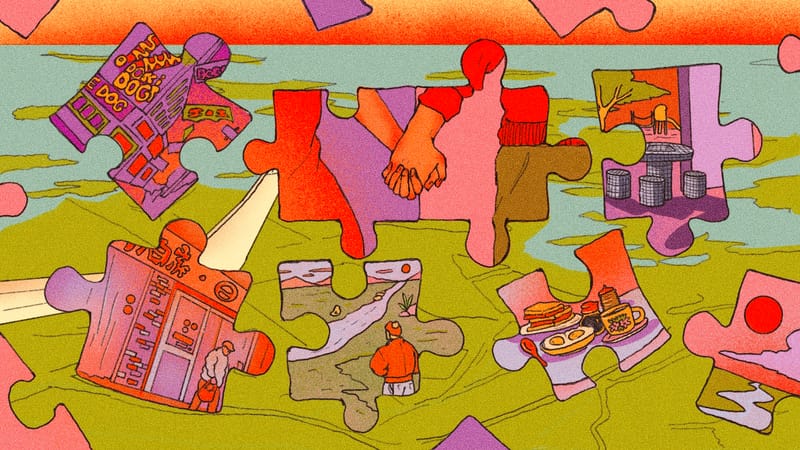
“Wah! Canada? So cold and so far! But ok lah, Canadians all very nice, right?” That last line might as well have been the name of the jigsaw puzzle box that we metaphorically opened on July 11th last year when we landed at Pearson International Airport in Toronto, Canada. It’s necessary to be specific because there is more than one Toronto in North America.
We’re here for at least the four years that I (Carolyn) will need to complete my PhD at the Ontario Institute for Studies in Education or OISE (pronounced “oi-zee”) in the University of Toronto. That’s quite a bit of time to work on this jigsaw, which also means our strategy isn’t to attend lectures, cook rice and plan trips to Singapore every six months. We need to feel the contours of each puzzle piece. We need to sit and stare.
Marc and I have decided that not all Canadians are very nice. Also, not all of them are very sure what it means to be Canadian, much like how Singaporeans and Singapore struggle with that notion. And whilst this isn’t a postcard about nice or not-so-nice Canadiana and Canadians, it is a collection of experiences and encounters we’ve had so far that will continue to guide us as we figure out which piece of the puzzle goes where.
According to Marc’s friend, who so very generously drove us around sprawling Toronto, the essence of Canada is more pronounced in regions like Quebec, with its logging, fishing and maple syrup industries. It’s also in the general, hands-on DIY nature of people who live in more rural areas.
He added, “We’re losing that Canadian-ness because immigrants are allowed and encouraged to be themselves.” Our friend also talked about the doing aspect of Canadian-ness, which is a trait he seems to embody; he’s open to exploring change, to debate, to difference. He’s also polite, helpful and giving. A nice Canadian.
It is true. Immigrants are allowed to be themselves. If you can find a corner to put your things down and just be, go ahead. But our friend, whose parents emigrated from Hong Kong, feels there should be more efforts to assimilate migrants into Canadian society. From my point of view—as a scholar focused on adult education and community development—Toronto’s efforts to encourage assimilation take the forms of English language lessons and basic literacy skills programmes. The education route. The reskilling to a pathway that’s up to Canadian standards pathway. With no guarantees of anything, not even a job. From what Marc and I have heard so far, many immigrants are willing to tread that path because there’s a hint of a chance at a permanent residency at the end of that rainbow. But until that happens, if it does, there are many no- and low-paying entry-level positions that are there for the taking and keeping. Yes, volunteering is strongly encouraged, similar to Singapore. Not so similar, however, is the Singapore situation where most low-wage migrant workers can’t even dream about converting that Work Permit into something more liberating. In that situation, assimilation is moot.
That said, what are immigrants assimilating into? Culture here, as in Singapore and other major cities, has been flattened into a uniform experience of time and space. Sat in the Swedish Restaurant of IKEA in Scarborough, we could have been in Beijing or Singapore. Savouring dim sum at the Perfect Chinese Restaurant, we could have been in Kuala Lumpur, Manhattan or Taipei. The Bay-Yonge-Dundas part of town is no different from any other city where La Senza, MUJI and UNIQLO cluster.
On October 26th, the Clay and Paper Theatre presented the 25th annual Night of Dread at Dufferin Grove Park. It was the culmination of weeks of puppet building and lantern-making workshops. The park was full of werewolves, ghosts, skeletons and generally heinous creatures of the night. People went to great lengths to come up with inventive, complex costumes. As evening light spilled through the trees, the Magpie Club—made up of youth on stilts—performed to a live chorus of haunting songs on the basketball court. After that, everyone joined a procession, led by a marching band, which wound its way around the neighbourhood, returning to the park when it was fully dark for a community theatrical spectacle called the “Fear of the Year”. Various fears were trotted out before the 2024 Fear of the Year emerged. It was…(drumroll please)…the Fear of Relentless Destruction, or FORD.
It might have been a jibe at Ontario’s premier and “least nice” man, Doug Ford, but we’ll never know. For context, this article offers a glimpse into Ford’s “unique” style of leadership. What followed was an enactment of how hope, with the help of the community, perseveres and triumphs against FORD. This fear speaks to larger stages of war and the environment but also, closer to home, the changing landscape of Toronto. With a multiplicity of condominiums built over the last decade, the city’s face has become markedly different. But it isn’t always shiny new progress. Many of the apartments are priced out of the ordinary citizen’s reach and so they sit; empty, eyeless windows in buildings with no soul.
At the end of the night, the Night of Dread Fear Master names the various fears that people have proffered on paper and burns them in a bonfire. The entire evening was a powerful demonstration of community participation, engagement and collective intention done in a way that wasn’t just spectacle or tapping on clichéd tropes of Halloween or the Day of the Dead, generating a concrete sense of solidarity.

Why Canada, everyone asks us. There’s a short story and a long story. The short one is that we wanted some time away from Singapore, to be in a place that was markedly different from its speed and intensity. To find a place that had space, nature, a place to hold our essentially questing—and vocal—natures. We had considered Australia, a far closer option, but somehow, neither of us was drawn to it. And so, on pretty much a whim, we set our sights on Canada.
Migrating (even if only for a season) always sounds adventurous. The lure of the unknown, however, is best reserved for remote fjords in Iceland, or tucked-away towns deep in South America. Toronto is a metropolitan city marked by suburban sprawl and a skyscraper downtown core. Its neighbourhoods are, unlike Singapore’s, demarcated along ethnic lines. Far from being a problem, though, they are celebrated as enclaves of specialised cuisine, traditional shops and services and become focal points for celebrating that community’s special festivities. Koreatown, Little Tibet, Little Poland, Portugal Village and Greektown. In these neighbourhoods are the tastiest momo, the most authentic tiramisu, the fattest cabbage roll, and the most succulent kimchi mandu in all its garlicky glory.
After six months, we feel the difference from Singapore. The air is fresher, less polluted. The pace of life is a tad slower. There is a burgeoning sense of freedom to think and speak without feeling censored by yourself or your country. The soul expands.
But it isn’t all roses. Migrants must understand that they will be assimilating into a tight labour market, a gaping lack of affordable housing, exorbitant commercial rentals, and a flaky public transport system. Toronto rolls out a threadbare carpet for those who might think that they’re moving somewhere better. Of course, just like anywhere else, if you arrive with millions, you’ll enjoy the quality of life that the city offers with its exclusive suburbs, high-end restaurants and access to cottages on Indigenous land.
Recognising Indigenous rights is a big thing in Canada. Land acknowledgements are the norm here, or Turtle Island as North America is known to First Nations, the Indigenous people of Canada, who have lived here for thousands of years. Every public event starts with one, so much so that the sentiment now is, “Okay. And then? How about we move from talk to action?” It’s an important sentiment because of Canada’s history of violent settler colonialism, where much of the reparation work that the government is doing revolves around the horrors of the Residential Schools and land claims. It’s chilling to think that the last federally funded Residential School closed down only in 1997. Even the Jesuits ran one Residential School in Spanish, Ontario, between 1845 and 1958.
Speaking of Jesuits, what better way to acknowledge a new land than to go on a retreat?
I (Carolyn) have been on silent retreats before; once in Ryde on the Isle of Wight in England, and another time in Chiang Mai, Thailand. Not a Vipassana, mind you—I’m not sure I could manage something that intense although I’m girding myself to possibly do one at some point. Silent retreats are a chance to run away from the world for a bit. The thing about silent retreats, however, is that the further from the outside world you run, the closer you move towards yourself, a frightening prospect for many.
I’m the stereotypical cradle Catholic; I don’t know my Bible and I stopped attending Mass ages ago. Marc used to be an Evangelical Christian. Collectively, we’ve decided the Society of Jesus offers the most tolerable form of sanctimony. So, I did my retreat last August at Loyola House in Guelph, just about two hours from downtown Toronto by train and a connecting Uber. Marc did his retreat in October, closer to us in Pickering at Manresa Jesuit Spiritual Renewal Centre, which we understand might not be around for much longer. This is a shame because the land that Manresa is on is beautiful. And also prime real estate. Many religious orders around the world occupy land that is simply amazing—large swathes of fertile forests, gorgeous ocean vistas and the all-important quiet and serenity. That “simply amazing land” is also often very contested.
The access we had to the land for the retreats—600 acres in Guelph and 21 in Pickering—was beyond a privilege. I’m not sure what it was, but even if it wasn’t complicity, it was at least profiteering in some form. It’s an uncomfortable feeling, one that incites indignation—“None of this is my fault!”—and it has pushed me to find out more. I’ve attended workshops conducted by the university’s Office of Indigenous Initiatives and continue to read up on as much Indigenous knowledge as I can. We don’t have similar land acknowledgements in Singapore but perhaps we should.
One of the first things we noticed on arriving in Toronto was the numerous bicycle lanes. They aren’t on every street, but there are enough of them to chart a path to where we usually want to go. And because the city is somewhat built on grid lines, the subway runs from East to West and from North to South, in a U-shape in the centre. This means that large parts of the city are served by buses or trams that generally also run the length of a single street. Cycling is often quicker than riding on public transport.
Cycling is much safer here than in Singapore. Speed limits are lower (40km/h on most city roads), and motorists are generally kinder to cyclists, often giving way or slowing down on a shared lane. Carolyn and I (Marc) decided to get second-hand bikes to minimise being out-of-pocket if they were nicked. But the inevitable happened. My bike was stolen from Adelaide Street East despite being locked to a metal bike ring. They even made off with the broken lock. It was a gut punch. I wandered the streets for a while, futilely hoping to catch a glimpse of the bike, or at least some part of it. Some friends said they knew a place where stolen bikes were resold. I briefly thought about going there, but the likelihood is that organised gangs run these places. I eventually bought another second-hand bike, even more ratty than the first. The most important thing we learnt was to have a damn good lock.
Toronto has the highest number of reported bike thefts in Canada. Over half are taken from the owner’s property, whether it’s the shed or garden, with 25 percent stolen off the street. An informal survey revealed that over 81 percent of Canadians have had more than one bike stolen. Tangentially, Toronto’s high rates of petty theft might represent an existential crisis with urban planning. Lots of large corporations buying up real estate and building up and up. Lots of new spaces for orchestrated community development. To what end? Down the road from us is Galleria on the Park, a massive multi-building, integrated-living development that sticks out awkwardly among the low-rise row houses and shops. Someone has clearly decided that everyone wants and needs this type of urban living—marked by capitalism, marginalisation and displacement.
We received a brochure from the City of Toronto detailing a proposal to turn the road that we’re living on into a “complete” street, which involves creating a dedicated bike lane, amongst other things. But bike lanes often eat into the lanes for cars, in many cases reducing roads to single motorised lanes, which sometimes leads to traffic congestion. Ford recently proposed and pushed through Bill 212 that allows the removal of some bike lanes in Toronto (only recently refurbished for millions of dollars), and the building of Highway 413 that will cut across wetlands, rivers, forests and agricultural areas. All this without Indigenous consultation or environmental assessment. We couldn’t help but feel familiar chills down our spines. How much say do Singaporeans really have when it comes to controversial bills that Parliament is ostensibly considering? Meanwhile, Ford’s Progressive Conservative Party won a majority in last month’s provincial elections held on February 28th, giving him an unprecedented third term as premier. He swept to victory on the back of an anti-Trump agenda, pushing strongly against the latter’s suggestion for Canada to become the 51st state. It remains to be seen, however, whether this newfound sense of patriotism and tit-for-tat tariffs on alcohol and electricity will carry him through his next term.
We attended a bike rally organised by Fight For Bikes on November 9th. Held in Christie Pits Park, we were protesting the provincial government’s plans to remove bike lanes on key streets in downtown Toronto. Over 1,500 people (and their bikes) showed up. It was moving but it came to nought. After the rally, everybody got on their bikes and rode east to Yonge Street in solidarity. The police, also on bikes, kept the cars away at the intersections as the procession made its slow, bell-ringing way. It was a reminder that bikes are not about to go away and, when the bike lanes are ripped up, we will indeed be riding, at our own peril, with the cars.
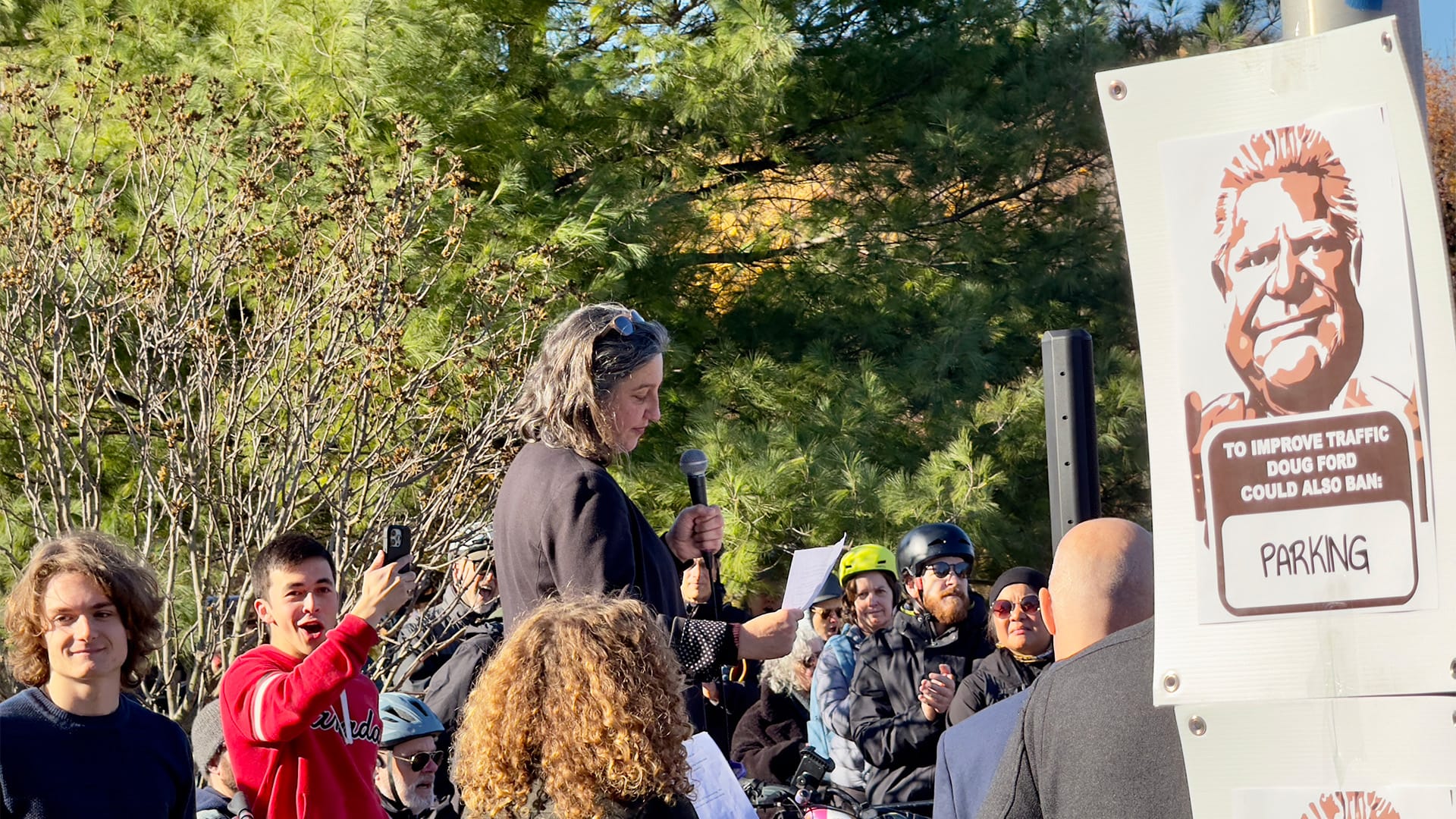
Petitions and protests, like the one we participated in, are part of a larger discourse spearheaded by Cycle Toronto. Their Move365 Network “aims to build a bold mobility network in parallel with the development of key transportation infrastructure in the city.” Such community-run groups, of which Toronto has no shortage, are refreshing and new for us, and speak of a critical balance that keeps the city from imploding. But sometimes, democracy also makes for a noisy plurality. We are on a local community Listserv (that’s still a thing here, like voicemail and fax machines), and were privy to friction among neighbours regarding supportive housing for homeless people, although “unhoused” is more commonly used now. A resident complained on the Listserv about how a supportive housing development on their street would devalue and render the neighbourhood unsafe. Overwhelmingly, there has been an outpouring of support, love and acceptance for such housing, because it would help the unhoused move out of living in shelters, parks and ravines, and into a space that gives them a chance at normalcy.
Part of that normalcy is finding work, but the job market in Toronto is, presumably, not too different from the job market in many other major cities around the world, ie: it’s difficult. Unless you’re a tech or finance bro, downtown Toronto doesn’t look kindly on you. Many migrants find themselves having to retrain and requalify, even in a field they’re already qualified in. This is to fulfill specific union requirements and also to reinforce a particularly protectionist approach to labour. And if you don’t want to go that way, it means starting at the bottom of the pile to gain what is known as “Canadian experience”.
For me (Marc), it’s been a bit of a black hole when it comes to jobs here, even though I’m sending out applications every two days or so. It seems like you have to know someone so they’ll hold a door open, otherwise there’s just silence and a view of trees shedding their leaves in autumn. But there is also much more to work than receiving a monetary return for your time and labour. Work is also all those hours that are not seen as “productive” in today’s economy. Catching up on reading; getting quality sleep; learning a new skill; or simply taking more time to write a poem, are some of the things that I’ve been doing. It’s been both restful and creatively generative.
I bought a typewriter and scored a gig writing poetry at a weekly farmers’ market in Dufferin Grove Park. I also volunteered for the 2024 Toronto Biennial of Art and am currently working on a new spoken word show. I’ve picked up wood and text carving. All this may not count as a “job” but it, too, is work.
I’m also learning to “see” the city, to understand its rhythms, its energies and its secrets. And like any palimpsest, it takes time to turn the page of each street. I particularly enjoy autumn, with its brief, sunny afternoons, whittling away at a piece of found wood in the park while watching people running after their dogs, children playing soccer and mums walking their toddlers through piles of orange-gold leaves.
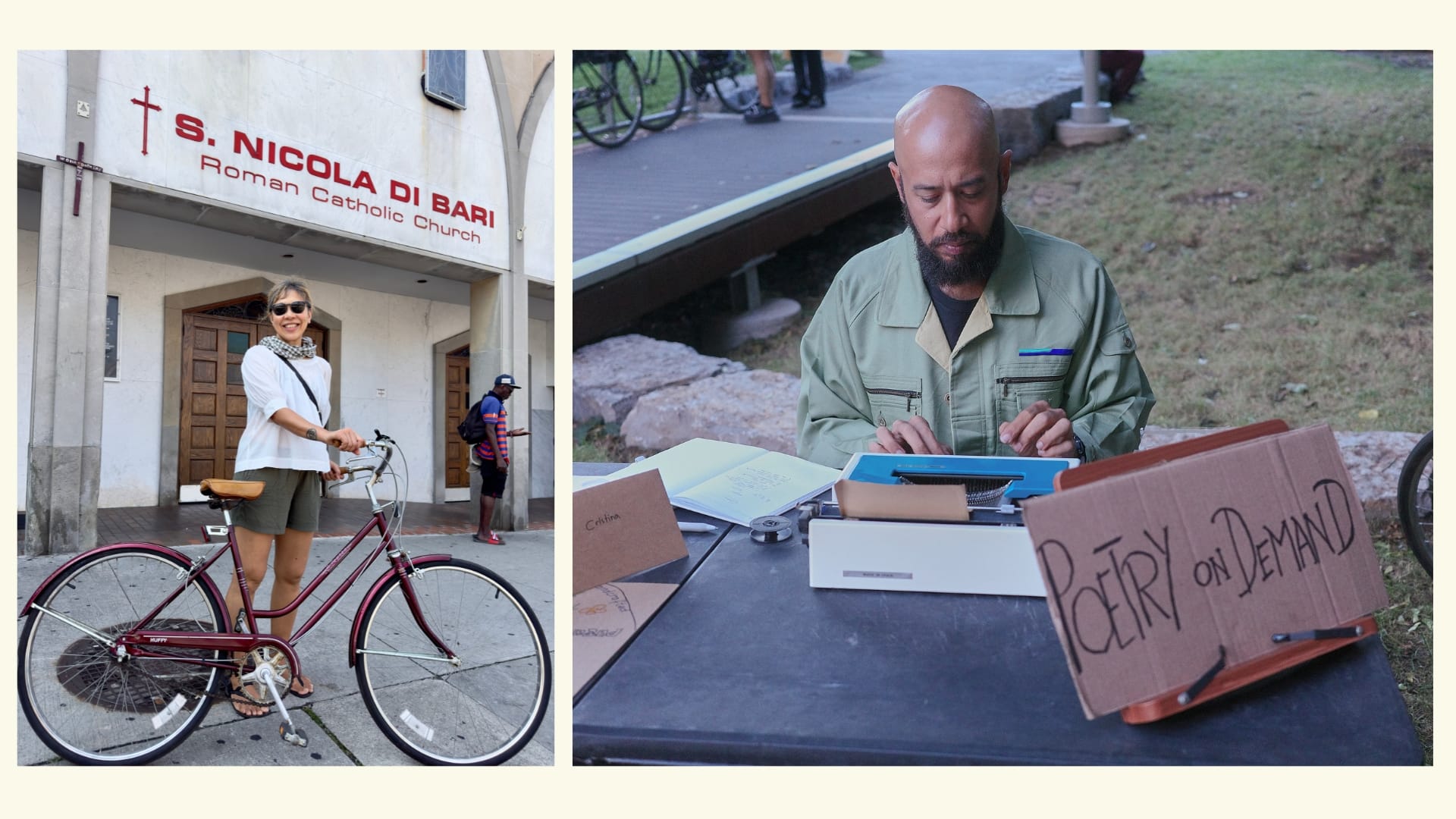
Not to be outdone, Carolyn has started making her incredible kimchi again and even gave some to one of the greengrocers at the market, who has become her go-to bak choy guy. The charm offensive is definitely working because she gets a very special price on her weekly vegetables.
While not comprehensive, these are some of the more salient experiences we’ve had in our first months in Toronto or, in Mohawk, Tkaronto—the place in the water where the trees are standing. So far, our Canadian experience has been holding small pieces of a far larger picture in our hands, slotting them where we think they fit. We’re very much aware that this puzzle will probably never be completed. As a country, Canada has layers of being and belonging that need decades, if not generations, to unpack. The recurring question of indigeneity; the balance between ecology and development; and the shifting notion of the migrant. The migrant question is something we grapple with in terms of how we see ourselves in this city. The word “migrant” carries the weight of difference, but also a sense of hope, a real chance of becoming part of a community. We will always be Singaporean, carrying that identity with us, but for now, we put on our puffy jackets of Canadiana and hope they take us safely through the seasons.
Carolyn Oei is doing her PhD in the department of Leadership, Higher and Adult Education at the Ontario Institute for Studies in Education, University of Toronto. She is a writer, educator and artist and is currently exploring the relationship between community and local government in Toronto.
Marc Nair's practice in the literary arts revolves around developing multidisciplinary approaches to writing and performance. He has published 11 volumes of poetry and works collaboratively with dancers, musicians, photographers and visual artists.
Letters in response to this piece can be sent to sudhir@jom.media. All will be considered for publication on our “Letters to the editor” page.