


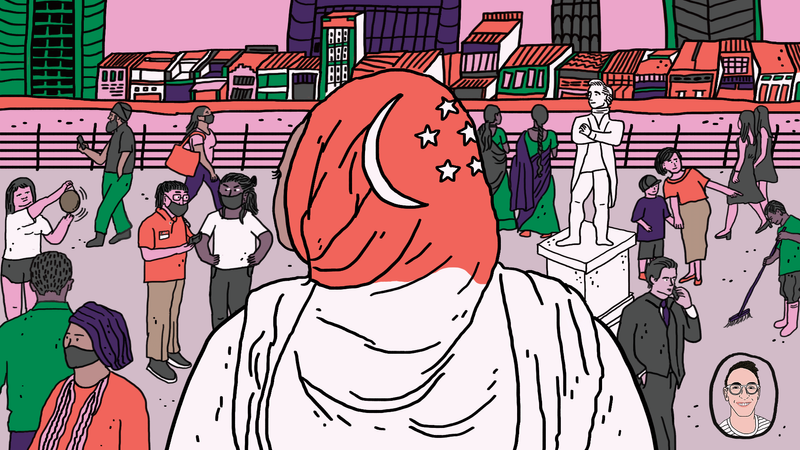
In December 1966, in a parliament composed only of People’s Action Party (PAP) members, one dissenting voice criticised the government’s uniform policy. Mohamed Ariff Suradi spoke of an incident in which Malay secondary schoolgirls had been asked to stop wearing their baju kurung uniform and instead wear a “skirt and blouse type of school uniform”. The schoolgirls’ parents, he lamented, were told “that this type of school uniform is more progressive than baju kurong.” The MP (member of parliament) rejected such a characterisation:
Mr Speaker, Sir, in my opinion, whether the students are progressive or not does not depend on their uniform; it does not matter whether the school uniform is baju kurong or skirt and blouse. It depends on the education imparted to them by the teachers in the schools and the encouragement they get to study at home.
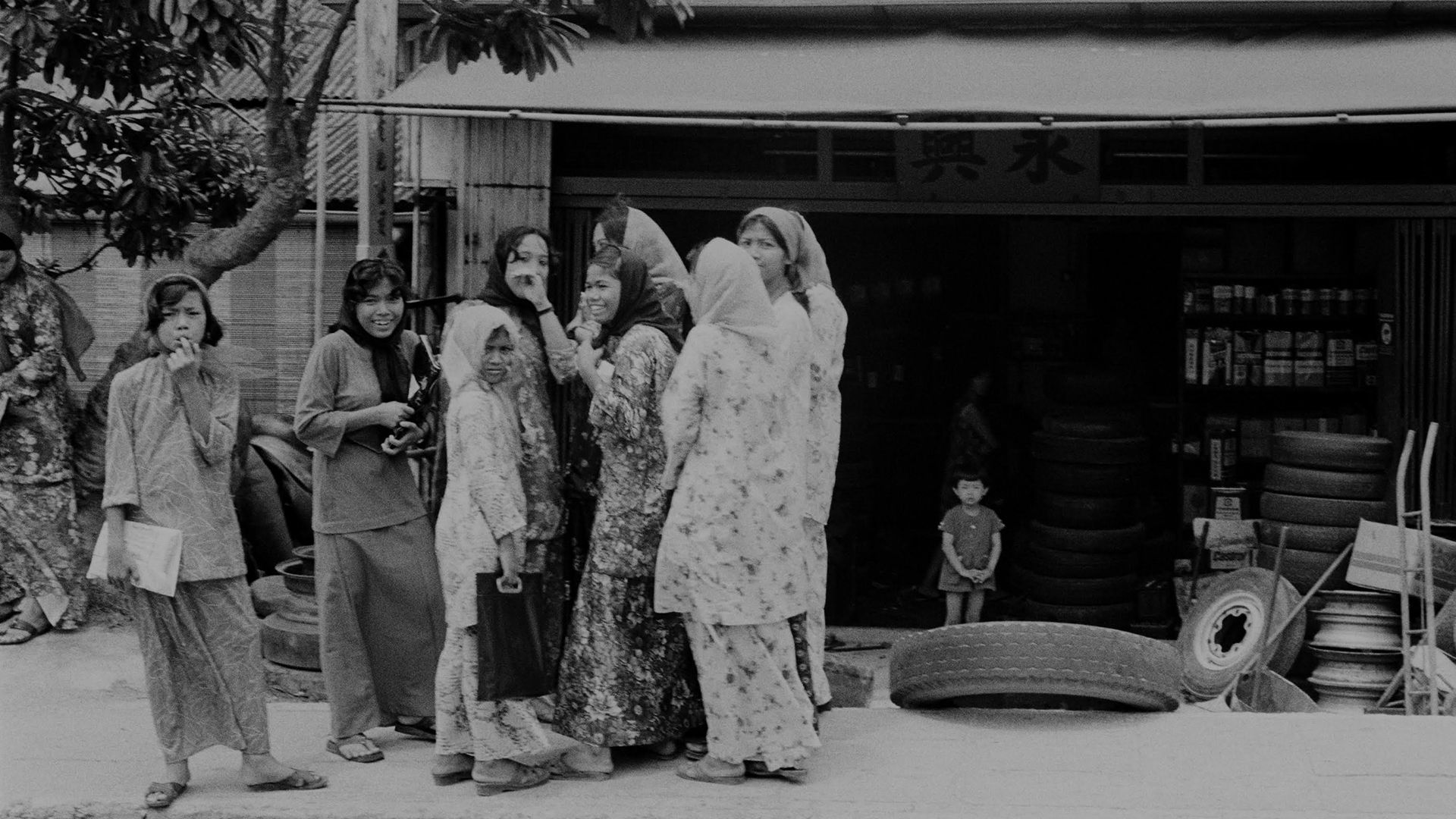
Yet, despite his protests, the baju kurung has since disappeared from national schools and so too has the tudung (or hijab). Except, perhaps, on Racial Harmony Day—the only day when Singaporean students are permitted to flaunt their sartorial differences.
These were the early days of the Singapore government’s efforts to standardise all school uniforms in the name of progress and national unity. In a land saturated with diverse traditions and practices, the PAP government has long been anxious about building a cohesive identity despite these differences. Diversity was taken to be in tension with national unity. Schools were thus chosen as an “equalising” arena to minimise differences, so as to make way for a distinctly Singaporean identity.
Nowhere does the PAP government’s framework for racial and religious harmony reveal itself so clearly as it does with their uniform policy and, more specifically, the so-called “tudung issue”. The debates surrounding the tudung issue tell us virtually nothing about the tudung, or those whom it impacts the hardest (Muslim women), and everything about this government’s own anxieties towards difference and diversity.
For decades, the Singapore government has, in effect, prohibited Muslim women from wearing the tudung in certain uniformed “common spaces”, like national schools, the Singapore Armed Forces and the Home Team. (And until quite recently, in nursing too.) What calls for such a measure? According to the government, “national security”. Singapore’s leaders have always maintained that if they were to “allow” the tudung to be part of the uniform in these particular spaces, then differences between people would heighten, which would in turn result in the fracturing of our present “harmony.” The message has always been clear: either you have your head scarf or your social fabric, but not both.
The PAP’s attitude towards the tudung reveals two things about it. First, its belief that Singapore’s cultural diversity is more of a risk to be managed than a quality to be celebrated. Second, the idea that certain traditions and practices are necessarily antithetical to its idealised vision of modernity and progress. Whatever the salience of these philosophies in Singapore’s early nation-building phase, they have long been a drag on society’s efforts to achieve genuine unity among the disparate races and religions of Singapore. It is only by interrogating and debunking them that we can create the space for Singapore’s varied cultures to mix and blossom.
Singapore’s nation-building effort has not been without its paradoxes. The very site in which differences are minimised is the site in which attempts are made to instil respect for such differences. In national schools, students are told ad nauseum that racial and religious harmony is central to their identity—and yet they are prevented from talking openly about race and religion.
A 2016 study found that most Singaporeans, of all races, don’t want to talk about “racial issues” because such conversations might lead to “unnecessary tension”.
On the surface, this might seem like a contradiction. That on the one hand, racial and religious harmony lies at the core of Singapore’s national identity, but on the other hand, Singaporeans can’t talk about race and racism. The PAP government, however, sees no contradiction: silence has always been a constitutive part of its brand of “harmony”.
Haunted by the racial riots of the 1960s, the PAP has often gone out of its way to mute racial and religious diversity, which, in its view, carries with it the spectre of riots and the potential crumbling of a nation. As the orthodox Singapore Story has it, the island was expelled from Malaysia in 1965 solely because of race. (Though alternative narratives do exist here and here.)
Since expulsion, the PAP government has operated on two assumptions—or what others might call “hard truths”—when it comes to dealing with race and religion. First, that races are not equal and never will be. And second, that tensions between different races and religions are, to some degree, inevitable. Indeed, racism has been naturalised in Singapore. Whenever the country’s leaders speak of racial tensions, it is to the natural world that they turn to draw out evocative metaphors. In 1989, Lee Hsien Loong said that “[f]our decades may have passed since the Maria Hertogh riots in 1950, but the volcano which erupted then is not extinct, only dormant.” In 2014, former politician Yaacob Ibrahim argued that racial tensions are always just “below the surface.” And more recently, in 2021, K Shanmugam defined 'racism' as something that “has always existed” and is a manifestation of “deep fault lines.”
In naturalising racism, the government skilfully manages to absolve itself of any responsibility for ongoing racial tensions. The question for Singapore’s leaders has therefore never been about how to overcome racism, but how to deal with racism.
Singapore is not the only country where Muslim fabrics bring racial anxieties to the fore. France, perhaps the most notable example, formally banned all “ostentatious” religious symbols from national school and state hospital uniforms, in 2004. Many Muslims in the French Republic felt that they were the target of this law as other, more “discreet” symbols like medallions, small crosses and stars of David were still being permitted. Then, in 2020, the French Senate went a significant step further: they passed an amendment that would ban all girls under 18 from wearing the hijab in public.
The restrictions against donning the hijab and other so-called “ostentatious” religious symbols are done in the name laïcité, France’s version of secularism. Laïcité draws a fine line between the private sphere, “where religion is said to belong”, and the public sphere, where differences of race and religion must be shed in the name of “impartial”, secular nationalism. It is in the public sphere where one assimilates into the “universal” and “equalising” French identity.
“French universalism insists that sameness is the basis for equality,” writes Joan Wallach Scott in her book, The Politics of the Veil. It is for this reason that the French census does not collect data on race, religion, or country of origin. France is a nation intent on being race blind.
That being said, freedom of religion is not something that laïcité claims to stifle, but to demarcate and protect. One is permitted to practise their religion as they please, so long as they do so privately. “Discreet” symbols are therefore allowed because they can be hidden behind clothing and be an expression of private belief. However, as a report by the French Council of State argued, other religious symbols “due to their ostentatious and provocative character, would constitute an act of pressure, provocation, proselytism or propaganda.” Thus, within this discursive framework, the hijab is taken to be a threat to religious freedom!
But far from being a “symbol” of the private sphere, the hijab actually constitutes a mode of existing for many Muslim women in the public sphere. It is a potent example of how religion is not a static thing that can be contained to certain spaces, but a living, breathing practice that moves through the world.
Perhaps as a result of not only failing to reckon with such differences, but actively labelling these differences as hostile to the Republic itself, as many as 58 percent of Muslims in France have reported experiencing religious discrimination. Moreover, a 2019 report found that 44.6 percent of French people “considered Muslims a threat to French national identity.”
Similar policies have been enacted in countries across Europe. Most recently, in August 2022, a commission appointed by the Danish government issued a report that recommended the banning of the hijab in all national schools. “[W]earing the hijab marks our Danish Muslim girls as being different from other Danish girls,” the report stated.
For a country that is so antagonistic towards difference, France in particular has a lot in common with Singapore. But that is not to say that they are the same. “Ours is not the French way, insisting on assimilation into one master language and culture: speak French, accept French ways and assimilate into French society,” said Lawrence Wong, current deputy prime minister, in 2021. On the contrary, Wong added, Singapore is a race-conscious society “for we cannot pretend that racial identities don’t exist.”
Discussions here often centre on this binary: we either ignore race and become a race-blind society or, to use the words of Lee Kuan Yew, we accept race as something “to put up with” and tolerate. But, in both cases, diversity is taken to be a problem. Differences, be it in complexion, thought or practices, are constantly said to be in conflict with—rather than a constitutive part of—national unity. And “tolerance” is our mode of dealing with such differences. But like patience, Wendy Brown points out, “tolerance is necessitated by something one would prefer did not exist.”
It involves managing the presence of the undesirable, the tasteless, the faulty—even the revolting, repugnant, or vile. In this activity of management, tolerance does not offer resolution or transcendence, but only a strategy for coping.
Though Singapore does not further the public/private dichotomy that exists in France, it does have policies rooted in similar beliefs. Namely, that unity can only be forged in sites where difference is turned into sameness. In France, this site is the public sphere, while in Singapore it is the common space.
“There will exist a constant tension between cohesion and common space on the one hand, and diversity on the other. The key to finding the right balance is accommodation” argued a 2003 government report. It is implied that only the common space can accommodate and tolerate the intolerance that exists outside of it. The tudung, clearly placed on the outside, then finds itself uncomfortably associated with communalism.
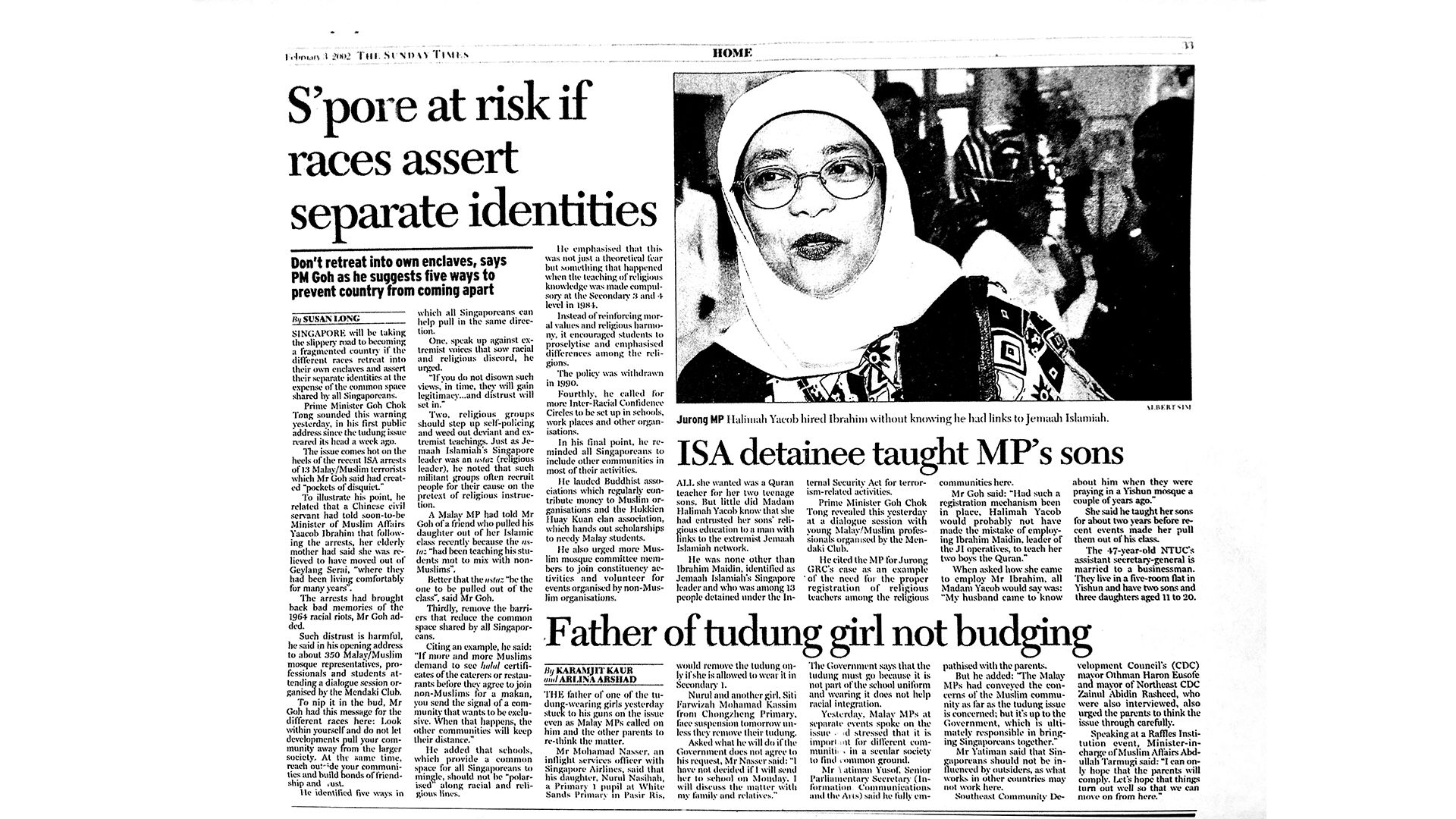
Such associations are made all too easily when one dares to challenge the government’s uniform policy. In February 2002, for instance, four Malay-Muslim girls were sent home after showing up to school wearing the tudung with their school uniform. The New York Times described it as “the most potent act of civil disobedience this tightly controlled nation has seen in years.” Meanwhile, Singaporean politicians and pundits alike labelled the act as “politically motivated” and deliberately divisive.
Mohammad Kassim, the father of one of the girls, begged to differ: “I want my daughter to study in a national school because I think it’s good, and even the prime minister said so. Here, she can mix with other students from other races.” He said to reporters, “To me, accepting her wearing the tudung… that is integration.”
Similarly, Faroukh Dawood, father of another girl, told The Straits Times (ST): “My choice for her was a secular school because I want her to integrate with children of other races.” Yet within the common space framework, such an act was taken to be hostile to the intentions of unity.
Goh Chok Tong, then prime minister, said that “non-Muslims, already wary about the aftermath of the Sept [sic] 11 attacks and the arrest of the Jemaah Islamiyah operatives, will be even more concerned with the push for wearing the tudung in schools.” Rather than denouncing the racist connection between these separate matters, Goh implied that the blame for such a connection should land squarely on the shoulders of those who advocate the wearing of the tudung in schools. Earlier that month, ST juxtaposed articles on the “tudung issue” and terrorism. When authorities like the prime minister and national paper conjoin these two distinct issues, it’s unsurprising that others do too.
The Singapore government readily admits to how divisive these conversations can be, which is why they insist on moving them “behind closed doors”. But never do they acknowledge their role in sustaining such divisions in the first place.
The paradox of this whole discourse is that the uniform is seen as inclusive, but at the same time is homogenous, which therefore, by its very nature, excludes. Despite two of the girls’ parents specifically wanting to send their daughters to national schools, they were kept out because they were cast as being communal.
After suspension, one girl was home-schooled while another left to pursue her studies in Sydney. Half the girls involved were compelled to leave the school system—despite their parents wanting them to remain. Not just in schools, but in all sectors where the uniform policy applies, this ban can have the effect of forcing Muslim women who don the tudung to become more isolated, not less. Instead of being “inclusive”, the ban forces these women to look for alternatives.
Ultimately, the tudung issue is a physical manifestation of the government’s efforts to silence cultural differences in society. Rather than having schools in which the diversity of Singapore is on full display, the government instead chooses to suppress it—as far as possible—to achieve a kind of “unity.” But in doing so, Singaporeans end up ignorant about the diversity that defines their society. When they leave the common space and encounter a country teeming with differences, they can't be blamed for not knowing how to deal with them. Most troublingly, though, we find that the ignorance necessitated by the common space provides fertile ground for bigotry.
Should we be surprised then when 55 years after the baju kurung incident, a Singaporean womenswear designer, Priscilla Shunmugam, asserted that Malay and Indian women had not “progressed” as far as Chinese women? Once more, sartorial choices were the yardstick for such progress. During her talk, hosted by the Asian Civilisations Museum, Shunmugam stated that “Chinese women have progressed significantly faster” than their Malay and Indian counterparts—one key marker being that they were the first to “adopt Western-dressing” like “the mini-skirt”. (Shunmugam later apologised for her “clumsy, hurtful and insensitive” comments.)
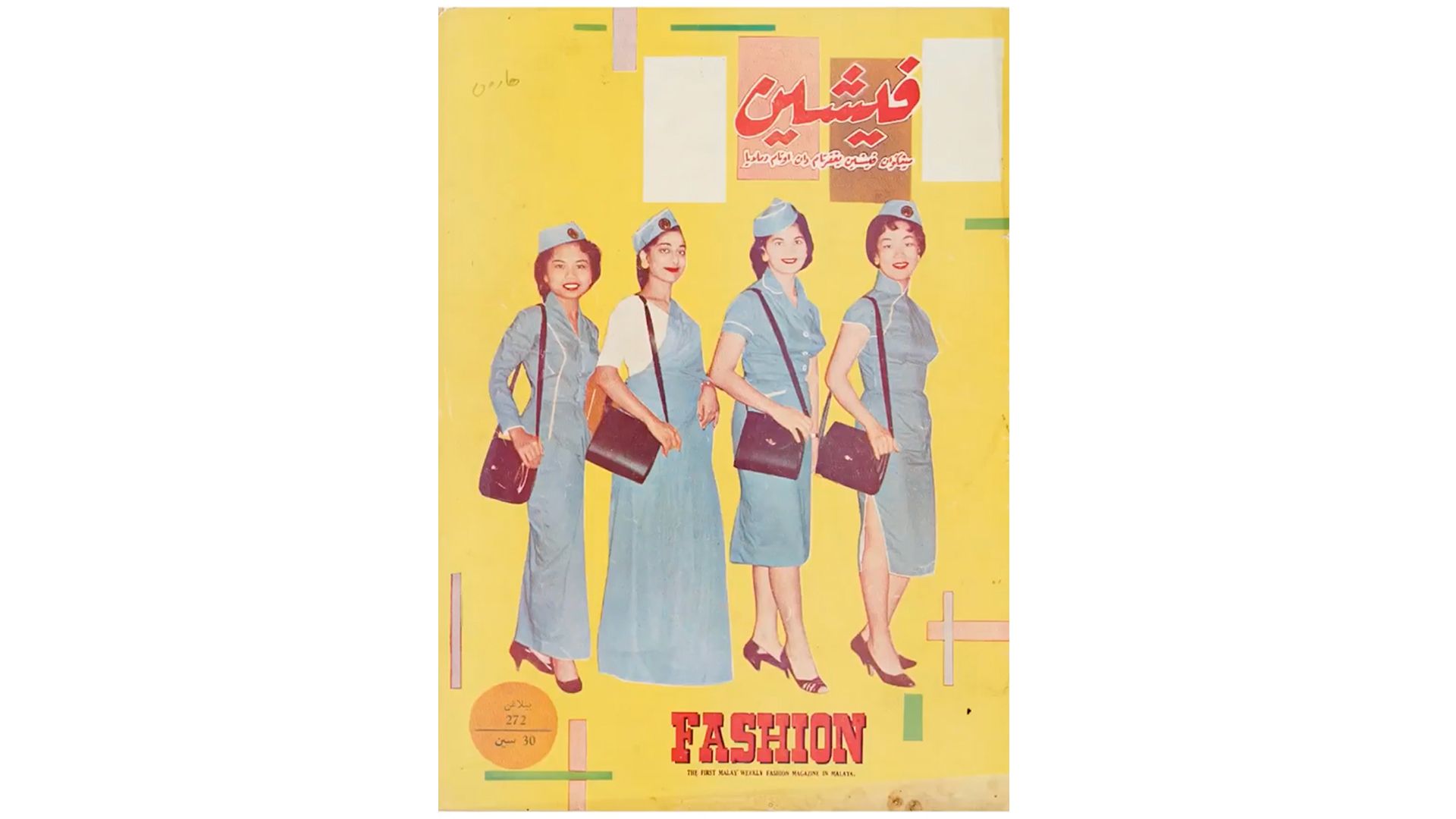
Both in 1966 and in 2021, women have been the site upon which “progress” is contested. In each case, it has largely been Malay-Muslim women who have been placed at the bottom of this unilineal evolution timeline, while Western (typically White) women lounge about, unquestioned, at the top. Malay-Muslim women have effectively been told to look West—just as Chinese women did—and fit themselves into the fabric of modernity: the mini-skirt! Throughout, the voices of Malay-Muslim women have been neglected. To borrow Lata Mani’s formulation, Malay-Muslim women “are neither subjects nor objects but, rather, the ground” of this discourse.
Though largely neglected in this discourse from above, tudung-wearing women are nevertheless forced to counter many of these narratives in their day-to-day lives. Writing in Beyond the Hijab, a platform that shares personal stories and perspectives of Singaporean Muslim women, Anisah Kader explains that the tudung “is a part of one’s identity, it is more than just a dress code. Please do not reduce its significance to anything lower than that.”
For many, the tudung is a practice of realising selfhood. Lepak Conversations, an Instagram page that encourages respectful discussions about things that matter to the Malay-Muslim community, writes that the tudung is not just a piece of fabric but something that helps “guide the behaviour, manner and speech of the wearer.” For Moja Kahf, the Syrian-American poet and academic, the hijab and various accompanying long and loose-fitting garments provide an unparalleled sense of bodily freedom.
In this little mobile sanctum, my body is free. My limbs swing loose; each leg is not stuffed sausage-like into a pant leg. Nothing cinches my waist. Nothing holds my belly in. Nothing demands that I conform to a certain shape or size. It is supple as a living membrane and offers a depth of layered meanings.
For Khaf, the hijab is not limiting but freeing. In other poems, Khaf rebukes notions that the hijab “traps” her as a woman.
Just because my veil blocks your senses, doesn’t mean it blocks mine. The veil is no blindfold. I see out; you are the one whose vision is obstructed…Is that why you find the veil frustrating from your male-identified viewpoint, you who are used to women putting out for your gaze? Because its aesthetic is the opposite of strut, is that the secret reason why you take it as such an affront?
But as Anisah Kader reminds us, the hijab can mean “many different things to various women – but, regardless of what it means, it is something that has to be regarded. It is not something you can tell a woman to remove.” Yet, too many countries demand that it be removed. In fact, more countries ban the hijab than mandate it.
To be a modern subject in these countries, it seems, you must wear modernity’s “progressive” and “unifying” costumes (thought up by White women in the West and manufactured by Brown women in Bangladesh). Implicit in this narrative is the belief that the tudung belongs to tradition; the past. Whereas the “free” unveiled hair and “mini-skirt” belong to the progressive modern; the future. Straddling somewhere between the two is the city-state of Singapore.
Tradition is thus treated like a sticky residue on the otherwise shiny veneer of Singaporean modernity. But “we have to accept the hand we were dealt with” said Goh Chok Tong when discussing the diversity of Singapore in 1999. Since tradition cannot simply be wiped off the face of the nation, it must be endured in various ways.
Yet not all communities are dealt with in the same manner. Sikhs, for instance, are allowed to wear the turban in common spaces. Chiam See Tong asked about the double standard in 1990, when he was an opposition member of parliament for the Singapore Democratic Party. “[The] practice of allowing Sikhs to wear turbans is a carry-over from the British days”, responded S Jayakumar, then home affairs minister.
The Government cannot agree if any individuals or groups should insist that because of a change in their religious practice, rules and norms which have been established for decades since colonial times should be upset.
Remarkably, British colonial policy of all things has set the standard for Singapore’s contemporary racial and religious harmony decisions! Twelve years later, ST editorialised:
Nothing is gained by harping on the exception made for Sikhs to wear the turban in school. Glaring contradiction it may be but, with time, it is likely to recede as fewer and fewer Sikh children now wear the headdress. Sometimes, it is wise to just let matters be.
The turban, like the tudung, is also accepted as a problem here. But it is a problem that is at least going away. The editors argue that it’s best to just maintain the status quo, and all will be well in due course. Underpinning this narrative is the belief that as we move further into the modern, we move away from the divisive traditions and cultures of our past, unsuited to a secular nation-state such as Singapore.
In 2003, The Straits Times Interactive reported on a dialogue between Lee Kuan Yew and a union leader.
[Lee Kuan Yew] noted that Malay women who put on the Muslim tudung, the headscarf, were finding it especially hard to find jobs. He said: “They complain that when the employers ask them: ‘Do you wear a tudung?’, when they say ‘yes’, the employer says: ‘I'm looking for a Chinese’.” While conceding the issue was indeed “a problem”, he also said it was a reality of living in a multiracial society...The long-term answer to help unemployed Malays to get jobs is through better education, especially for women.
In Lee Kuan Yew’s statement, racism was once more accepted as a fact of life in Singapore’s diverse society. No surprise then that in 2022, Muslim women who don the tudung continue to face difficulties getting jobs. Yet the answer to this “problem”, according to Lee Kuan Yew, did not lie in an all out anti-racist effort, but in merely improving the education of Malay-Muslim women. Perhaps Lee thought that with a better education, they would become more modern and maybe decide not to wear the tudung thereafter. He and his government would be mistaken.
Implying that the tudung is some relic of the pre-modern world fails to recognise the existence of women in the modern world who do wear the tudung—and in increasing numbers too. Worse, such thinking perpetuates and normalises racist beliefs. Indeed, it is this very normalisation of racism that justifies the existence of the common space. The common space framework insists that, on the outside, with all its untamed differences, racism will unfortunately take place from time to time. But if we carve out spaces in which we remove these differences—as far as one can—then we might all learn to get along with each other as equals.
But too often, the opposite is true. One cannot silence difference without also inciting ignorance, from which racism grows all too comfortably. Singapore’s racial and religious harmony laws are sufficiently heavy-handed so as to broadly conceal the tensions brewing in Singapore society. Tensions that are not “natural” but sustained through ignorance, enshrined by the common space. These tensions surface when we see hijabis face discrimination both within and without the workplace. But they also arise with other minorities. Like when an Indian man carried out a prayer ritual at his doorstep in 2020, his Chinese neighbour came out fuming with a gong, banging it in his face to spite him and his ritual. Or a month earlier, when a Chinese man walked up to an Indian man and lambasted him for dating a non-Indian.
The tudung issue is just a microcosm of a much larger problem in Singapore society—and that problem does not lie with the veil. It lies with our refusal to recognise the full differences that make up the reality of our lives in Singapore. Rather than immersing ourselves in the rich diversity of our nation, we cosplay in our equalising “secular” uniforms, and build a kind of “harmony” upon that hollow foundation. No wonder then that Singapore’s leaders so often speak of the “delicate social fabric” that they are trying to preserve. Perhaps it wouldn’t be so delicate had we built our nation upon stronger foundations.
Fiachra Ross is interested in anti-colonial nationalism, federalism, and racial capitalism in twentieth century Southeast Asia. He is currently pursuing his MPhil in World History at the University of Cambridge.
This is the last of six essays that Jom has published to coincide with Singapore’s 57th National Day.