
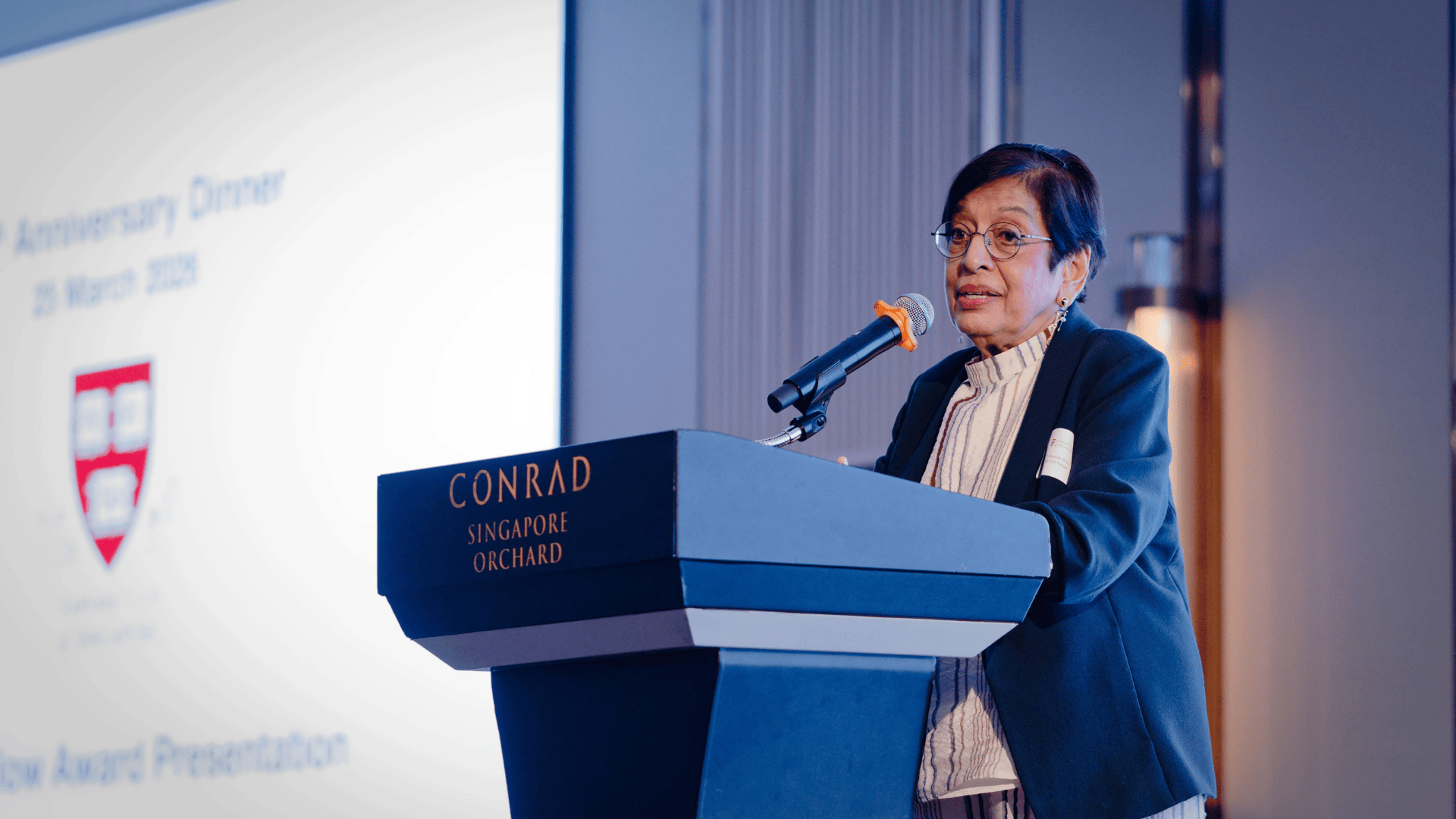
On March 25th, the Harvard Club of Singapore (HCS) announced that Dr Kanwaljit Soin had won its 2026 Fellow Award. Dr Soin is an orthopaedic and hand surgeon, a former nominated member of Parliament, and an outspoken campaigner dedicated to improving the lives of women. She was a founding member of the Association of Women for Action and Research (AWARE), serving as its president between 1991 and 1993. This is her acceptance speech, which Jom felt deserved a wider audience. We’re grateful to Dr Soin for allowing us to republish it.
Dr. Vivian Balakrishnan, Minister for Foreign Affairs;
President, Fellows, and members of the Harvard Club of Singapore;
Distinguished guests, and dear friends:
I thank the Harvard Club for the extraordinary honour of this award. I am humbled as I stand beside giants like Dr. Noeleen Heyzer, Professor Wang Gungwu, Mr. T. Sasitharan, and Dr. Ang Swee Chai. They are my heroes.
Although the award bears my name tonight, I accept it with the deep awareness that no one contributes in isolation. Every achievement we make, every barrier we break, and every truth we uncover is shaped and sustained by community.
We are gathered here under the banner of Harvard, and its most enduring dictum: Veritas. Truth.
But as far as I know, Harvard does not teach truth as a destination you simply arrive at. It teaches truth as a method. It is the rigorous, often exhausting habit of asking the uncomfortable questions:
- What are we assuming?
- Whom does this serve?
- And what have we overlooked?
Truth is not just what we see; it is investigating the lenses through which we are forced to look. To illustrate why this matters so deeply, let me take you back to the US Air Force in the early 1950s.
Pilots were struggling to control their jets. Crashes were frequent. The military, looking at the problem from the top down, blamed “pilot error.” They assumed the men lacked skill or focus. But a lieutenant named Gilbert Daniels, who had studied physical anthropology at Harvard, did not accept the military’s assumption. His academic training had taught him to observe the huge natural variation in human bodies, and so he suspected the problem was not the pilots. He suspected the problem was the cockpit itself.
You see, the cockpits had been built for the “Average Pilot.” The designers had taken the average height, weight, and reach of thousands of men, and built a seat to fit those exact dimensions. The assumption was perfectly logical: if you design for the average, you accommodate the majority.
Daniels decided to test the assumption. He applied his own method of Veritas. He measured over 4,000 pilots across ten physical dimensions to see how many of these men actually fit this “average” profile.
Do you know how many fit? Zero.
Out of 4,000 men, not a single one was “average”. One pilot had long arms but short legs; another had a wide chest but narrow hips. Daniels demonstrated a fundamental truth: When you design for the average, you design for no one.
Because of his willingness to question the flawed metric of the “average pilot”, the Air Force had to change. They threw out the rigid seats. They invented adjustable pedals, adjustable straps, and adjustable chairs. They stopped forcing the human to fit the machine, and finally designed the machine to fit the human.
Tonight, I want to suggest to you that we are still living in the era of the rigid cockpit. We have built our society for a statistical “average” that does not exist.
We have designed careers for an “average worker” who has no caregiving duties. We have designed healthcare for an “average” patient who is supposed to neatly fit the standard protocol.
I want to look at four areas where we are still forcing people to fit into systems that were never designed for their realities.
First, in women’s advocacy
Here, the comforting story we tell ourselves is that visibility is the same as progress. We celebrate the “firsts.” We count the women in Parliament and in the boardroom. We look at the high education levels of women in Singapore and tell ourselves equality has been successfully achieved.
But Veritas demands we look closer.
Representation can coexist quite comfortably with inequality. Success does not automatically overcome bias because bias decides who receives the benefit of the doubt. When achievement fails to silence that doubt, the problem is not performance. The problem is the perception, stereotype and organisational structure itself. That is why women may be present, yet excluded from power; included, yet unheard.
The uncomfortable reality is that we have inserted women into institutions designed around an outdated norm—the assumption of an uninterrupted career trajectory. We often talk about fixing the motherhood penalty, but the deeper issue is the stubborn assumption that caregiving is strictly a woman’s domain.
True equality isn’t just about helping women adapt to these rigid systems; it is about redesigning our work cultures to free men from the relentless pressure of the breadwinner, giving them the space to nurture and to care.
When we confuse numerical parity with true equality, we are not fixing the system. We are hiding the problem.
Second, in healthcare and social policy
Minister, you and I share a bond—we were both trained as surgeons.
You moved into the arena of public policy to fix the system, and I stayed in practice to fix the bones. I will leave it to the audience to decide which of us took on the more impossible task. But from our different vantage points, I believe we face the same uncomfortable truth: how not to confuse efficiency with excellence.
Our technical and administrative capabilities have soared. We can process data, build infrastructure, and deploy resources with incredible speed. But as our policies grew more efficient, our systems grew less human.
We measure what is easy to count: bed occupancy, wait times, economic output, costs. But in this drive for efficiency, the human being can become secondary to the process. In our clinics, we treat what the scan shows; we fix the organ; we clear the bed. But all too often, we do not make the time to listen to the patient.
We run the risk of knowing everything about a person’s biology or economic status, yet remaining absolute strangers to their life. Healing is not just a transaction; it is a relationship.
Third, the arc of our human lives
Just as those early Air Force pilots were crashing because the cockpit ignored their physical reality, we are burning out because our definition of success ignores our biological need for connection. We have designed the world for an “average” citizen valued primarily as an isolated, productive worker.
The Harvard Study of Adult Development—the longest study of human life ever conducted—followed generations of people for over 80 years. The researchers looked at physical health, careers, and wealth. But their conclusion was incredibly simple. The strongest predictor of a happy, healthy life is not wealth, not IQ, and not corporate rank.
It is the quality of our relationships. Yet, we design careers that require us to trade community for advancement. We optimise for independence, forgetting that human beings are fundamentally designed for interdependence.
This failure to design for human connection becomes most painfully obvious as we grow older. We are living longer—a massive triumph of public health, sanitation, and technology. But we are asking people to live these longer lives within social and labour policies designed for much shorter ones.
We celebrate “active ageing” statistics, but we must remember that participation is not the same as inclusion. We retain older adults in the workforce, yet marginalise their influence. We praise their resilience but quietly penalise their physical vulnerabilities.
We are advancing, but we are not flourishing. Veritas requires us to build systems where our entire lifespan—especially our later years—is not merely endured, but can be lived with continued purpose, productivity, and dignity.
The truth is that we all want to be recognised and valued.
Fourth, we arrive at Artificial Intelligence
The assumption here is that the machine is neutral—that algorithmic judgement must be objective.
But let me give you a recent example from healthcare, highlighted in a landmark 2019 study published in the journal Science. A widely used AI algorithm in hospitals was designed to flag which patients needed extra, high-risk care. To do this, the AI used a proxy: it looked at how much money had been spent on patients in the past, assuming that higher healthcare costs meant a patient was sicker.
But Veritas demands we look at the assumption. The algorithm assumed that cost equals need. It did not realise that marginalised communities historically had lower healthcare costs not because they were healthier, but because they had less access to care. The AI didn’t know the difference.
As a result, it effectively pushed healthier patients to the front of the line, while quietly downgrading severely ill patients from the marginalised communities, denying them proactive care—not out of malice, but out of a flawed metric.
When we just trust the algorithm to figure things out for us, we are not innovating. We are simply letting the machine learn our historical prejudices and automate them for the future.
We are scaling our biases.
From gender to healthcare, from the arc of our lives to AI, the challenge is exactly the same. In a society like Singapore—highly educated, technologically advanced, and relentlessly future-oriented—that challenge matters deeply.
We often assume that because our physical and digital infrastructure is world-class, our social infrastructure must be as well. But Veritas asks us to look at the gaps. It asks us to listen to the patient feeling lost in a hyper-efficient ward, the older adult feeling invisible in a fast-paced economy, and the women still carrying the invisible load of caregiving.
And as Singapore strides forward as a Smart Nation, Veritas demands we bring this exact same scrutiny to our technological ambitions. We cannot afford to be passive consumers of innovation, assuming that new systems will automatically solve our deep-rooted social challenges. We must actively ensure that our rush toward the future does not leave our most vulnerable citizens behind.
Harvard’s enduring contribution has never been knowledge alone, but the courage to interrogate it. Veritas is not a slogan or a destination; it is a discipline—a lifelong commitment to asking hard questions, especially of ourselves.
It demands the courage, confidence, and openness to listen when others question our assumptions—especially when those voices come from different experiences or positions in society, and when they speak truths that differ from our own.
Questioning our national assumptions—whether about social roles, healthcare efficiency, or artificial intelligence—is not a sign of disloyalty; it is the highest form of civic duty. We must shed the assumption that we have “arrived” just because the metrics look good on paper.
True leadership is not the comfort of good intentions. It is the courage to question the metrics we inherit, and the resolve to change them.
It is about redesigning our cockpits.
It is about redesigning our systems:
...so that women do not have to be exceptional just to be equal;
...so that patients are seen, not just processed;
...so that true success is measured by our relationships, not just our productivity;
...so that older adults are actively included, not just quietly accommodated;
...and so that technology serves humanity, rather than dictating our values.
If we can bring the true spirit of Veritas—rigorous, humane, and receptive—into how we design systems, deploy technology, and value one another, then truth will be more than just an abstract ideal; it will be the foundation on which we build our future.
Years ago, I had the privilege of walking the Harvard campus in Cambridge when one of my sons was completing his master’s degree there. I remember being struck by the sheer weight of history, the deep sense of inquiry, and the vibrant community of minds. To now be welcomed into that same community here in Singapore is a profound, full-circle moment for my family and me.
Thank you to the Harvard Club of Singapore for this honour.
Before I end, I would like to salute Swee Chai for coming all the way from the UK to attend this ceremony.
Thank you.
After Ang Swee Chai won the 2024 HCS Fellows Award, Jom wrote about the event as part of a profile on her.
Letters in response to this piece can be sent to sudhir@jom.media. All will be considered for publication on our “Letters to the editor” page.