
Singapore’s education system is the best in the world—or at least, that’s the story we tell ourselves over and over again until it acquires the status of “fact.” Like all stories, however, this one would look different if told from a different perspective, or if the storyteller chose to widen the frame.
So far, the story of Singapore’s education system has been framed very narrowly around one singular data point: our consistently strong performance in the Programme for International Student Assessment (PISA), conducted every three years by the OECD. PISA measures proficiency in reading, maths, science, and (purportedly) creative thinking (more on that later), in a nationally-representative sample of 15-year-olds.
Singapore has found itself near the top of the rankings since 2009, when it first started participating in the assessment. While it’s only in the most recent assessment cycle (2022) that Singapore has ranked first on everything, its students have consistently been in the top three countries on each of the three domains. Our worst performance ever was a shame-inducing fifth in reading, back in 2009.
It goes without saying that these results have been highly affirming for educators and policymakers alike—and not without reason. To be clear, we are not arguing that Singapore students’ strong performance is somehow illusory. But they can also sometimes serve as an impediment to needed changes. If Singapore’s education system is the world’s best, why should we continue to evolve? Don’t mess with success, as they say.
And yet…
In the public preview of her upcoming book, Unease, sociologist Teo You Yenn writes of Singapore: “The education system for children is excellent, but it is also true it is hard to find one parent or child happy in it.” Our work at EveryChild.SG has brought home this truth: so many of our students, parents, and even teachers, feel overloaded, beaten-down, and burnt-out by the education system.
Is this what it feels like to be number one?
We felt it was time for an honest comparison of our system with that of other rich countries that also perform strongly on PISA. What we found surprised even us.
Data source: OECD PISA Results, 2022
If you follow the British press, you’ll occasionally find opinion pieces about the UK’s “exam obsession,” a preoccupation with A-level results which one commentator called a “blight on society”. Read from a Singaporean perspective, this feels rather quaint. Because nobody—nobody—does exams like we do.
Singaporean students take the PSLE at age 12. The PSLE is a high-stakes exam, which does more than measure students’ progress—it has a material impact on their future. Such an exam at such a young age is unusual among high-performing systems. Many delay high-stakes selection until age 15 or later, and some until the end of secondary education.
Yet even this understates just how unique Singapore’s education system is. It’s true that a handful of Central European countries offer high-stakes exams at 12 for students who wish to enter academically-selective secondary schools, known as “gymnasiums”. Yet these exams differ from PSLE in two important ways:
- They are often optional, students who do not wish to apply for academically-competitive secondary schools can skip them. Many choose to do so: according to the Czech government, for instance, only about 25 percent of students indicate that “gymnasium” is their target. This reflects Czech citizens’ confidence that non-selective schools also offer a high-quality education.
- They are typically non-determinative. Admission to competitive secondary schools typically doesn’t rest fully on exam results; teachers’ recommendations and a student’s overall performance in primary school are also taken into account. Further, the system is flexible enough that “late bloomers” can switch between the vocational and academic tracks on the basis of improved academic performance in secondary school.
Contrast this with Singapore’s system, where secondary school seats are allocated on the basis of PSLE results alone (with DSA—the hyper-competitive route that grants access to selective secondary schools on the basis of a few criteria—being the only source of flexibility), and where switching between secondary schools on the basis of improved academic performance is rare.
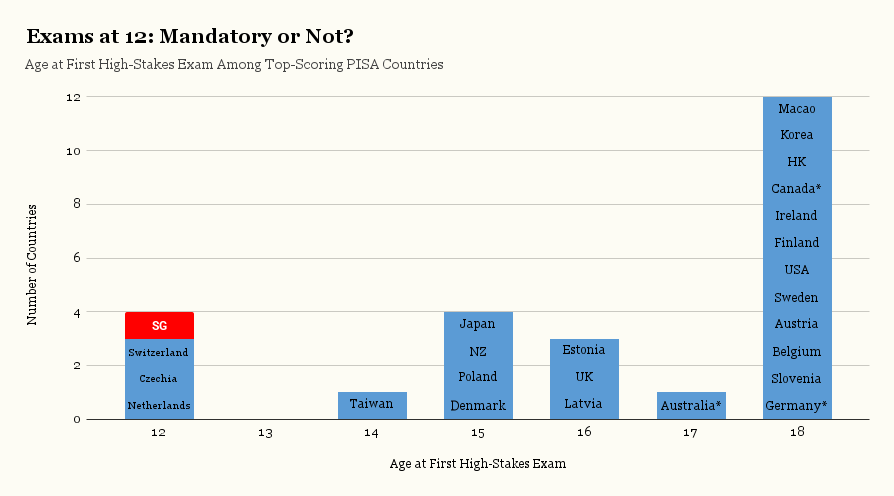
Even in Germany, which pioneered the gymnasium system, many states have moved away from formal entrance examinations in favour of a more flexible streaming system based on teacher reports, parent wishes, and a student’s overall academic aptitude as demonstrated in the classroom. Germany is also increasingly moving towards “combined” schools, where students can switch between academic and vocational tracks based on their abilities and interests without switching schools.
Singapore appears to be one of very few high-performing systems that combines all three features: an early, mandatory, and highly consequential national examination. No wonder Singaporeans can’t just “snap out of” our obsession with exam results. In no other developed, top-performing country do a tween’s exam results matter as much as they do here.
If Singapore’s only resource is its people, though, is this really a problem? Perhaps we do need to be more demanding of our children than, say, Germany, which has natural resources and a deep industrial base to sustain it? Perhaps. But, even granting that this premise has some validity, we’re burning through our only resource, not building it.
In psychology, “achievement goal theory” (developed by researchers including Carol Dweck, who also coined the phrase “growth mindset”) explains how different types of motivation influence individuals’ relationship with creativity and failure. Systems that promote “mastery/ learning goals”—that is, those that focus on competence, not competition—tend to foster higher levels of experimentation and innovation. (This is true of workplaces, as well as of schools.)
On the other hand, systems that promote “performance goals”—those where competitive rankings are a central feature, and where fear of “looking stupid” relative to peers is a prime motivator for improvement—tend to produce risk-avoidance, perfectionism, and dread of mistakes.
Singapore’s educators are well-intentioned, and the Ministry of Education’s desire to promote 21st Century Competencies (21CC), such as inventive thinking and collaboration, is genuine. But there’s no denying that the system still has a strong tendency to promote performance goals rather than mastery or learning goals. With a mandatory, high-stakes exam at 12, it couldn’t really be otherwise.
Our current education system, which was built for a different era, is no longer producing the type of human capital we need at scale, and may in fact be undermining intrinsic motivation, creative self-efficacy, and the courage to fail among our top-performing cohort of children—the very ones that by now should have won Nobel prizes, written Booker Prize-winning novels, or founded Fortune 500 companies.
In a system like ours, even students that genuinely love to learn will find themselves increasingly motivated by a “performance goal” (to perform well on PSLE relative to peers), and may absorb all the risk-avoidance and cookie-cutter thinking that tend to predominate in performance-oriented systems. In our experience on the ground, many teens and young adults that have come through this system may even have forgotten what intrinsic motivation feels like.
Remarkably, for all their achievements, Singaporean students don’t seem to have a very high opinion of themselves. In 2022, PISA conducted a specialised assessment that measured students’ creative thinking. (Singapore ranked, you guessed it, first). Yet a student survey connected to the assessment revealed a surprising truth—Singaporean students don’t think of themselves as creative. MOE reported: “Less than half of our students believed that they could produce good stories (Singapore: 47%; OECD average: 61%) or drawings (Singapore: 42%; OECD average: 55%), or invent new things with a creative streak (Singapore: 43%; OECD average: 57%). Schools and parents can help our students develop greater confidence in their creative self-efficacy.”
To an extent, this probably reflects a documented tendency for Asian respondents to choose less “extreme” survey responses than Western ones, making cross-cultural comparison more difficult. (Students in other Asian countries also reported low creative self-efficacy relative to the OECD average.)
Still, it’s hard to dismiss this finding out of hand when it aligns so closely with many Singaporeans’ lived reality. Yes, we score high on PISA’s “Creative Thinking” assessment, which largely emphasises structured problem-solving within defined parameters, but when it comes to what experts call “generative creativity”—the ability, drive, courage and calculated risk-taking needed to write a novel, found an innovative company, or risk failure in other creative pursuits—it’s not likely that we’re topping any charts. Smaller countries, like Finland and New Zealand, have a much larger cultural footprint than we do. And when it comes to science, the rural US state of Nebraska (population: 2m) has produced no fewer than five Nobel laureates. (Singapore, with a resident population of 4m? So far, zero.) Singapore’s education system beats all of these countries’—on paper. But what if the rankings are measuring the wrong things?
Our students possess an exceptional potential for creativity. PISA proves that much. But our system makes it too hard for most of them to do anything of note with that potential. We may have some budding Spielbergs out there, but they’re never going to shoot their first film when they spend all weekend in tuition.
And if our children aren’t confident in their creativity, or in any of their other non-academic and 21CC skills, they will be hesitant to use them at the right opportunity. Hence the feedback we at EveryChild.SG often get from tertiary educators and employers: our students struggle to think out-of-the-box or tackle tasks without clear structure and direction.
The highest paying jobs today are no longer about knowledge retention. They are about analytical thinking, creativity, creative application of knowledge, joining the invisible dots, flexibility, innovation, entrepreneurship, collaboration, and curiosity.
This trend will only deepen with AI making inroads into more professions, and doing the basic knowledge-based work for us. The need to update the main KPI of our primary education system is thus more urgent than ever. Every year that our young students spend cramming and taking extensive tuition to prepare to be competitively stack-ranked at PSLE, instead of playing, collaborating, and working together on creative endeavours, is another year of their lives spent developing increasingly irrelevant skills.
Which brings us to our multi-billion-dollar private tuition industry. Its sheer size makes it fair to ask the extent to which our national educational achievements reflect the strength of the tuition industry, rather than of the public education system. And indeed, it’s notable that many countries that tend to join Singapore at the top of the PISA rankings—South Korea, Hong Kong, Taiwan, Japan—are those with an extensive “shadow education” sector.
Does PISA really measure the strength of an education system? Or is it better understood as a gauge of a population’s willingness (and financial ability) to inflict extracurricular, for-profit drilling upon their offspring?
A provocative question, and not one we’re fully equipped to answer at the moment. But keep that thought in mind as we look at how Singaporeans’ tuition spending compares to other high-performing countries’.
In a nationally representative survey of Singaporean parents and youth (commissioned by EveryChild.SG and conducted by global survey company, NielsenIQ, in February 2026—full results to be published soon), parents reported spending an average of S$764 on private tuition per child, per month during primary school. (This average includes both those who use tuition, and the very few who do not.) Some 16 percent of families reported spending more than S$1,200 per month.
International comparisons on this topic are messy, as different countries report this data differently (or not at all). But looking at the best available data throws up interesting insights. South Korean parents spend, on average, roughly ₩434,000 (S$371) on private tuition per student, per month, according to our analysis of the most recent available data, from 2023. And Japanese students spend a monthly average of about ~¥15k–¥21k per month on juku/ tuition centres (S$140-200), based on 2021 data. (We were not able to find recent, high-quality data for other economies, like Hong Kong and Taiwan, that also have large private tuition industries.)
Meanwhile, some countries achieve respectable PISA scores with hardly any tuition expenditure at all. Households with children in the Netherlands spent on average around €34 (S$50) per month in 2022 on private tutoring, underscoring just how rare for-profit tuition is there. In some other top-scoring European countries, tuition spending is not even reported; anecdotally, academic tuition is all but unheard-of during primary school.
Even if actual spending is higher than reported in some countries, the overall lesson here seems to be obvious: it’s possible to do things differently. It’s possible to have a high-performing education system without asking parents to spend such a substantial portion of their monthly paycheck on extracurricular tuition. And it’s also possible to build an education system that’s fairer for middle- and lower-income families, for whom tuition spending is especially burdensome.
What would it take to make this happen?
Large class sizes in primary school may be one reason for Singaporean’s high tuition spending, as parents seeking personalised instruction for their children must often turn to the private sector to find it. Singapore is also an outlier when it comes to class sizes. While our pupil/teacher ratio (around 15) is in line with international norms, this has not translated into “normal” average class sizes. That’s because the pupil-teacher ratio counts all teachers employed at a given time. Those employed in administrative or curriculum development roles, and specialist or senior teachers who don’t teach a full course load, are all included. This matters because it’s the actual class size—not the abstract ratio—that’s felt on the ground. And here, we fall short. Among the top-scoring PISA countries, the average primary school class size is 22; in Singapore, it’s 33.
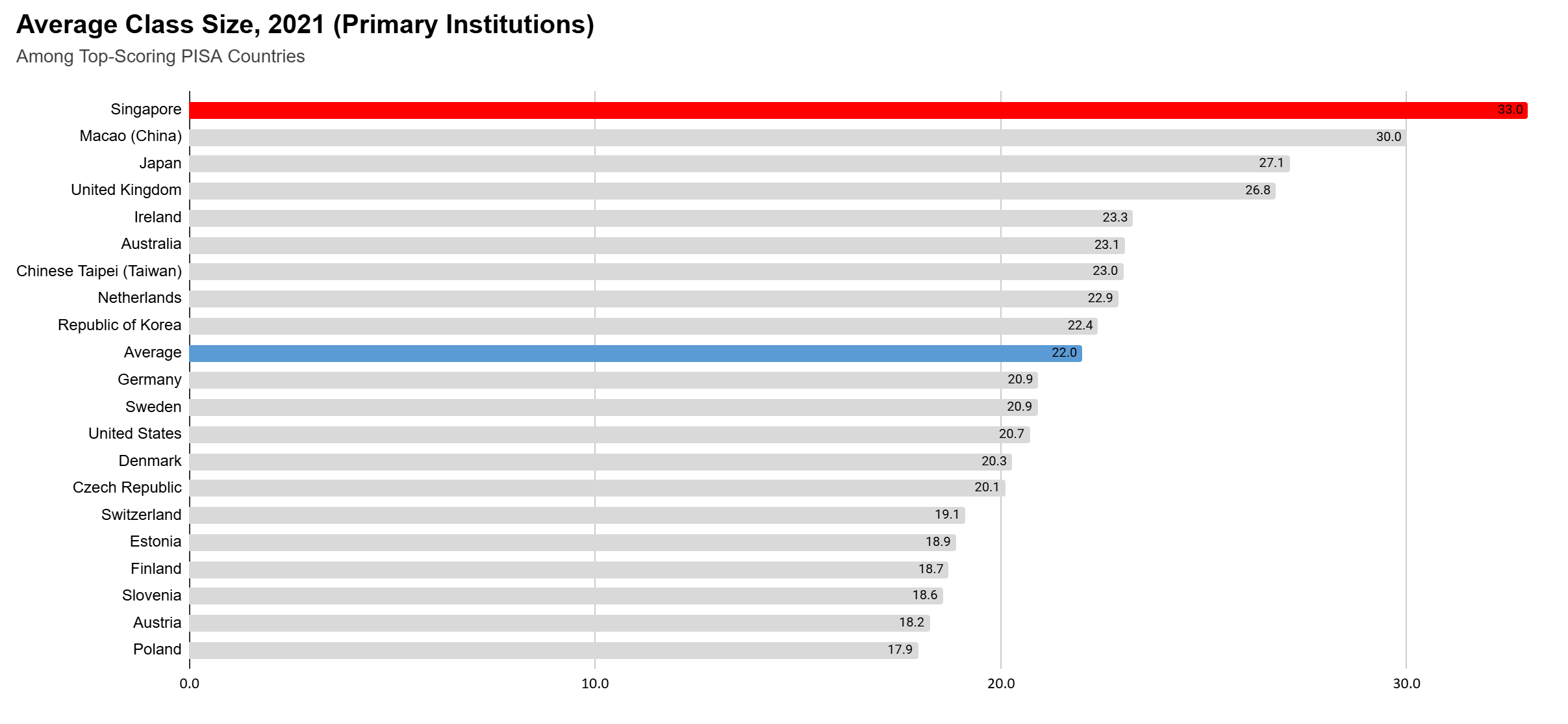
The gap between the Singapore average and the norm in top-performing PISA countries only widens in secondary school, with 33 students per class against an international average of 23.1 in lower secondary institutions.
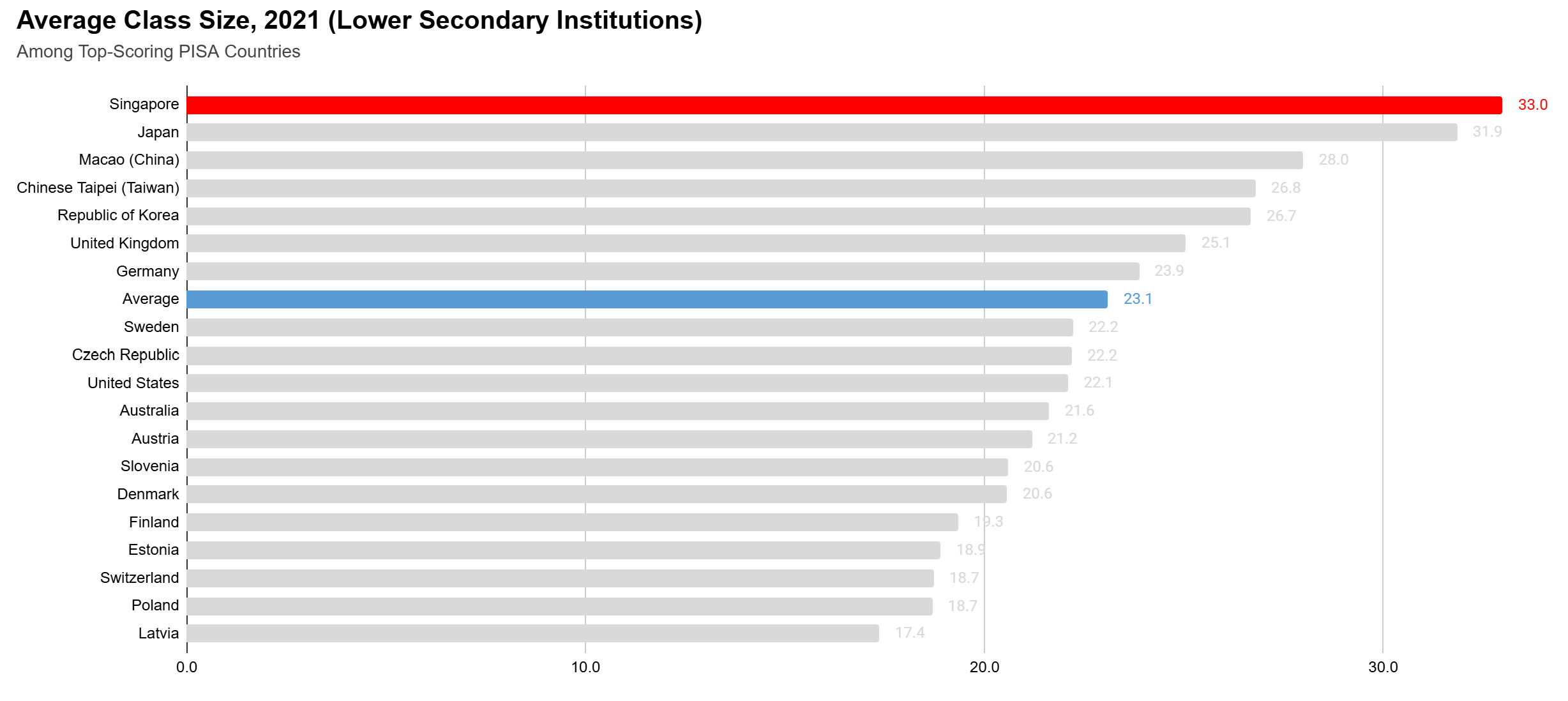
Smaller class sizes allow teachers to provide more individualised attention to each child; to nurture children’s creativity and collaboration skills through meaningful exploration in the classroom (eg, participatory learning, project-based learning); and to support multiple learning styles. Without smaller class sizes, it will ultimately be difficult to shift teachers’ pedagogy from top-down lecturing to the more discursive, exploratory approach that, evidence suggests, most effectively nurtures 21CC.
Reducing class sizes isn’t free. Education spending must be balanced against other national priorities, like infrastructure or healthcare. But here again, a comparison with our peer countries can be useful. Singapore is just below average when it comes to investment per student, spending US$10,412 per primary student in 2021, compared to an average of US$10,501 for other top PISA countries. (Figures are drawn from World Bank and UNESCO datasets, and may reflect differences in definitions of government expenditure.)
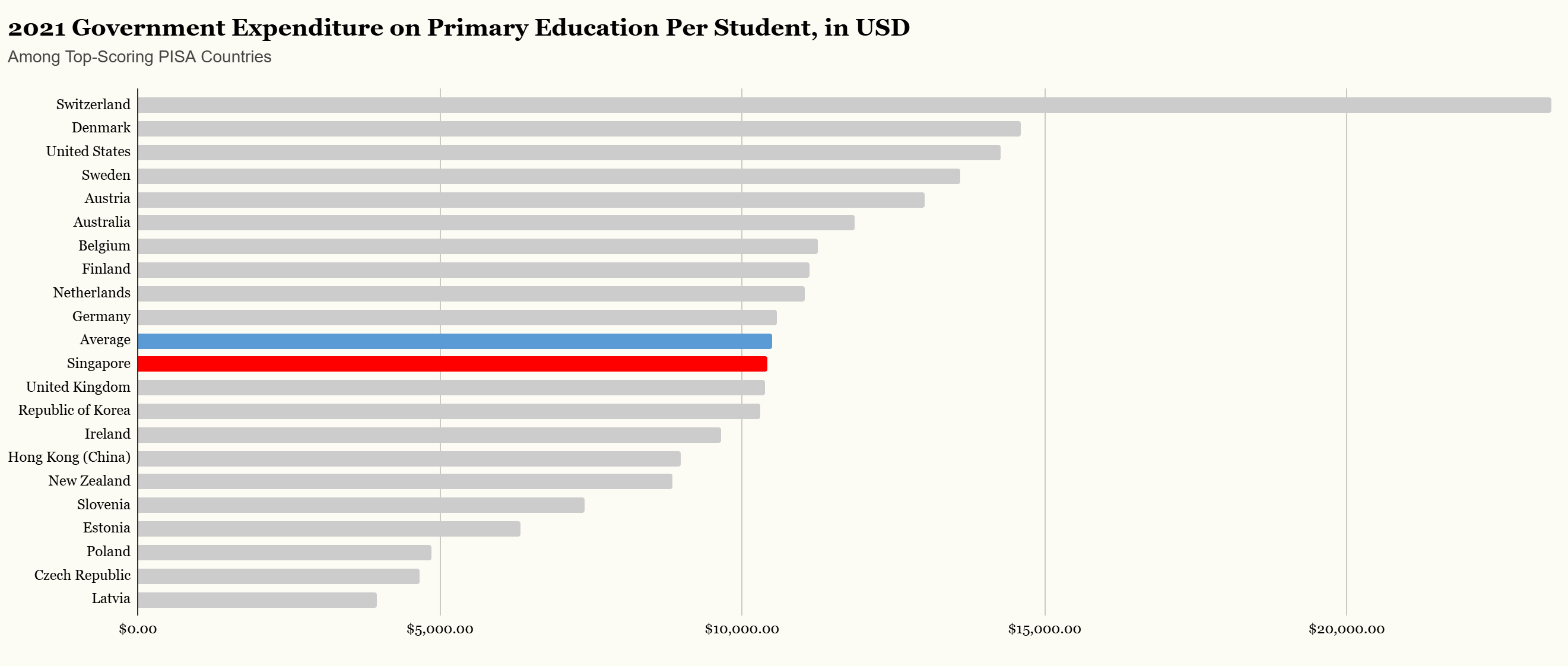
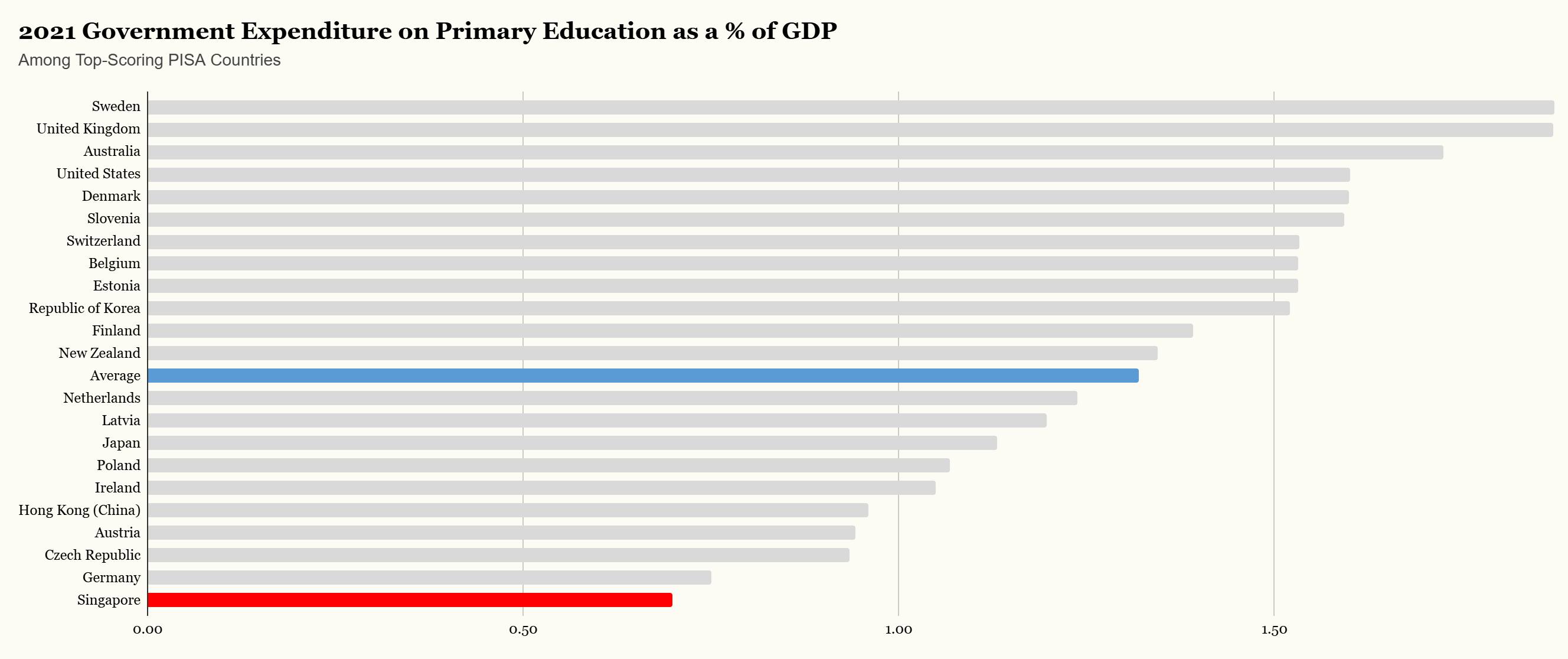
However, Singapore is once again an outlier when it comes to spending on primary education as a percentage of GDP. Singapore’s reported government expenditure on primary education was approximately S$2.9bn in 2021, though cross-country comparisons are sensitive to differences in in how countries classify and report education expenditure.
Total spending on education has also declined sharply as a percentage of total government expenditure, from 17.3 percent in 2017 to only 10.1 percent in 2022. This likely reflects a combination of factors, including a declining student population, as well as growth in GDP and overall government expenditure.
Even so, Singapore’s education spending as a share of GDP remains below that of many comparable high-performing systems. While such comparisons are influenced by differences in demographics and national income, they still point to policy choices about how resources are allocated.
What if, instead of letting our education budget shrink further in relation to our other priorities, we were to increase education spending closer to the levels seen in other top-performing systems? Moving from around 0.7 percent to 1.3 percent of GDP for primary education would potentially enable investments such as smaller class sizes, more individualised support, and expanded student services. The numbers indicate that we may have enough room to afford this, should we choose to make it a priority.
Alongside investment in a new, modernised curriculum, and through-train alternatives so PSLE becomes optional, this could significantly improve learning and teaching for both students and teachers. More interactive learning in smaller classes would help nurture stronger 21CC, to prepare our children for the AI era, while also helping to attract and retain more teachers. We share how this can be done, step by step, in our 10-Year Plan to Transform Primary Education.
Less anxious parents, happier students, stabilising TFR?
One can dream.
EveryChild.SG is an NGO whose vision is to ensure that every child grows up in a loving and nurturing environment, and caregivers and educators are resourced to build this environment.
Letters in response to this piece can be sent to sudhir@jom.media. All will be considered for publication on our “Letters to the editor” page.
If you enjoy Jom’s work, do get a paid subscription today to support independent journalism in Singapore.