One plus one equals two (hmm) Two plus two equals four (are you sure?) Four plus four equals eight (you got it!) Doblehin ang eight Tayo’y mag-otso-otso (otso-otso), otso-otso (otso-otso) Otso-otso (otso-otso), otso-otso na —from “Otso-Otso” (2005) by Bayani Agbayani
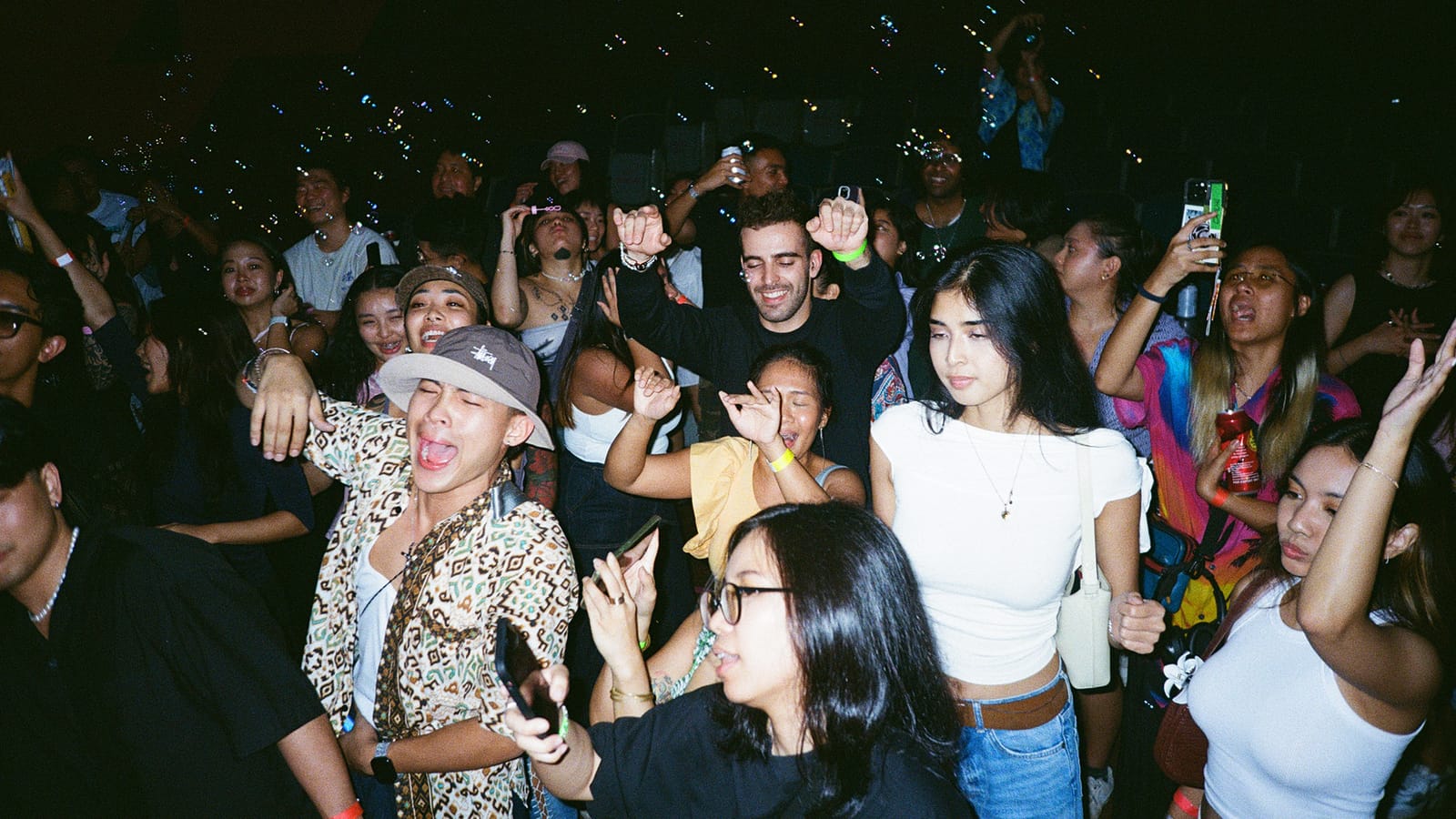
My friends and I find ourselves in a sweaty circle forming at the centre of a tiny dancefloor. The converted cocktail bar is cramped, the floor is slippery, but no one seems to care. Everyone around us, however, seems to know the moves to the song said to send a shimmy through every Filipino. They arch their lower backs and thrust back and forth to the rhythm of otso-otso (otso-otso), otso-otso, while also making way for fellow partygoers entering and exiting a nearby bathroom. Filipino singer Bayani Agbayani’s “Otso-Otso” (eight-eight) conjures childhood nostalgia with its campy mix of 8-bit beats and some squidgy foley of fast-forwarded cassette tape. My favourite part of the song is the bridge. It modifies the chorus: slowing it down, speeding it up, then returning to its original tempo; every acceleration and deceleration sending a frisson of excitement through the already frenetic crowd.
A hopping club late on a Saturday night? Not quite. It’s the middle of a Sunday afternoon, and we are at a Thanksgiving Daytime Party in a bar on Purvis Street, organised by the creative collective Secret Pals. “Just pals, helping pals in secret” goes their tagline, coined by co-founders April Luistro, a graphic designer and creative strategist, and Patrick Gerard Elicaño, a freelance photographer and writer. The latter’s on the deck, spinning a mix of groovy hip hop, the street-style techno beats of budots,and familiar Filipino pop songs. But this party’s also a regional one; it’s a tie-up with OnlyPans Taqueria, a Mexican restaurant based in Manila, and the servers are dishing out tacos in their bright red “Hot Girls Eat Tacos” tees. As I watch everyone dancing around me, I realise I’m standing at the intersection of multiple temporalities as time zones, rest time, circadian rhythms, and music tempo all begin to blend into one.
A Secret Pals Sunday afternoon party in collaboration with OnlyPans Taqueria, a Mexican restaurant based in Manila. Credit: Pranz (@pranzkaeno)
In music, the mood of a song is significantly influenced by its tempo. This is measured in beats per minute, or bpm. I played the trumpet for my secondary school band, so most of my teenage years were ordered by the cyclical pulse of the metronome: click, clack, clack, clack, click, clack, clack, clack, click. Classical music theory associates different tempos with different moods. There’s adagio, or at ease in Italian, the tempo marking for slower pieces of music. At 55-65 bpm, this pace sits slightly below the typical resting heart rate. Allegro, on the other hand, is lively, bright and fast, and indicates that music should be played at speeds between 120-168 bpm. This is also our heart rate when we’re exercising. Tempo allows us to not only keep time, but also feel time.
For subscribers only
Subscribe now to read this post and also gain access to Jom’s full library of content.
Young Singaporean men beset with economic anxiety, navigating changing gender norms, and fed on a social media diet of conspicuous consumption are charting new career paths both worrying and brave.
What if your favourite packet of Maggi isn’t just comfort food, but a mirror of global capitalism, cultural loss, and nostalgia? The writer unpacks how a Swiss invention became a South-east Asian staple; redefining taste, memory, and the meaning of home in just two minutes.
Paid
Thank you for your paid subscription to Jom.
Please click on the link sent to your e-mail to login to your account.
You’ve successfully subscribed to Jom - A weekly magazine about Singapore
Welcome back! You’ve successfully signed in.
Great! You’ve successfully signed up.
Your link has expired
Success! Check your email for magic link to sign-in.