
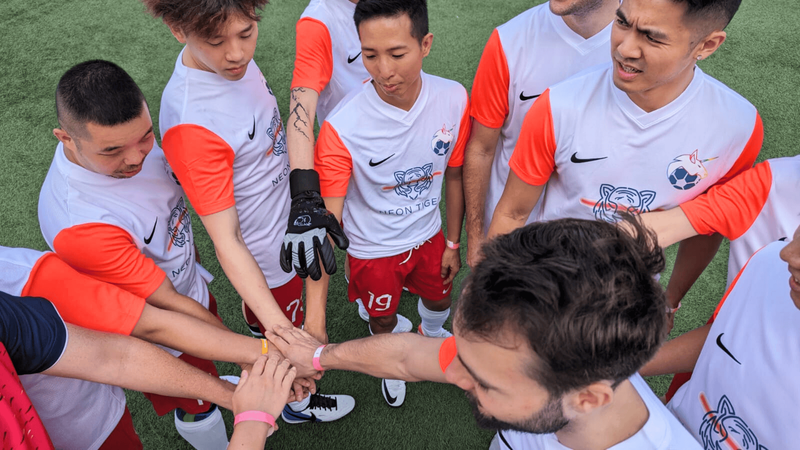
The last time I saw Pete—founder, heart and soul of Hong Kong’s first and only gay football team—we were in a dark bar in Soho lamenting what felt like the final days of the team. Pete had started One Nil almost 15 years before, and the adventures we had shared together, from the last-minute goal with a broken arm, or the time we lost our keeper to the Tokyo nightlife a few hours before a tournament, were the stuff of legend. Once a vibrant and close-knit family, it seemed to me that One Nil had started to disintegrate due to the natural forces of time, that our days seemed numbered.
In Chinese gay internet lingo, the number one, a phallic representation, is the sign for “tops” and zero, the hole, is the sign for “bottoms” and 1-0 is a typical score in bed…if you know what I mean. The team has always been a mixed crowd: we’ve had tall guys, short guys, thin guys, muscular guys, bankers, students, writers, guys who were good at soccer, guys who wanted to be good at soccer.
Though our name came easily, the raison d’etre of One Nil is at times difficult to explain. After all, what does being gay have to do with playing football? A gay football team challenges stereotypes that have long plagued the sport. In the 1990s, former Tottenham Hotspur center-back Sol Campbell faced relentless abuse from rival fans across the country after his controversial move to bitter rivals Arsenal, including chants that labeled him a “Judas cunt with HIV”—a stark example of how homophobia and stigma were weaponized in football culture. Graeme Le Saux, another England footballer, was pelted with homophobic chants in stadiums across the country simply because he liked antiques. Both players are in fact straight. In 1998, Justin Fashanu, the first openly gay professional footballer, killed himself after a career plagued with hostility from his teammates, managers, and family.
Despite wider acceptance of homosexuality in the West today, things have remained the same in the world of football. Since Fashanu’s death, most footballers to come out as gay have been retired ones. Only Blackpool forward Jake Daniels came out in 2022 while still active, followed in 2023 by Czech midfielder Jakub Jankto, who plays in Italy for Cagliari. Occasionally, there is news about professional players coming out in minor leagues, though they are never named, making the story harder to corroborate. It’s no wonder: a 2022 report found that 40 percent of the abuse sent online to male football players was homophobic.
In this context, particularly in Asia, where there are no openly gay male professional footballers, a team like One Nil shatters the misconception that athleticism and queer identity cannot coexist. It also becomes a sanctuary where players can be unabashedly themselves, free from the judgements and constraints often found in conventional sports environments, at work, or in school. This was the motivation for Pete to start the team. He put up posters in gay bars, posted on forums and websites, and emailed friends, until finally there were enough core players to play our first match in 2009.
We weren’t bad. In 2014, the year I joined, we won an amateur league in Hong Kong, and the following year we clinched second place in a gay football tournament in Tokyo. We loved that tournament: we’d land in Tokyo, party like crazy that night, go play the other ten gay teams from all over Japan the next day in ferocious games of football (and I truly mean fierce—one time, ambulances got involved) and then celebrate, all together. It was a rare, and wonderful, intersection of gay international sport.
However, as time passed, not enough changed in the team. Ten years on, it was a lot of the same faces. Maybe the younger guys weren’t so interested in football, or maybe we had less access to them than we thought. Our youngest member a decade ago was still our youngest member now. People were starting to reach and surpass the 40-year milestone, with all the injuries and adult obligations that brings.
On top of that, life in Hong Kong started to get really complicated. Politically, the 2019-2020 protests violently split in two a society that hadn’t fully recovered from the 2014 Umbrella Revolution. Before Hong Kong had a chance to heal, the Covid-19 pandemic locked everyone in their homes for nearly two years. It was probably one of the most difficult places in which to be during the pandemic, and combined with the 2019 protests, life became exhausting. Those who could, left.
For One Nil, it became very difficult to recruit new members or to motivate existing ones to come out and play. The chat group was silent for months, and it seemed that the team was petering out of existence. But then came the 2023 Gay Games.
The Gay Games began in 1982 with 1,350 queer athletes in Kezar Stadium in San Francisco, California. The brainchild of a group led by American Olympic decathlete Tom Waddell, they went beyond a mere sporting event. It was a mission to create an inclusive space that challenged the discrimination LGBTQ+ individuals faced in sports and society.
By the third Gay Games in 1990, held in Vancouver, the event had become a global phenomenon, with athletes and artists from over 30 countries. The 1994 Gay Games in New York City coincided with the 25th anniversary of the 1969 Stonewall Riots, when police raids at a popular gay bar had galvanised the gay rights movement. The New York event attracted around 11,000 participants, making it one of the largest international sports and cultural festivals at the time: for comparison, the 1992 Summer Olympic Games in Barcelona had fewer than 9,400 athletes.
The Gay Games V in Amsterdam (1998) were notable for their focus on human rights, while Sydney’s Gay Games VI (2002) coincided with the Sydney Mardi Gras, creating a vibrant cultural atmosphere with a lasting legacy, including a boom in gay sports clubs in and around the host region. Besides the cultural and social impact, the Gay Games are also a considerable economic opportunity for the host city. Paris 2018 for instance, reported a revenue boost of US$117m (S$150.8m) to the city.
Much like the Olympics, which promote excellence, respect, and friendship, the Gay Games’s ethos is participation, inclusion, and personal best. To conventional sports like track and field, swimming, or wrestling, the organisers have welcomed non-Olympic sports that reflect local culture, like dodgeball, cheerleading, same-sex dancing, and even rodeo.
It’s supposed to be competitive, but not too serious. The Pink Flamingo is one of the games’ most beloved and flamboyant events: a blend of comedy, drag, and aquatic ballet. Swim teams perform elaborately choreographed and often hilariously campy skits in the water, complete with costumes, props, and plenty of glitter.
The Games provide an essential counter-narrative: that athleticism and queer identity can coexist. Yet despite their international character, they had never been held in any Asian city. This is perhaps not surprising given the more conservative attitudes toward LGBTQ+ rights in many parts of the region, but an Asian Gay Games would serve precisely to challenge such views and create new opportunities for acceptance.
Hong Kong is one of the more progressive Asian societies when it comes to LGBTQ+ rights. Homosexual relations were decriminalised in 1991. In India, that same law was struck down in 2018, and in Singapore, 377A was repealed only in 2022. The last ten years have seen a series of small but important wins for the community in Hong Kong. In 2017, a court allowed a British woman’s same-sex partner to receive a spousal visa; in 2020 the High Court declared it unconstitutional to deny same-sex couples the right to apply for public housing.
It was a Dutch national and long-time Hong Kong resident, Dennis Philipse, who led the Hong Kong bid, convinced that an event like this was necessary to challenge local prejudices and create opportunities for dialogue and acceptance in Asia. In 2014, Philipse founded a Facebook group called Out In HK (OIHK) with the aim to build an inclusive community centred around wellness and sport. Philipse used OIHK’s success to make a case for Hong Kong to host the Games. In 2017, it was announced as the host city for Gay Games XI, to be held in 2022.
Still, there was resistance. Pro-Beijing lawmaker Junius Ho called the Games disgraceful, adding that he was not interested in the “dirty money” they might generate for Hong Kong. Encouragingly though, then-Chief Executive Carrie Lam publicly voiced her support.
The pandemic restrictions, among the most draconian in the world, pushed the Games back to November 2023. Then, in February 2022, the Federation of Gay Games announced that Guadalajara, one of the shortlisted candidate cities, would co-host. The official statement cited the risk of pandemic-related travel restrictions, though previously the growing opposition to the event as well as the after-effects of the protests had raised nervous eyebrows. In that same statement, Philipse, who had shown indefatigable optimism and pitbull tenacity for seven years to bring the Games to Asia, announced his resignation.
Still, Hong Kong would have its Games, or at least some version of it. The city had had almost a year to breathe, free of masks. Shortly after Pete and I met in the Soho bar, One Nil started to come back to the pitch and kick around, if only timidly. A few new players joined the team. Too little, too late, I thought, even as Pete’s optimism grew. Ultimately, so many players expressed interest in the Games that we split and entered two teams: One Nil Tigers and the One Nil Dragons.
Over the next couple of months the team started training with an unprecedented gusto. We even practised drills and talked tactics—unheard of previously. For many of us, our middle-aged joints were creaky, and our sprints lacked the speed of yesteryear, but the optimism and the excitement were palpable. We had heard that football was one of the most popular events—a total of 16 teams had signed up—and as the only official gay football team in Hong Kong, we wanted to make a good impression on our overseas brothers and sisters.
Despite the concerns, the Games started on the right foot. A huge banner draped over Queen Elizabeth Stadium in Wan Chai reminded us of the GGHK motto: Unity In Diversity. Regina Ip, a controversial pro-China politician and historically a target of liberal politicians, not only attended the opening ceremony but delivered the welcome address too. “History is being created today,” she proclaimed.
However, things started feeling a bit weirder when the football tournament began. First of all, the venues for the different events were unnecessarily spread out across Hong Kong island, Kowloon, and the New Territories. Hard to get a festive vibe going when we were all so far away from each other.
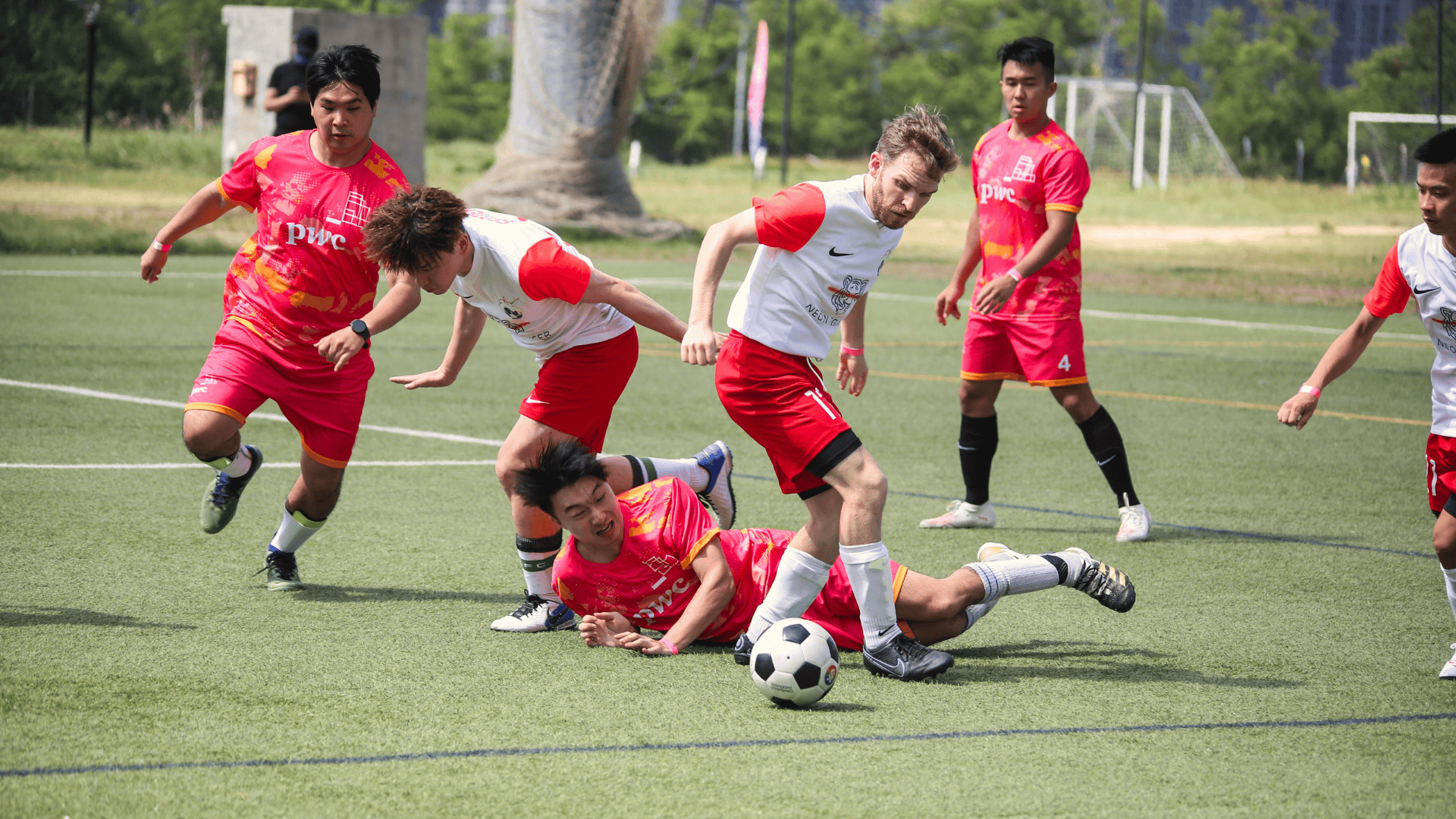
Second, when we arrived at the pitch, it looked like One Nil was the only team that was, well, gay. Most of the others were corporate teams from the Hong Kong offices: Ernst&Young, Deloitte, Google...It turned out that one of the most popular sports at the Gay Games was actually just full of straight local teams from the official sponsors. This was perfectly in accordance with the rules, of course. There is no criterion that says that heterosexuals are not allowed to play at the Gay Games—that would be exclusive and hypocritical. The intention of the Gay Games, though, is to create a space where it’s more than just straight athletes, and in Hong Kong it was looking like any other local tournament One Nil had participated in.
Why were there so few international gay teams?
A few reasons. The first is that having two co-host cities diluted the concentration of athletes for any given sport, with teams likely choosing the closer destination. Guadalajara, the co-hosts, also had a very healthy turnout for football, and they hosted gay teams like London Titans FC, Stonewall Lions, and Toronto United. Why travel halfway around the world for a cool gay tournament when you have another cool gay tournament much closer to home?
Even so, more teams nearby might have been interested, but inclusivity doesn’t necessarily mean accessibility. Not counting travel and accommodation costs, the registration fee alone was over US$100 (HK$785; S$128), plus additional fees for each sport you wanted to participate in. This is a much bigger ask for people in South-east Asia than in Europe or North America.
Even so, we could have expected some of the Japanese teams we had previously played against, or some of the official teams from Australia, such as the Sydney Rangers FC. A GGHK committee member revealed on condition of anonymity that the Hong Kong government had explicitly told them “not to promote the event too much.” It seemed there was a concern of so many people gathering together in one place. The fear then, wasn’t directed so much at the gay community per se but simply at the potential political disruption a large congregation of people might cause. Perhaps this was why all the sports had been so spread out.
Luckily, we were not the only gays in that particular village. The Hong Kong Football Club fielded a talented mixed team with many gay women who beat the Tigers in the qualification round and were later defeated by the Dragons in the knockout stage. There was also a solitary team from overseas, the Cambodian Lotus Sports Club.
Hailing from the small village of Kampong Chhnang, this team of trans men had found sanctuary in football—their wonderful story is the subject of an award-winning 2022 documentary. They were mostly teenagers, inexperienced in competitive football but delighted to be participating thanks to a sponsor who flew them to Hong Kong. When they scored their first goal, in their last match, we all celebrated wildly.
But with the majority of the teams straight, One Nil felt like we had to try extra hard, to show that the gays can face up to the straights in a competitive game of football.
It was a desperate fight. Between cramps and injuries, half the Tigers couldn’t walk by the end of the last game, where we secured third place against Linklaters, and made the medical team work overtime. On the other pitch, the Dragons reached the final against Deloitte.
It was impossible not to choke up when the referee blew the final whistle and the scoreboard showed we had won 3-1. Only a few months before the team had nearly disappeared. Now, we were champions of a 40-year-old international movement.
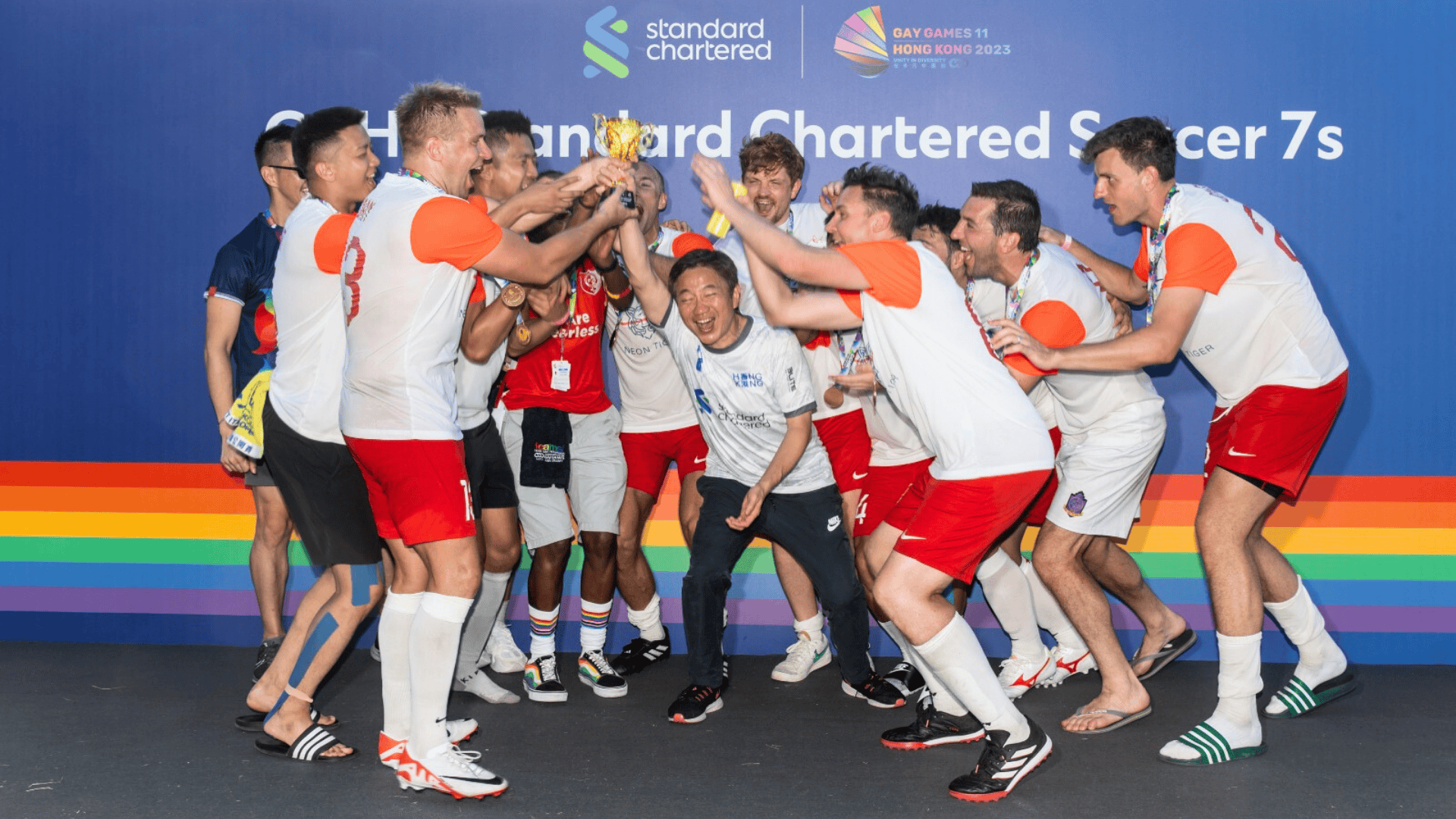
“We forget sometimes how incredible it is to be the first gay team in Hong Kong,” Pete told me. He spoke about the long struggle to find belonging; to counter pre-existing notions about queerness and sport; and the hateful homophobia many of us had received in the game we loved. “This tournament has kickstarted a new generation for the team when it had seemed like we might not have survived only a couple of years previously.”
The victory felt like a vindicating chest thump against those who still oppress us and look down on us. Perhaps One Nil’s mission is not over yet, and there is a chance to inspire other gay football lovers around the region to form their own teams, their own families.
The future of the Gay Games is unclear. The turnout numbers were bad. The original estimates for Hong Kong (pre-announcement) were for 12,000 participants from 100 countries. In the end only 2,400 from 45 countries registered, with Guadalajara recording similar numbers. On aggregate, this was the fewest participants since 1986.
I wonder if there is a larger trend that suggests lesser demand for this kind of event. Gay Games participation peaked in Amsterdam 1998 with 13,000 participants and has been steadily declining ever since, with the exception of Paris 2018 which had 10,000. At the many social events during GGHK, most athletes were fairly seasoned—I did not see many in their 20s.
Still, as a first foray into Asia, the Gay Games likely made a strong impact. Even with reduced numbers, a March 2024 study from Kent State University estimated the impact on Hong Kong’s economy from direct and indirect spending to be around US$25m (S$32m). That the event was allowed to take place, even under China’s watchful eye, is a positive sign. Taiwan, which refused to send any athletes to Hong Kong over fears of arrest, is seeking to become the second Asian city to host the Gay Games, having submitted a bid for the 2030 edition. The Gay Games in Hong Kong might not have been the success story we expected, but they have helped to create an opening for the Games to expand into the region.
Could we see Singapore, a sister city to Hong Kong in so many dimensions, host a Gay Games? It’s possible. Singapore has had a presence at the Games since at least Sydney 2002, when 35 people participated, and has three groups as Gay Games member organisations including The Straits Games, Singapore Frontrunners, and Out In SG (the sister group of Out In HK). They coexist with different formal and informal gay sports groups, meaning that there is already a healthy overlap of LGBTQ+ life and sporting life in the Lion City. Singapore has spent an average of S$90m annually in recent years to develop its sports infrastructure, with an explicit aim to rally communities together . Why not this community as well?Besides political will, what’s needed is someone with the vision and energy to bring together the different groups around the island—a Singapore answer to the leadership Philipse showed in Hong Kong for long.
But time is running out. Beyond the city-state, many things have improved in the last 40 years for the LGBTQ+ community, even in Asia. People are finding new sanctuaries. Just like how gay bars are decreasing in popularity, maybe this tournament will one day be a thing of the past. Even the name, Gay Games, seems outdated, given that terms like “queer” or the letters LGBTQ+, are more widely used. Time will tell. But for now, One Nil will be at the Games in Valencia, Spain, in 2026, to defend its title.
Alfredo Molinas is a Singapore-based entrepreneur, writer, and triathlete with a background in tech, retail, and education. He enjoys working at the intersection of creativity and strategy—whether launching start-ups, designing race kits with personality, or analyzing sports data (for fun!). He’s also the founder of Fierce Unicorn, a small but loud activewear brand that believes sport should be anything but boring.
Letters in response to this piece can be sent to sudhir@jom.media. All will be considered for publication on our “Letters to the editor” page.