

Our picks
Politics: Lim Tean and the far right
Over a quarter of Singaporeans consider immigration to be a pressing political issue, according to Jom’s voter sentiment survey last year. But this did not translate into electoral gains for the nativist People’s Alliance for Reform (PAR). PAR obtained less than a quarter of the vote in all its contests at GE 2025; its leader, Lim Tean, lost his deposit in a three-way election for the Potong Pasir SMC. Nativism can’t seduce the multicultural Singaporean? Perhaps, though as we’ve seen from Germany to Portugal and the UK, the far-right can stun the mainstream with rapid electoral gains. Centrists ignore disgruntlement with high immigration to their own peril.
Lim this week responded to the elevation of Japan’s Sanae Takaichi with characteristic fire. The self-baptised feminist weaved together the stories of five female nationalist leaders, including Takaichi and Italy’s Giorgio Meloni, into a seductive narrative about maternal love: “No mother will want her children to be 2nd class in their own country.” Nigel Farage gets an honourable mention in a piece titled “Restricting Immigration And Populism Are Not Dirty Words !!” No, not necessarily, and to be sure, the roots of any xenophobia in Singapore are with the ruling People’s Action Party (PAP), which has long snuffed out any reasonable, transparent discussion on immigration. It’s a complex story, spanning Lee Kuan Yew’s Chinese supremacist musings, and the party’s subsequent policy from the 1980s of giving preferences to ethnic Chinese immigrants, to the more contemporary concerns with the Comprehensive Economic Cooperation Agreement (CECA), signed in 2005 between India and Singapore.
We don’t know CECA’s actual impact, because the government doesn’t publish data on the ethnic breakdown of our non-resident population, including the number of intra-corporate transfers and their dependents who’ve moved to Singapore under CECA. But between 2004 and 2023, Singapore’s population rose 43 percent from just over 4m to just under 6m, possibly the highest growth rate of any developed country. Our birth rate is low, but how much should we grow? Ordinary Singaporeans, many experiencing job insecurity amidst a spiralling cost of living, have been excluded from that conversation. Suck it up, says a neoliberal machine addicted to growth. Opposition parties, like the Progress Singapore Party, that try to fairly interrogate immigration’s dynamics are quickly painted into a racist corner.
And they’re outflanked on the right by the Lims of the world. Whatever the merits of his socio-economic arguments, they’re delivered with dangerous rhetoric that's previously led to horrid anti-Indian sentiment. He relies on dehumanising dog whistles. Immigrants “swarm” Europe, he said this week; one commenter criticised Singapore for “desperately taking in the trash from mainly third world countries”. In order to neuter the appeal of such inflammatory language and xenophobia, the PAP must be completely transparent with immigration, population and jobs data. This will foster a more honest conversation about the Singapore we want.
Politics: Wayang
Act I
March 2024. “The catastrophic situation in Gaza demands urgent action.”—Burhan Gafoor, Singapore’s permanent representative to the UN.
April 2024. “At Singapore Airshow [Feb 2024], the Gaza War Was a Selling Point for Israeli Arms Makers.”—Haaretz, Israel’s newspaper of record.
Act II
May 2025. “Singapore reiterates its support for a negotiated two-state solution...” —Ministry of Foreign Affairs (MFA)
July 2025. Lawrence Wong fetes Miriam Adelson, the 79-year-old billionaire co-founder of Las Vegas Sands, and right-wing Zionist who’s apparently against the two-state solution and wants the West Bank annexed.
Act III
July 2024. “[I]t is the established policy of the Government not to publicly divulge any details of defence sales for national security reasons.”—MFA, responding to whether “Singapore has made any defence sales, such as weapons or any other material that can cause harm to civilians, to Israel since 7 October 2023”.
October 2025. “I have explained that we have already been contributing on the medical front in the last two years.”—Vivian Balakrishnan, minister of foreign affairs.
October 2025. Singapore is one of the states that’s been supplying parts for Israel’s F-35 jets, part of the “collective crime” of genocide against Palestinians, said the UN’s Francesca Albanese.
Editor’s note: Juxtaposition of selected, excerpted quotes for dramatic effect? Justified, in our view, to reveal the contradictions, if not the hypocrisy. Do read the full quotes, and also “Genocide in Gaza? Our moral responsibility”, our essay exploring Singapore’s problematic ties with Israel.
Business: Princelings
We keep learning more about Singapore’s connections to the Prince Holding Group, described by the US, in coordination with the UK, as “one of Asia’s largest transnational criminal organisations”, part of the global scamming industry. The Washington Post (WaPo) reported that as recently as last December, NTU “partnered with the Prince Foundation on an overseas learning program focused on expanding access to education and entrepreneurship”. An NTU spokesperson told the paper it worked with the group from 2022-24 on overseas programmes for students but does not have any ongoing collaborations.
Meanwhile, the Khoon Group, one of the 146 “targets within the Prince Group Transnational Criminal Organization” sanctioned by the US, has provided electrical engineering services to HDB. It received recognition for its work—including projects at Sengkang, Tampines and Jurong West—at the HDB Awards 2024. (HDB said that it has no current dealings with the group.) Chen Zhi, Prince Holding’s boss and criminal mastermind, acquired 55 percent of the Khoon Group in 2023. A document that year, The Straits Times (ST) reported, indicated that the Khoon Group was actively engaging Chen after his investment. Separately, another Singapore-based firm implicated is FSM Holdings.
Both Khoon Group and FSM have been incorporated in the Cayman Islands, players in the opaque world of spiderweb capitalism. And their reliance on our little red dot is part of a phenomenon now known as “Singapore washing”. WaPo quoted Ja Ian Chong, associate professor of political science at NUS: “The relative secrecy and lack of a more active press makes it easy for companies to hide here, whether for legitimate or less legitimate reasons.” ST quoted Lawrence Loh, director of NUS Business School’s Centre for Governance and Sustainability: “Perhaps the few incidents are a price to pay for Singapore to be well regarded as a good place for international business.”
What ST didn’t say, but Heidoh did, is that Khoon Group’s CEO, Jansen Ang Kok Kwang, and its chairman (and Jansen’s father), Ang Jui Khoon, are decorated PAP grassroots leaders. The Angs surely did not know what Chen, the person they sold their firm to, was up to. Similarly, when Chee Hong Tat, Ng Chee Meng and Ong Ye Kung, PAP ministers, hobnobbed with Su Haijin years ago, they could not have known that he’d later be associated with the notorious “Fujian gang” in Singapore’s biggest-ever money laundering case. But it’s deeply worrying that foreign crime bosses feel they can easily access powerful Singaporeans to demonstrate credibility. And for many of the vulnerable Singaporeans scammed—nearly 1,000 people lost at least S$100,000 in the first half of this year—they’re left with an awful realisation: of being robbed by the owner of a firm that powers our HDB flats.
Some further reading: At a Jom Cakap event earlier this year, The Economist’s Sue-Lin Wong said that Singapore’s government is doing more than any other to combat Scam Inc. On Wednesday, the police announced that it had identified 27 Singaporeans and seven Malaysian suspects working at a scam factory in Cambodia, on top of the 15 already charged.
Society: Are you what you eat?
Singaporeans have a growing taste for organic and free-range produce, such as chicken, beef, pork and eggs, despite their higher prices. Much of this appetite stems from the perception that such products are healthier than their factory-farmed counterparts. “Consumers are becoming more educated about nutrition and increasingly value provenance, transparency and freshness,” explained Joe Stevens, chief executive of Little Farms, a gourmet grocery chain. Though, some nutritionists note that the difference is modest. “...eating conventionally raised meat doesn’t make your diet ‘unhealthy’ by default,” Winnie Chia, Republic Polytechnic lecturer at the School of Sports and Health, told ST. What matters more, she added, is “balance, variety and moderation”.
Even though quality and perceived nutritional benefits still top consumers’ list of motivations, ethical considerations may be taking root too. In a 2024 Lever Foundation survey, 88 percent of respondents agreed that “hens that produce eggs should not be kept in cages; they should have the freedom to walk and move around.” When asked about the advantages of cage-free eggs, 39 percent cited “higher quality”, 30 percent pointed to “animal welfare”, and 25 percent chose “improved safety”.
No matter the reason, a higher demand for ethically and sustainably produced products is a good thing, and will hopefully lead to wider availability and lower prices. But conscious consumption requires informed decisions. We must learn to read beyond the labels and the marketing language that sound health- or welfare-driven but don’t always guarantee better practices. For instance, does “free-range” really mean animals roam freely, or merely that they have some access to the outdoors, however limited. And is “cage-free” a case of semantics. While many chickens aren’t stuffed in battery cages, the reality is that they’re still kept indoors, in large and often crowded aviaries. Understanding where your food comes should also include some awareness of the source country’s regulations. In short: know the difference between marketing claims and regulated claims.
“Dis-moi ce que tu manges, je te dirai ce que tu es.” “Tell me what you eat, I will tell you what you are.” So wrote the French gastronome Jean Anthelme Brillat-Savrin in La Physiologie du goût (1826), suggesting that a person’s character and a society’s refinement can be seen through its cuisine and eating habits. From that aphorism came our modern adage: “you are what you eat.” Food for thought?
Society: Poorest rich person
“I couldn’t hang on further, so I asked Mom for help 6 months ago to pay the $6000 monthly interest on the debt…I’m already 50 years old but I am still bothering Mom and asking for money. I should be the one taking care of Mom…” Jenny Prawesti told her 78-year-old mother, Sauw Tjiauw Koe, in February 2019 before suing her a few years later for a 50 percent stake in 26 Singapore properties.
The duo moved to Singapore from Indonesia in the 1980s along with two of Jenny’s siblings. Her father stayed back, supporting the family with a monthly allowance of US$100,000 (then more than S$200,000), which he increased to more than US$180,000 (more than S$300,000) at the turn of the millennium. Sauw began investing in Singapore real estate in the late 1990s. By 2002, she owned nine properties outright and later bought 26 more, including Centrepoint, jointly held with Jenny’s brother and Jenny herself. Most properties were registered 90 percent in Sauw’s name; brother and sister held nine and one percent respectively. Jenny claimed her mother had promised equal ownership of all 26 properties after the Centrepoint purchase; Sauw suggested that the lawsuit may have been a retaliation for her refusal to pay Jenny’s credit card bills. Last week, the judge rejected Jenny’s claim.
Predictably, online commentators were quick to comment. “Her weekly allowance is my annual salary. LOL.” wrote a Redditor. Another responded, “Different life. Different ses.” Indeed, most can barely imagine the lives of the ultra-rich, let alone empathise with their financial difficulties. However, “wealth does not pass three generations”. A 20-year study of more than 3,200 ultra-rich families found that seven in 10 tend to lose their fortune by the second generation, while nine in 10 lose it by the third. A plausible explanation is young successors’ excessive spending habits fuelled by parents who “financially enable” them, stunting financial independence.
In rejecting Jenny’s claim, the judge remarked that the case was part of a “regrettably growing catalogue of family disputes over the ownership of assets”. It could be about to get worse. An HSBC report forecast that the number of millionaires here will rise from 400,000 in 2022 to 700,000 in 2030. These millionaires may not own supercars but are likely to own a mortgage-free apartment, stocks, and over S$1 million that their children can inherit. “The great Singaporean wealth transfer”, as Business Times (BT) called it—also known as, inheritocracy—may produce a generation reliant on parental handouts, prone to overspending, and low on financial literacy. So what happens when these heirs get their inheritance? Some rich Singaporean scions, said BT, could choose early retirement, shrinking an already thin workforce. More broadly, their spending habits, attitude towards money, and if and how they reinvest into the economy will fundamentally change society “sooner rather than later.” In the playground of the rich, the masses could be reduced to mere spectators.
History Weekly by Abhishek Mehrotra: Remembering John Miksic
At dusk on the fourth day of Singapore’s first archaeological dig, John Miksic trudged back to his hotel, shoes caked in rain-soaked soil; spirit heavy with disappointment. Of the five sites at Fort Canning, four had yielded little. “We did consider giving up excavating the fifth area…but later decided to try our luck,” he’d recalled. As the team dug near the Keramat Iskandar Shah the next day, the earth changed colour, opening a portal to an undiscovered world. Beneath, 14th century Majapahit gold jewellery; beads made from Indian and Persian glass (Miksic would later confirm they were produced at a proto-factory on Fort Canning); and porcelain fragments from China’s Yuan Dynasty, prominent between 1271 and 1368.
Over the next five days, they unearthed more than 2,000 items that upended received wisdom and forever changed how we see ourselves. Singapore’s history, it turned out, stretched back not to the 19th century but the 14th. For long periods, it had been at the heart of a vast maritime trade network linking millions spread along a 10,000 km-long coastline—far from a deserted isle destined to remain so without British largesse and foresight. Miksic was convinced that tales of a flourishing medieval Singapore, recorded in the Sejarah Melayu and proved by his findings, inspired Stamford Raffles to choose it as a colonial trading hub.
Modern Singapore’s affluence “only seems surprising if one ignores the fact that Singapore has really been in the scene all along, displaying some signs of its future potential as early as the fourteenth century,” he wrote in Singapore and The Silk Road: 1300-1800, his 2013 magnum opus that spurred the Ministry of Education to change its secondary school history syllabus a year later, and won the inaugural Singapore History Prize in 2018.
The book was the culmination of three decades of work beginning from that 1984 Fort Canning dig, which the National Museum had invited Miksic to lead. He was then teaching at Yogyakarta’s Gadjah Mada University after stints in Kedah and Bengkulu. In 1987, he became a lecturer of archaeology at the National University of Singapore and later established its Southeast Asian Studies Programme—a national pioneer, and somewhat lonely for the fact. Public funding was a pipe dream, so Miksic relied on private grants from Royal Dutch Shell and the Ford Foundation among others. At times, his teams comprised students and citizen volunteers; at others, “museum staff, hired Indian labourers, and some national servicemen who were being punished.”
Time was tight too. Often, they’d conduct “rescue digs” days before development began on archaeologically promising sites. Still, astonishing treasures emerged, including Miksic’s favourite, “The Headless Horseman”, in style and material unlike anything else found in South-east Asia. Over his career, Miksic and his teams uncovered hundreds of thousands of artefacts: each a tiny affirmation of Singapore’s position at the centre of South-east Asian archipelagic life; each a small confirmation that even centuries ago, Malays and Chinese, and myriad other South and South-east Asians lived together on this bustling port-city. For the New Yorker who made these shores his home from 1987 until his death last week, this knowing of the self was vital. “Once you have enough to live on, you want something to live for: identity, a desire to know your ancestors,” he told the New York Times. “It’s an innate part of what it means to be human.”
Earth: Homecoming
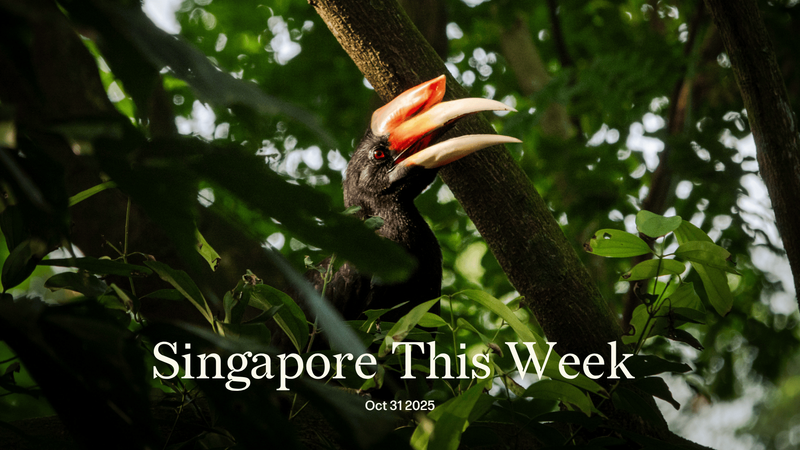
Centuries ago, lush rainforest held Singapore in loving embrace. A deep, rich green blanket with marvellous splashes of blacks, browns, yellows, ochres, and reds lent by hundreds of bird species. Seventy of the winged beauties were native to the island, and first captured in the gorgeous works of local artists commissioned by William Farquahar between 1819 and 1823. Among the trogons, woodpeckers, hornbills, barbets, and babblers were the hornbills. And among the hornbills was the Rhinoceros Hornbill—males with black-rimmed red eyes, females with red-rimmed white ones; black plumage, white legs and banded tail, huge orange bill crowned with a magnificent, scarcely credible red horn that gives the bird its name.
British conscientiousness captured them on paper; British industry exiled them from the island. Forests were cleared, buildings erected, bridges built, as verdant settlement became bustling emporium. The soundscape changed, and the landscape with it. The Rhinoceros Hornbill left our shores sometime in the late-19th century, though one was sighted in 1921. Now, with less than one percent of our original rainforest left, it may have returned.
Earlier this week, the majestic bird was spotted at Sungei Buloh Wetland Reserve, sending the local bird-watching community into fits of ecstasy. Already, experts have concluded that the bird is a healthy juvenile which makes it “less likely to have come from captivity”, but the Bird Society of Singapore is yet to decide whether it’s truly wild. Chances are that it glided over from peninsula Malaysia, where the species exists in reasonable numbers—the International Union for Conservation of Nature considers the species “Vulnerable” to extinction, a grade above “Endangered”.
Could this be the start of an avian rewilding? The Oriental Pied Hornbill, also locally extinct —extirpated in conservation parlance—around the same time as its rhino cousin, was rehabilitated after a similarly unexpected sighting in the 1990s. In a week where Singapore lost a being who showed us glimpses of its material past, the reappearance of another who reminds us of its natural one feels almost providential.
For a deeper insight into how breakneck development denuded local forests and wildlife, read “Winged Woes: a historical look at birds in Singapore”, written by Neo Xiaoyun with visuals by Jay Wong. The essay was published in Jom’s annual print magazine issue No. 2, available for purchase here.
Arts: Paying attention to pure intention
What does it mean to pause in a place that demands nothing of you, save your attention? A “true” public space like a park or library—so the American artist and educator Jenny Odell argued—“demands nothing from you in order for you to enter, nor for you to stay...you don’t have to buy anything, or pretend to want to buy something, to be there.” That’s one of the enticing invitations of this year’s Singapore Biennale, the island-wide contemporary art platform that opens today and spans five months and five locations: the Civic District, Wessex Estate, Tanglin Halt, Orchard Road, and Tanjong Pagar Distripark. The theme of this eighth edition, organised by the Singapore Art Museum, is “pure intention”, and it’s the public spaces that are “part of our daily rhythm” that have the attention of its curatorial team. Even if our intentions are hardly ever “pure”, there’s something pleasurable about the attempt to engage with art for its own sake, with an attention that’s innocent of the agendas of others. “There is no particular cluster that is a central thesis,” said curator Selene Yap. “You are invited to take routes you might be more curious about.”
Visitors might stumble across an artwork as part of their daily commute through commercial spaces; or they might set out, purposefully, on one of the Biennale’s suggested trails through parks, malls, and galleries. “I’m excited to create a work that can be stumbled upon as one traverses the escalators in a busy shopping centre,” filmmaker Tan Pin Pin told ST. Her work, “On a Clear Day You Can See Forever”, occupies a third-floor nook in Lucky Plaza. On one screen, we see Inuka, Singapore’s first polar bear born in captivity, paddling lazily in perpetual loops across a faux-Arctic landscape; on the other, we’re propelled across the Pan Island Expressway in dashcam footage at 80km/h. Tan has long meditated on Singapore’s elastic timescales, stretching them out and compressing them in ways that reflect how we’re forced to speed up when what we really want to do is hit the brakes. Many of the Biennale’s artworks, installations, and workshops prioritise immersion, participation, and site-specificity; in another Lucky Plaza work, Filipino artist Eisa Jocson collaborated with domestic workers to transform a shop unit into a living room, where you’re invited to join in a karaoke session—and reflect on how the caregiving and domestic labour we depend on are commercialised and regulated in Singapore. These, and over 100 more artworks, are here for your attention alone. You could take your time to meander through them, or you could join the monthly Biennale run club and infuse aesthetic intention with every step. “Attention is so valued precisely because it is rare and unstable,” wrote the British art historian Claire Bishop. Here’s to experiences of art that value the rare, if unstable, you.
If you enjoy Jom’s work, do get a paid subscription today to support independent journalism in Singapore.