
News this week included: Donald Trump’s invitation to Singapore to join his “board of peace”; Mark Carney’s “nostalgia is not a strategy” speech at Davos, which has resonated locally; the passing of Liu Thai Ker, Singapore’s first master planner; jail for preschool leaders who covered up molestation of toddlers by a cook; a survey showing that many young Singaporeans expect million-dollar inheritances from their parents; seniors not retiring but choosing “fractional” jobs; a Chinese paper in Malaysia under investigation after allegedly mistranslating the Agong’s speech, after the government’s move to make the teaching of Malay and history mandatory across all schools; and South-east Asian countries banning Grok, an AI-powered chatbot that allows the creation of nude deepfakes, including of children.
Our picks
Politics: ‘FO with your LO’
It’s been a week since Lawrence Wong, prime minister, stripped Pritam Singh of his title as Leader of the Opposition, the PAP’s latest salvo in the long-running Raeesahgate. It is too early to predict its longer-term impact on their respective parties’ fortunes, but the early signs aren’t good for the ruling party. Singh and the WP, which he leads, appear to be winning much sympathy from non-partisan Singaporeans, based on anecdotal and survey evidence: a Yahoo! News poll of over 10,000 people showed that some 78 percent of respondents disagreed with the demotion, at the time of publication. (It’s still live.)
Many online are also cheering the WP’s decision not to nominate a new LO, as Wong had suggested. “In other Westminster systems, the title of the Leader of the Opposition is established by law and is not the prerogative or choice of the Government of the day or the Prime Minister. This approach expresses the authority and sanctity of the people’s vote,” the WP said in a statement on Wednesday. “The Workers’ Party takes the view that the leader of the largest opposition party in Parliament, is the leader of the opposition.” Even Calvin Cheng, former nominated MP and strident defender of the crown, admired the WP’s tactical nous, saying he thinks the PAP has run out of moves. “Once [the LO role is] offered, it can’t be at the discretion of the ruling party to dictate who it should be. People just cannot accept this.”
To understand public sentiment, it’s worth recalling that the WP has, over the past two decades, established a clear distance between itself and other opposition parties. In the past two elections it has outperformed the PAP in aggregate in the districts it contested. A post-election poll last year by IPS, a thinktank within NUS, found that the two parties had similar levels of credibility among respondents (and well above the others). An earlier Jom poll ranked Singh as one of Singapore’s most popular politicians. Many Singaporeans, even PAP supporters, appreciate that Singh and the WP, sometimes celebrated/derided as “PAP-lite”, are the ones in Parliament who’ll check a hegemon’s excesses. After decades of pummelling the opposition into submission, the PAP this time may have gone too far. Does it really want to obliterate all?
Singaporeans will be eager to see how all this affects the dynamics of parliamentary debates. As the LO, Singh had preferential treatment from the Speaker, and contributed to some of Parliament’s liveliest discussions in decades. Given that the WP has closed ranks—assuming an ongoing internal investigation doesn’t penalise Singh further—it may be wise for the PAP to relent, and offer Singh similar time on the floor. Though recent events suggest that wisdom may be in short supply, as seemingly more moderate politicians like Wong and Indranee Rajah nurture their skills in the arch-conservative ways of old.
Some further reading: In “The unchanging PAP playbook”, we analyse the reasons why the PAP has long dealt with dissent, in society and Parliament, in the same way.
Society: Cold comfort
For generations of Singaporeans, recess has been a site of everyday micro-culture, the sole pocket of agency amidst the timetable’s rigidities. It is a place of decompression, where friendships are cemented and new flavours are tasted. Mee rebus, chicken rice, fishball noodles, and other culinary delights punctuate the uniformity of the day. And children learn valuable life lessons by exercising autonomy over pocket money for the first time.
In 2024, that ritual began to change. Tired of playing landlord to vendors in traditional canteens—and having to adjudicate on rents and ingredient costs amidst global food inflation—schools started piloting pre-portioned meals from centralised kitchens, packed in containers and distributed like airline food. The shift reduced manpower, standardised nutrition, and simplified procurement. What was marketed as modern, healthy, and efficient instead sparked a cross-generational backlash from parents, students, and alumni. As one Reddit commenter put it: “[L]unch time is honestly one of the highlights for most of our days (not exclusive to students), so I don’t know why they think it’s okay to give such unappetising food to anyone.” Recent grumblings at the elite Hwa Chong Institution are simply the most visible manifestation.
Defenders of the old-school canteen are not just being sentimental. They are also describing a form of labour that modern markets routinely underprice: care work. Care has no price tag on it and is not optimisable. “From day one, when I started this business, I always told myself I do this for the children,” Madam Aini told CNA. “When they want to eat, I make sure they have enough, and those who don't have enough, I help them.” These are the quiet bonds and everyday acts of kindness that marked the warmth of Singaporean childhoods. Canteen operators have always felt like an extension of the familial kitchen. Even before 2024’s large-scale shift, shrinking profits meant their numbers were thinning. “[T]he canteen aunties aren’t returning without either a raise in salaries or a fall in rental,” one commenter noted.
The debate over pre-prepped school meals is not about taste alone. It is about the culture and environment we cultivate for children at their most impressionable age. Whatever the actual logistics and other savings reaped through the shift to central kitchens, we lose many things that are harder to quantify, including the very culture of recess. Perhaps this early brush with the cold calculus of Singapore Inc’s economic machine may be the schoolchildren’s most vital life lesson.
Society: The flies we can’t see
The rich are getting richer. Last year the wealth of the world’s over 3,000 billionaires reached a record US$18.3trn, having grown at a rate three times faster than the annual average of the prior five years. If those numbers don’t mean much on their own, consider this: the world’s 12 richest billionaires have more wealth than the bottom half of humanity—over four billion people. One in four humans, meanwhile, suffers from food insecurity. These are from a devastating new report by Oxfam, “Resisting the rule of the rich”. It takes aim at the worrying confluence of economic, political and technological power, from Kenya to the US. “The super-rich have built their political power in three main ways: by buying politics, investing in legitimizing elite power, and directly accessing institutions,” Oxfam says, noting their worrying dominance in media and AI. “[T]hese two deeply concerning trends of growing authoritarianism and rising inequality are not separate problems. They are not distinct dilemmas. They [are] instead deeply entwined, as governments across the world side with the powerful, not the people, and choose repression, not redistribution,” said Oxfam.
How relevant is all this to us? Much billionaire wealth was created here last year, while there are more millionaires here now than in London. Still, defenders of the Singapore model will argue that we’re not that authoritarian, and we’re not that unequal. Compared to other democracies, money’s influence on our political process is negligible. Moreover, close to two-thirds of the electorate, with the lived experience of inequality, just opted for the same ruling party and its unique brand of redistribution, including its “VCR” (voucher, cash, rebate) approach to dealing with the spiralling cost of living. Notwithstanding electoral deficits, all these are valid points. But even if the government can temper income inequality, global forces suggest that wealth inequality, which Singapore doesn’t measure, is only going to get worse. The socio-economic and cognitive distance from Sentosa to Yishun will keep widening, nudging even more Singaporeans across the Johor Strait to a place they can afford. Natural selection?
Indeed, the inability of the capitalist class to influence the political process is immaterial—if their material interests are already shared by the political class. The fact that Silicon Valley techno-libertarians are moving here to grow their wealth and pursue individualistic ideals is the clearest vote of confidence in the PAP. (A neutered media, cheap blue-collar labour, and a depoliticised working class can’t hurt.) It’s easy for Singaporeans to condemn plutocrats who engage in illegal industries, such as scamming. “[W]hen we open the windows, some flies may also enter,” a minister memorably said last November. It’s far harder to contemplate how we enable the global “rule of the rich”: the accumulation of wealth and power by those either cloaked in legitimacy, like crypto wizards; those whose deleterious impact is felt far away, like arms merchants; or those, like quants at the AI frontier, engaged in an arms race whose conclusion might be catastrophic in many ways. Some of Singapore’s entrepreneurial “pioneers”, like Hong Lim and Manasseh Meyer, made their fortunes partly off the opium trade. They live on through place-names in our imagination, and should remind us that too insular a view on wealth can be exhilarating in the moment, but damaging in time.
Some further reading: In “Curtis Yarvin’s Plot Against America”, The New Yorker explores why many rich techies are keen on illiberal democracy, if not autocracy. “Yarvin proposes that nations should eventually be broken up into a ‘patchwork’ of statelets, like Singapore or Dubai, each with its own sovereign ruler. The eternal political problems of legitimacy, accountability, and succession would be solved by a secret board with the power to select and recall the otherwise all-powerful C.E.O. of each sovereign corporation, or SovCorp.”
Society: Another Gen Z fashion brand
From asymmetrical button-ups and baggy jeans to text and anime characters plastered on T-shirts, these are some of the latest product offerings from various Gen Z fashion brands. Their marketing videos typically follow a script: seemingly impossible launch deadlines, having no samples or inventory, and the possibility of losing their life savings. Some openly admit to taking creative direction from ChatGPT. The online response? Unkind.
Some netizens alleged these creators are copying pattern designs from Vietnamese fashion brands and marketing strategies from established local ones. Others were troubled by the ethics of white labelling—the practice of stitching brand labels onto ready-made pieces or “blank apparel” sourced from manufacturers, often only after minor alterations. The practice became increasingly common as creators can place orders online with offshore manufacturers, removing the need to physically be in the factories. Paired with a dropshipping model, most online stores do not have to carry inventory, which reduces warehouse costs and prevents deadstocks.
This rise of Gen Z entrepreneurs reflects both desire and necessity. It’s never been easier to start a business which, if successful, opens the doors to riches and freedom. These alternative “hustles” also work as a hedge against the increased unemployment rate among young people in traditional career pathways. Online communities, courses, and self-styled lifestyle coaches sharing tips and know-hows make business ownership accessible even to those with little formal training. This phenomenon is examined in greater depth by Toh Ee Ming in her essay for Jom.
While these founders are often well-intentioned—and deserve credit for their willingness to risk failure—the frustration directed at them stems from a perceived lack of depth. Many are not designers, resulting in products that feel underdeveloped. Their marketing, heavy on spectacle, prioritises virality and profit over craft. Details are sparse: fabric composition, stitching, cut and construction, and how garments move on the body are rarely addressed beyond static poses. In an industry already notorious for its environmental toll, such omissions are glaring, especially when these brands market themselves as “sustainable” or aligned with “slow fashion.”
Content creators turning entrepreneurs is nothing new. Local beauty influencers like Christabel Chua and Sahur Saleim, have all launched successful fashion, makeup and skincare brands. The difference lies in duration and depth: years spent cultivating expertise, credibility, and community before translating that trust into a product. What they offer is not merely merchandise, but the assurance that it has been shaped by knowledge, care, and time. From them, Gen Z creators might learn to slow their pace—to appreciate the research, patience, and labour that quietly shape work of lasting quality.
Society: The brittleness of new science
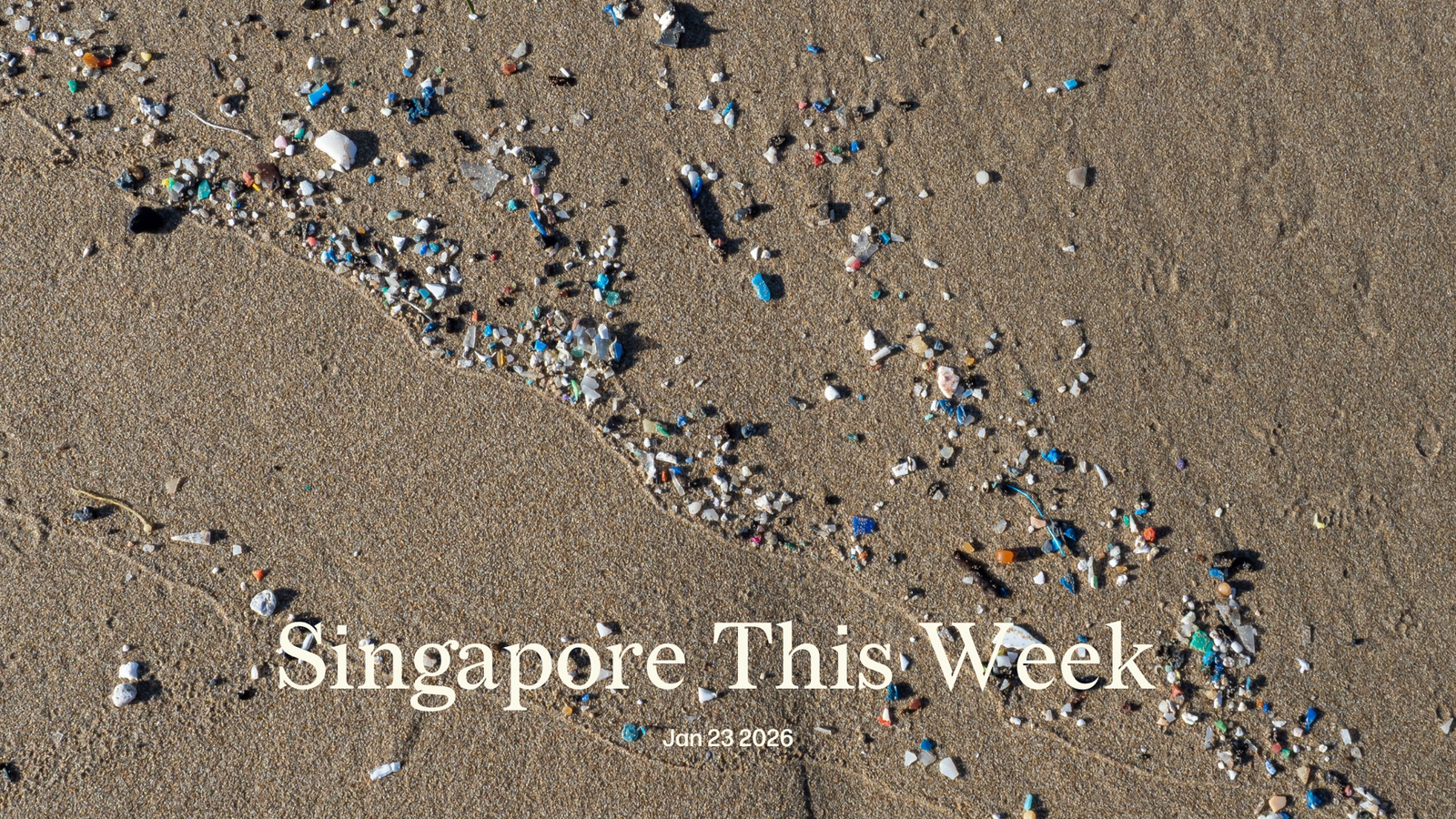
Micro and nano-plastics (MNPs) are everywhere. In the clothes you’re wearing and the vehicles you travel in; from the fibre optic cables relaying these words and the device on which you’re reading them. Studying them is devilishly difficult. Researchers are confounded not just by their size but also by the fact that some commonly used detection methods struggle to distinguish them from molecules naturally present in human tissue.
Last February, The Guardian published an article headlined “Levels of microplastics in human brains may be rising rapidly, study suggests.” Alarming. No one wants to be walking around with spoonfuls of the things rattling in their skull. But eleven months later came a “bombshell” (The Guardian’s word). Turns out the original study, along with numerous others, may have been plagued by methodological flaws.
This, in itself, is not a scandal. Modern science always had this choppy, staccato rhythm—hypotheses formed, experiments conducted, and reality modelled until it can be uncovered. Undisturbed, it is in constant conversation with itself, sometimes friendly, sometimes garrulous, until a consensus coalesces, or at least a quorum. (Researchers have been debating the presence and impact of microplastics in the brain for a while, including this cautionary paper published in Nature Medicine last year.)
Until recently, much of this refinement took place beyond public view. Popular perceptions of scientific knowledge formed slowly and settled deeply. This wasn’t altogether bad. Unlike war, natural disasters, celebrity weddings, or even momentous political developments—see, for instance, our opening blurb—sense, not speed, best serves public interest when it comes to science.
But this considered slowness is at odds with the scientific community’s eagerness to engage, the modern media’s urge to tell, and our desire to know, with certainty. Cue, a blizzard of information which creates confusion, then disorientation and finally, resignation. Last year, we were on the verge of becoming human-plastic hybrids; now we’re not? I don’t know what to believe or how to be anymore. Stupefaction invites exploitation. Plastics sit downstream of the fossil fuel industry which has formidable lobbying muscle. As The Guardian itself later conceded, “this row will probably be referenced by bad actors to discredit future results.” There are ideologues too, who would seize on any uncertainty or climbdown to dismiss the very real ecological havoc plastics continue to wreak.
In such a charged environment, what’s the onus on those producing scientific knowledge, on those reporting it, and on those consuming it? For scientists, a more cautious public engagement; for the media, deeper understanding of emerging fields; a more mindful weighing of evidence; and reportage that buttresses information with education. For the reader, a more nuanced understanding of scientific progress; patience; and a healthy media diet that includes slow journalism (nudge, nudge).
Some further reading: In “R.F.K., Jr., Anthony Fauci, and the Revolt Against Expertise”, The New Yorker examines the journey from hypothesis to fact, and the public’s relationship with scientific authority. “But in science, and in intellectual inquiry more broadly, where you draw the line matters enormously. Keep things too open and you’re endlessly debating whether Bush did 9/11. Close them too quickly, though, and you turn hasty, uncertain conclusions into orthodoxies. You also marginalize too many intelligent people, who will be strongly encouraged to challenge your legitimacy by seizing on your missteps, broadcasting your hypocrisies, and waving counter-evidence in your face.”
History Weekly by Faris Joraimi
In 1992, the Malay daily Berita Harian documented Hajah Rosnah Zainal Abidin cooking rice. She never boiled it in a pot or an electric cooker, but steamed it with pandan water, because steamed rice was “pretty”; she also believed it makes you feel full for a longer time. And of course, the women of Pariaman, from whom she was descended, always cooked their rice in steamers. Hajah Rosnah founded Warong Nasi Pariaman around 1948 with her husband, Haji Isrin; by the time of the interview, she had been selling rice dishes in the Minangkabau tradition—known widely as masakan padang, or nasi padang—for over 40 years. They started a mobile cart, before leasing a unit on 738 North Bridge Road. Their eating-house at this location would become the oldest surviving Minangkabau eating-house in Singapore. Until the end of this month, at least, when it will be closed for good.
Pariaman today is a city of about 100,000 people on the west coast of Sumatra, where a flat plain meets highlands with volcanic lakes and fertile valleys. Over centuries, it was ruled by local lords and headmen, who in turn owed loyalty and tribute to sultans. An economy grew around rice-farming and trading black pepper and gold with the rest of the world. In 1663, the Dutch East India Company gained control of the coast by treaty and force, building a fort in Pariaman in 1684. But Pariaman was soon overshadowed by a neighbouring port to the south, Padang, which became the economic and political hub of west Sumatra as it fell increasingly under Dutch control. Hence “nasi padang”.
Several Minangkabau eateries sprouted in Kampong Gelam, where west Sumatran traders had come to do business since the 19th century as part of Singapore’s Malayo-Muslim commercial community. Each of them has a following; my parents are regulars of Sabar Menanti, while some friends prefer Rumah Makan Minang. I’ve kept coming to Warong Nasi Pariaman because they’re true to the old-fashioned techniques, especially the use of charcoal fire. The beef knuckle rendang is so tender it almost melts to the touch; a smoky aroma laces their ayam masak lemak putih (grilled chicken in coconut cream) and sambal balado. The menu recorded in 1992 has largely stayed unchanged, and they still close shop by the early afternoon once the day’s batch sells out (it always does). Backbreaking labour goes into preparing these dishes. The cooks today, led by second-generation owner Encik Jumrin Isrin, are usually up by 4am for kitchen prep. You wonder how they’ve kept going for so long without cutting corners: is it duty, a sense of obligation, pride in the tradition?
When the grand old Warong closes—to much sorrow, shock, and frustration—a lot of things will go with it: expertise, craft, a social experience, a place to return to. I’d taken so many friends there, for whom this was their introduction to Minangkabau culture. At some point, I’d come often enough that Encik Jumrin started remembering my face. On breezy days when the awnings flapped, the Sultan Mosque’s prayer call vibrating in the air, you found yourself back in an older and slower Singapore. Or perhaps even further back, in Pariaman, by the windy Indian Ocean with your rice drenched in gulai. This portal is closing.
Art: SAW XIV
“Please take care of yourself this @sgartweek, your health is most important,” one artist posted to Instagram, against a blister pack of Redoxon Vitamin C tablets. “We have peers doing beautiful work over the next few weeks,” went another, “Save your energy, take it in moderately and most importantly, these works only find meaning when shared with you”. If artists are dispensing medication and advice on moderation, it’s a sure sign that Singapore Art Week (SAW)—a misnomer now more than ever—has become an endurance sport. The visual arts extravaganza frontloads the year, cramming every inch of arable art land with exhibitions, performances, fairs, symposia, talks, workshops, you name it. SAW boasts over 100 programmes running between January 22nd to 31st; the start and end dates of the “week”, however, get a little blurry at the edges. Every other artist and organisation in Singapore, whether involved directly in SAW or not, plans their programming around this sprawl in an attempt to seduce both curious passers-by (including a Jonas Brother) and rarefied curators working in spaces far afield as Paris’s Palais de Tokyo, Shanghai’s Rockbund Art Museum, and the Los Angeles County Museum of Art.
If you’re trying to figure out what to see in this snarl of events, you’re not alone. You could go for the usual suspects, the twin art fairs of S.E.A. Focus and ART SG that typically anchor the season; the ever popular art walk OH! Open House, this year travelling to the obscure Moonstone Lane; or the blockbuster shows served up by the National Gallery Singapore and STPI, the former on five pioneering South-east Asian women artists giving force to the political through the personal, the latter a groundbreaking show on printmaking in contemporary art. But if you’re wondering what it’s like to witness the sights and sounds of SAW from a different perspective, Post Museum’s guided trails might be the adventure for you. This year, the independent outfit’s curated tours feature two that are co-created and guided by visually impaired collaborators. They’ll walk you through shows at the Tanjong Pagar Distripark and Waterloo Street, among other sites, with tours designed around multisensory navigation and spatial storytelling, so you aren’t just digesting art with your eyes, but with your entire body. And then there’s the experimental musical festival Sonic Shaman, in Singapore for the first time, that invites you to broaden your aural horizons with “Borderless”. Rave at a silent disco, encounter a sound-sculpture inspired by a 1,000-year-old Japanese ritual, and make leaf crowns in a participatory installation as your body becomes an instrument in a larger communal orchestra. Perhaps we should have multiple planting and vegetative cycles throughout the year, rather than a forced blooming every spring.
Abhishek Mehrotra, Faris Joraimi, Sakinah Safiee, Corrie Tan, and Sudhir Vadaketh wrote this week’s issue.
Letters in response to any blurb can be sent to sudhir@jom.media. All will be considered for publication on our “Letters to the editor” page.
If you enjoy Jom’s work, do get a paid subscription today to support independent journalism in Singapore.