



A little over two years ago, amidst the pandemic, Malaysia banned chicken exports due to a domestic supply crunch. Many in land-scarce Singapore were concerned. Over drinks, an acquaintance remarked that he believed the bans were a ploy to later justify price hikes on locally sold chicken. A few of us laughed. Perhaps it was funny that chicken lay at the heart of such an elaborate conspiracy. But I realised this may be less about poultry than distrust in authority.
Singapore is rife with conspiracy theories. A popular one suggests the 1961 Bukit Ho Swee fires were manufactured, to quell resistance towards the government’s relocation efforts. Another describes beliefs among older Singaporeans that Internal Security Department agents spied on every company and Housing Development Board building to monitor discussions of opposition politics. On Reddit forums, users document others they’ve heard in Singapore over the years. Common themes include: covert acts undertaken by political leaders, top-secret military operations, the state’s surveillance capabilities, the integrity of our elections, and more. Before the 2023 Presidential Election, for example, a rumour suggested that the eventually disqualified presidential hopeful George Goh was a government plant, to ensure credible (though not too credible) “opposition” to then frontrunner and current president, Tharman Shanmugaratnam. Reading these reminded me that power invites suspicion rather naturally.
This was around the time I began to consider studying the political drivers of conspiracy theory beliefs in a field dominated by apolitical perspectives of the phenomenon. I study political psychology. Broadly speaking, this includes when and why people trust “experts”, and more recently, the structural underpinnings of conspiratorial thought. In casual settings, most people I’ve spoken to hold a rather poor impression of conspiracy theory believers: “lunatics”, “Trump supporters”, “anti-establishmentarians”, “crazy”, are among terms I hear bandied about. Though understandable, this impression—and perhaps more precisely, its universalism—is a little unfair, and should be challenged.
Recent research may be catching on. Scholars are increasingly looking at conspiracy theory beliefs as more than a cognitive tendency afflicting individuals per se, instead contemplating the structural conditions that may promote their spread. Singapore is a great place to interrogate the assumptions these rest on. A study published in 2022 (more on it shortly) found that GDP per capita correlates with lower levels of conspiratorial thinking. Yet, Singapore is an outlier, with higher levels of such thinking than its high income might suggest. Why?
In recent years, talk of disinformation and misinformation has gained traction. Disinformation refers to false information spread deliberately to deceive—by states or actors with political agendas to mislead or otherwise influence public opinion. Misinformation, by contrast, is false information spread without this intent—often shared by individuals who believe it to be true. (The definition and labelling of falsehoods, including, say, when satirical or parodical content uses one to make a point, is an important point of discussion, though beyond the scope of this essay.)
Both disinformation and misinformation represent challenges to political and social trust, as well as the stability of democratic institutions. But it is important to distinguish these from conspiracy beliefs. The latter are specific narratives that usually attempt to explain key societal events with reference to secret or malevolent plots involving the elite: political leaders, scientists, billionaires.
Disinformation and misinformation do not necessarily involve such elaborate or intentional deception. Conspiracy beliefs may thrive in an environment rife with misinformation and disinformation, but they are a distinct phenomenon.
Scholars have been aggressively developing psychological interventions to reduce people’s susceptibility to misinformation. A famous psychologist, for example, proposes “prebunking”—exposing people to fake news or typical features of misinformation before they encounter it in the real world—to “inoculate” individuals, à la intellectual vaccination. Other well-known means of combating fake news rely on similar techniques. Such efforts are rarer in dealing with conspiracy theories (though they do exist: researchers recently designed a generative-AI chatbot that offers persuasive counter-arguments to conspiracy theories.) This is partly because conspiracy theory beliefs tend to be more resilient, more socially braided, often with one’s identity or distrust in authority.
Psychologists say they possess the following features. First, conspiracy theories claim to address issues that ought to be of public interest. They also often describe harmful acts, and are “oppositional”, meaning the explanations they propose challenge official narratives. Importantly, they ascribe agency, attributing intentionality to certain individuals at the expense of more structural or systemic explanations.
Given these, their epistemic foundations are shakier. Taken together, they are less likely to be true. This is important too. Often, there is no inherent reason a conspiracy theory is wrong (that is, simply by virtue of it describing a conspiracy), though the simplistic nature of these narratives renders them, in their totality, less plausible. (For our purposes, let’s set aside the more radical conspiracy beliefs—the world is secretly controlled by lizard people, for example—which reside on the fringes of the public sphere. On the other hand, sizeable minorities, and in some cases, majorities, believe conspiracy theories that target key political elites.) Last but not least, conspiracy theory beliefs are sticky; they are notoriously resilient. As social constructs, they may become the basis for shared understandings and worldviews.
Like disinformation and misinformation, conspiracy theory beliefs can undermine the workings of democracies. But their study has thus far been dominated by social psychology, itself shaped by the cognitive tradition—proposing cognitive explanations for what it sees as fundamentally cognitive phenomena. This tends to inadvertently individualise phenomena which are more complex. Studies thus paint a bleak portrait: political extremism, intolerance of uncertainty, paranoid ideation, beliefs in the supernatural, hypersensitive agency detection, anxious attachment, the lack of critical thinking—these are a few well-known tendencies associated with the disposition. The title of a prominent paper reads: “Analytic thinking reduces belief in conspiracy theories”.
Taken together, such studies insinuate that the disposition is irrational, reflecting a psychological deficiency. (A prominent psychologist I’ve spoken to believes many scholars in the field do so explicitly, with condescension.) This contributes to the ease with which we dismiss anything which smacks of conspiracism. For many, a “conspiracy theory” is ipso facto false.
However, social and political conditions play an important role in making individuals more vulnerable to falsehoods, misinformation, and, presumably, conspiracy beliefs. Robert Putnam, a famous political scientist, called it some time ago. He’s known for stressing the importance of regularly participating in social activities—bowling associations, running clubs and the like—for a healthy democracy. Not doing so causes a disconnect; it chips away at our ability to generalise from our experience and believe others are worthy of our trust.
Loneliness, not merely physical solitude, but a disconnect from community, has key political implications. Individuals who feel alienated from civic life, or deprived of meaningful relationships and a sense of belonging, may become more susceptible to extreme ideologies and conspiratorial narratives which promise to plug these gaps. Empirical studies support this.
In essence, social alienation, coupled with an erosion of trust in others and public institutions, leaves many grasping for stories that give them a sense of identity and belonging—even if they’re founded on questionable claims. In these settings, conspiracy theories and other forms of misinformation become a source of meaning, community, and resistance to the perceived failures of mainstream liberal societies.
And so, the prevailing cognitive psychological lens is a problematic one with which to view conspiracy theories everywhere, to say the least. Labelling something a “conspiracy theory” strips it of epistemic legitimacy; it immediately becomes less credible. In authoritarian settings, this is easily weaponised.
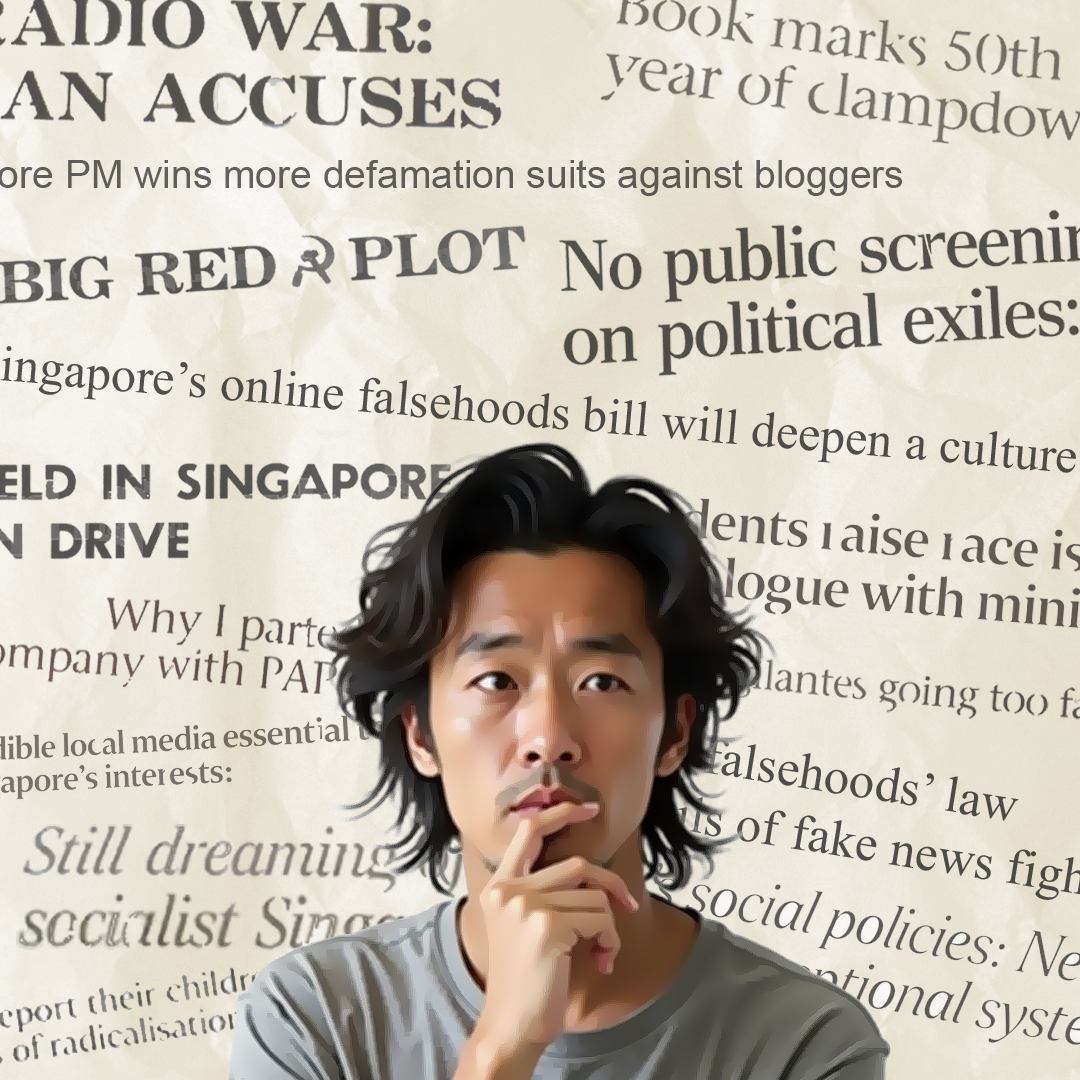
As we know, the information landscape in Singapore is tightly controlled. Under Lee Kuan Yew’s leadership, the government leashed the press. In 1974, it passed the Newspaper and Printing Presses Act, which subjects print media companies to licensing, effectively allowing authorities to regulate the press and clamp down on dissenting views. National security, political stability, and economic growth—or some combination of these—are typically used to justify such measures. It has cultivated a media environment with limited space for independent journalism or critical commentary; Singapore ranks 126th in the World Press Freedom Index.
Digital media have been steadily coming under regulation as well. In justifying the Protection from Online Falsehoods and Manipulations Bill (POFMA)—which grants government authorities the right to police online spaces by issuing correction orders and takedown notices—K Shanmugam, law minister, cited well-known findings that conspiracy theories overly simplify the truth and erode public trust in key institutions (which is true). This rhetoric was regularly used to rebut legitimate concerns that the law would be abused for partisan gain. After the first four POFMA orders were given to opposition parties and members, S Iswaran, then communications and information minister, suggested it was an “unfortunate convergence or coincidence”.
The idea that POFMA is truly a political weapon is arguably a “conspiracy theory” too. Likewise, with many other political musings—who’s to say? Allegations of executive interference in the judiciary, for instance, have often been rebuked as nothing more than a “conspiracy theory”. Point being, where information flows are circumscribed, it is reasonable to wonder, natural to conjecture. Maybe it’s even necessary.
Recent works are starting to uncover the structural conditions associated with conspiracy beliefs. Democratic indexes, for instance, correlate negatively with conspiratorial thinking, hinting at a relationship between the two. (It’s arguably too early to say authoritarianism causes conspiratorial thinking, but nonetheless.) In Singapore, for instance, a common misconception is that your vote is not secret. “They confirm know who you vote for.” Our votes are indeed secret—but you can understand why there is doubt. Where transparency into political processes is lacking and the government has a reputation for clamping down on dissidents, it is normal for such fears to circulate. I would argue it is very rational under conditions of limited, imperfect information flows.
Academics, journalists and practitioners alike are keen to stress the dangerous consequences of conspiracy theory beliefs. But we should ask deeper questions about their prevalence. For one, clearly, conspiracy beliefs are not the same phenomenon worldwide. They may possess a certain character in liberal democracies, but other features elsewhere. Unfortunately, scientific research on the topic has obtained its data by and large from industrialised Western populations, yielding an incomplete picture.
In a place like Singapore, it is evident they possess very specific social functions. Avenues for political expression are few and far between; meanwhile, political grievances persist. So, where does the angst go? It likely gets privatised, expressing itself in everyday conversations and laments, in the “ridiculous” underbelly of conspiracy theories.
Global attempts to measure conspiratorial thinking are becoming more common. One such study explores the relationship between national economic performance , measured using GDP per capita, and conspiratorial thinking.
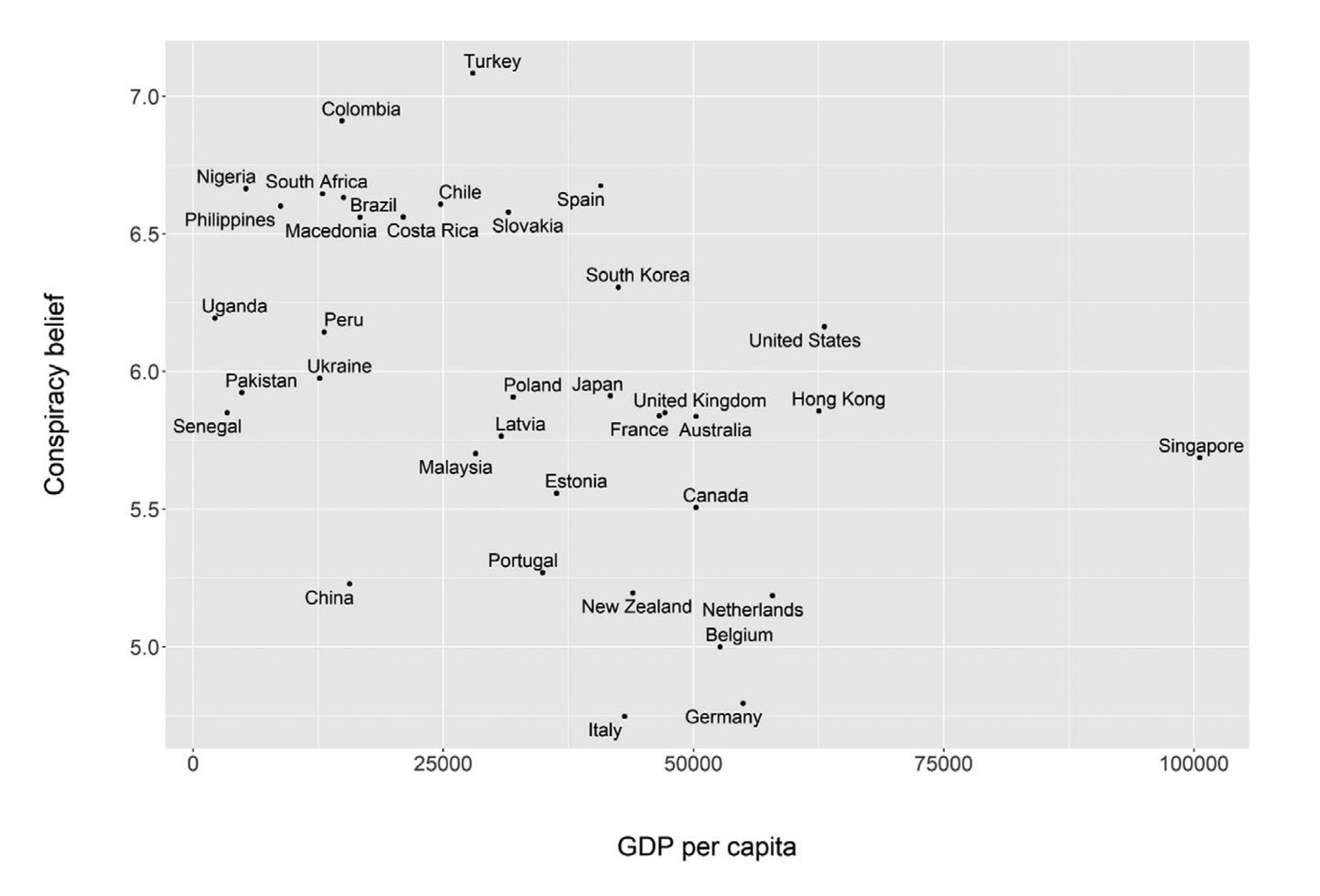
The findings demonstrate a strong correlation between the two, though causation is, unsurprisingly, tricky to prove. The authors do triangulate their findings to account for this, and we may infer that, at the very least, poorer perceptions of how the economy is doing are likely to increase beliefs in conspiracy theories.
Singapore’s position is arresting. Considering how high its GDP per capita is, it should exhibit lower levels of conspiratorial thinking. What gives? Well, GDP per capita is arguably a poor way to measure Singapore’s economic health, given socioeconomic inequality in the republic is also sky high. (Official statistics on the matter, already pretty damning, likely underestimate the true extent of this inequality.) And indeed, recent work finds that inequality is associated with higher levels of conspiratorial thinking. It sparks perceptions of societal disintegration, driving the cynicism embedded in conspiratorial thought.
But I’d argue other factors are involved too. James Scott, a pioneering anthropologist who recently passed on, studied everyday forms of resistance that marginalised groups resort to, where openly challenging authorities is not viable. Foot dragging, gossiping, feigned ignorance, and other subtle forms of non-compliance—he termed these “weapons of the weak”.
Our conversations, likewise, aren’t insignificant. They represent a daily avenue for resistance in political environments where explicit dissent is not permitted. Conspiracy theorising must be seen via this lens too. They allow individuals to express criticisms and skepticism regarding the government and dominant institutions in ways less likely to draw scrutiny to themselves. Just as peasants in Scott’s work used rumors and gossip to safely express discontent, conspiracy theories tend to spread in ways that protect their proponents’ identities.
But for Scott, these “weapons of the weak” are also functional; they subtly undermine the authority and legitimacy of dominant groups. By suggesting hidden agendas and malevolent intentions, conspiracy theories, likewise, chip away at the credibility of dominant institutions and actors, levelling the scales. This makes more sense once you consider the power imbalances between governing elites and Singapore’s general public. Per cognitive accounts of the phenomenon, conspiracy theory believers are more likely to perceive agency where there may not be any. But what if this disposition towards perceiving agency is itself a reflex caused by a perverse lack of accountability? Our cognition, in other words, may be inextricably entwined with the environment.
People are typically not blissfully unaware. Much of cognitive psychology itself stresses that how we think is a response to our epistemic limitations. We rely on a range of heuristics and biases as shortcuts when making decisions and evaluations. For instance, the availability heuristic: we tend to rely on more recent or otherwise readily available information to make judgments. If an incident is highly publicised, we may overestimate its frequency. But there’s usually a reason we resort to these biases; many suggest it’s evolutionary. To go about in the world, we need to somehow make sense of our extremely complex environment.
In repressive or otherwise opaque conditions, conspiratorial rhetoric targeting elites is also functional. It allows individuals to signal awareness of their subjugation even while they may not have access to all the relevant information. “There’s something nefarious going on behind the scenes—you can’t fool me.”
We see this often in Singapore. For example, with the Oxley Road affair. Many conjectured that the “real reason” for preserving the estate is superstition—demolish the house and kiss goodbye to power. Likewise, Tharman Shanmugaratnam, president, was previously considered by many the ideal choice for prime minister (PM). He repeatedly stated he did not want the position, whilst the party did not appear to seriously consider him. People conjectured, meanwhile, that it was “really” due to his liberalism; others hypothesised that he would have been a threat to the former PM. (Others claimed it’s due to his racial identity; to me, this has a more objective basis).
Right or wrong, they’re responding to something.
Our ideas of power should thus figure more heavily when we discuss conspiratorial thinking. Political thinkers, in this regard, draw an important distinction between “power over” and “power to”.
“Power over” refers to the capacity to control or dominate others. It is the ability to influence someone else’s actions, often against their will or interests. A government that imposes regulations on its citizens, or an employer that exerts control over their employees by threatening job loss, both exert power over. “Power to” refers to the capacity or ability of an individual or group to achieve their goals, create change, or accomplish something. It is the power to act and effectuate positive outcomes. A local community that organises to build a park or people using their skills to create new technologies embody the power to.
Seen this way, conspiracy theory beliefs—especially in more repressive contexts—arise in response to “power over”, perceptions of being repressed. Studies link them to feelings of disenfranchisement, powerlessness, as well as more material conditions, like economic inequality and corruption. They provide individuals with a sense of control and agency. By uncovering “hidden truths”, believers may feel empowered, more able to make sense of and navigate their complex environment. Sharing conspiracy beliefs also creates common identities and a sense of community among like-minded individuals. This provides further emotional and psychological support. Conspiracy theories often position believers as dissenters who challenge the official narratives promoted by those in power. This oppositional stance may also be interpreted as “power to”, allowing individuals to resist dominant structures of power.
Historically, conspiracy theories tend to be more prevalent during times of crisis, when uncertainty looms and people search for more meaning. Consider the conspiracy theories surrounding the Covid-19 vaccine. Some Telegram channels attracted thousands of avid users, many of whom documented the health complications, including magnetic sensations, they suffered as a result of the vaccine.
Anti-establishmentarianism is indeed a powerful source of meaning and identity. But it’s fanned by distrust in official sources of authority. I wonder if these narratives would have had the same kind of appeal they did—a survey conducted in 2021 found that more than half of the respondents in certain age brackets were worried about the safety of the vaccine—had there been more earnest communication from government officials regarding the risks associated with vaccines (all of which are miniscule compared to the dangers of contracting Covid-19 itself). An immigrant from Bangladesh passed on due to myocarditis three weeks after receiving the vaccine. Yet, it took authorities 19 months to attribute the likely cause of death to the jab. Countering misinformation requires better information, and more transparency, not less.
It is likely conspiracy theories reflect distrust in political systems as much as they inspire it. In my view, we speak too much about the latter at the expense of the former. It’s more meaningful to interrogate systems and those responsible for their design.
However you cut it, power dynamics and political institutions are central to the story. We may recall the mother of all conspiracy theories in Singapore (which, incidentally, was articulated by the government): Operation Spectrum, or the so-called “Marxist Conspiracy” of 1987, in which the government detained a group of social workers without trial under allegations of plotting to subvert the state. The point here is that the pejorative understanding produced by much of the social scientific literature may be easily instrumentalized by authoritarians, for whom criticism, or the whiff of threat, is inconvenient. Justifying clampdowns on conspiratorial rhetoric or activities is all too easy, for well, they promote subversive ideas.
This is unfortunate. I’m not saying that everything critics advance is true or legitimate. But we should ask why politically conspiratorial rhetoric arises in the first place. Snuffing it out with the full force of the law or media, curtailing expressions of natural skepticism, amounts to throwing the baby out with the bathwater, and our democracy is poorer for it.
Had there been more communication from official authorities on the matter, citizens would likely question the secrecy of their votes less. Were there greater trust in our political institutions—and more transparency in our political processes—skepticism about the integrity of the Presidential Elections would be less pronounced. More official information on the subject, and there’d be less need for people to concoct narratives surrounding the influx of Chinese and Indian nationals. Information is power too, and one wonders why it isn’t freer in Singapore.
Likewise, recall the controversy surrounding the Graduate Mothers Scheme in the 1980s. Policymakers, and Lee Kuan Yew in particular, believed that the quality of Singapore’s talent pool was set to decline, as university-educated adults were not having enough children with each other. (Singapore’s birth rates were declining, but this trend was more pronounced among university graduates.) Many minorities then suspected in private that the Singaporean leadership was secretly gunning to engineer a master Chinese race. Had Singapore’s leadership treaded more carefully around the sensibilities of minorities when pushing their pronatalist policies—or not developed a reputation for such intrusive governance—such whispers may not have had reason to emerge, let alone spread.
I could go on. Point being, it is very rational to suspect power—I believe this to be true in general—but especially under less liberal conditions. This makes it imperative to avoid dismissing conspiracy theories at first glance. Often, there’s more than meets the eye. Someone that expresses a conspiracy theory, for instance, may not believe it as much as they believe in it (i.e. resonate with the connotations attached to it). Meaning is multifaceted and beliefs are complex things, barely comprehensible at times. They are bound up with our social lives, thus subject to their pressures—a point Manvir Singh, an anthropologist, makes very well here.
But at the heart of many avid endorsements of false or otherwise suspicious information is an implicit understanding that they may not be entirely right. Still, the sentiment underlying these narratives, the suspicion encoded in its makeup, resonates with people, or these theories would not gain traction. We should ask ourselves why that is. This is especially so in a society where political transparency is limited and dissent is risky. We can’t preserve the conditions under which conspiracy theories are likely to thrive, and also vilify them when they emerge. Something’s got to give.
Pradeep Krishnan is a PhD researcher at the University of St. Gallen, where he studies political psychology and public attitudes towards experts in Europe. He retains a keen interest in political discourse in Singapore. When he’s not fretting over Manchester United’s recent form, Pradeep also enjoys consuming existentialist novels and films.
Letters in response to this piece can be sent to sudhir@jom.media. All will be considered for publication on our “Letters to the editor” page.