

Dear Jomrade,
Today we’ve published:
- “Singapore This Week”, by Jom
- “Everyday economics: the quiet logic of hawker centres”, by Serene Koh
- “Letters to the editor”. Joshua Tan responds to Shen Chenzi’s essay on young Chinese migrant women.
This was the week of feasting and fasting, one to witness our city’s sheer ethnoreligious diversity. Sunday marked the beginning of The Great Lent for some Christians, one that’ll last till the Easter long weekend in April. Monday afternoon, the eve of Chinese New Year, was Singapore’s great, annual, unofficial half-day holiday. Reunion dinner that evening, for many, would have ranged from communal joy to cringe-worthy personal intrusion. (If you missed it last year, read “The unbearable silence of Chinese New Year” by counsellor James Leong.)
Tuesday, the first day of the year of the fire horse, when oranges are swapped and tarts nibbled, was also “Fat Tuesday”, the last chance for Catholics to gorge (hence Mardi Gras) before Ash Wednesday, when their lent begins. And after the usual uncertainty about the sighting of the crescent moon, we learned on Tuesday evening that Ramadan would begin here on Thursday.
So what does one do on a Friday evening in Singapore? Iftar with a Muslim friend, gruel with a penitent Christian/Catholic, or yet another round of CNY gorging. Each a spiritual experience, and if you still don’t have at least one friend from each of those groups, well there’s your fire horse new year (social) resolution. Whatever you choose, do spare a thought and dime for those who still go hungry.
Aside: as I was researching this week’s newsletter, I went down a few calendar/astronomy rabbit holes. I enjoyed Al Jazeera’s explainer on how the crescent moon is sighted; a video of Palestinians watching for it outside Jerusalem’s Al Aqsa mosque; and this Vietnamese American Instagrammer’s explanation of the differences between the Gregorian, Lunar and Lunisolar calendars (Islamic=lunar; Chinese=lunisolar).
- Why is Singapore seeking to regulate blind boxes?
- Paris Baguette’s love affair with Singapore
- STB tries to woo single Americans through “Aunties, Not Algorithms”
- Why the government has introduced a new CPF life-cycle investment scheme
- How the lives of the Orang Seletar have changed with development
- The Wanderlings, and their innovative theatre and raves for babies
Above are the issues we chose to explore in more depth.
Other news this week included: the seizure by Bangladesh authorities of the assets of Muhammed Aziz Khan, a naturalised Singaporean billionaire, and of those close to him, over money laundering allegations (which he denies); “Singapore Budget 2026: Is It Good Enough?”, a public dialogue last Sunday organised by MARUAH, a human rights organisation; unverified claims that two Singaporeans may have fought for the IDF during the genocide in Gaza; a Facebook post by a Chinese Singaporean about “becoming a minority in my own land” sparks a range of reactions; and the third otter population census.
If you appreciate our independent journalism, join the 2,000 odd paying members now to get access to all our content, starting from just S$10 a month. It’s the only way we can keep doing this.
“Everyday economics: the quiet logic of hawker centres”, by Serene Koh
You may recall that Serene, a behavioural scientist, is Jom’s first columnist, writing about a subject that respondents to our reader survey last year said they were keen on.
Today she’s published her fourth column for us, and appropriately, in this foodie week, it’s about one of Singapore’s cherished institutions.
But more than that, column #4 represents a conceptual shift. Her first three columns (see below) were a trilogy about, as she put it to me, the psychology inside our heads—how we think, mis-think, and justify ourselves in everyday life.
The next three, starting with today’s hawker centre piece, is about how societies perform behavioural work through space, norms, and systems, as told through ordinary, Singaporean places.
“If the first trilogy was about how behaviour lives inside people,” Serene told me, “the second trilogy is about how behaviour lives inside places.”
This is a piece about tissues, trays, and trade-offs—and how they help hawker centres function. It’s a week, then, to recognise how our behaviours on any given day are shaped by a complex mix of culture, tradition, other beings, planetary movements, and modern systems.
Jom makan,
Sudhir Vadaketh, editor-in-chief
Jom
Jom on Everyday Economics
 Serene Koh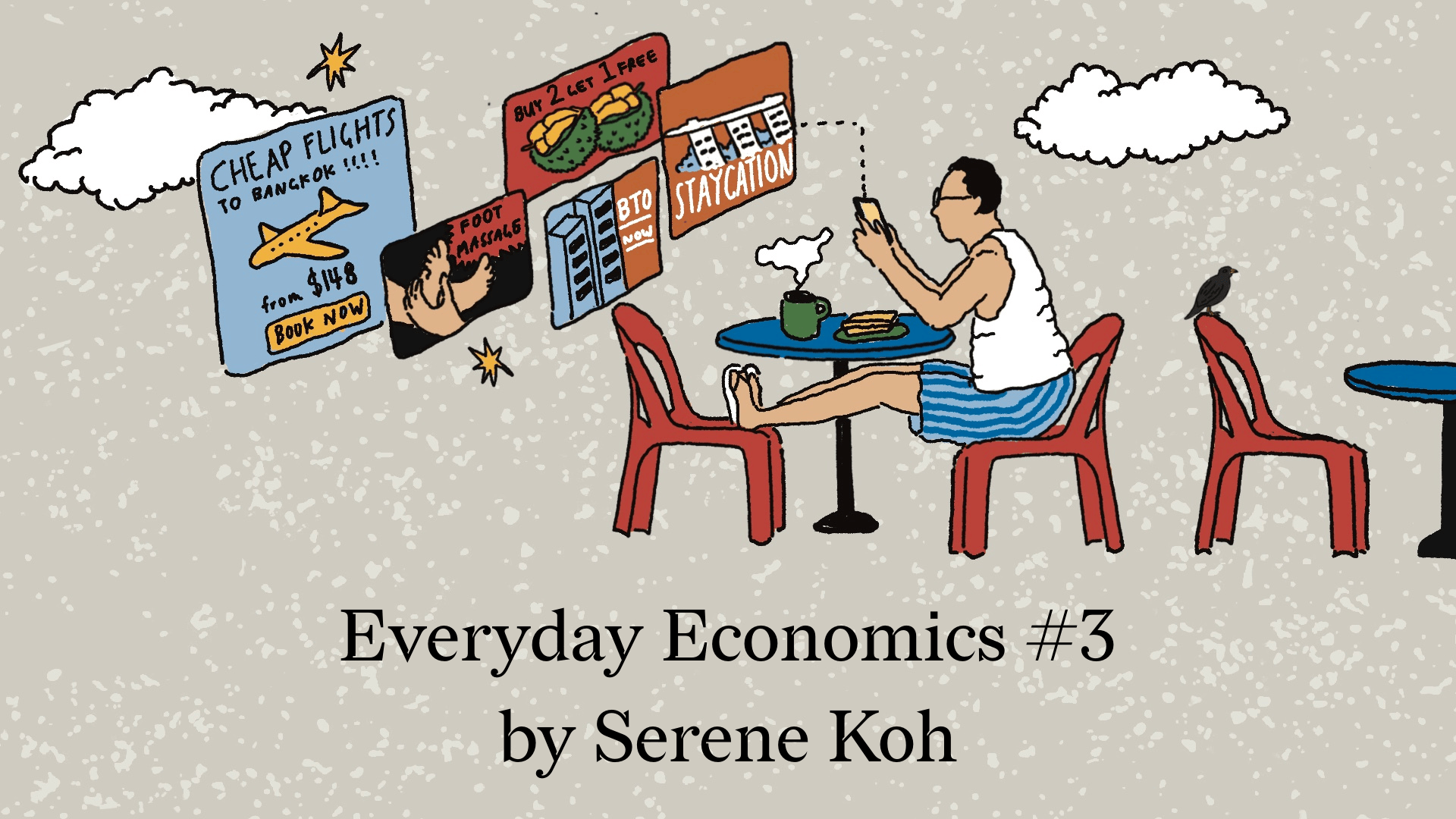
 Serene Koh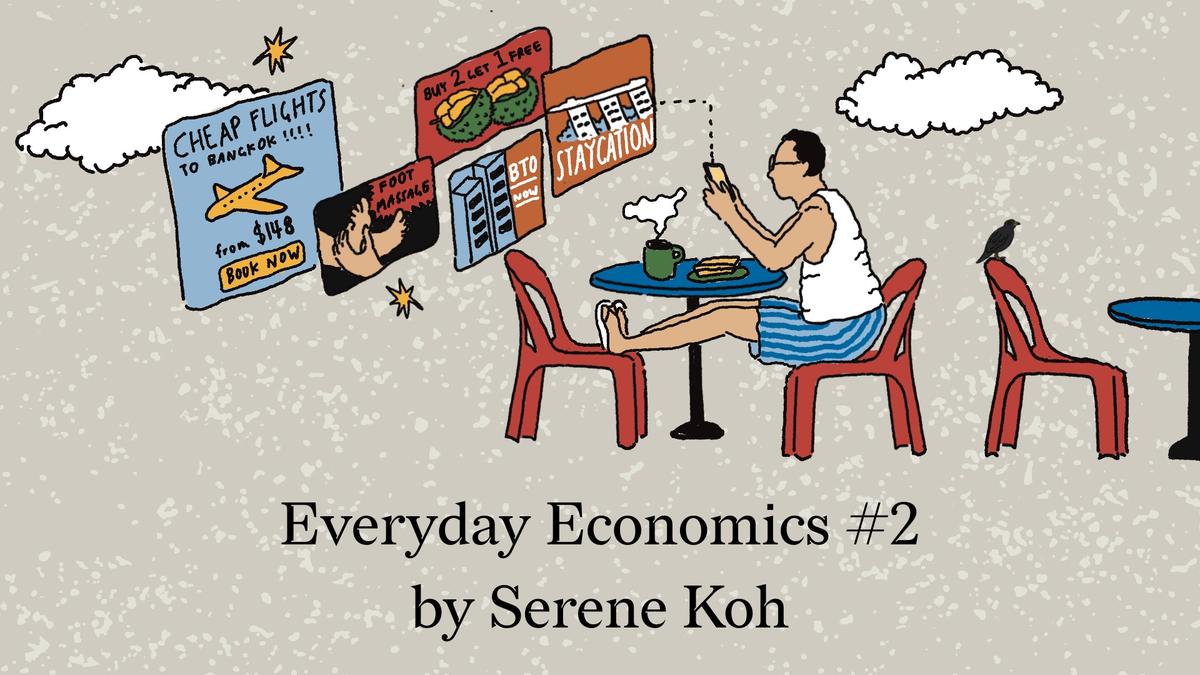
 Serene Koh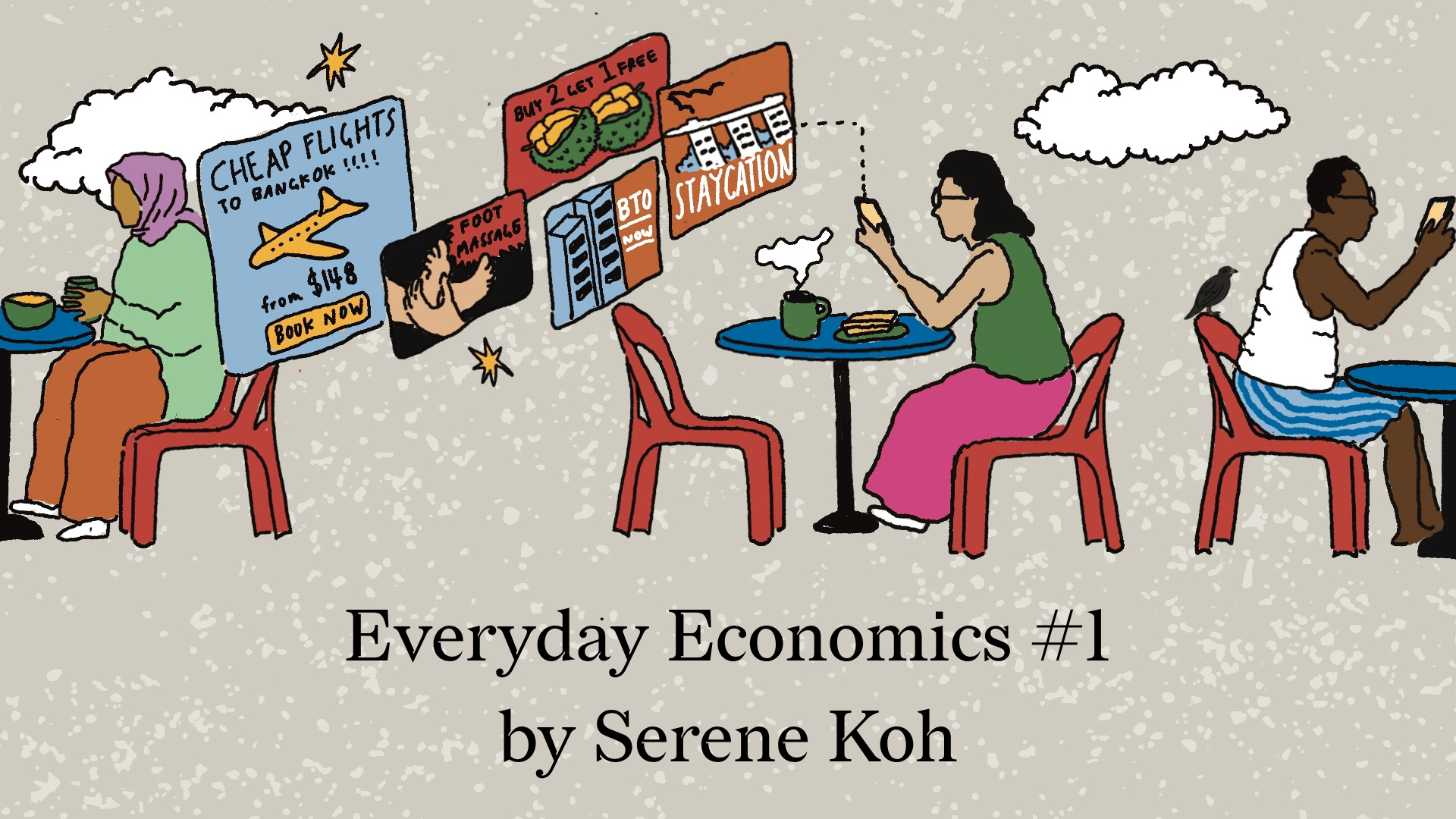
Singapore This Week
Society: From Korea with lava
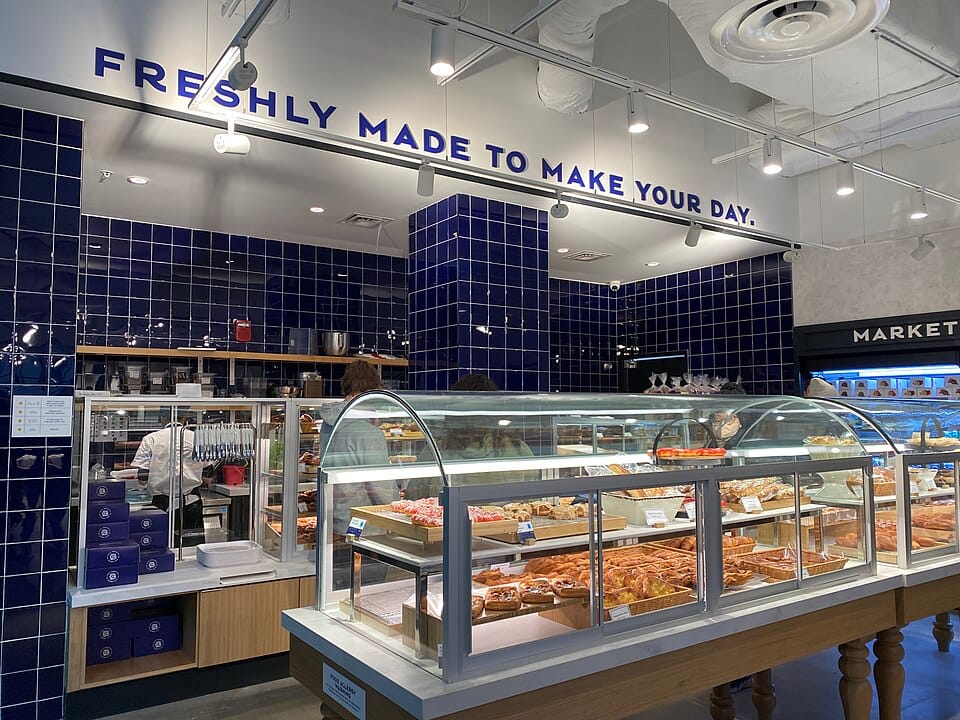
Paris Baguette screams France. The name, the Eiffel tower in the logo, the blue theme, the weaved Parisian bistro chairs, the Breton striped uniform, the cream cakes, macarons, French fries, French toast, the eponymous loaf, and more. Its origins are in Sangmidang, a bakery in 1940s South Korea. The brand as we know it opened its first store in 1988. In 2004, it opened its first overseas outlet in Shanghai, then the US in 2005, starting in LA’s Koreatown. Perhaps its greatest coup was entering the French market in 2014 and, just two years later, winning the annual Coupe du Monde de Boulangerie. The best baguettes in Paris are…Korean? A worthy morsel to chew on, one imagines, as globalists tussled with nativists across the continent.
The chain came to Singapore in 2012, and today has over 20 stores here, part of over 4,000 globally. A 2016 case study by SMU said that its international positioning was “as a premium, high-end, health conscious brand targeting upper-class consumers” across Asia and the US. It opened stores in central and upmarket areas—for instance Orchard Road and Changi Airport—priced its products at a premium, and created localised offerings, such as bahn mi in Vietnam. Among other competitive advantages were vertical integration—owning bits of the chain from ingredient suppliers to distribution—and centralised production. Its new manufacturing plant in Johor has seven fully automated frozen dough production lines that can produce 100m bakery products a year, serving six South-east Asian countries.
Five years ago, Paris Baguette adopted a “no pork, no lard” policy in its local outlets, and last week, MUIS awarded it halal certification. With the Singaporean taxpayer backing its local R&D, it plans to expand its halal-certified footprint across the region and also explore opportunities in the Middle East. (That Singapore can be a launching pad for halal food brands was further demonstrated by our significant presence at last month’s Gulfood 2026 in Dubai—featuring, among others, Kim Guan Guan Coffee, Tan Seng Kee Foods and Yeo’s.)
To mark its halal milestone, Paris Baguette yesterday launched in Singapore its (unashamedly Korean) K-Lava Tteokbokki Pastry Tart, which combines cheese, rice cake, and Gochujang mayo. Coming just in time for Ramadan, it wouldn’t be out of place at the Geylang bazaar. Perhaps more important than taste is the symbolism of the bite. Amidst relentless stories about local food brands struggling, and in an era globally marked by rising xenophobia and persistent bigotry towards Muslims, the continued evolution of this (Korean?) brand in our little red dot should evoke a quiet, deep, pleasure—not unlike that from the aroma of its freshly-baked bread. A pleasure leavened by the desire to promote, cherish and celebrate both the Pariamans and the Parises.
Some further reading: in “The unlikely rise of the French tacos”, Lauren Collins delves into the complicated politics of food globalisation. “If cultural appropriation usually involves a dominant group profiting from a minority group’s cultural heritage, the case of the French tacos presents a complicated power dynamic: here, a minority group of French entrepreneurs of North African descent is profiting from the cultural heritage of an even more minoritarian group of Mexican restaurateurs who, in turn, see their counterparts as part of a monolithic France.”
Other stuff we like
“Low-skilled” jobs? Sarah O’Connor of the Financial Times argues why we need to stop calling some jobs “low-skilled”, partly because it'll help us think more creatively about our AI-powered future. CNA syndicated the piece.
What does AI upskilling actually entail? Liang Kaixin of IPS is currently pursuing a two-year part-time Master’s degree in AI and Innovation. In this commentary, she shares the ups and downs of her journey.
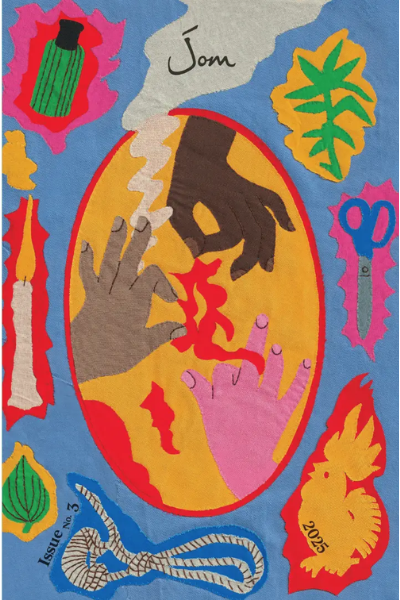
Jom print issue No.3 has just launched!
Dive into its themes of movement, mobility, and magic.
A flavour of Jom. Occasionally, Jom publishes essays outside the paywall. These are on issues we think are in the public interest, and deserve a wider airing. In the past two years, we have published nearly 50 such pieces. Read some of these if you’d like to see samples of our work. We hope they’ll convince you to subscribe. And even if you’re here with no intention of doing so, we hope you’ll enjoy these offerings and consider it time well spent!