
Twenty years ago this week, the world’s first so-called “Internet war” was also Singapore’s first cable TV war, a 24/7 spectacle like never before. By 1999, Singapore Cable Vision (SCV) had completed its island-wide cable network, which offered dedicated news channels like BBC and CNN. By mid 2001 SCV, which later merged with Starhub, had 265,000 cable TV subscribers in Singapore, in a population of just over four million. They might have watched the tragedy of 9/11, and the bombs over Baghdad on March 19th-20th 2003, as a US-led coalition began what it called Operation Iraqi Freedom.
The initial imagery was dramatic but carefully distanced. From across a river one view showed buildings precisely targeted, as if detonated from within, explosions releasing what looked like celebratory fireworks into the night sky. Then there were the green-tinted, night-vision views of mortar fire and the black-and-white rolls that showed targets moments from destruction, the moment of impact concluding a narrative journey that one hadn’t signed up for but had to sit through. This was mass media pixelation masking flesh-and-blood, a cinematic, PG-13 flick that desensitised us, that kept us in la-la land.
The only humans we really saw in those early days were joyous Iraqis welcoming “liberation” and the coalition’s commander-in-chief, George W Bush. “To free Iraq, to save its people, and to defend the world from grave danger,” he said from the Oval Office, flanked by gold-framed photos of his daughters and wife. For those who’ve believed in a post-world-war-2, US-led security order in East Asia, it all had a comforting precision about it, the forces of good and evil neatly partitioned. One almost felt like sitting next to the avuncular “Dubya” in front of the fireplace, with marshmallows and hot chocolate, and thanking him, and the American people, for once again saving us. (Bush's nickname is a play on “W”.)
Well before Al Jazeera was widely watched, it was easy to be entranced by reporting from mainstays of the American and British establishments. Yet not only did the gruesome human cost of this invasion soon become clear—ultimately about 4,600 American military personnel and about 300,000 Iraqis directly from the fighting—but the very rationale for it, centred on weapons of mass destruction (WMD), was within months exposed as a lie.
As “Iraq” dragged on for longer than the early triumphalists ever imagined it would, the cable TV war transitioned from faux spectacle to a genuine exploration of evil. This included the manipulative propaganda machines in the West, concocting enemies wherever enemies were needed, and the barbarity of groups like ISIS, the most dominant of a new breed of jihadists to emerge from the ashes of a civil war sparked by the invasion. Their radical ideologies continue to threaten societies everywhere, including Singapore.
In the two decades since, democracies have engaged in relentless self-interrogation. Media channels, from the BBC to The New York Times, expressed regret for their coverage. Books and movies challenged official narratives. Many have decried Bush’s seeming rehabilitation in the age of Trump. The 2016 Iraq inquiry (Chilcot Inquiry) by the UK concluded that Saddam Hussein did not pose a threat to British interests; the intelligence on WMDs was flimsy; and that the war was unnecessary. Many British politicians have called the war illegal.
Even as all this has happened, Singapore has yet to publicly reassess its own involvement in the invasion. The last apparent statement on the invasion from the Ministry of Foreign Affairs (MFA) is from 2003, which recites the words of S Jayakumar, then foreign minister: reaffirming the belief that Saddam had WMDs and that the lack of a United Nations (UN) Security Council resolution “cannot be taken as an excuse for inaction.” (Read: to hell with UN protocols.) This past week, as media channels around the world have offered their own 20th anniversary retrospective, Singapore’s mainstream media has said nothing about our involvement.
“It is clear to everyone, unless that person wears blinkers, that this is a war to remove the weapons of mass destruction from Saddam Hussein,” said Goh Chok Tong, Singapore’s then prime minister, a week after the invasion had begun. Goh avoided discussion of Iraq in his two-volume memoirs and, along with the MFA, did not respond to Jom’s requests for comment. Their inability to own up to their past does not bode well for Singapore’s foreign policy future.
The period from September 2001 till the invasion of Iraq in March 2003 was filled with successive American attempts to convince the UN, and the world, of the threat of Saddam. “My colleagues, every statement I make today is backed up by sources, solid sources,” Colin Powell, the US’s secretary of state, told the UN’s Security Council on February 5th 2003, with regards to Saddam’s alleged WMDs. Powell failed to convince the Council to back military action (and later regretted his presentation, a “blot on my record”).
Thus the UN wasn’t on board and, unlike in Afghanistan in 2001 and in the former Yugoslavia in 1999, neither was NATO (North Atlantic Treaty Organization). People everywhere were against it. The coordinated protest on February 15th 2003, 10 days after Powell’s speech, occurred in about 600 cities around the world, and is recorded as the largest anti-war rally in history.
No matter, the US, led by Bush and the neocons, pressed ahead with a convenient new form of multilateralism, the Coalition of the Willing. Only four countries contributed troops to the invasion force: Australia, Poland, the US and the UK. On March 18th 2003, the coalition comprised a total of 31 members. By March 20th 2003, the day of the invasion, another 13 countries had joined, including the likes of Micronesia, Palau, Portugal, Rwanda and Singapore. The US, operating outside the ambit of international law, wanted as many allies on paper as possible. Had the smaller countries been bought? “Coalition of the billing” or “coalition of the shilling”, some critics cried.
“While Singapore neither received nor needed the kind of financial inducements from America that might have lured others into a ‘coalition of the willing’, the fact that the war came at a critical final stage of negotiations of the US-Singapore free trade agreement [FTA] was not lost on observers,” wrote Amitav Acharya, a professor of international relations, in Age of Fear: Power Versus Principle in the War on Terror. (From 2001 to 2007 Acharya worked in Singapore as head of research at the predecessor of the S. Rajaratnam School of International Studies, or RSIS.)
On March 22nd 2003, Tony Tan, deputy prime minister and defence minister, confirmed that Singapore would allow American ships, aircraft and “assets” to use its military bases, as it had “in the campaign in Afghanistan.” On March 28th 2003, Goh Chok Tong, prime minister, made his “blinkers” speech to the Research Institute of Economy, Trade and Industry in Tokyo.
Singapore believed that Saddam possessed “biological or chemical weapons of mass destruction, not nuclear weapons”, Goh said, and was worried about them getting into the hands of terrorists who might target Singapore. “Better go with the U.S. and we were able to convince our own population, including our Muslim population, that this is not an Islamic issue of the West trying to hit out at Islam; this is an issue of security for us.”
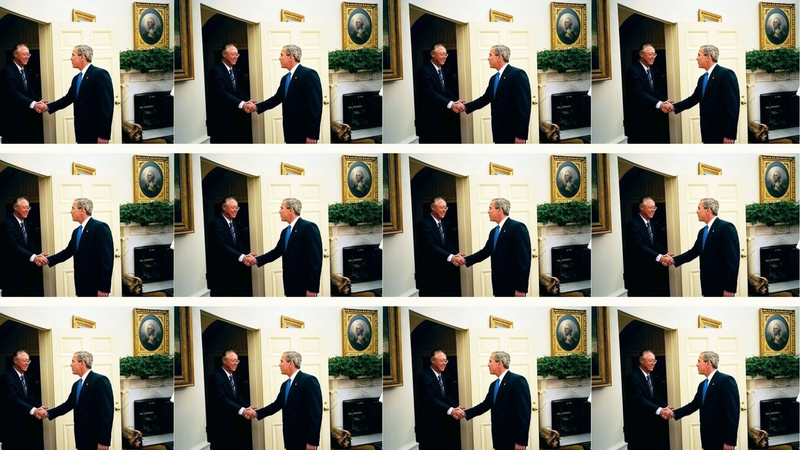
Though Singaporeans can’t march on the streets, there was actually great scepticism about the coalition’s casus belli. Many suspected the government was motivated less by immediate security concerns than by broader geo-strategic and economic imperatives. Sure enough, six weeks after Goh parroted in Tokyo the US’s line about Saddam, he was in the White House, watched over by Bush, Powell and others, to sign the FTA.
In “No sign of Iraqi weapons – How now, Singapore?”, an editorial in The Straits Times (ST) on June 7th 2003, Tan Tarn How mentioned the FTA. “America is big and powerful, and we need it more than it needs us. Thus, my final questions are these: Would the Government have taken any reason the US gave? If not, where would it have drawn the line?”
By that point, it would have been clear to Singapore’s foreign policy establishment that the US had lied about the real reasons for invasion. On March 2nd 2003, three weeks before the invasion, The Observer in the UK had published a whistleblower’s e-mail showing how American spies were trying to bug the UN offices of six non-permanent “swing states” on the Security Council, presumably to unearth secrets that would offer leverage over them. (The incident is the basis for “Official Secrets”, a riveting 2019 film that depicts whistleblower bravery and the lengths to which governments go to hound them.)
More damning was a Vanity Fair interview of Paul Wolfowitz, the US’s deputy defense secretary, on May 9th 2003. “The truth is that for reasons that have a lot to do with the U.S. government bureaucracy we settled on the one issue that everyone could agree on, which was weapons of mass destruction, as the core reason.” (Wolfowitz, according to the Pentagon, also mentioned terrorism and the “criminal treatment” of the Iraqi people.)
Today, 20 years on, analysts still debate the US’s real reasons for invading: Saddam’s supposed involvement in 9/11; oil; WMDs; a fallen warrior’s desire, post 9/11, to recover some pride; miscommunication; and the rise of the neocons in the 1990s and their belief that a victory in Iraq might catalyse democracy across the Middle East.
Whatever the case, Singapore continued its participation in the Coalition of the Willing. (Costa Rica left in 2004 following the failure to find WMDs.) From October 2003 to 2008, the Singapore Armed Forces (SAF) sent 998 soldiers and service people to join reconstruction efforts in Iraq.
It’s probably important to contextualise Singapore’s commitment to Iraq in terms of its broader support for the US’s so-called war on terror. In the months following 9/11, Singapore’s police discovered plans by Jemaah Islamiyah (JI), a militant Islamic group that operates around South-east Asia, to bomb several embassies and other targets around Singapore. Among other bits of evidence, a JI-made surveillance video showing targets in Singapore was discovered in the rubble of a house in Kabul, Afghanistan, belonging to an Al Qaeda operative close to Osama bin Laden.
Scores of alleged operatives were detained without trial and the threat was snuffed out. Still, from that moment on, Singaporean authorities, like in many parts of the world, developed a heightened sensitivity to the threat of militant Islam. That paranoia, and the difficulty officials seem to have had in distinguishing militancy from perceived conservatism, led to the occasional stigmatisation of Singapore’s Malay Muslim community.
Consider the wearing of the tudung, or veil (the subject of a separate Jom essay). In February 2002, four Malay-Muslim schoolgirls were sent home after wearing the tudung with their school uniform (which is disallowed in secular schools). Though the kids’ fathers had championed integration—“My choice for her was a secular school because I want her to integrate with children of other races,” one said—some in the establishment labelled the act as “politically motivated” and deliberately divisive.
Goh said that “non-Muslims, already wary about the aftermath of the Sept [sic] 11 attacks and the arrest of the Jemaah Islamiyah operatives, will be even more concerned with the push for wearing the tudung in schools.” The same month, ST juxtaposed articles on the “tudung issue” and terrorism. In one fell swoop, the prime minister and the national paper had conflated women’s dress with terror.
Consider also the historical beliefs of Lee Kuan Yew, Singapore’s first prime minister, who handed over the reins to Goh in 1990. Lee had argued that Indians and Malays are genetically inferior to Chinese and, separately, that Singapore’s Muslims could not be trusted in a conflict with Malaysia or Indonesia.
9/11, then, was a baptism of fire for Bush, elected in 2000, but it was also a seminal event for Goh (prime minister from 1990-2004). Shortly after 9/11, Goh called for elections, presumably hoping for a bumper victory. He recorded the ruling People’s Action Party’s highest winning margin (75 percent) since 1980. The JI and terrorist threat intensified during that period. And in March 2003, the same month that the US-led coalition invaded Iraq, Singapore encountered its first case of severe acute respiratory syndrome coronavirus (SARS), which afflicted the city-state for months.
This was the backdrop for Goh’s perseverance with the US-led coalition in Iraq. In “America the indispensable power”, Tan See Seng of RSIS noted that Goh and his successor Lee Hsien Loong proudly embraced the anti-terror agenda of Bush and the neocons, including “...the U.S. view that terrorism in Southeast Asia was all part of Al Qaeda’s international network, hence subscribing, perhaps unwittingly, to the notion of an ‘Al Qaeda central’.”
Long after the problems with the invasion were clear, Goh and his successor Lee Hsien Loong, son of Lee Kuan Yew, continued to praise Bush. “Your steadfast leadership has helped to anchor this effort to make the world a better and safer place for us all,” Lee fawned in 2006. Among numerous other connections, the elder Lee knew Donald Rumsfeld, secretary of defense under Bush and one of the invasion’s architects, from as far back as 1975. The point here is simply that any discussion of Singapore’s involvement in Iraq must consider the extent to which Goh, the Lees and other senior Singaporean leaders were in thrall to the post-9/11, jingoistic dogmas preached by US neocons.
“When Bush visited Singapore in 2009 after he had stepped down, I took him to play golf at Sentosa,” said Goh in his memoirs. “He hit a long and straight ball. Straight shooting as you would expect from a straight talker.”
In 2009, Iraq’s sectarian civil war was easing, only to make way for a period of insurgency and the rise of ISIS. Much blood was still being shed. It’s rather poetic that at that very moment, the war’s “straight shooting” instigator and his Singaporean enabler were hitting golf balls amid some of the world’s priciest real estate, on an island, Sentosa, whose name means peace.
(In Goh’s two-volume memoirs, the word “Iraq” appears just once, in a footnote about ISIS. The word “golf” appears 71 times.)
The only official, long publication about Iraq is Partnering to Rebuild: Operation Blue Orchid, published by the Ministry of Defence in 2010 as a paean to the SAF’s involvement in reconstruction efforts.
It is filled with photographs of glamourous soldiers: divers aboard a speedboat, their angular black sunglasses sitting above Zoolander pouts; seamen squatting on The Protector, an unmanned vessel that is used “for extremely dangerous encounters” (which never materialised); pilots in the cockpit of a cargo plane, smiling cheerily at the camera, next to the words “In the line of fire” (which never materialised).
The experiences of these tiny, ancillary forces seem a world away from those of the invasion forces, as captured, for instance, in “The Hurt Locker”, which won the Oscar for Best Picture in 2010. Singapore should be grateful that its soldiers garnered some experience there and returned home safely, but we still don't know why they were really there.
“Without a stable Iraq, there can be no stability in the Gulf region,” said Teo Chee Hean, then defence minister, in November 2003. It’s repeated in the book without a hint of irony: the Coalition of the Willing created the instability in the first place.
To be clear, our small size notwithstanding, Singaporean political commitment enabled the invasion of Iraq and Singaporean taxpayers funded US-led efforts there. Sure, many Singaporeans are glad to see the back of Saddam the tyrant, but the circumstances are highly troubling. The government today warns about ISIS, and the SAF since 2014 has contributed troops to the Defeat-ISIS coalition, but it never speaks about the invasion that helped create the jihadists. Like other inconvenient bits of the Singapore story, it appears as if the establishment is eager to promote collective amnesia over Iraq.
Yet given the treacherous state of geopolitics and international security—including Russia/Ukraine and China/Taiwan—and Singapore’s desire to protect its interests while balancing those of larger powers, as well as our electorate’s desire for greater transparency and accountability, it’s important to encourage frank assessments of past foreign policy decisions.
In recent months, Singapore has praised the sanctity of international law and the rights of small states to face up to larger aggressors, in supporting US-led sanctions against Russia. Twenty years ago, Singapore was on the wrong side of international law and the rights of small states.
Realists would laugh off the idea that states should be bound by consistency of action. They might agree about the immorality and illegality of the Iraq invasion at a personal level—while also contending that, from a realist perspective, it was in the interests of a small state, worried about terrorism and WMD proliferation, to “bandwagon” with the US, at the time the unchallenged global superpower. Jayakumar’s full statement to Parliament on March 14th 2003 offers granularity to this position, including Singapore’s discomfort with a unipolar world: “the world may well be better off with a more balanced structure of international power.” (Which the rise of China since has led to.)
Even so, one should ask why the realist ideology is still so dominant here, interwoven as it is with the belief in Singapore’s inherent vulnerability. Perhaps it’s in our broader interests to encourage other approaches to foreign policy.
Did Singapore conclude that Saddam had WMDs based on its own intelligence or based on the US’s? Long after it became clear that the WMD rationale was flimsy, why did Singapore continue to support US efforts in Iraq? Did Singapore’s position worsen anti-Muslim bigotry here? Today, when the government warns about self-radicalised Singaporeans inspired by ISIS, does it see any connection to its own support of the Iraq invasion?
Politicians won’t offer easy answers to these. Rather, it’s important that Singapore fosters a climate in which people in the arts, academia, media, civil society, and think tanks feel confident feeling their way towards them. The democratisation of foreign policy discourse may spur a more ethical and empathetic approach to that most fundamental of questions, how Singapore relates to our neighbours.
But then again, perhaps our politicians would rather we all just sit back and watch TV.
This editorial is by Jom’s team. We are grateful to Ian Chong, Fiachra Ross and other readers for their input.