
On a cold, winter afternoon in Cambridge, England, propped against my bed and feeling the knots in the carpeted floor, I discovered the poems of Boey Kim Cheng. At the time, I’d joined my university’s Decolonise English Campaign, but had sheepishly found myself ill-acquainted with the English-language poetry of Singapore. Nestled deep in the heart of empire, an ability to articulate a national lineage seemed necessary. If not as a representative of Singapore, then in being able to provide counterexamples from the post-colonial world—different experiences, different conceptual frames, different Englishes. I’d purchased a copy of Clear Brightness, Boey’s fifth collection, to read after going through the Collected Poems of Arthur Yap. I began to leaf through the pages and once I started reading, I found I couldn’t stop. Lines from the book’s eponymous poem, “Clear Brightness”, have remained with me:
Here the bush is charred, the trees
splintered, pulverised like Dad’s bones
after the fire. The ash taste clings
to the house, even after hosing and sweeping.
It seeps into my dreams, into the new life
I have made, and on my sleep it is still raining
ash, flakes falling like memory, on my dead settling
like a snowdrift of forgetting.
Boey’s poems left me breathless. They spoke of movement, of restlessness, of yearning, and of unsettling. They had a peripatetic verve that saw Boey’s speakers traverse a multitude of places and memories. They held a kind of wry, observational power to them, an imagination that was constantly looking both beyond and back within Singapore. Something of Boey’s concerns held an eerie mirror to my own life, itself stitched together by the comings and goings of my ancestors, from Malaysia and South Korea to the US and Hong Kong and Singapore. And on to England, as an undergraduate, being given the chance to become grounded someplace new, where I would find that the baggage of all the previous migrations that had sustained my life could and would not leave. Boey’s poems spoke to that kind of solace.
“...your writing didn’t just release me from the burden of conscience, didn’t just make me feel less alone,” wrote the poet and essayist Zhang Ruihe, in a heartfelt letter addressed to Boey. “The greater gift was that your writing opened the door to a world I hadn’t known existed in Singapore—a world in which people thought about and wrote poetry, invested time and energy in that most arcane of the literary arts.”
The exquisite and aching quality of Boey’s poetry has left him much vaunted in the annals of Singaporean literary history. In 1992, his debut poetry collection Somewhere-Bound won the National Book Development Council’s Book Award for Poetry. This was followed by a nomination for the Singapore Literature Prize for his 1995 collection Days Of No Name as well as his receiving the National Arts Council’s Young Artist Award in 1996. The poet and scholar Shirley Geok-lin Lim once called Boey the “best post-1965 English language poet in the Republic today.”
The irony herein is that Boey renounced his Singaporean citizenship long ago, having emigrated to Australia with his family in 1997. Poet and critic Gwee Li Sui has written that Boey’s writing drew “attention to an invisible coating over a young nation’s creations.” He elaborated that Somewhere-Bound, Another Place and Days of No Name, three of Boey’s books, insinuated “mental deviance, a refusal to cooperate in acts of nation-building, and a preference for existential flux and vagueness.”
This rejection of a desire to adhere to a nationalist narrative was perhaps what set Boey apart from his predecessors, but also gave a sense that his leaving was inevitable. Boey continues to occupy a unique, perhaps vexed, position as a Singaporean literary émigré who is no longer a Singaporean. This peculiar position was further complicated when, in 2016, after decades spent living away, he made the quiet decision to return, one driven primarily by filial piety. His mother was aging and her health was declining. He felt a tremendous sense of guilt to have not been in Singapore when his father and grandmother passed. He’d taken on an associate professorship at Nanyang Technological University (NTU), teaching English and creative writing. A prodigal return, but on an expatriate package.
“You do feel a double sense of betrayal. That you leave your adopted country to come back to your place of birth to live and work,” he described of his return to Singapore. It is a feeling I am familiar with—having renounced my American citizenship in 2017, I returned to attend graduate school in 2021. It was a position of ambivalence and imposture that I haven’t altogether learned to resolve. As Boey articulated, “It’s been strange, returning as a native turned foreigner, to be an expatriate here. You feel doubly an outsider, and the ground has once again shifted under your feet.”
Boey Kim Cheng was born in Singapore in 1965, the year of the country’s independence. His childhood was marked by displacement and troubled years. Growing up, Boey kept moving until he was 12 or 13, never having a permanent home. His mother raised him primarily, after his father succumbed to the worst of alcoholism and gambling, becoming an intermittent presence in his family. In an interview with the poet Desmond Kon, Boey explained of his father: “He had a terrible life, ruled by oneiric urges. Always in debt, in trouble. I think part of me wanted him dead, so that the trouble would disappear for good. And when he went, it was too late. I discovered how much I missed him.”
Boey’s mother worked as a seamstress to support her family. However, overburdened by single parenthood, she ultimately left Boey and his sister to his paternal grandmother in Tanglin Halt. “I was trained from the beginning not to have any idea of an abiding home,” he explained. “Later, reading poetry fuelled the restlessness, the longing to escape the regimented system at school and the confines of the nation-state.”
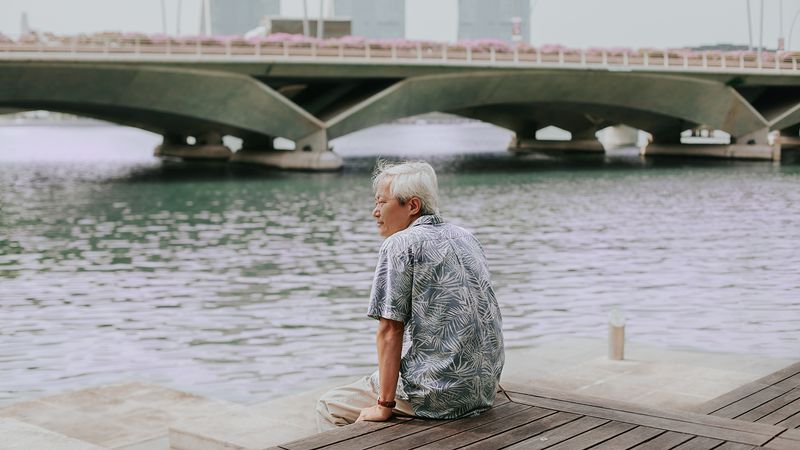
Poetry first came to Boey as a child, courtesy of the library at the British Council. In the 1980s, it was located at the Singapore Rubber House, across from Clifford Pier. For this profile’s interview, Boey suggested Queen Elizabeth Walk, a place he has known and loved that still resembles its past form. He was dressed in a faded blue shirt, overlaid with a pattern of white palm fronds, light beige slacks, and brown loafers. A tousle of white hair sat atop his broad face and sharp eyes. He has aged, a contrast to the portraits of a restless, young man with dark hair that have accompanied many of his past volumes.
It was not our first time meeting—when I returned to Singapore from the US in 2022, we wound up on a panel together to read our poems. It was there that I sheepishly produced three of his books from my backpack for him to sign, and revealed that his novel, a fictionalised memoir of the Tang Dynasty poet Du Fu, was a primary motivator for my graduate work in East Asian Studies. We became occasional pen pals, with me sending over essays or poems that had referenced his work. Our meeting to discuss a profile of his life felt like an organic outgrowth of that.
As a teenager at the British Council’s library, Boey first encountered the works of Lawrence Durrell, Seamus Heaney, Philip Larkin and Edward Thomas—English and Irish poets who would shape his incipient desire to write. At the National Library and at second-hand bookstores around Bras Basah, Boey found more contemporary authors, such as the poet Jack Kerouac and the travel writer Bruce Chatwin. “The reading experience for me is always bound up with the places that I read the books in,” remarked Boey. It may come as a surprise that Boey began his life in Chinese-medium schools, enrolling in the now defunct Poi Ching Primary in Toa Payoh. The switch to English-medium schools came when he transferred in Primary Four to the also defunct Monk’s Hill Primary, after his father’s failed attempt at getting him a place in his alma mater, St Anthony's Boys' School. Later on, Boey continued his education at Victoria School and Nanyang Junior College. As Boey entered adolescence, the memory of classical Chinese verses gradually faded, and a new linguistic world came into shape before his eyes.
Boey’s father has maintained a towering presence through much of his work. Central to the essay collection Between Stations and poetry collection Clear Brightness were memories of long walks with his father through Change Alley, Orchard Road, and Little India. They were recorded in fastidious detail, with attention to the gait and limp of Boey’s aging father, alongside the impressions of sight, smell, and sound so characteristic of Boey’s vivid prose and poetry. The absence of Boey’s father evolved into an ache, a desire for his presence. It formed the contours of Boey’s spirituality: “It is hard to trace how or when it began in childhood, the conversation with a god that I had no name for. It probably began with prayers to keep my father safe, to make him come home to us, for my parents to be reunited,” he explained. “I remember reciting feverishly in Cantonese, for that was what I spoke and thought in as a child.” Perhaps, the tenuous and tortured relationship between Boey and his father found a modicum of peace in these walks; from St Joseph’s Institution, down Orchard Road, onward to the ice cream parlour in the FitzPatrick’s supermarket, and into the ether as Boey’s father returned him to his grandmother.
In Between Stations, Boey relied on old photographs of his father as a young man and family portraits to try and discern the moment that his father changed, while also recalling moments of doubling he experienced when he had children of his own. “Fatherhood has changed me quite profoundly, in ways I could have never imagined possible,” he described. “There is a sense of a déjà vu about it—that you become your father, and the little things you do, like carrying your child on your shoulders, trigger sensations of being in your dad’s body. It’s a moment of convergence, when you become both father and child, and that’s a powerful and meaningful experience.” In some of their final encounters, his father living alone in a small flat along Beach Road, Boey wrote of terrible shouting, of denying his father the kindness of taking one of his cigarettes. “It was too late, living with the weight of parenthood and rediscovering love for my father—he was dying and I didn’t make it back to say the words I needed to say,” Boey remarked. His father passed away while he was in Australia, caught between recollections of an old life and the making of a new.
The 1980s were when a sense of the old Singapore disappearing became increasingly apparent to Boey. “My sense of things passing, of how impermanent everything here is in Singapore became sharpened, quite acute,” he recalled. The ambles he shared with his father became a mainstay of his behaviour prior to conscription. “I walked around a lot in the couple of years before enlisting in NS [National Service], as if to commit these places I loved to memory before they vanished. Perhaps that’s how I acquired what Unamuno called ‘the tragic sense of life’.” The sense of a physical inscription, of the urban landscape impressing itself upon the body, has continued to shape Boey’s work.
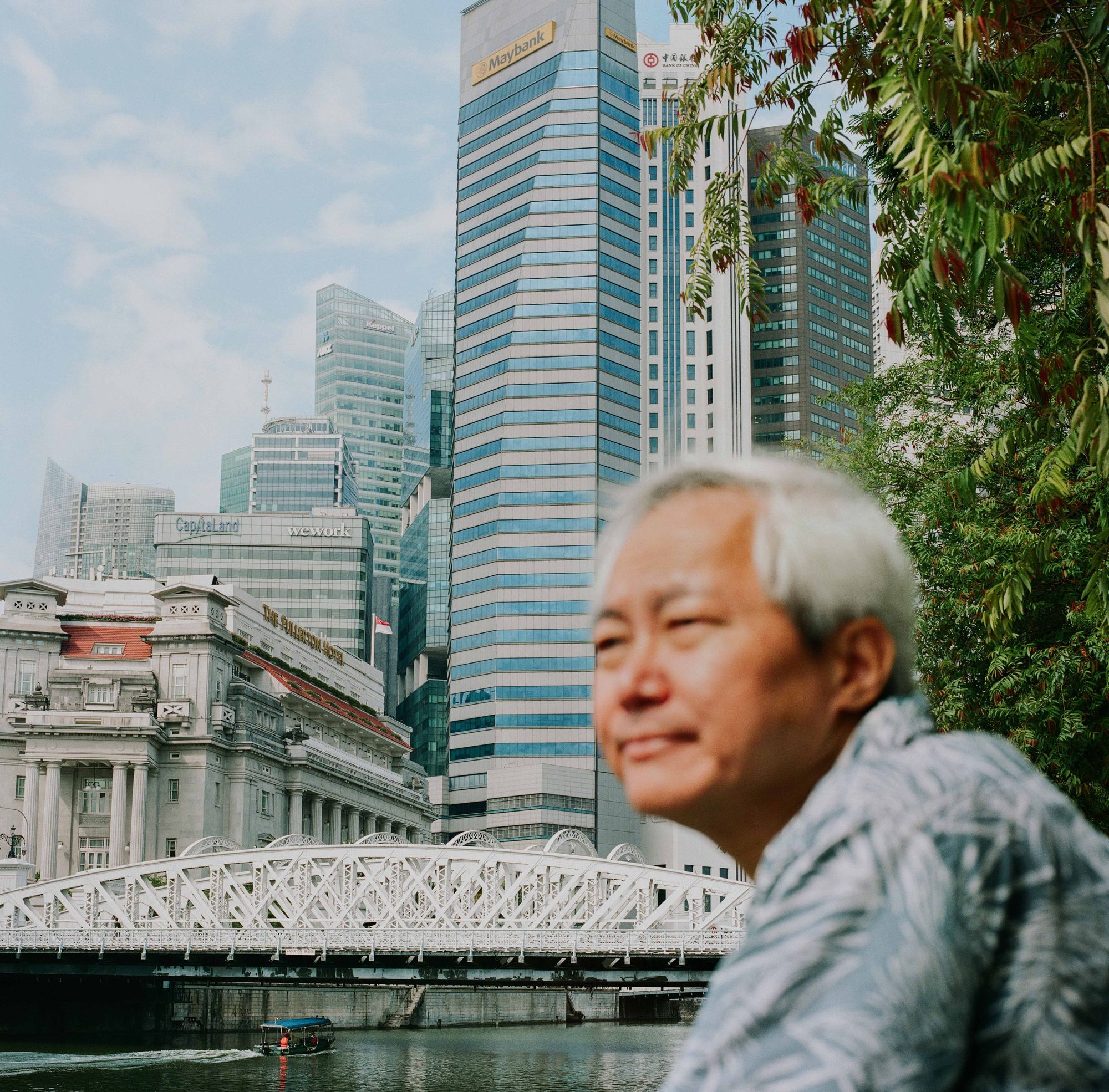
As we ambled along the river, he pointed out the looming bank buildings where warehouses once stood. A transformation into commerce’s own image, which reflected Boey’s own commitment to rendering demolished space in his writing.
Boey’s time in the military proved to be a period of creative absence. “It was two and a half years of army, during which I hardly read anything, and the poet’s vocation I had pledged myself to was all but forgotten,” he recalled. “Most of the time it was a numbing, deadening routine of training and carrying out orders without questions, trudging through the same training ground again and again.” This monotony was juxtaposed against Boey’s first memories of travel abroad—to Taiwan where he bivouacked on a hill in the rain and the cold, to Brunei where he got lost in the jungle, and to Thailand where he built a Bailey bridge with his platoon.
Boey’s first year at the National University of Singapore (NUS) was spent “trying to think civilian.” Felix Cheong, a poet, writer, and Boey’s contemporary at the English literature department in NUS, recollected a social circle of “literary, geeky sorts of fellas”. They traded poetry and music recommendations, compared notes, and hung out with the poet and professor Lee Tzu Pheng. Boey amassed an impressive. jazz-heavy, vinyl collection. “He’s someone who values old friendships very deeply,” Cheong described. “Even back then, he had a very old soul.”
Boey realised then that his teenage poetry—imitating the likes of John Keats, Wilfred Owen, Ted Hughes, and TS Eliot—did not feel quite real. After a barren two years, Boey began to write about his time in the army (in what has become a cliché for male Singaporean writers). These poems were more deeply satisfying, more real in their substance and emotional heft. They eventually made it into his first book of poetry, Somewhere-Bound, published in his second year of college. “The memories are without the bitterness or disillusionment that were part of youth. Just some regret that the prime years should have been spent in a sort of bondage.”
Cheong noted that Boey had “a restlessness in him that he still wasn’t doing well enough. He had to keep pushing the boundaries. It was the very craft of poetry that he was interrogating.” Much of Boey’s work in poetry was self-taught. He has described Singapore in the 1980s as a ‘cultural desert’, compared to now. “I think you invent your exemplars, you invent your influences, you invent your ancestors, as you start out,” he explained.
Boey’s undergraduate years and creative growth coincided with a period of marked political intensity in Singapore. This was the period of Operation Spectrum; the notorious covert operation that saw Singapore detain 22 people without trial under the Internal Security Act in 1987. Their crime? An alleged plot to use “communist united front tactics” to “subvert the existing social and political system in Singapore.” The group consisted of Catholic lay workers, social workers, activists and theatre professionals. (Jom profiled one of them, KC Chew, last year.) Boey recalled the suspicion of not knowing whether the people around him were agents of some sort, eavesdropping on conversation. Coupled with the rapid disfiguring and changing of the neighbourhoods he loved, this “horrible” period fostered in him a desire to leave Singapore altogether. In an essay from Between Stations, Boey described an evening with his peers, drinking beers on a coast, imagining all the new migrants the government would bring in to replace them once they’d left. I felt a strange twinge of guilt reading that passage—in 1997, the year that Boey left with his family for Australia, my own would arrive in Singapore from the US.
The culmination of Boey’s intellectual life as an undergraduate was an honours thesis on Seamus Heaney. His development as a poet had been facilitated by his reading journey at NUS, discovering poets such as Gerald Manley Hopkins, Li-Young Lee, Philip Levine, Rainer Maria Rilke and Mark Strand. “These all steered me into a poetry of the real, of looking at memory and experience through the lens of poetry,” he mused. In 1987, Boey made a pilgrimage to Hopkins’s mass grave in Dublin, in a lot buried with other priests. But it was Heaney whom he recalled really taught him the craft. This paved the way for other Irish poets, including Michael Longley and Derek Mahon.
Beyond the sturdiness of their lyrics, the fine ear these poets had was evident in the cadences of their poems. Boey has also described admiring the approach to politics taken by these Irish writers. “At the time, the situation in Northern Ireland was pretty bad, and there was a lot of pressure on them to deal with that,” he explained, referencing The Troubles, a roughly 30-year period of ethno-nationalist and religious conflict.
“The way they resisted that political pressure was exemplary for me. In Singapore, in the 1980s and early 1990s, the political situation was also pretty bad,” he remarked. “They showed me how poetry can stand on its own and resist the demands of politics while not ignoring it entirely. It didn’t have to succumb to pressure to make any statements, to take any sides.”
Boey’s first stint as a PhD student was at NUS, right after his undergraduate years, but he opted to discontinue his studies. He could not find a suitable supervisor to guide him in his journey of studying the Irish poets further. Instead, he opted to take on a role in the Singapore Prison Service, followed by a time as a probation officer. As he wrote in an essay in Between Stations titled “O Calcutta”, about a trip to India in 1997 on the cusp of emigrating to Australia:
As part of the job training and orientation, I had to witness a caning session. The sight of the inmates being queued up with nothing on but a loincloth, and the indifferent expressions of the officers and wardens as the razor-thin cane lashed the exposed buttocks of the inmate tied to a rack, told me I was in the wrong place.
And then I was brought on a tour of the death row. Most of those waiting to be hanged were drug traffickers, and the amount in many cases was just a little over the death-penalty clincher of fifteen grams. These were the most “privileged” inmates in Changi; they were well-fed and had their own cells. They smiled and greeted me, but there was an indescribable look in their eyes that has remained with me: a mixture of embarrassment, remorse, peace and terror.
[…]
The next job was more like a continuation of my Prisons Service experience, except that I wasn’t required to wear a uniform. As a probation officer my clients were juvenile delinquents with the potential to graduate to prison or a drug rehabilitation centre. Almost all the case histories read the same: broken families, three-tier families packed into one-room flats, the abusive or absent father who spent most of his time in prison and the rehab centres, where one day they would meet their sons.
[…]
Once again my attempt at some kind of social work had failed. I didn’t want the cycle: work, reservist duty in the army, travel, looking for work again. And trying to find space for writing. Getting a permanent residence in Australia seemed a way out. It would be a one-way ticket this time.
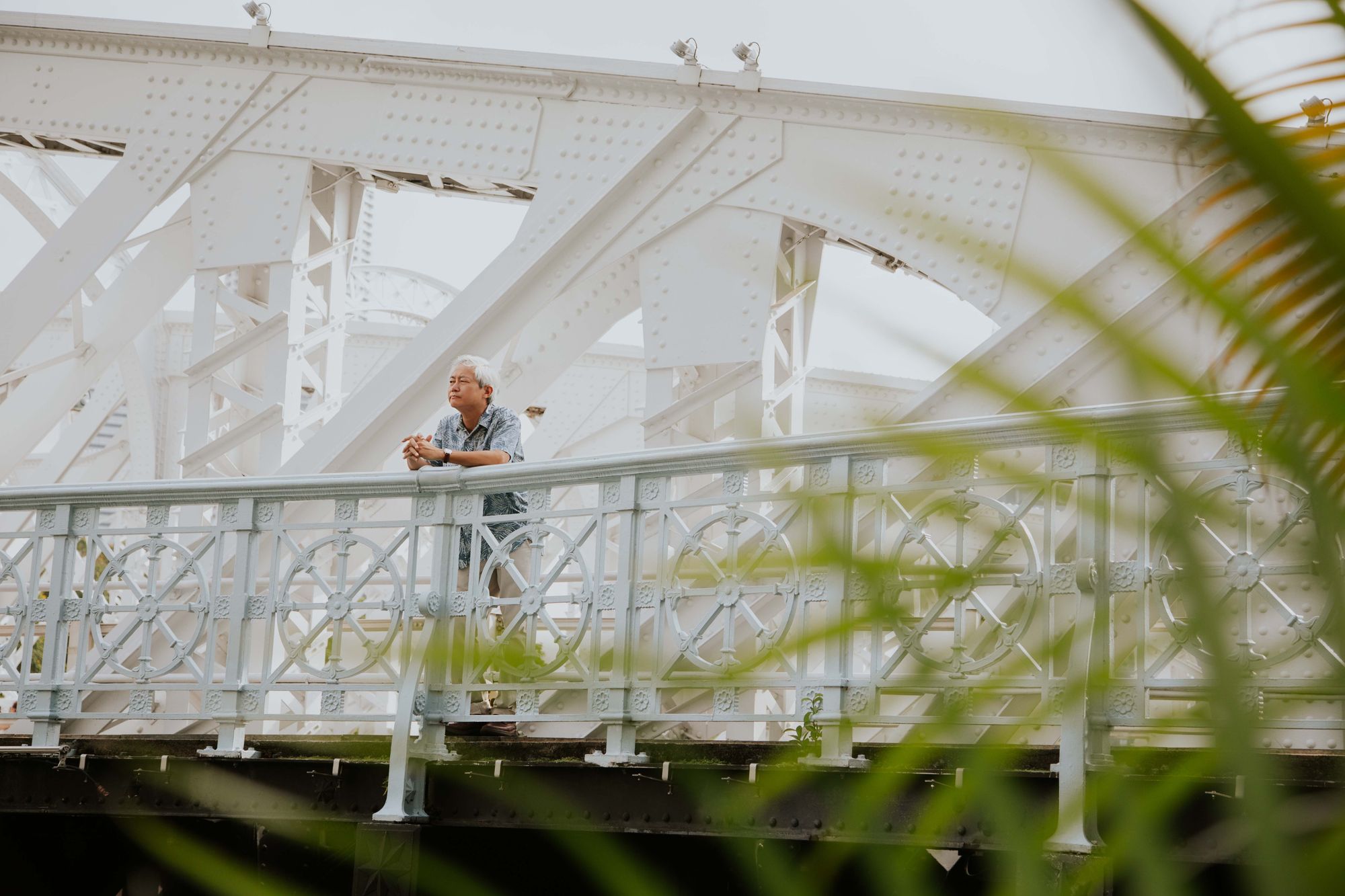
Boey’s decision to leave was also in part the result of his being snubbed by Singapore’s literary establishment. In 1995, Boey lost the Singapore Literature Prize to Roger Vaughan Jenkins, despite the prevailing view that his Days of No Name was more aesthetically accomplished than Jenkins’s From the Belly of the Carp. As critic Gwee wrote, “Although the state judges declared Jenkins’s win unambiguous, many found the aesthetic standards jarring, lending much force to an erstwhile quiet suspicion that the way to win a state award was simply to write for the state.”
The year preceding Boey’s departure was recounted in thorough detail in his essay collection Between Stations. The book began as a tentative series of travel articles for The Straits Times, by the request of journalist Ong Sor Fern. They evolved into a series of deeply personal, reflective essays, flitting between Boey’s sojourns in China, India and Morocco and the ways they had revived memories of childhood, adolescence, and young adulthood in Singapore. Boey’s essays are marked by a fascination with the stories of those he met along the way, and found parallels in his collection Clear Brightness. The poem “To Markets”, for example, consists of 15 sections describing a bevy of locations—Cairo, Calcutta, Change Alley, Istanbul, Kashgar, Marrakesh, Tangiers, and Xian, among others. “It was a year of madness, covering so much distance, trying to see as much as I could before the money ran out,” he described. “I haven’t done anything like that since. You get tired of travelling around the world to see ‘our own filth, thrown in the face of mankind’, to quote Claude Levi-Strauss.”
In 1994, Boey undertook a creative writing fellowship in Iowa, long lauded as a premier destination for burgeoning writers. “It was a liberating few months,” he described wistfully. “I had been feeling pent-up, working in the Civil Service and despairing of finding room for poetry in real life. So it was great to shrug it off in the wide expanses of the Midwest, Amtraking to Arizona and San Francisco. It led to a more loose-limbed line, and more attentiveness to the moment, leaning closer to the ground of experience.”
Boey had briefly considered emigrating to the US, yet the prospect of securing a green card seemed too onerous. So, too, had Boey seriously contemplated moving to Germany, to pursue a PhD thesis at Freiburg, studying Rilke and Heidegger. Yet, as he confessed, “I didn’t have the courage or ingenuity to pursue it.” And so it was that Boey and his wife left Singapore for a new life in New South Wales.
Berowra lies 36km north of Sydney. Surrounded by creeks and the bush, it has a population of 12,000 people, and, at some point in the 1970s, was allegedly home to Mel Gibson. Its name was derived from a local Aboriginal word meaning “a place of many winds”. It is this that gave coherence to Boey’s arrival and settling into the suburb, becoming more attuned to the land, becoming accustomed to the occasional bushfires that came close to his new home. In his essay ‘Place of Many Winds’ from Between Stations, Boey wrote:
On the western horizon the Blue Mountains hover, and to the north the ridges of Muogamarra Nature Reserve roll on like the rucks of an endless green carpet. After the clutter of the Singapore skyline, the emptiness is liberating, but also frightening. Space, freedom, these were inconceivable abstracts in Singapore. And unregulated time. Here, everything seems to breathe slow time or timelessness.
One of Boey’s first neighbours was an older, white Australian lady who had lived in Singapore with her husband, who had been posted there as a plant manager before Boey was born. Another’s father was a former prisoner of war in Changi Prison. These old place names would ring strange in the crisp Berowra air. Boey’s plot of land became home to daffodils, freesias, and jonquils, alongside the existing jacarandas and plum trees. On the fire trail, the bush revealed gums, dense canopy, and the leafy rot. An abundance of time, space, and silence.
After a period of odd-jobbing in Sydney and a series of unsuccessful applications for other work, Boey fell back on the academy. He received a research scholarship at Macquarie University, where he completed his doctoral thesis on Irish poetry. This eventually led to a position as a professor of English and Creative Writing at the University of Newcastle. I asked Boey if he ever encountered any scepticism—perhaps anxiously, I imagined the disdain and derision of a classroom of older white Australians. This was 2003, a period when Australia had yet perhaps to warm to Asia in the way that it seemed to have as of 2023. “One of my colleagues asked if I wrote in English,” he recalled. “I didn’t see that as racism or anything. It was a bit of an insult and slightly offensive, but I could understand where he was coming from. The mind can be a little provincial, especially for people living away from metropolitan cities like Sydney or Melbourne.” Boey’s predecessor had relied on a curriculum of fantasy and science fiction for his classes. The arrival of Boey instigated a shift toward poetry and non-fiction.
“I was a creative writing sceptic when I started teaching. I didn’t believe it could be taught,” Boey admitted. “But my doubts were soon dispelled when I saw how with a good reading programme and a supportive literary community, students can discover their voices, styles and themes.” Some of Boey’s students became friends, sharing in his love of poetry, and these friendships helped him to feel more grounded and accepted in Australia. One of his students, he shared, is dying. Their limited time left is one of the reasons he’s been so eager to return.
I asked Boey if he has felt accepted by Australia’s literary community. After all, he immigrated in his 30s and has continued to write poems evocative primarily of Singapore. “I’ve always worked on the margins,” he attested. “I think trying to reinvent myself as an Australian writer has been a struggle, getting recognition there while also maintaining my links to Singapore.”
The rise of Boey’s literary stature in Singapore, as Gwee argued, is in part related to a sense of collective guilt for his having departed for Australia. Boey had become imagined to be a displaced Singaporean because of his unpatriotic aesthetics. In 2006, during a reading in NUS, he had to remind his audience, “I am not an exile!”
“It’s hard to see myself as fully Australian or fully Singaporean, you know. You’re always sort of somewhere in between. You navigate the mental spaces. Sometimes you lean more towards the Singapore side of yourself, and then sometimes you shy away from it,” Boey remarked. While he has continued to remain in this in-between state, I asked if his children, raised in the open expanses of Berowra and accustomed to glimpses of Singapore on holidays, have grown up with a similar sort of restlessness. “I don’t ask my children,” he said. “But watching them grow up, I haven’t seen any sort of interrogation of their sense of identity. We never tried to force our politics on them.”
For Boey, his return to Singapore in 2016 yielded an even more palpable sense of the dizzying changes he experienced in the 1980s. “It’s hard to come back to a Singapore that has been utterly transformed into a global city,” he admitted. When Boey left in 1997, there was no Marina Bay Sands, no Esplanade, and the Singapore River “was still a river”. In the intervening 20 years since Boey’s departure, Singapore had been utterly transformed by the imperatives of development and the inflows of global capital and labour. “There was a lot more space still in the 90s, up to the year I left. Now there is a density about Singapore that can be challenging to deal with, in a built-up environment, in the sheer press of bodies around you, on the streets and in the trains,” he observed. “And you don’t see or hear Singaporeans around you in the public spaces. The population has [almost] doubled since the 90s, but most of the increases have come from new migrants, expatriates, foreign workers.” As Boey mused, “I am experiencing a homesickness for my adopted country now.”
At NTU, teaching undergraduates in English and Creative Writing, Boey found a shift away from the mature students he had taught in Newcastle, all while tending to his ailing mother. He also took on graduate students, including the novelists Daryl Yam and Ng Yi-Sheng, nominee and recipient of the Singapore Literature Prize respectively. “The best memories are of students, working with them to find their voices and themes. They are a lot younger here, but the ardour and the youthful energy and talent are wonderful and affirming,” he observed.
Laetitia Keok, a poet and editor who had Boey as her thesis supervisor, described his pedagogical style: “He created a space that was non-judgemental and unimposing enough for me to first witness what a healthy workshop can do for younger writers. I also really loved that he always got us to read our poems out loud—in his words: all poems should be read aloud.” Laura Jane Lee, a poet who Boey also taught, recalled, “I would bring a little notebook to write down choice quotes because a lot of the things he says are very inspiring. They make for good poem fodder.”
NTU itself has been an object of Boey’s appreciation. He remarked, “There is the history of the university, strong echoes from its days as Nanyang University, the original building and the beautiful gardens and the spread of trees around.” At the time of his retirement, boxes of his books were left for any student to take.
The stresses and rigours of an academic career have also affected Boey’s creative output. He admitted that he might have published more books had he had more time and energy. During his stint at NTU, Boey ventured beyond poetry and essays to craft Gull Between Heaven and Earth, a novel reimagining the life of the Tang Dynasty scholar, poet, and historian Du Fu (712-770). Boey sifted through the 1,300 or so poems that Du Fu had written in order to reconstruct a narrative of his life. “Identifying the key poems allowed me to piece together his life. Du Fu had a wife and children, but there were no records of their names, so I had to glean that from his poetry,” he said.
Boey’s other project, the gargantuan almost 700-page anthology To Gather Your Leaving, was a continuation of his work on Asian Australian poets. The anthology collates the work of Asian diasporic poets across the English-speaking world, including Li-Young Lee, Ocean Vuong, Sarah Howe, Victoria Chang, Arthur Sze, and Ee Tiang Hong. Boey described the anthology as an act of “mapping, of charting a new terrain, a floating, nebulous, liminal country” that has opened up with the phenomenon of “transnationalism and the fluidity of migration.” Yet, as poet Tse Hao Guang wrote in his critique of the anthology:
The cumulative effect of these editorial decisions is to reinforce the narrative that the only or best way for an Asian writer working in English to be recognised, read and anthologised is to get as close as possible to the centres of Anglophone literary production.
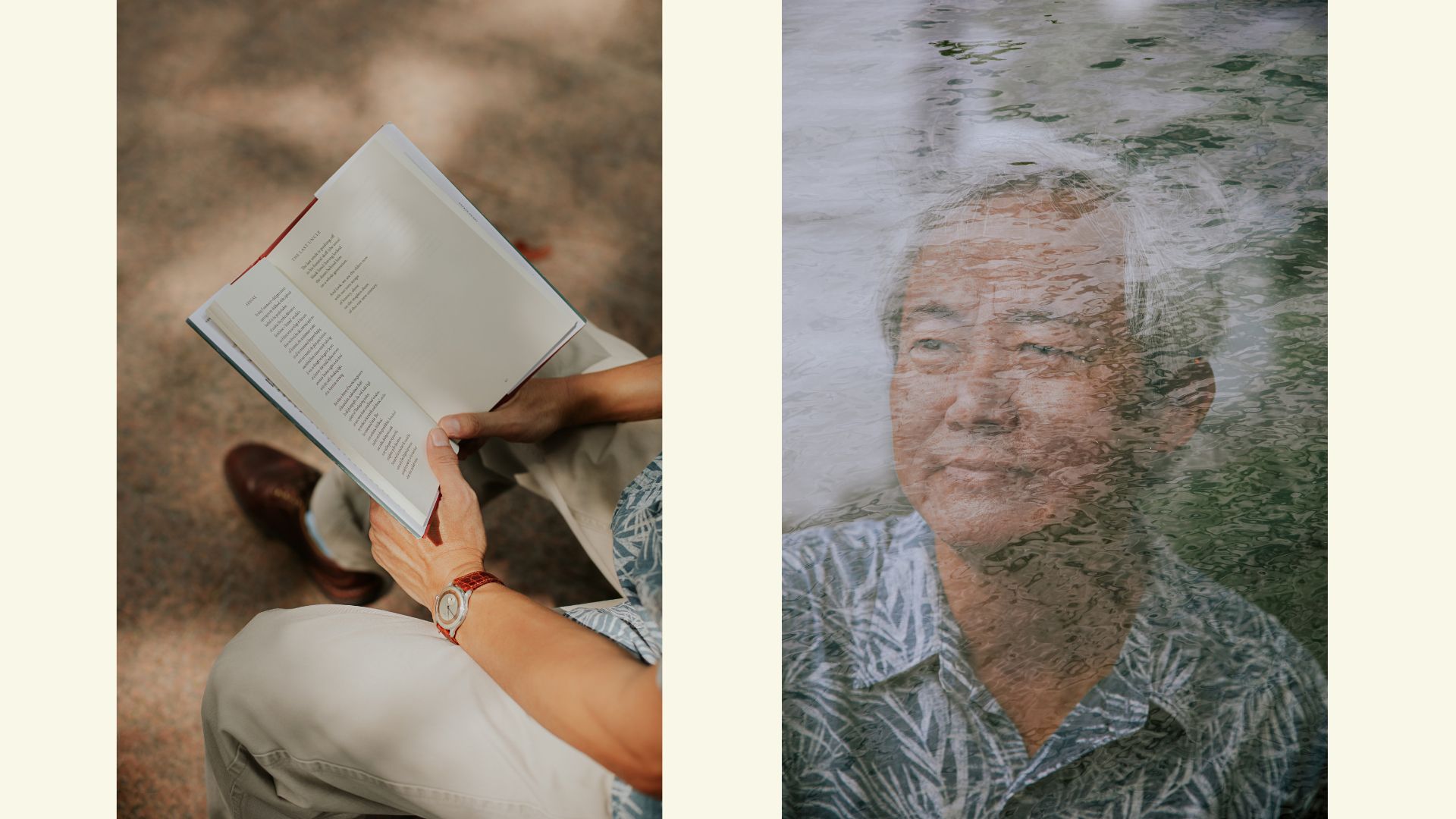
However, it is The Singer that has emerged as Boey’s most sublime creative achievement in his time back in Singapore. The recipient of the Kenneth Slessor Prize for Poetry, the collection is full of maximalist, expansive poems that spill over pages and pages. Like his previous work, Boey’s poems move and meander between the landscapes of Australia, India and Singapore, possessing the pace of a journey by foot, yet with a breadth and ambition unmatched in Boey’s previous collections. Journalist Ong Sor Fern wrote that Boey’s writing seemed to be invigorated by a “renewed sense of mortality”. One imagined, perhaps, that this derived from the book having a very different impetus: unlike Boey’s previous work where his father loomed, The Singer, referencing the eponymous machine his mother worked on, came into being upon her death. While many of the poems in the book accumulated over the course of the past 10 years, with his last book of poetry Clear Brightness being published in 2012, The Singer’s titular poem began as a tribute to his mother. Boey wrote in his poem:
You half-pray the lines of the poem will
unravel, the sewing will never stop, making the shirt you will wear
to the end, and you will carry your mother inside its pockets and
its empty sleeves.
“I resisted writing an elegy for months but gave in and wrote the title poem, which is about my mother’s sewing machine,” he reflected. “It was the only way I could deal with her being gone and me again being too late to say the words that mattered.”
In Singapore, Boey observed that the literary scene has changed. “There’s certainly a burgeoning interest in poetry and a lot more rooms and platforms for poets to express themselves,” he explained. “The literary community is a lot more visible and active now than it was back in the 80s. There wasn’t an equivalent of Sing Lit Station. There was very little of the literary scene that you would see happening.” Part of this, as Boey described it, has manifested in different waves and movements. In contemporary poetry, he sees the emergence of many poems driven by ideas or concepts, poems sceptical about sentiments and feelings. Here, he sees the weighing of the mind over the heart and the body. “Ideas are not enough,” he asserted. He sees the confessional trend, one that has dominated Singaporean poetry in English under the influence of poet Cyril Wong. Poems dealing with personal crisis and identity, poems that are courageous and unafraid. But by his own admission, Boey continues to prefer the “good old-fashioned lyric”. He explained, “I’d rather go back to poems where I can hear the music. I can hear the rhythm.”
The establishment of stronger institutions and programmes to cultivate the literary scene has transformed writing in Singapore, whether as a result of the democratising influence of the Singapore Poetry Writing Month, or the seeming plenitude of readings and events. Yet, Boey has maintained a healthy wariness toward these developments. “I think what’s missing now is a sense of solitude,” he explained. “I don’t know whether it’s a good or bad thing that the moment poets start writing and publishing, they find themselves being grouped with this movement or that, or they become drawn into a kind of circuit.” Admittedly, there can be a lot of pressure for writers to make themselves known not only through social media and alignments with certain schools of writing, but also through active participation in open readings. He said, “I do think that as a writer you need a lot of solitary space and time. A lot of solitude.”
Perhaps Boey’s detachment, one bordering on sagely, has been underwritten by the assurance of his poetic legacy. Yet, one senses no such pretensions about his life of letters. The traces he has left will continue to bear their own weight.
Solitude seems not only to have been central to his creative practice, but also to the character of Boey’s retirement. At present, Boey has retired from his position at NTU and returned to Australia. The expanse of time ahead will “mostly allow rereading” of those he had previously rushed through: Cavafy and the Tang Dynasty poets, Wallace Stevens and WS Merwin, Philip Larkin and Elizabeth Bishop, Galway Kinnell and Seamus Heaney.
At the point of his departure, having spent his time shaping a new generation of writers, witnessing the continuing and unrelenting transformation of Singapore before his eyes, Boey remarked, “It’s sad leaving Singapore for the second and perhaps the final time, but I am more than ready to go home.” Home, his plot of land in Berowra, will provide time and space to read and remember the “vital poems that have made me what I am.” Like so many Singaporeans abroad, Boey will continue to make annual sojourns back, but is certain that there is a finality to this departure. At the end of our conversation, he recalled a retirement poem by the Tang poet and politician Wang Wei (699-759). “I should end with it,” Boey remarked:
In old age I favour silence
And cease to care about the ways of the world.
As far as I am concerned there are no long-term plans;
Only the desire to return to these old woods.
The breeze through the pines loosens my belt
And the mountain moon shines as I play the lute.
You ask me about the way of emptiness;
The fisherman’s song drifts through the deep ravine.
Jonathan Chan is a writer and editor of poems and essays. He received a BA in English from Cambridge and an MA in East Asian Studies from Yale. He is the author of the poetry collection “going home” (Singapore: Landmark, 2022). More of his writing can be found here.
Letters in response to this piece can be sent to sudhir@jom.media. All will be considered for publication on our “Letters to the editor” page.
Correction: An earlier version listed Arthur Yap, instead of Arthur Sze, as being one of several Asian diasporic poets in an anthology. Jonathan has also suggested some other minor changes to his copy, which we've made.