
News this week included: a shortage of blood donors; seniors visiting the dentist less often; concerns over bus stop construction at Serangoon River forest; how ube became the new matcha; how a veteran teacher is using technology to teach Tamil; rising memory chip prices affecting computer upgrades and Sim Lim Square retailers; an explainer on PSLE bootcamps; and a story about those who go missing—about four people every day—in Singapore.
Below are the issues we chose to explore in more depth.
Our picks
Politics: The fog of war
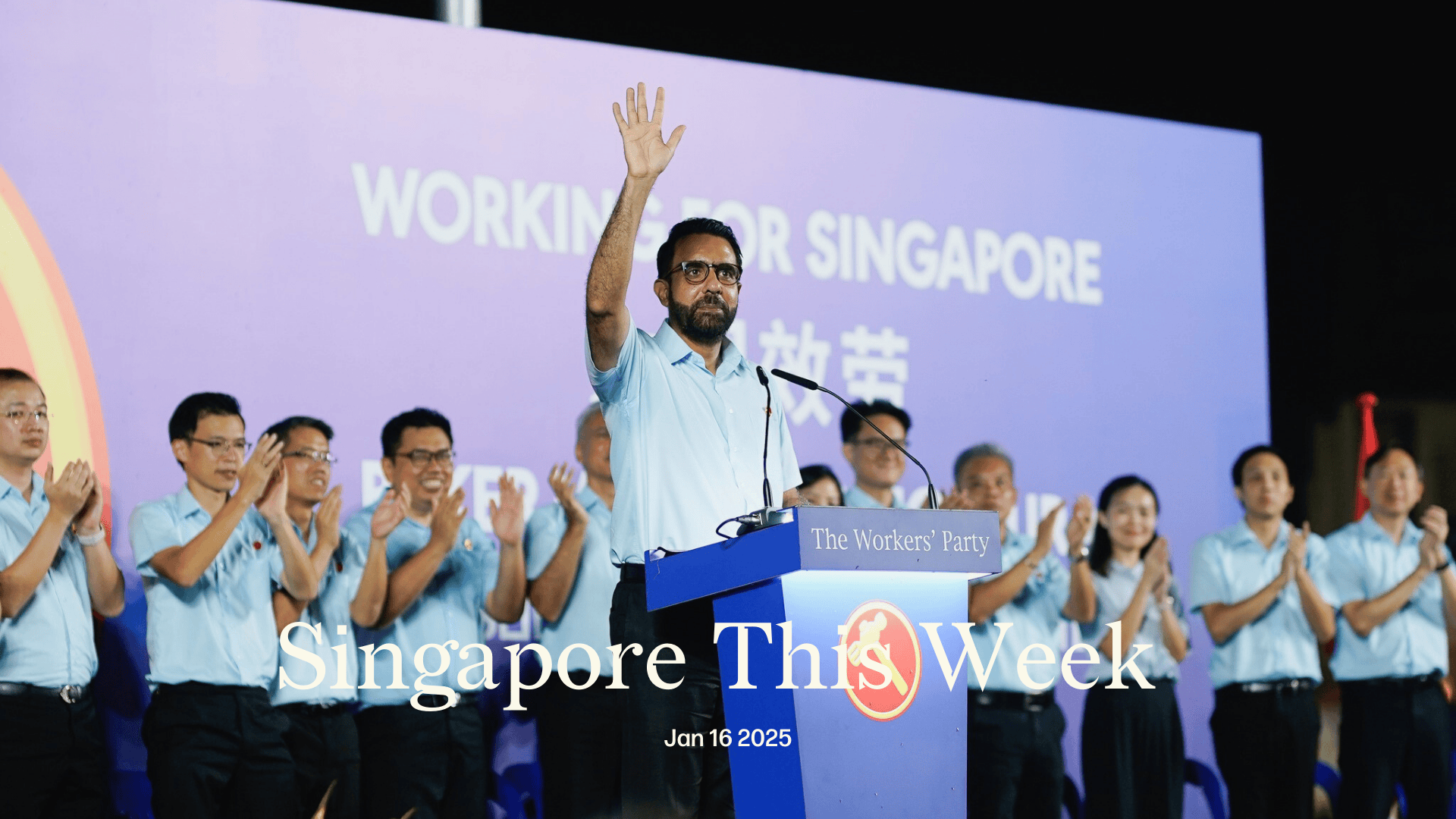
Does accepting a court’s judgement mean you necessarily agree with it? No. In Parliament this week, Pritam Singh, WP chief, made clear his position on his conviction for lying during Raeesahgate. He was responding to a motion that, among other things, stated that his conduct was dishonourable and unbecoming of an MP, and that his continuation as leader of the opposition (LO) would undermine public confidence in the integrity of Singapore’s political system. “[M]y conscience will always be clear” on both charges, he said, even as he reiterated his “responsibility for not responding quickly enough to correct [Raeesah] Khan’s lie”.
Singh referenced the criminal conviction of Tharman Shanmugaratnam, president. In 1992, Shanmugaratnam was director of the Economics Department at MAS, when he and others were charged under the Official Secrets Act in a news leak case. Like Singh, he pleaded innocence. Acquitted of the more serious charge of communicating secrets, Shanmugaratnam was eventually found guilty of a lesser charge of negligence, and was fined. In 2023, on the eve of the presidential election, his pithy dismissal of the case was “they got the wrong man”. Is any judiciary, error-prone as humans are, the final arbiter of “the truth”? Only god is, the religious might contend.
And what impact should a judgement have on an individual’s conscience, their standing in the community, and their ability to perform their role? Surely in the court of public opinion, at least, the nature of the crime matters. Tharman’s sympathisers might suggest that a growth projection is a relatively innocuous secret to leak, whoever did it. Singh’s might say that any leader—when faced with a subordinate who's both admitted to lying and being a rape survivor—may fumble, stuck between condemnation and empathy, between the interests of the group and the individual.
The opportunity to meditate on these philosophical questions was the saving grace of an otherwise predictable session. All PAP MPs present voted in favour. So did the fresh batch of (allegedly non-partisan) nominated MPs, which would’ve pleased the PAP-dominated committee that chose them. Singh lifted the party whip, but all 10 WP colleagues present also proved their loyalty to him. In concluding remarks, Indranee Rajah, minister and leader of the house who tabled the motion, broadened her attack to all WP MPs, characterising their position as “[t]he rules don’t apply to us”. (Singh rejected this.) Yet there is a whole gamut of recent incidents overseen by the current ministerial crop—from the TraceTogether debacle and the Tan Chuan-Jin affair to the recruitment of supposedly non-partisan NMPs—that critics are equating, rightly or not, on similar grounds of timeliness and integrity: well the rules don’t apply to you either.
Lawrence Wong, prime minister, yesterday stripped Singh of his LO title, and asked the WP to name a new one. The PAP will hope that this sows discord within the only opposition party in Parliament. The WP had earlier initiated internal disciplinary proceedings to conclude by April, though events may now accelerate broader decision-making on a raft of issues. (For now they’re as united as ever, brandishing a new #WeContinue slogan.) Will any new presumptive LO have to first succeed Singh as party secretary-general? Some supporters believe the WP, more cohesive and well-resourced than it’s ever been, should simply thumb its nose at a position that is not constitutionally enshrined, but at the behest of the prime minister. (“FO with your LO.”) Whether in dispensing vouchers or titles, the PAP relishes its role as benefactor to the huddled masses. What if some actually snapped back?
A marvellous riposte for the popcorn-munching gallery, though it’s uncertain if it’ll help the WP broaden its appeal to the middle ground. Does being a “responsible and loyal” opposition mean accepting any handout under any circumstance—or pushing back under perceived oppression? PAP fans will cheer the demotion of one of Singapore’s most popular politicians, and will again clamber up their sanctimonious high ground in defending it. Eugene Tan, law professor and dependable commentator, buttressed the party’s talking points “at a time when there are real and growing concerns about the eroding integrity of political leaders around the world.” Will non-partisan Singaporeans buy into the equivalence of Singh’s lie with the worst excesses, say, from the US? Or will they perceive the PAP’s machinations as simply the latest in decades-old efforts to maintain its hegemony, now wrapped in a saccharine, strumming, serenade about alternative views and inclusivity?
Society: Citizenship for Gurkhas and their families
You’ve spent your whole childhood here. Your tastebuds have grown familiar to flavours of laksa, char kway teow, and pandan waffles. Your speech is flecked with lahs and lohs. But as soon as your father retires, it’s time to return to your “home country”—which you’ve visited only a few times. Such are the lives of Gurkha children. Recently, Jules Thapa, the 34-year-old daughter of a Gurkha, recalled her “hard and confusing” first few years “returning” to Nepal when she turned 16. In her Facebook post, she appealed for Gurkha families to have citizenship pathways, as the kids, she said, are “just as capable and talented to contribute to Singapore’s economy”. While Gurkhas can bring their spouses and children to Singapore, their dependents are not allowed to hold work permits, and they must all return to Nepal upon retirement. This is unlike the UK, among other places, which offers Gurkhas and their families settlement rights (with opportunities to apply for citizenship) if they have worked for at least four years.
It was with the British Army that the Gurkhas first came here, recruited for their fearless military prowess and loyalty. The police force retained them during its formative years to “help restore law and order on the streets” and they’ve been here since. Presently, the Gurkha Contingent (GC) is a paramilitary unit of about 2,000 officers in the special guard and counter-terrorist force. At times, they make an appearance in large-scale international events like the Trump-Kim summit in 2018. In 1987, Home Affairs Minister S. Jayakumar told The Straits Times (ST) that GC played an important role in quelling communal tensions since “they and their families are not part of Singaporean society”, “they are totally impartial” and can “obey orders and keep peace regardless of which racial group is causing the trouble”. Their “apolitical” identity was retained through restrictive policies like not being allowed to marry local or non-Nepalese women. They reside in Mount Vernon Camp, a separate gated enclave, away from the local community.
Singapore’s approach to Gurkhas reflects how transmigrant labour has always been bifurcated—“expats” versus “migrant workers”—and exploited through a logic of “use and discard” basis. The need for Gurkhas in a multi-racial society built on migrant labour is ironic. Shouldn’t impartiality be a given for all professionals in local security forces regardless of their connection to the population? The need to segregate the GC from locals might just reify our underlying assumptions on racial and religious differences, enabled by confirmation bias and self-fulfilling prophecies. Consider the discrimination against Muslims in sensitive units of the Singapore Armed Forces on the presumption that religion will matter more to them than nationality in any conflict with our Muslim-majority neighbours. When can the conversation shift—from racial division as a threat to stability, to ways of forging trust and faith in a multi-racial, multi-national society?
Tech: A world of pain for Manus
In tranquil times, internationalists would have celebrated Manus.ai: a Singapore-based company founded on Chinese expertise backed by a US venture capital (VC) firm with an Indian partner. Instead, Manus is staggering from superpower punches.
Its woes began in April last year, shortly after it released a trial AI agent able to create presentations, apps, and websites from simple prompts. This step change from existing LLMs that needed more human steering attracted a US$75m (S$97.5m) investment from Benchmark, an American VC, at a US$500m (S$650m) valuation. Displeased, Trump’s Treasury Department put Benchmark on notice for a potential breach of a Biden-era ban on US investment in advanced Chinese tech. Manus fired two-thirds of its staff, shuttered its Beijing headquarters, and decamped with its core team to Singapore, new headquarters, to continue accessing US funding. There matters stayed until December when Meta, Facebook’s parent company, acquired Manus for a reported US$2.56bn.
Enter Beijing. The Chinese Commerce Ministry has now opened an investigation into the deal, claiming that it may have run afoul of restrictions on export of tech developed in China. If the Ministry deems it so, China could block the deal and perhaps even hold management criminally liable, reported ST.
It’s not mere politics. Chinese media and even influencers not obviously allied to the government castigated Manus for “killing the donkey after the grinding is done”: exploiting cheap engineering talent to build a world-class product before defecting. Meanwhile, the US funding eco-system, crucial for cash-hungry AI start-ups, is acquiring a taste for Trumpian nationalism and xenophobia.“[W]ow, actions have consequences?” chortled Delian Asparouhov, partner at the storied VC Founders Fund, when Benchmark’s investment attracted US scrutiny. He later accused Benchmark of aiding “the enemy.” Tim Draper, another prominent investor who once backed the Chinese search engine Baidu, has vowed to shun the country until Xi Jinping “sees the light or is replaced.”
None of this bodes well for Singapore, long considered leeward of geopolitical winds. When Manus moved, and then was bought by Meta, some claimed the country’s studied neutrality, its socio-political stability, and openness to business made it the perfect Philosopher’s Stone on which to conduct the alchemy of tech, talent, and capital. Or, to use observers’ more contemporary jargon: it has the potential to become the “vibe-coding start-up of the world” and “The Switzerland of AI”. But this episode and last year’s microchip smuggling fracas (alongside much else) suggest that Washington and Beijing are ushering in a zero-sum age. As the world grows smaller and more selfish, as superpowers strike “with us or against us” poses, and nationalisms turn febrile, what happens in a society which has exchanged its civic freedoms for an economic prosperity reliant on business openness and tolerance?
Some further reading: In “China’s new back doors into western markets”, the FT analysed the trend of “Singapore washing”.
History: Whose? And for whom?
The National Archives’s online catalogue of 4,860 publicly accessible histories is about 80 percent of its total holdings, we learned this week, which means around 1,000 pieces are missing from our ever-expanding national jigsaw. They may never be revealed. Or they may be partially revealed. They may be revealed to the public. Or they may be revealed to some of the public.
One reason given by Josephine Teo, minister for digital development and information, for withholding certain oral histories was the interviewees’ wishes. “For example,” she said in response to a parliamentary question by the WP’s Fadli Fawzi, “Mr CV Devan Nair, Mr S Rajaratnam, Mr E W Barker and Dr Albert Winsemius…specified that the Cabinet Secretary may consider releasing their oral history interviews five years after their death.” Indeed. Respecting the wishes of the dead is right and honourable.
The other reason proffered was “national security or international relations.” Critics may object to the opacity; the unanswered, pesky who-what-how-why-when that arise in response to such vague hand-waving. But at least there are parallels. Most democracies make such determinations, even though many appear to have clearer rules around disclosure or at least, lively discussions about classified material. Here, “access may need to stay partially or fully restricted for a longer time [undefined], even after the agreed withholding period has passed,” was all Teo offered.
As Faris Joraimi, Jom’s history editor, has written in this week’s essay, the Singaporean documents in the Albatross Files—wrenched for every drop of narrative nectar—were opened only for two people, both with ties to the ruling party. Faris titled his essay “Whose Feelings? The Albatross Files”. Another option was “Whose history?”
Repeatedly to the point of tedium, Singaporeans are told to appreciate how far they’ve come; to admire the sacrifices made; to protect, nurture, and cherish this tiny isle adrift in the sea that we call a nation. To understand. But the paths to understanding—the information, data and the history; the warts and the skeletons—oh, those are closed for a “longer time”. Really, what we are expected to know is not the story of the nation, but the heroics of the state.
Some further reading: “Whose Feelings? The Albatross Files” by Faris Joraimi; and “A turn towards transparency: the case for more open data in Singapore” by Hui-Yuan Neo.
Arts: A new Golden age?
It’s got good bones, a real estate agent might say, if they’re trying to sell you on a house with popped tiles, peeling paint, but a functioning roof. Sure, it’ll take a big bite out of your renovation budget, but trust me, you’ve got a lot to work with. The Projector knew this. The team fashioned a hip indie cinema from the bones of its past, charming us with creaky seats, narrow aisles—and an impressive lineup of arthouse and auteur flicks, often with extended runs. When it went into voluntary liquidation last year, to the tune of S$1.2m in debt, fans were devastated. The Projector had sold us on cinematic hope, the lone holdout in a brutal landscape dominated by streaming giants and the skeletal remains of cinema halls. But now, just months after aficionados bid farewell to The Projector with an all-out afterparty, there’s a flicker of a new hope.
In a plot twist, an anonymous investor has bankrolled the restoration of its Golden Mile Tower premises to its former glory by way of a new indie operation called Filmhouse. He’s hired many of The Projector’s core team members to fill the same three-screen venue on Beach Road, including Sharon Tan, former general manager, and Walter Navarro, former head of programming, in the same roles. Tan offered a few morsels of information about the owner to ST: “a cinephile who was a regular attendee at screenings held at The Projector”, a Singapore permanent resident from China who’s backing the business on his own, and who doesn’t work in film or entertainment. Filmhouse, set to open by early next month, promises that same mix of festival darlings and curated retrospectives that gave The Projector its edge, plus an upgrade to a 4K projector in one of its halls. Some fans cheered the return of an independent space, others weren’t so sure, and many more occupied that space in-between. “Excited, but also skeptical about how Filmhouse can avoid the fate of The Projector, particularly when they’re hiring all the same people,” went a comment on Reddit, “You don’t end up in sudden liquidation without some serious mismanagement.” Another chimed in, with conditions: “Please upgrade the back-breaking seats! Number one complaint for older cinephiles. Excited, die die support but have reservations.” Could Filmhouse make this beloved space a more permanent home? “I am trying / to sell them the world” Maggie Smith wrote, in a poem for her children. “Any decent realtor, / walking you through a real shithole, chirps on / about good bones: This place could be beautiful, / right? You could make this place beautiful.” The Filmhouse could be beautiful, right? We could make this place beautiful.
Arts: Hard times, soft systems
When aliens arrive on earth in Story of Your Life, Ted Chiang’s short story (later Denis Villeneuve’s blockbuster film, “Arrival”), they offer humanity a time-bending new technology. Some nations interpret this tech as a weapon. The protagonist, a linguist, recognises it as a tool, perhaps even a gift. What do we do with such a thing? COMMA, an arts festival running at *SCAPE for the rest of the month, invites us to figure tech out—together with a long list of emerging Singaporean artists.
If you’ve ever Googled your date online before you met them offline, you might want to check out “Consensual Hacking”, a workshop on digital and relational consent offered by Feelers, a research lab of artists and designers working at the intersection of art and technology. We part with terabytes of information every day, handing over intimate data to governments and conglomerates alike—but what happens when a prospective mate has access to the same? In this participatory session, you’ll explore what it means to ask for, offer up, or refuse consent in digital romantic spaces, in both conversation and hands-on computer practice. For those more musically inclined, there’s “Tune Your Drums”, where musician Syafiq Halid marries staccato electronic soundscapes with sonorous Malay percussion. The barrel-like jidur, the kettle gongs of the talempong, the two-headed gendang sunda—all of these drums share the spotlight with the immersive electronic ecosystems that Syafiq has long conjured, both as a composer and sound designer. Here, field recordings exist alongside heady synths, and you’ll get to see brand-new movement choreography astride instruments created just for this performance. And, finally, there’s a substantial slate of programmes devoted to Ballroom, that dazzling queer subculture that’s spawned many more dance genres. Go for workshops to hone your ballroom craft, watch a documentary dedicated to South-east Asian ballroom pioneers, or go for your very first ball. If we want to remake this digital world in our own image, this festival might be a good place to start.
Abhishek Mehrotra, Sakinah Safiee, Corrie Tan, and Sudhir Vadaketh wrote this week’s issue.
Letters in response to any blurb can be sent to sudhir@jom.media. All will be considered for publication on our “Letters to the editor” page.
If you enjoy Jom’s work, do get a paid subscription today to support independent journalism in Singapore.