
Our picks
International: Yanked
Even as Donald Trump, US president, takes a machete to entire industries, he has been nothing but bountiful for policy wonks, analysts, bean counters, IR nerds, and the rest of the global commentariat who can barely keep up with the outrages caused by a mabuk White House. The latest imbroglio, the kidnapping of Nicolas Maduro, Venezuelan dictator, has triggered two questions.
First, what’s the aim? Absent a coherent explanation, observers are deducing by elimination. It’s not to “bring democracy” to Venezuela, suffering under Maduro’s brutal dictatorship for over a decade. No Trump administration official has uttered the ‘D’ word since the January 3rd brouhaha—just as well, given the upshot of the US’s 21st century democratic endeavours elsewhere.
It’s not to stem the flow of drugs into the US. Trump insists Venezuela under Maduro has become a narco-state flooding the US with cocaine. In truth, Venezuela is a bit player in the trade. It’s not misplaced concern either. Trump recently pardoned a former Honduran president charged with trafficking cocaine that caused “unfathomable destruction” in the US.
Migration fares little better as an explanation. Some eight million, 20-25 percent of the population, have fled Venezuela’s impoverished economy since Maduro took over. But most have moved into neighbouring countries, and whatever northwards illegal migration exists is unlikely to stop just because Maduro is gone. His administration remains in situ.
Oil tempts. There’s history—American firms plundered Venezuelan riches in the 20th century—and there’s apparent opportunity: Venezuela’s state-owned energy firm, the PDVSA, sits on the world’s largest proven oil reserves. But even this rationale beggars credulity. Decades of corruption, neglect and sanctions, some enacted by Trump himself, have hollowed out Venezuelan infrastructure. Restoring extraction to its 1990s peak would require billions of dollars and years of effort. Perhaps, as Bloomberg suggested, Trump’s aim is longer-term dominance—to control so much supply that it can wage war on friend and foe without being susceptible to market pressures. Or perhaps, as Vox wrote, Trump simply “likes the general concept of pillaging conquered lands.”
The second question is what this means for everyone else. Here, the possibilities are endlessly terrifying. Could Venezuela be the preview to an invasion of Greenland, which squats over untold mineral wealth, including the rare earths that China has used as leverage against US pressure? Once unfathomable, it’s now being spoken about widely, including by the Danish PM herself.
Meanwhile, does China itself now have licence to invade Taiwan? Absolutely, say the best. Absurd, counter the brightest, including Singapore’s Bilahari Kausikan. As analysts gambol in the field of big power possibilities, middle and small powers are reduced to bleating out pleas: Singapore, along with other ASEAN nations, has urged restraint; the EU is “following the situation closely”; and India is “concerned”. To be clear, no tears should be wasted on Maduro and indeed, millions of expat Venezuelans have cheered his removal. But perhaps a nostalgic glass could be raised in memory of a saner, more considered world order now clearly past.
Politics: Raeesah relapse plagues Pritam
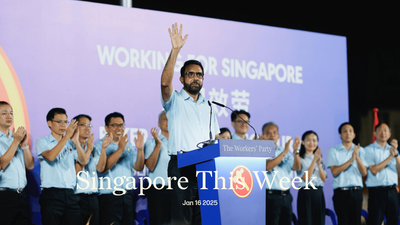
Last month, the High Court dismissed the appeal by Pritam Singh, Workers’ Party (WP) chief, against his conviction for lying to a Committee of Privileges (COP). He accepted the judgement and would have hoped that it signalled the end of the Raeesahgate affair. Not so fast. On December 17th, Indranee Rajah, minister in the prime minister’s office and leader of the house, said that Parliament must “deliberate on an appropriate response” to the conviction when it opens next Monday. She later added that the court’s findings may also have implications for Sylvia Lim and Faisal Manap, Singh’s colleagues, who were also alleged to have lied to the COP.
After the judgement, the WP indicated that it was “studying” the verdict. But internal disgruntlement appears to have been brewing. On December 28th, the WP announced that “a request has been made for a Special Cadre Members’ Conference”. The mainstream media suggested that at least 20 cadres (of some 100 odd total) had wanted the conference in February. And on January 3rd, the party said that its Central Executive Committee (CEC) “has directed that a disciplinary panel be formed to determine if Pritam Singh has contravened the constitution of the party”, with the process to be concluded within three months. (Aside: given that allegations about financial improprieties at WP town councils first emerged in 2013, Singh has effectively now had accusations collectively hanging over him for over a decade.)
Indranee cheekily compared Singh’s lie to those of former WP MPs, Raeesah Khan and Leon Perera. Each would have been expelled had they not resigned, Singh said at the respective times. “It is up to the Workers’ Party to decide what it intends to do in light of the court judgment (that he had lied under oath), and Mr Singh’s acceptance of the judgment, fully and without reservation,” Indranee said.
How severely should the WP respond to Indranee twisting the knife? Will its base desire harsh action against Singh, in order to preserve its image as a “responsible and loyal” opposition party? Or, given that many followers perceive that the system has unfairly targeted Singh—one of Singapore’s most popular politicians—will the CEC respond with a slap on his wrist, effectively calling Indranee’s bluff? On Monday, the PAP could pre-empt it with its own motion against Singh. The GE may be long gone, but popcorn and pundits are set for a return.
Update: after we published, we learned that Indranee has just filed a motion for Parliament to consider Singh unsuitable to be Leader of the Opposition.
Politics: The wayang of the unelected continues
The People’s Action Party (PAP) launched the nominated member of Parliament (NMP) scheme in 1989 as a way, ostensibly, to infuse diverse voices into a Parliament it dominated. Non-partisan sectoral leaders could, in theory, speak about controversial issues without worrying about constituents and re-election. While NMPs have used the platform to mainstream a range of ideas, critics have long complained about everything from the opaque selection process to the undermining of democratic norms. Goh Chok Tong, Singapore’s second prime minister (1990-2004), said in his memoirs that he preferred the unelected NMPs, “experts in the particular areas”, to those who might actually win a democratic mandate. “I felt the quality of people who might come in, at that point in time, in the opposition, was not the kind of people I wanted to do the check and balance.”
In a book of reflections published three years ago, former NMPs were generally supportive of the scheme, though also circumspect about challenges, including the self-censorship of those seeking renomination by a PAP-dominated selection committee. Ahead of GE2025, the scheme’s reputation was tarnished when two NMPs dropped out to join the PAP, to widespread condemnation. (One stood for election and won.) This week, the committee appointed a slate of eight men and one woman, including just one returnee from the previous batch: Mark Lee Kean Phi, chief executive of Sing Lun Holdings. (Psst: aspiring applicants should study Lee’s words in Parliament.)
Partisanship and bias were further demonstrated when a photo emerged showing Dr Haresh Singaraju, one of the new NMPs, volunteering in 2023 for the PAP in Tampines. He claims to no longer be a party member.
Of course he isn’t.
Society: Goodbye, Ravi
Madasamy Ravi, better known as M Ravi, a human rights lawyer and activist, died on December 24th 2025, aged 56. A 40-year-old man who called the ambulance is facing two drug-related charges, after both allegedly consumed methamphetamines prior to Ravi’s death.
Arguably the most enduring contribution of Ravi was the public fashioning of the activist, community-organising, hard-scrabbling, take-no-prisoners, cause lawyer of underdogs. He represented everybody from opposition politician Chee Soon Juan and striking SBS Transit bus drivers to vaccine skeptic Iris Koh.
His most important work was in a landmark constitutional challenge to S377A, which criminalised sex between men (and was finally repealed in 2022); and, of course, his relentless anti-death-penalty activism—notably his role in saving Malaysian Yong Vui Kong from the gallows.
Read Jom’s full obituary to M Ravi.
Society: Carpe diem consumers
It’s 8am, the quiet morning accompanied by the buzz of cyclists about to set off on a 13km ride. They glide past the glassy silhouettes of Singapore’s skyline and the scenic calm of Gardens by the Bay. A cargo bike pedals alongside, ferrying a DJ spinning buoyant sets as the city slowly comes alive. At the end awaits a cool matcha latte. It’s an experience curated by Wild Pearl Studio, a collective for music lovers and party goers, together with a specialty cafe and a cycling lifestyle brand. Other collectives, bars, and nightclubs too are shedding their nocturnal identity, reappearing as daytime marketplaces for local crafts, secondhand clothing, tarot readings, and sometimes as micro-theatres spotlighting emerging artists.
Faced with high rents, operators are stretching time itself, programming spaces from morning to night. This is fueling the rise of a one-stop social ecosystem where music, food, wellness, and shopping overlap, blur, and inform one another. Cafes like Ceres serve a delight of lattes and madeleines through the day and morph into wine bars (m/m bar) by sunset. RASA Space has also flirted with daylight by collaborating with Beam—a multidisciplinary movement studio—for a yoga session accompanied with ambient soundscape. This philosophy of multi-functionality is being institutionalised on a larger scale. Zouk Group will renovate its flagship Zouk Mainroom with modular layouts and acoustic walls designed for both intimate performances and large-scale parties. The group has also promised an upgraded, concert-grade sound system, and increase in combined capacity to 3,500 people across all of its venues (including Capital and Phuture).
This shift to all-day, mixed-use programming parallels broader state-level urban ambitions. The Urban Redevelopment Authority’s “Rejuvenating our Downtown” masterplan imagines the central business district as a place where “people can live, work, and play”. At Raffles Place, serviced apartments, offices and clubs like Nova and HighHouse sit a stone’s throw away from each other. The boundaries between work, leisure, and rest are softening.
While the rise of one-stop social hubs allows us to reimagine the possibilities of space, it also demands scale—coordination, logistics, and manpower planning—that can be taxing on smaller businesses. They may also encourage a carpe diem mentality—a “one and done” approach where consumers flit from one new experience to another. In an age of pop-ups and programming, smaller businesses and independent artists may never find the consistency and continued patronage they need. So perhaps the quiet work ahead is to relearn ritual—fostering familiarity and connection to a space by being a regular. After all, culture is shaped not only by those who create, but by those who return, linger, and show up again.
Some further reading: In our annual print magazine issue No. 3, Sakinah Safiee writes about how the younger generation is redefining Singapore’s party culture.
Society: Abuse against men in the home remains underreported
Men experience intimate partner violence too. This may seem self-evident, yet stigma, shame linked to perceived emasculation, and expectations around masculinity often deter men from reporting abuse or seeking help. While underreporting cuts across all genders, social and institutional assumptions about who qualifies as a “victim” can further suppress reporting among male survivors of domestic violence. “Men are often taught to endure, to be a provider and protector, and not be ‘weak’,” Yasmine Neo, a counsellor, told The Straits Times (ST). Many of her male clients fear ridicule or worry that they will “automatically be viewed as the perpetrator.” Others are discouraged by the prospect of not being believed. As one common refrain goes: “Who doesn’t have to suffer at the hands of his wife?”
Abuse against men takes many forms, including emotional, psychological and economic harm; threats, intimidation and stalking; and patterns of control that isolate victims and restrict their autonomy. Men may also experience physical violence—being hit, choked, kicked, slapped, bitten, or having objects thrown at them, though the prevalence of intimate partner violence against them is poorly studied and measured. In the US, an estimated one in seven men will experience physical violence, and one in six men sexual violence, by an intimate partner in their lifetime. In the UK, around 757,000 males are subjected to domestic violence each year.
By contrast, in Singapore, reported domestic violence cases rose in 2024, with spousal abuse cases increasing six percent year-on-year to 2,136. While the Ministry of Social and Family Development doesn’t break down them down by gender, one can infer from its responses to the media that between 2021 and 2024, about 25 percent of applicants for personal protection orders were men. At the same time, service providers report a gradual rise in the number of men seeking help. At Lutheran Community Care Services, for instance, its Men Kinship Circles support group assisted eight male survivors of family violence last year, up from six the year before, and three each in 2023 and 2022.
Domestic abuse is considered gendered because women, globally, face a disproportionate risk of severe, repeated, and lethal intimate partner violence. One in three women, or an estimated 840m, have experienced partner or sexual violence during their lifetime, a figure that’s barely shifted since 2000. It’s a pattern linked to structural gender inequality and norms around power and control. This framing has been essential in making visible male-perpetrated violence against women and in shaping effective legal and service responses. But when applied too narrowly and without adaptation, can render male survivors statistically and narratively invisible, thereby raising barriers to recognition, reporting, and appropriate support. Treating victimhood as gender-exclusive ultimately reinforces harmful masculinity norms, fuels false binaries in public debate, and weakens prevention efforts for everyone.
For a list of helplines, visit here.
Culture: Fair haven
Depending on how you got there, you may have heard it before you saw it. The “elephant peregrinating”, the “peels [sic] of laughter”, the pop of fireworks. But you’d have to be living under a rock not to have seen it, a glittering oasis spanning some 30 football fields from Lau Pa Sat down Robinson Road, “a long avenue terminating in a triumphal arch...and on the highest point an illuminated fountain”, bordered by Mount Palmer (before it was levelled) and the coast (before it was reclaimed). The ferris wheel was a hit with younger folks, but also the two cinemas, one for comedies, the other for “official pictures”. The 1922 Malaya-Borneo Exhibition took six months to set up, then ran for just three weeks. Not that it mattered to the 300,000 people who visited (in a city of just 427,800), including Edward, Prince of Wales. The colonial tropes of these regional expos may have been their initial draw, showing off the flora, fauna and other exotic wares of the British empire to those who thronged the bustling port city. But it was the sideshows of Singapore’s first-ever funfair that spawned others in its ilk: a year later, business brothers Ong Boon Tat and Ong Peng Hock opened the New World amusement park in Jalan Besar, also boasting a carousel, cinema and “joy wheel”. These “lusty and strapping parade grounds” were a great social leveller, “where a Towkay may entertain twenty friends to dinner in the ‘million dollar’ private apartment of the expensive restaurants,” reported The Singapore Free Press and Mercantile Advertiser in 1937, “and where the humblest member of the working class may spend his very hard-earned fifty cents or more unostentatiously at the gaming booths, the open-air cinema, or the laneside hawkers.” Yet even as these permanent parks shuttered, one after the other, the surprise pleasures of the pop-up carnival are still hard to resist—perhaps more so for the funfair operators themselves.
Lee Woon Chiang, the self-styled “Uncle Ringo”, has been entertaining generations of families with his bumper cars, spinning teacups and viking ships since 1984. “Uncle Ringo has been travelling for 40 years,” the 72-year-old told ST, “I think selling happiness is my expertise.” It’s the temporary quality of these itinerant fairs, which may appear in the field behind your apartment block overnight, that beguile so many of us; yet as the island’s unoccupied spaces shrink, so has the funfair industry, now dominated by two players: Lee, and J’Kids Amusement, run by Eddy Goh. Both were nearly wiped out by the pandemic, but have recovered somewhat by splurging on imported rides—some costing as much as S$650,000—and courting the corporate dollar, with their family days and anniversaries. The future remains uncertain, but these veterans are undeterred. The “laughter from troupes of urchins”, so ST reported in 1922, has persisted into the present day. “All kids are the same,” Lee insists, “when they go on a bumper car, they will laugh.”
Arts: Fringe benefits
The Singapore Fringe, recently rescued from patronage purgatory, is back. The already pint-sized festival has downsized—it’s presenting four shows this year, from the previous seven. But its persistence is nothing to be sniffed at, considering how it was shorn of its title sponsorship from telco M1, which had backed the festival financially since its inception in 2005, then abruptly pulled the plug last year. This edition of the festival opens next week, and promises a reimagination of everything we’ve come to expect of representation, especially when it comes to race, sexuality and disability on stage.
“Celup”, a one-woman show, is 25-year-old Sofie Buligis’s meditation on what it means to be “Malay” in Singapore. “Everyone in Singapore has this idea of what it means to be Malay, this box in our heads,” she told ST. “But 98 per cent of Malay people in Singapore don’t feel like they adhere to what that box means.” Buligis, who’s of Javanese, Boyanese and Chindian descent, has wrestled with reductive racial boxes her entire life. She isn’t the only one who’s struggled with broad definitions of minorityhood. In another Fringe show, “Invisible”, Jaspreet Kaur Sekhon was relieved to receive a script that didn’t pigeonhole her as a performer with a disability. The 46-year-old, who has Down syndrome, gets to play a meaty diva role: a well-heeled hotel guest in a position of assured authority. The play was written by Haresh Sharma, resident playwright of The Necessary Stage, which organises the Fringe. And the company’s casting process has conjured characters who bend both race and gender. “[T]here are female actors playing male characters and Indian actors playing Chinese characters,” Sharma said in an interview, “why can’t Jaspreet play an affluent woman who stays at the hotel?”
And finally, of the Singaporean offerings, there’s “A Lesbian Love Story: The Musical”, a sparkly celebration of the sapphic. Having tired of the tried-and-tested queer tropes, co-creators Rosie McGowan and Kluane Saunders hope this musical will broaden possibilities for queer love on stage and screen. “There’s a website that is a collection of all the ways lesbian characters have died almost as soon as they have either established a relationship that people are rooting for, or as soon as they come out,” McGowan said. “There isn’t enough stuff out there that’s just fun, where actually characters’ sexuality is not a big deal and it can be made fun of in a fun, gentle way.”
This week’s issue was written by Abhishek Mehrotra, Sakinah Safiee, Corrie Tan, Tsen-Waye Tay, and Sudhir Vadaketh.
Letters in response to any blurb can be sent to sudhir@jom.media. All will be considered for publication on our “Letters to the editor” page.
If you enjoy Jom’s work, do get a paid subscription today to support independent journalism in Singapore.