
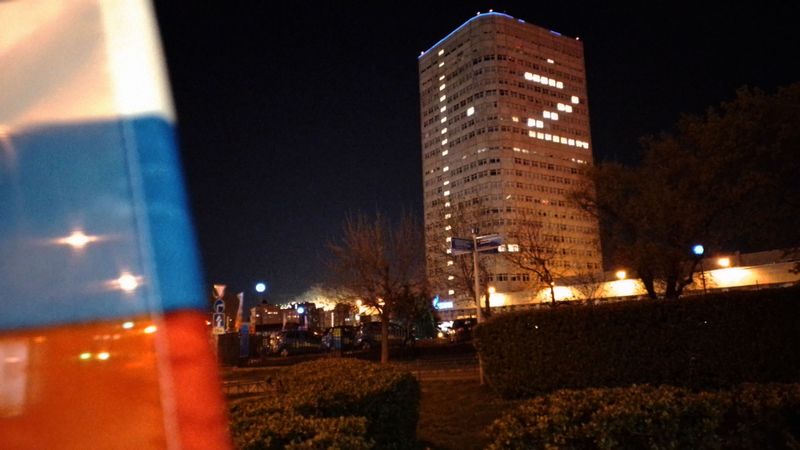
I struggle to put into words exactly how I am feeling, to express precisely the thoughts that are running through my head, like unstoppable runners going on until their legs atrophy from the very thing they are cursed to do for the rest of their lives. We are running, back and forth, not knowing what lies ahead. There is a thought in my mind, and then it disappears. I forget about, for a moment, this war, and all that it means.
“There is no war ongoing between Russia and Ukraine, but the special military operation is evolving successfully.” Such was the response by the Russian Embassy in Singapore to an interview by The Straits Times of Dmytro Kuleba, Ukraine’s minister of foreign affairs.
This coincided with an estimate of as many as 25,000 military deaths since Vladimir Putin, Russia’s president, moved to “denazify” and “demilitarise” Ukraine on February 24th, this year. The official death toll from the Russian Defence Ministry stands at 5,937. Despite these casualties, Russia’s occupation of approximately 20 percent of Ukraine, and the recent decision for “partial” mobilisation, one cannot call it a “war”. Instead, according to the Kremlin, it is a “special military operation”. Calling it otherwise risks one being fined up to 1.5m rubles (S$36,000) and a prison sentence of up to 15 years for spreading “fake news”.
“I try not to use the word ‘war’ in class, in writing, or in conversations with strangers,” Dmitry Barskih, a 21-year-old university student told me. “When I have to, I replace the word ‘war’ with ‘conflict’, but I have never had to change my position or lie about my views so far.”
According to OVD-Info, over 16,000 people have been detained for anti-war stances. The Kremlin has also moved to label undesirable journalists and popular figures as “foreign agents”, many of whom, like Ekaterina Schulman and Evgenia Albats, have left the country. Seventy-four of such “foreign agents” were named since the start of the war.
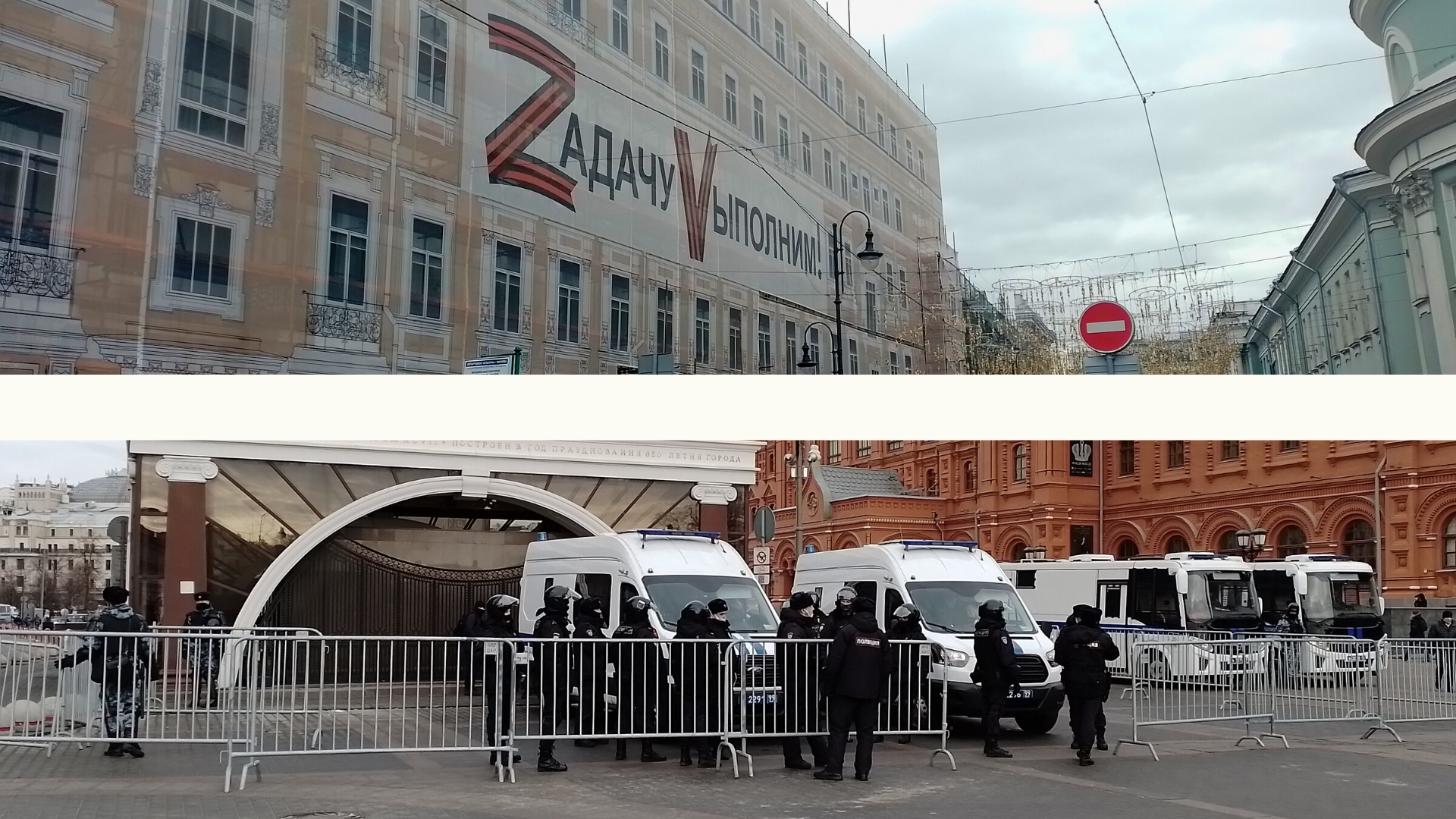
Since mobilisation was declared on September 21st, nearly 2,400 people have been arrested for protesting against the Kremlin’s move. On that day, I took a walk through the centre of Moscow from the Kremlin down to Pushkin Square through Tverskaya. Police and dreaded OMON officers patrolled the streets in great numbers, asking non-protesting bystanders to show their documents as they shivered in fear.
A friend of mine, who holds citizenship of Russia and another country, was on the street by his apartment when a gang of police officers manhandled him into a white van. “You are going to war,” said one of the officers. Pretending not to comprehend Russian, my friend resisted as they tore his coat. He showed them his foreign identification and was set free. Putin claimed that the first wave of his “partial” mobilisation would not include students or those without military experience. My friend was in Russia as a foreigner, a student, and most of all, had no military experience.
I remember once, reading a great work of the controversial Ayn Rand. (Born in Russia in 1905, Rand emigrated to the US in 1926, and would later become a doyen of libertarians and free-marketers.) In her first novel, We The Living, you will find in words the inexpressible suffering of the people of this country. It is set after the October Revolution of 1917. It follows the story of a Russian girl named Kira Argounova (a character which Rand illustrates herself into).
Kira is a free spirit who wants to become an engineer to design her own creations, not dictated by the state. But because Kira’s family had aristocratic roots, she is prohibited from studying at university, from being a carrier of “bad blood”. In the process, she gets caught in a love triangle. One man is a rebel, who rejects the revolution, the other a loyal communist who would give himself for the cause. How it all plays out is a tragedy, but one that must be read by all.
In the book’s afterword, Rand mentioned that the original title she wanted to name her work “Airtight”, to describe precisely how it felt like living in the newly established Soviet Union. In recent days, that is how I would describe the environment of Russia. There are those who are victims of this regime by their own ignorance; they only receive information from state media and dismiss reports from non-state channels. They, perhaps in good faith, listen to what the state has to say and believe in the task of “de-nazifying” and “de-militarising” Ukraine. Those who support the war and Russia’s actions lived their formative years during the Soviet Union and witnessed with pain in their hearts the withering away of their socialist state. They are enthralled by what is happening: finally, Russia is showing not just Ukraine, but the entire world its strength.
Then there are those who know the tragic truth, who understand that this war is incompatible with what a civilised nation should do. They receive their news from various sources and yearn to leave this madness. But these people should not be viewed as traitors. As Evgenia Albats, a Russian journalist who has now fled the country, said, “Russia is my motherland, my loved ones are there…but of course such is my motherland, my motherland and hope.”
A July poll, conducted by the independent Levada Center, indicated that 76 percent of respondents supported Russia’s actions in Ukraine, a five percent drop since March. The 55-and-older age group was most supportive while 53 percent of those aged 18-24 did not support Russia’s actions. In April, it was estimated that at least 200,000 Russians had already fled the country.
Mobilisation is the last straw for many more. The men of this country who understand what is happening are fleeing. They are scrambling to leave by any means necessary. Flight tickets have been booked out, their prices have risen to extortionate levels; highways towards bordering countries are clogged for kilometres. It is estimated that over 260,000 Russians have fled the country since mobilisation began. But what happens when all these gaps are plugged? All of this country, every inch of once porous borders, will be sealed - airtight.
“Brain drain will continue picking up steam,” predicts Alexei Markov, a Master’s student in his 20s. “The authorities are highly unlikely to wake up from chauvinistic delirium and start putting effort into creating a positive environment for living and self-realisation, their goal is to keep their power at any cost.”
And even as I attempt to explain the very tragedy that this country is facing, I can only hope that you comprehend an ounce of what I say. There are ordinary people, people who did not care about politics, about wars, about NATO, and who are now ordered to kill their Slavic brethren or else be jailed or, against their will, be sent to the front. I came across a set of illustrated posts on social media recently which presented the following lines in Russian:
“Как-то странно…
Если ты совершишь преступление,
Государство посадит тебя в тюрьму…
Если преступление совершает государство,
То тебя сделают соучастником.
Окажешься быть участником преступления…
Сядешь в тюрму.”
“It is somehow strange…
If you commit a crime,
The state puts you in jail…
If the state commits a crime,
They will make you an accomplice.
You will be part of a crime…
Go and sit in jail.”
I do not want to jump straight towards invoking Alexander Solzhenitsyn, but really how else could I say it but to recall his words, “Shall we sum up the whole history of Russia in a single phrase? It is the land of smothered opportunities.” And after all these years, after the great Solzhenitsyn penned down these words in The Gulag Archipelago, how much of Russia has changed? Nothing. For many Russia’s invasion of Ukraine came as a shock, but this was not his first adventure abroad. In 2008, Russia invaded Georgia to “protect” the Georgian breakaway region of South Ossetia from a supposed “genocide”. Again, in 2014, Russia staged a referendum to annex the Ukrainian peninsula of Crimea into the Federation, a test case for what has happened recently.
But Solzhenitsyn, who died in the same year of the Russo-Georgian War, was hopeful of Russia’s president. “Vladimir Putin inherited a ransacked and bewildered country, with a poor and demoralised people,” noted Solzhenitsyn. “He started to do what was possible—a slow gradual restoration.” In the process, Putin strengthened his hold on power by weakening the various institutions of democracy in Russia. (Though some argue that Russian democracy died when Boris Yeltsin, Putin’s predecessor, ordered tanks to fire upon the country’s legislature in 1993 to reassert his weakening authority, after pushback against his failing liberal reforms.) In 2020, a referendum to amend the country’s constitution passed with little surprise. One of the amendments “reset” the term limits of those who have served as heads of state. Putin will be expected to serve an unprecedented third consecutive term after a presidential election in 2024.
Putin’s social contract to leave Russians alone, so long as they vote for him, has been shredded. Now, once apolitical families have to bid farewell to their sons to fight in a war they never asked for. Young men who don’t know how to strap on a helmet, let alone fire a gun, are being sent far from their homes to a land their great-grandfathers and grandfathers fought on. On this blood-soaked land, on this sacred soil of the tarnished Holy Rus’, a horde marches Westward towards a goal indiscernible from total destruction.
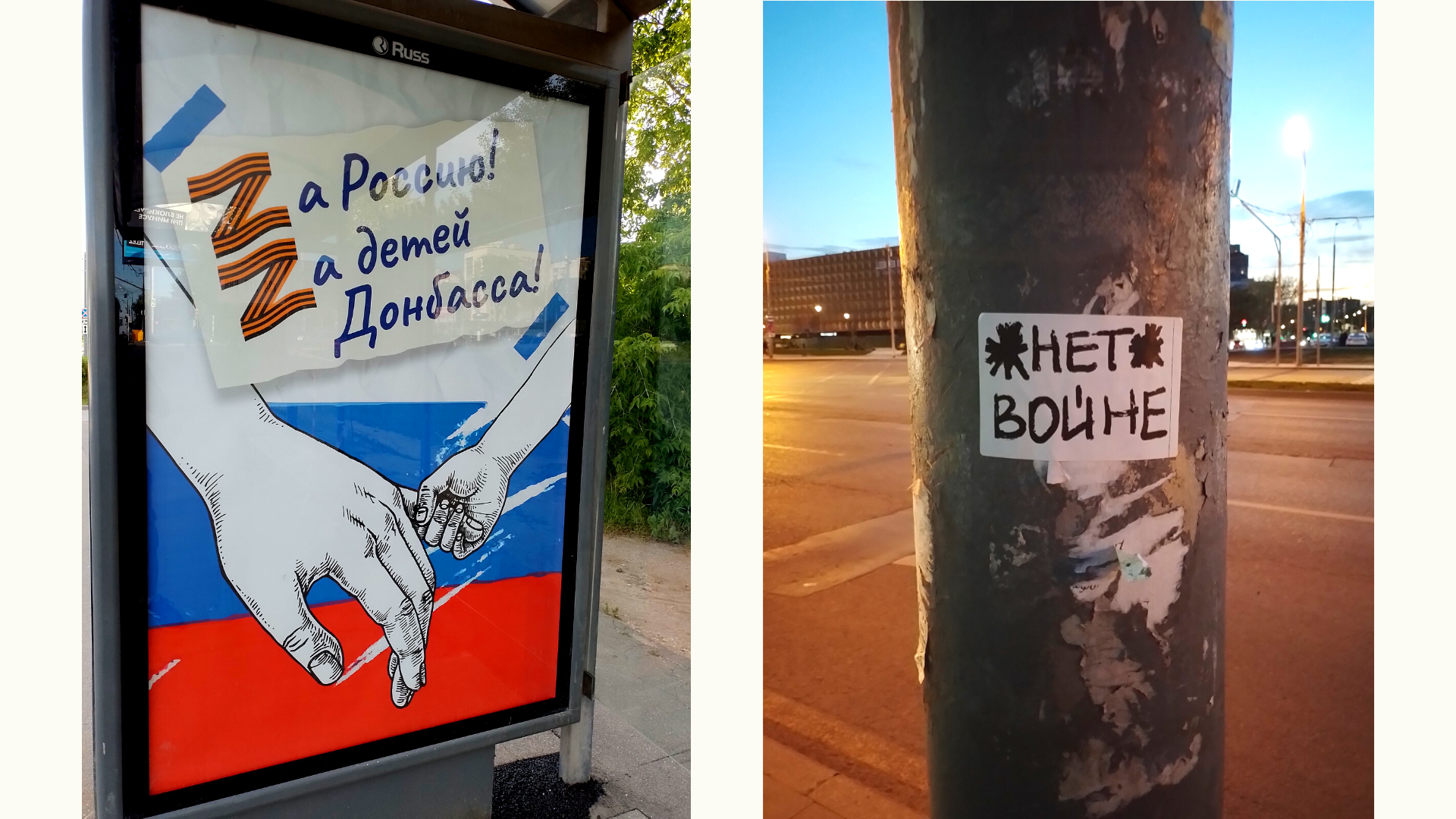
Yet, on this day, in the afternoon and evening before I wrote these words, I was able to enjoy a double-cheeseburger with fries and a Russian version of Coca-Cola at a Russian version of McDonald’s. I went to have a latte at a Russian version of Starbucks, followed by a visit to a movie theatre to watch a lame Russian version of “Red Riding Hood”. Yes, this is our reality here in Russia; as Leon Trotsky said, in his contrarian remarks against the signing of the Brest-Litovsk Treaty (which ended Russia’s participation in World War I), there should be “neither peace nor war”. That is what we have today.
They call it a “special military operation” not a war. Even though it is a war. They call it a “partial mobilisation”, not a full mobilisation. Even though it is a full mobilisation. Men of minority ethnicities and those of impoverished regions throughout Russia are being called up indiscriminately to face ammunition manufactured and shipped by NATO countries. While they may die at the hands of their Slavic brothers, they would have only gone that way because someone in a bunker, somewhere unknown, said that they must. How many opportunities will have to be smothered for those in power to learn that this cannot sustain itself?
“There’s a lot of uncertainty,” Nikolai, a musician in his 30s, told me. “What bothers me personally is that when everything is over, what will happen to the veterans, who only know how to kill for a living, returning to normal lives? During the Chechen war in the 90s the mafia ruled and bandit shootouts were commonplace. God forbid this will repeat.”
Markov worries for the future of his country too. “Russia may turn into a ‘snowy Africa’ or a ‘snowy Iraq’. Young people will continue leaving, looking for a better future. Older ones will live out their lives. No one will care for Russia.” But in a country where homophobia is masked by the ever-increasing importance of “traditional” and “Christian” values, a personal fear haunts Markov. “I will have to run away and plead for political asylum in case homosexuality will be criminalised in Russia.”
Patriarch Kiril, head of the Russian Orthodox Church, has before labelled Russia’s opponents in Ukraine as “evil forces”, and has been a spiritual advocate for the preservation of a Russkiy Mir, a Russian World that is a unique civilisation with its own spiritual mission.
The lines from “The Second Coming” by William Butler Yeats come to mind: “Things fall apart; the centre cannot hold; / Mere anarchy is loosed upon the world, / The blood-dimmed tide is loosed, and everywhere / The ceremony of innocence is drowned; / The best lack all conviction, while the worst / Are full of passionate intensity.” Russia is edging ever closer to a crossroads, one towards the precipice of complete destruction and disaster, or the other bringing this country towards redemption.
“It is highly likely that in the long run, Putin and his team will completely leave the political scene due to age or health,” noted Dmitry Barksih. “A new leader may arise, who might have the goal of getting Russia back to normal. However, there is no one right now who is capable of that. So, the future is rather dark.”
Russia’s history is almost Sisyphean. At every moment when all seems possible, where this country was breaking away from the very things that held it back, everything comes crashing down and the worst is unleashed upon this land. But, unlike Sisyphus, we cannot imagine that the leaders of this country embark on this task happily; unless, they do. If so, we are doomed.