
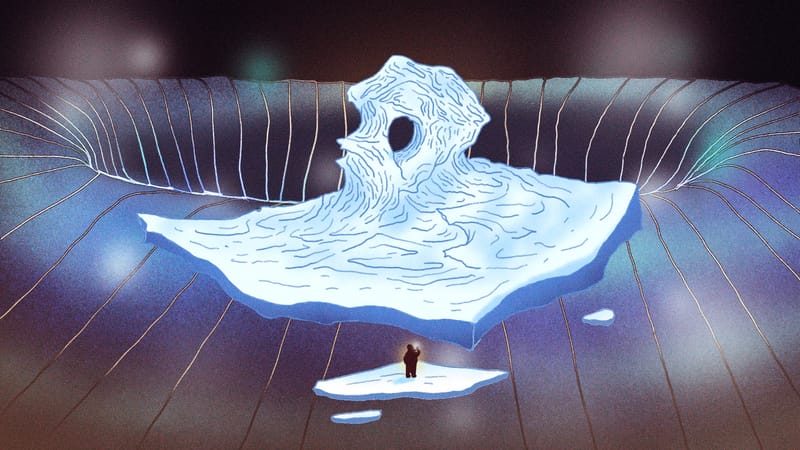
Time is like water,
and water is as cold and deep
as consciousness.
And time is like a reflection
made partly by water,
partly by me.
Time and water
rush trackless to vanish
inside my consciousness.
- Stein Steinarr, Icelandic poet
A letter to the future
Ok is the first Icelandic glacier to lose its status as glacier. In the next 200 years, all our main glaciers are expected to follow the same path. This monument is to acknowledge that we know what is happening and what needs to be done. Only you know if we did it.
August 2019, 415 ppm CO2
- Andri Snaer Magnason’s obituary for the Ok-glacier
The story goes like this. Naddodd or Garðar Svavarsson or Flóki Vilgerðarson find Iceland in their respective century and are struck by its profound beauty, a stark barrenness that extends as far as the eye can see.
Naddodd explores the land, ascending a mountain to search for any sign of fire. But no smoke comes. He returns to his boat. As he boards, a sheet of snow descends. He decides the island shall be known as the Land of Snow. Snæland.
Garðar Svavarsson travels all the way along the island’s coast, being the first person to confirm that it is indeed an island. He goes ashore and stays for the winter. He bequeaths the island with his name. Garðarshólmi.
Flóki Vilgerðarson sets sail, with his family in tow. Flóki’s daughter drowns during the journey. The surviving members of the family follow the third of Flóki’s three ravens, the one that did not return, and find themselves ashore. Flóki hikes upwards, not looking for smoke, but looking for shelter for the coming winter. Instead, he sees the polar ice of the West Fjords. He decides this is the Land of Ice. Ísland.
If any of the three travellers had kept their eyes on the horizon longer, they would have noticed the massive ranges afar and called it the Land of Mountains. Or if their timing was right and a volcano erupted, the Land of Magma. Or if they mistook the craggy outcrops of rock on the mountains for creatures, the Land of Trolls. But as far as we know, they had not seen any of these things. They saw the snow, they saw themselves, they saw the ice, and their vision was limited by where their eyes could reach. The name that stuck was the one that all could understand, that all had seen. The Land of Ice. Iceland.
The story goes like this. A Palembang prince sails towards an island he spots from a hill across the seas. His ship, a prahu or jong, we are not certain which, is buffeted by unexpectedly rough waters, the vessel threatening to go under. The crew toss everything large, but still, water seeps into the deck. The captain asks the prince to throw his crown overboard. The crown splashes, sinks, the clouds clear. They land ashore. The prince looks at the edge of the forest and through its dense foliage, he spots a majestic mane, a blossoming tan, framing the fierce features of the creature’s face. He asks his advisor for the creature’s name. सिंह. Sanskrit for “lion”. Siṃhá. The prince’s mind swells at this previously unseen sight. He wants to name the island after what he did not know. A testament to his nescience. Singha Pura. The Lion City.
My family went to Iceland to experience sights unlike any we had ever seen. Geologically, we are nothing alike. While Singapore is insulated on all sides from tectonic plate activity, Iceland sits directly on the intersection of two tectonic plates. And Singapore’s highest point is Bukit Timah Hill, a paltry 164 metres high, compared to the multiple peaks in Iceland that are over 2,000 metres tall. Yet, there are surprising cultural overlaps despite these earthly differences.
It too is an island that realised it would need to be friendly with all to survive. It would have to train its people, since there was little to no arable land to cultivate. It was a colony, supervised from afar. But while we pilfer our urine and waste to create new water, Iceland uses its geothermal water to generate energy, jagged pipes crawling up mountains and mossy plains spreading energy across the land. Less than 400,000 people live in Iceland, compared to over 5.9m in Singapore; below 10 percent of our population, in other words, living on more than 100 times as much land. While the available land is plenty, the romantic pickings are slim. Singaporeans test their mettle on Tinder, Bumble, Hinge, Coffee Meets Bagel, Grindr, Christian Mingle, or Paktor. Icelanders have their own app: Islendiga-App. The apps in Singapore are used to connect with a stranger; Islendiga-App is designed to prevent you from dating your cousin.
One of our first stops in Iceland was Þingvellir, a national park with a short hike through historic Icelandic markers. There is a crevice that grows as the plates drift apart, the former site of the Icelandic Parliament, and a clear water pool where people can sink between the earthly crust. We strolled through slowly, this being our first day in Iceland. We admired the staggering rockface, towering boulders that could block out the sun, and a tiny creek, with water that did not so much pour as it slid, its bubbling the only sound across the area other than the crunch of gravel under foot.
It was one of our first sites in Iceland, and though small, I was struck by its serenity. It would pale beside the many sites we saw over the next week. But in that moment, I could have watched it forever. It was so unlike our urban fountains, surrounded by the bustle of the city. There was an ease to this brook, one that would continue running if no one was looking. I snapped a picture of it, to hold on to its tranquillity.
The information board was surrounded by three other tourists. I waited for them to leave so that I could learn more about this creek, wondering why such a slight sight was deserving of its own board. I learned that the creek is called “Drekkingarhylur”. And as I read on, an eerily familiar feeling set in. Despite being thousands of kilometres away, Singapore’s dank and fetid air blew in, its humidity sitting on my skin. Drekkingarhylur still ran. But the words on the board ruptured its calm. I took a blurry picture of the board and left. I could not stay any longer.
We continued through Þingvellir, snapping photos of the high rocks and the vast expanse. We broke off the path to follow a rocky road towards Silfra, one of Þingvellir’s two diving sites. We lingered, watching as tourists bundled up in thick gear covering everything but their eyes waddled into the submergence point. The water was so clear we could see to the bottom, basalt rocks protruding, algae dangling, light shimmering. I could still hear Drekkingarhylur bubbling.
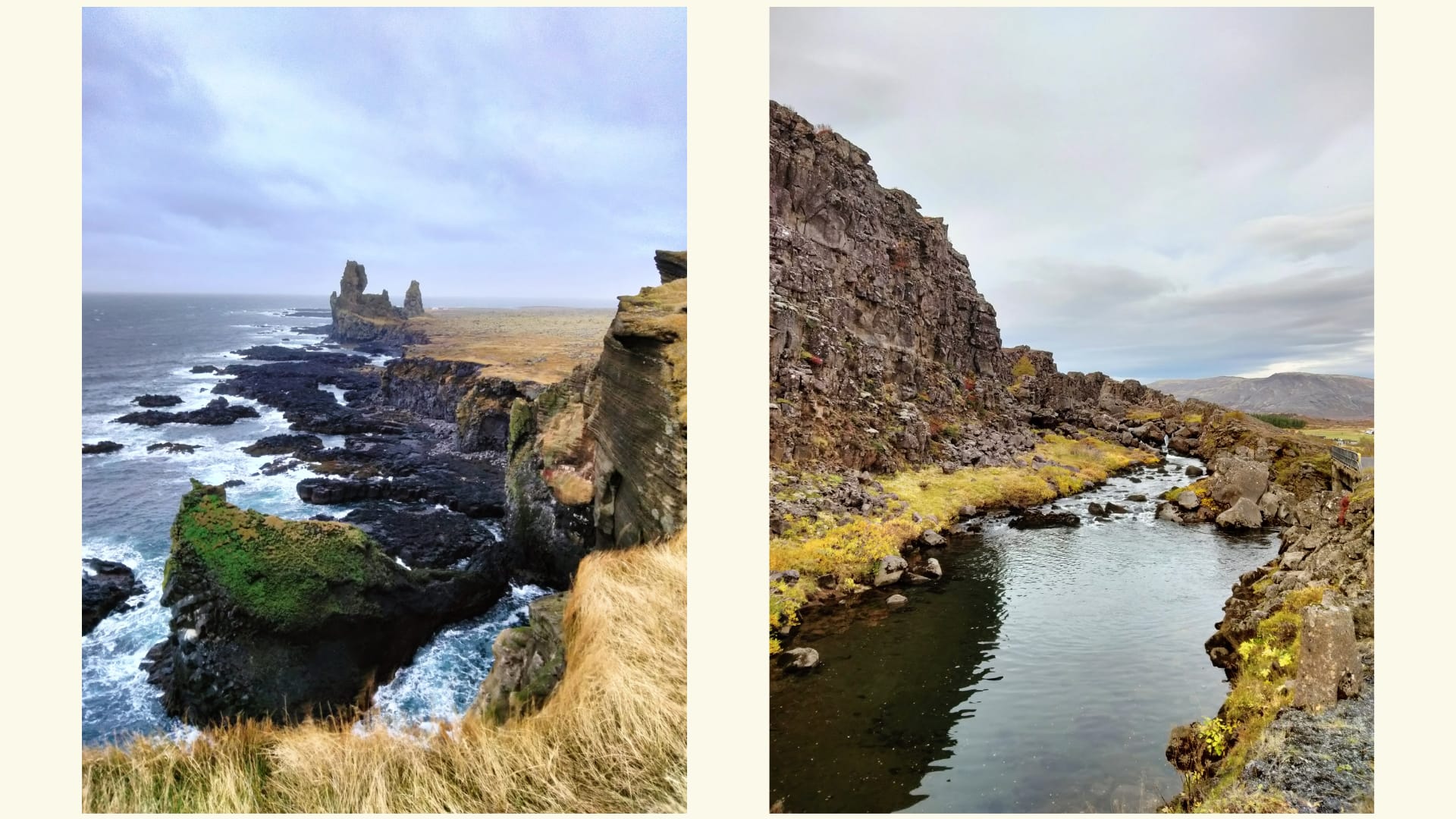
Because of the drift of the tectonic plates, the nation grows bigger every year by 2cm. The earth comes from underneath and forces the island’s two halves to part in its wake. And every year Iceland shrinks by 2cm, as the tide erodes away at its coast. Like a great conveyor belt, the earth pushes up and out, as the sea sweeps in and down. Give Iceland a few eons and it could be an entirely different landmass, reconstituted, reformed, although the exact same size. A geological Ship of Theseus.
Singapore has no tectonic plates to help with our eroding coast. We resort to shipping millions of tonnes of sand from our neighbours and dumping it into the sea. We call it “reclaimed land” but what are we reclaiming? We are not recovering something we have lost. We gain something we never had. Land. We take from elsewhere, broker deals that do not involve the people who live on that sand, and we pour it into the ocean, and call what remains ours.
Both islands are aware of the precarity. As global temperatures rise, Iceland’s glaciers shrink. The ancient, melted water slinks off, spilling into the Atlantic, slithering from current to current, until it finds its way to our shores, the waves lapping imperceptibly higher on the imported sand of East Coast Park.
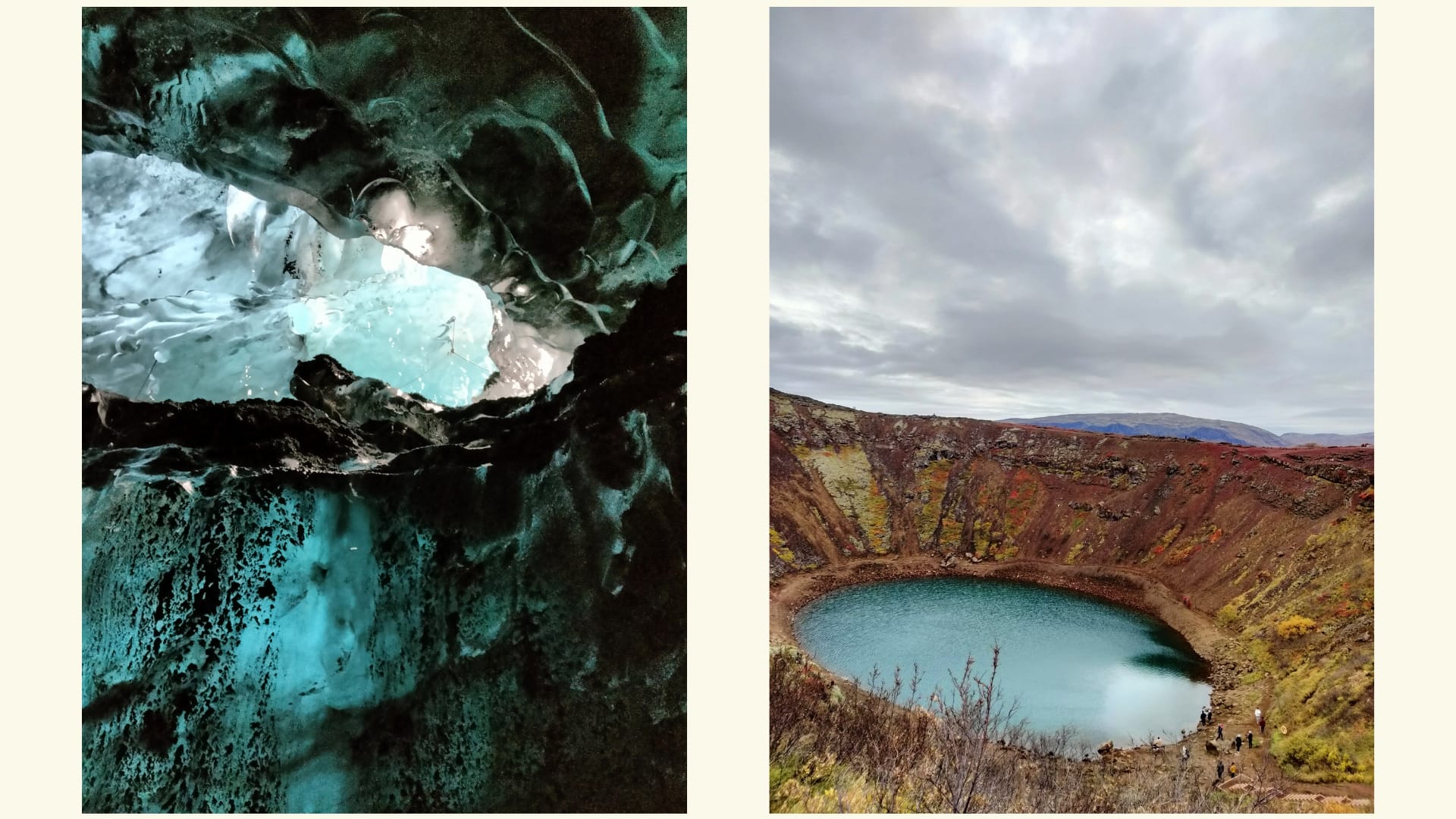
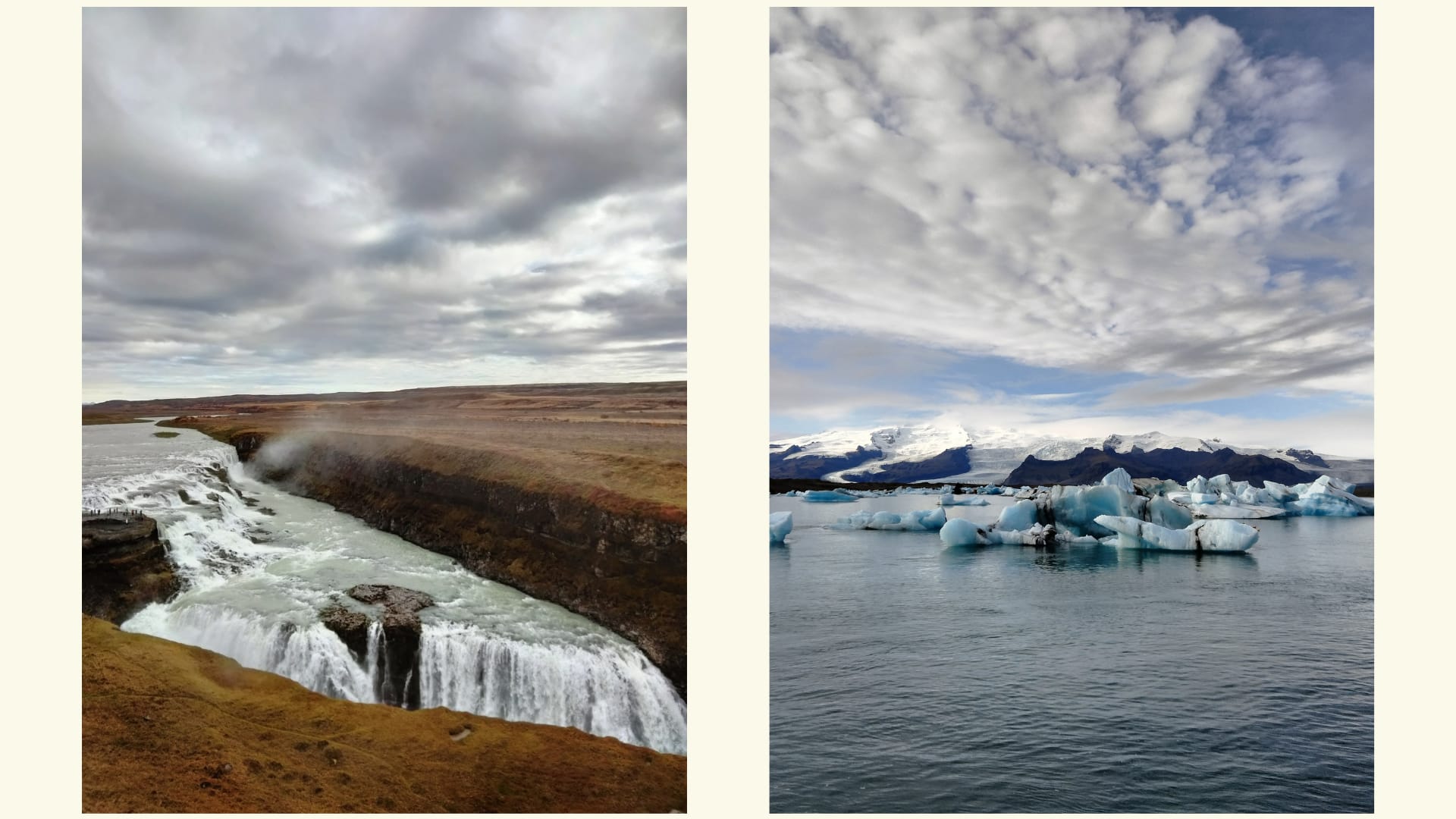
At the ice caves off the Jökulsárlón glacier lagoon, cave guides reset their routes every winter. The glaciers recede during the warmer months and reform, with little to no trace of the caverns from the year prior. The edge of the glacier itself retreats further and further away each year, 150 metres backwards to be precise. The glaciers, even in Iceland’s frigid winter, cannot return to their former mass. The slightest increment of a degree has an irreversible impact on the icy expanses. When we drove towards the ice cave in our refitted jeep, tires as tall as me, we could see what the glaciers had left behind. Black ash from ancient volcanoes, boulders carried forward by its push, now abandoned.
The jeep stopped at the furthest point it could go, in a makeshift car park that, like the glacier, recedes each year. We clipped on crampons, metal spiky undersoles that allowed you to tread safely on the ice. I didn’t understand what that meant until I felt the first crunch underfoot. The crunch clued me in—we were on the glacier, we had been for a while, breaking in solid ice. With each step, a little drop flowed down the mountain and tumbled into the sea.
We ascended past trickling streams, the crampons mostly crunching ice but occasionally screeching on pure rock. The sound was sharp on the ears, the honed metal scraping against stone. The landscape was surreal, black stone and blue ice abound with the only trace of our world being the jeeps down the incline. I told my father he looked like he was on the moon. My mother had not joined us—the slope was too difficult for her, so she stayed at the lagoon, and went on an amphibian boat tour. We joked later that she had finally gone on a DUCKtour after years of avoiding it in Singapore.
We climbed with a stuttering pace, the ice occasionally slippery and the crampons cumbersome. But the main reason we slowed was for the group’s photography.
I steered clear from the gangly teenager who leapt at every opportunity, stumbling as he landed, his crampons screeching and straining. The boy’s parents let him run freely while they captured the landscape in their lenses.
“How can you take in the scenery if you are not looking?” my dad complained.
His frustration grew within the caves itself, which we entered through a narrow tunnel of carved ice. The ice shone deeply, a glow unlike anything I have seen. The guides had carved a makeshift staircase of uneven ice slabs, descending into the pit of this glacier. Water fell within the cave, sections of the ice melting before our eyes. It was a tiny area, one that only allowed a single file of traffic, made slower when people paused for selfies. The largest part of the opening was filled by a wooden slab, heaved down to act as a platform, a staging area for family pictures framed by a glowing blue behind. Our guide took photos of every group, and we posed too.
In On Photography, Susan Sontag stated that part of the tourist’s ritual of taking a photograph is to “certify experience”, creating physical proof of a phenomenon otherwise unbelievable. I did just that, trying to capture the blue ice. But every picture of the ice cave on my meagre Android paled in comparison to its uncapturable glow. Its emanations felt like an inverted sunbeam; its cold aura sapping the heat from your skin as it struck. The phone could not register its subtleties. It placed its own filter over it, in an attempt to capture it, to freeze it in its pixels. It failed.
Like many tourists visiting Iceland, we hoped to see the northern lights. But we knew the chances were slim. And every time we spoke of it, the odds felt like they dropped. Each night, my dad stayed up late to see if he could spot the waving borealis. Each night, nothing showed. On our last days in Reykjavik, my mother and I went to the Perlan, a planetarium that guaranteed a simulated view of the northern lights.
We filed into the dome and sat back in reclining chairs, while the screen above filled with views of the night sky. The story was narrated by Aurora, who deigned to show us her glimmer and shared her many myths over the years. An animation revealed how ancient civilisations sought to explain her, whether she was a dragon with a man’s face darting through misty mountains in China, spirits returning to the Great Beyond to the Cree, or for the Algonquin, the flickering of the grand cosmic flare tended to by the Earth’s creator, Nanabozho. Every society defined the phenomenon in their own way, to fit into their understanding of the universe.
And now, we do the same, subsuming her to our designs. We know that the northern lights originate from fluctuations in the Sun, tugging on our magnetic field and then snapping back like a rubber band, creating cosmic waves that carry electrons which collide with our atmosphere and release colour and light. That is what we say we know. But we cannot say for certain that Nanabozho does not sit inside our Sun throwing kindle to the flame, each little spark, each pop of smoke bursting across its surface. We understand it as what we can see.
We never saw the northern lights.
My sister and father fell sick from the ice caves, doubly unfortunate because they were the two insured to drive. There was no rest for them, except when we stopped at sites they didn’t want to look at, like Gullfoss, one of Iceland’s famous waterfalls. My mother and I embarked down the wooden staircase, embedded into the side of the hill. We were unsure of the scale of the waterfall or whether it could impress us. We had visited one waterfall, walked behind its gushing tumble, seen the sky through the other side of a sheet of water. How different could waterfalls be?
But we heard its rushing, its roar, and importantly we saw the massive car park almost full, buses double-parked, tourists milling about. Like queuing at the nasi lemak stall with the longest line—when in doubt trust the herd. The wooden steps were worn by the hundreds of tourists who poured down its steps every day, the middle of each slat sagging. The steep staircase had three landings; my sister stepped down to the first and saw some of the fall’s magnificence. But the cold air was too harsh, and she was still sick. She left.
At the second landing, a majestic field of torrents greeted me. What my sister had seen was merely a tributary of the waterfall, only one of many cascading floods spilling over the edge of the world. I turned back to call her down, but she was gone. My mother and I descended the rest of the way, following the rocky path that led directly beside the falls. As we grew nearer to its source, its itinerant mist turned into a constant splash, like the intermittent sputtering of a hose thumbed down by a physical education teacher. I had to skim the water off my face every minute, as the drops became heavier.
Gullfoss ranks low in numbers as a waterfall, neither its cubic volume, its speed, nor its flow impressive when measured against any of the top contenders like Niagara Falls or Victoria Falls. Even its height pales in comparison, as only slightly larger than our smallest super-tree. But that does not make it any less impressive when you stand beside it. And it was almost erased entirely, a century before.
The story goes like this. A British man visits Iceland in 1907 and sees Gullfoss as a perfect place for a hydroelectric dam. He and Tómas Tómasson, a local landowner, begin to prepare for a massive site of renewable energy. Tómasson’s daughter, Sigríður Tómasdóttir, is disgusted by the deal. Gullfoss needs defending. And she would be its defender.
She lobbies, fights, resists, repeatedly says “no” until eventually, the deal falls through. It remains unclear if this was due to her tireless campaigning, or if the British man had changed his mind, or if she had delayed things long enough for the limited funds to drain.
All we know is this. Her father saw power. Energy. Dominion. Sigríður saw beauty. Splendour. A testament to our tininess. Her vision was what persisted.
Thirty years before the smartphone, Sontag was trying to understand the rising prevalence of the camera and the ensuing ubiquity of photography. For the tourist, it gives shape to the day. The open-ended nature of tourism can create some insecurity, the tourist unsure if they are doing it “right”. But searching for the photograph grants them structure, a way to succeed in viewing. The image proves that what we saw was real. In this way, the tourist almost seeks to own the landscape they photograph. That is how my father saw the other tourists crossing the glaciers, with their photographs taking precedence over the raw unfiltered visual experience.
But Sontag volleyed another reason for the tourist’s perpetual trigger finger: the camera acts as their grounding technology in the face of sheer disorientation. Photography becomes a way of grappling with the unknown. We cannot understand the scale of the mountain we look at, but we can understand our photo of it. Maybe the photograph is not an act of dominion, but one of subordination. A recognition of the sublime. The tourist stands in front of the Icelandic mountain, to say, “Look how big this is.”; “Look at this majesty that has nothing to do with me.”; “Look at this place that will outlive us.”; “Look at how little we exist.”
Sontag has one more justification for the photograph: it fights time. While the coast erodes, the photograph persists. It will outlast its view. The glacier will never exist as it does now. Next winter, it will be smaller. And the winter after that, smaller still. But in the photograph, it is frozen in time. It will always look like it once did, even as its cliffs tumble. The photograph is memento mori.
“Precisely by slicing out this moment and freezing it, all photographs testify to time’s relentless melt.”
Perhaps an evocative enough photo can spur on action, a testament not just to our present but a rallying call for the future. Sontag has her doubts. The photo can desensitise. It can make “the horrible seem more ordinary—making it appear familiar, remote (‘it’s only a photograph’), inevitable.” The moral charge of a photograph is limited. But think of the image of the polar bear, floating on a dwindling berg. It is not just recreating reality; it reflects our harms. Perhaps the photo deadens our will. Or it hardens our resolve. The photograph is an opportunity for us to reject the world “as the camera records it.” It is an opportunity for us to say “no”.
When we travel, we can leave our bags, our shoes, our laptops, our phones. But we will still be traveling with ourselves. That is the baggage we can never put down. We cannot leave behind the pathways that our neurons have raced across. We cannot unsee what our eyes have experienced, been bombarded by, some of the pigments permanently staining the whites of our eyes. We cannot ignore the transparencies we overlay to help us contend with what we do not understand. I could not forget the damp heat of Singapore on my skin, even as the waterfalls stung me with its icy specks. And when I stood beside a quiet creek, Drekkingarhylur, or by its other name, the “Drowning Pool”, and read the list of women executed in its shallow brook, I could not help but think of a list of deaths just like it, names added casually, like a logical sequence of numbers and not an avoidable flood of tragedy and despair.
The story goes like this. A severe enough punishment will create enough fear to dissuade any sensible person from bringing a powdered or liquid death to our shores. It is the hard math of governance, the soft heart for the masses and a hard heart for the person. The noose saves more lives than it takes.
In Halldór Kiljan Laxness’ novel, Iceland’s Bell, farmer Jón Hreggviðsson fled Iceland for Denmark, its colonial master, to escape the death penalty. Falsely accused of murdering the state’s hangman, Jón pleaded with the King for his pardon.
“Their injustice is bad, but their justice is worse.”
Iceland abolished the death penalty in 1928.
I looked at Iceland and saw a country like our own, an island with limited resources, one that constantly feels the grip of precarity—a precarity that justifies any action as long as it supports a purported good. A precarity, bordering on paranoia, as if at any moment everything we built could plummet into the sea.
Or perhaps the engulfing has already begun. Perhaps all we have made is spilling into the sea’s great maw. And unlike Iceland, we have no rupture coming from our middle replacing what is lost. There is nothing to fill the hole we dig, each time we add to our list. We may plug that abyss with more and more people, flown in faster and paid less, but the hole still grows. We are hollowing out ourselves from the middle, like Kerið, the ancient volcanic crater that spent all its magma and collapsed in on itself.
Each name added to the list is granted paltry offerings: a final meal, money to purchase treats for others waiting their turn, and a final photoshoot. They are allowed to purchase new clothes or wear their favourite outfit. They can choose their pose. And then the photo is given to their family before the names are etched onto the list. The people are now gone. But the photos persist.
Sontag said that “to take a photograph is to participate in another person’s (or thing’s) mortality, vulnerability, mutability.” It is an acknowledgement that the subject of the photo will shift, change, grow. It captures the moment, but it knows the moment will continue.
The list ends the story. It refutes the possibility of change. It is an act of finality. It freezes its subjects. It makes the present past. The list is inevitable.
But we can say “no”. We can protect the waterfall. We can preserve the glacier. We can change the story. We can look at the photos and imagine a world where they are not final images. We can create a world where they are brief snapshots before a life was fully lived. We can say “no”, like Sigríður Tómasdóttir did 100 years ago.
The story goes like this. Sigríður cannot imagine losing Gullfoss. So she puts all she has into preventing its annihilation. She treks across the nation, raising awareness as she trudges from town to town. She pens letters to denizens, pleading for their support. She says to the nation that this cannot be done in their name. And, as the story goes, she threatens to throw herself into Gullfoss’ plunging depths, unwilling to live in a country that could tolerate such devastation. She triumphs. Gullfoss still flows freely.
Overlooking the waterfall today is a stone tablet with Sigríður’s face carved into the rock. Her silhouette looks out on the tonnes of water pouring into the abyss, the same as it did a century ago. We stood beside the stone, at the edge of Gullfoss, paying tribute to the eternal image she fought to save. The water roared below. Every drop thundered.
Myle Yan Tay writes essays, plays, fiction, comic books, and reviews. His works have appeared in The Bangalore Review, Drunk Monkeys, and New Naratif. His play, “Brown Boys Don’t Tell Jokes” was staged last year by Checkpoint Theatre, and his debut novel catskull was published by Ethos Books. You can find more of his work here.
Letters in response to this piece can be sent to sudhir@jom.media. All will be considered for publication on our “Letters to the editor” page.
Further reading:
“Magical thinking: shaping sand for our dreams”, Aleithia Low
Time and Water, Andri Snær Magnason
Dreamland – a Self Help Manual for a Frightened Nation, Andri Snær Magnason
On Photography, Susan Sontag