
News this week included: the seizure by Bangladesh authorities of the assets of Muhammed Aziz Khan, a naturalised Singaporean billionaire, and of those close to him, over money laundering allegations (which he denies); “Singapore Budget 2026: Is It Good Enough?”, a public dialogue last Sunday organised by MARUAH, a human rights organisation; unverified claims that two Singaporeans may have fought for the IDF during the genocide in Gaza; a Facebook post by a Chinese Singaporean about “becoming a minority in my own land” sparks a range of reactions; and the third otter population census.
Below are the issues we chose to explore in more depth.
Our picks
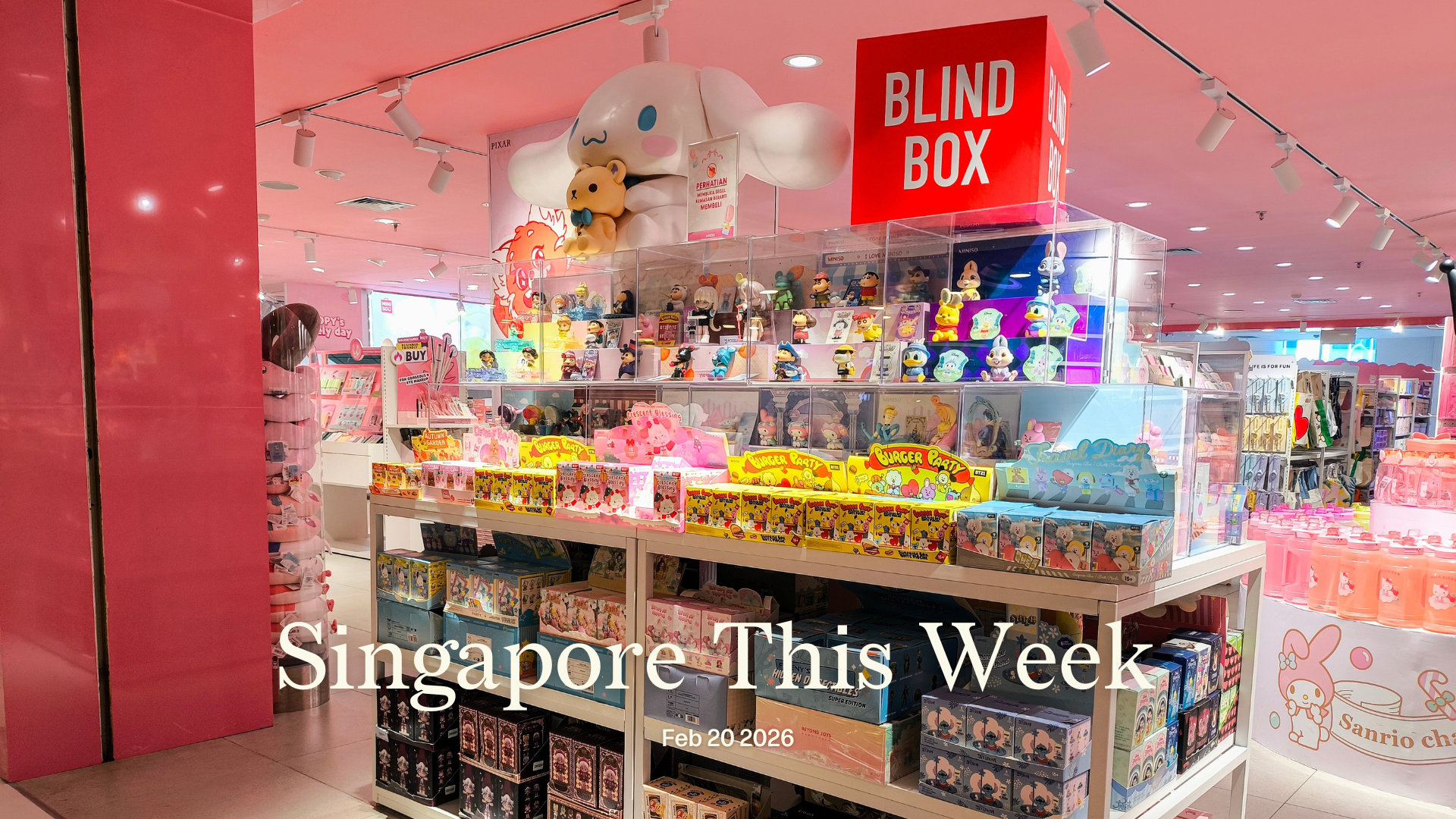
Society: What you don’t see is what you get
Surprise has powered the business of monetised uncertainty since at least the late 1700s. Victorian “lucky dips” at UK funfairs gave way to Christmas crackers, invented by confectioner Tom Smith in the 1840s. In the US, early coin-operated vending machines dispensed gumballs and toy capsules. Imported to Japan in the mid-1960s, these machines evolved into gachapon, now ubiquitous.
Commodified delight endures because our brains crave novelty. When we encounter new or unexpected joy, they release dopamine; the neurotransmitter at the heart of the brain’s reward system. Since dopamine is tied to pleasure, it not only feels good; it keeps us coming back for more. When uncertainty can be packaged, priced, and endlessly reproduced, the thrill of “maybe” and “what if” becomes a lucrative business model; as we see with blind boxes. The global market size for these was worth about US$11.38bn (S$14.4bn) in 2021 and is projected to more than double by 2033. Blind boxes are sealed packages containing one item from a themed series—a figure, toy or accessory. Buyers know the range of possibilities, but not which they’ll get until they open them. Popular collectibles include Molly and Labubu by Chinese toy giant POP MART.
But what begins as delight can slip into compulsion. The same dopamine loops that make surprise pleasurable also make it habit-forming. In this engineered cycle of anticipation, reward, and near-miss, the line between harmless fun and addictive design blurs.
Prompted by these fears, China has banned sales to children under eight, requires guardian consent for minors, and mandates probability disclosures. In Singapore too, blind boxes, especially among children and youth, have elicited concern. Responding to a parliamentary question from Dennis Tan, Workers’ Party member of Parliament, K Shanmugam, home affairs minister, said that the government will introduce conditions under which blind boxes may be offered, including perhaps a mandatory disclosure of odds.
The stance reflects Singapore’s broader approach to substances and activities that carry a risk of addiction. Drugs are illegal, while alcohol, cigarettes and gambling are regulated, heavily taxed, and managed through safeguards. In these cases, it is hoped that individuals exercise some degree of self-control. Blind boxes sit awkwardly within that model: sold as toys, but structured like games of chance. The question is not just whether regulation will suffice, but how much responsibility a society should place on self-restraint when the product itself is designed to erode it. Perhaps the answer lies not in tighter rules, but in finding other ways to satisfy our need for novelty; ones that create meaning and connections without a price tag attached.
Society: From Korea with lava
Paris Baguette screams France. The name, the Eiffel tower in the logo, the blue theme, the weaved Parisian bistro chairs, the Breton striped uniform, the cream cakes, macarons, French fries, French toast, the eponymous loaf, and more. Its origins are in Sangmidang, a bakery in 1940s South Korea. The brand as we know it opened its first store in 1988. In 2004, it opened its first overseas outlet in Shanghai, then the US in 2005, starting in LA’s Koreatown. Perhaps its greatest coup was entering the French market in 2014 and, just two years later, winning the annual Coupe du Monde de Boulangerie. The best baguettes in Paris are…Korean? A worthy morsel to chew on, one imagines, as globalists tussled with nativists across the continent.
The chain came to Singapore in 2012, and today has over 20 stores here, part of over 4,000 globally. A 2016 case study by SMU said that its international positioning was “as a premium, high-end, health conscious brand targeting upper-class consumers” across Asia and the US. It opened stores in central and upmarket areas—for instance Orchard Road and Changi Airport—priced its products at a premium, and created localised offerings, such as bahn mi in Vietnam. Among other competitive advantages were vertical integration—owning bits of the chain from ingredient suppliers to distribution—and centralised production. Its new manufacturing plant in Johor has seven fully automated frozen dough production lines that can produce 100m bakery products a year, serving six South-east Asian countries. This rapid global growth has an ugly side too. In mid 2022, South Korean women’s groups criticised poor working conditions. Later that year, consumers boycotted the chain following its poor handling of a workplace death.
Five years ago, Paris Baguette adopted a “no pork, no lard” policy in its local outlets, and last week, MUIS awarded it halal certification. With the Singaporean taxpayer backing its local R&D, it plans to expand its halal-certified footprint across the region and also explore opportunities in the Middle East. (That Singapore can be a launching pad for halal food brands was further demonstrated by our significant presence at last month’s Gulfood 2026 in Dubai—featuring, among others, Kim Guan Guan Coffee, Tan Seng Kee Foods and Yeo’s.)
To mark its halal milestone, Paris Baguette yesterday launched in Singapore its (unashamedly Korean) K-Lava Tteokbokki Pastry Tart, which combines cheese, rice cake, and Gochujang mayo. Coming just in time for Ramadan, it wouldn’t be out of place at the Geylang bazaar. Perhaps more important than taste is the symbolism of the bite. Amidst relentless stories about local food brands struggling, and in an era globally marked by rising xenophobia and persistent bigotry towards Muslims, the continued evolution of this (Korean?) brand in our little red dot should evoke a quiet, deep, pleasure—not unlike that from the aroma of its freshly-baked bread. A pleasure leavened by the desire to promote, cherish and celebrate both the Pariamans and the Parises.
Some further reading: in “The unlikely rise of the French tacos”, Lauren Collins delves into the complicated politics of food globalisation. “If cultural appropriation usually involves a dominant group profiting from a minority group’s cultural heritage, the case of the French tacos presents a complicated power dynamic: here, a minority group of French entrepreneurs of North African descent is profiting from the cultural heritage of an even more minoritarian group of Mexican restaurateurs who, in turn, see their counterparts as part of a monolithic France.”
Society: Love island
Move over, Paris. Ciao, Venice. Scooch, Bali. The mandarins have spoken; Singapore will assume its rightful place as the world’s romance capital. Its spotless pavements, impeccably-timed pedestrian crossings, and symmetrical boulevards—phrases that once had the Montagues and Capulets writhing in each other’s arms—will now be used to woo lovelorn singles who will soon get hitched and lay bonny babies in their cute new BTO flats. Ok, that last bit is made up.
But the Singapore Tourism Board (STB) is indeed inviting singles to “Aunties, Not Algorithms”, a campaign in which state-anointed aunties will sift through hundreds, thousands, MILLIONS (who can say) of eager profiles to handpick one lucky couple—of course a man and a woman, silly—to be flown out for a four-day curated experience featuring a swanky hotel stay, a Michelin-chef hosted cooking class, and an “auntie-approved” itinerary. The mind boggles, and yet, here we are. STB wants to use the well-documented anomie with modern dating apps—Jom wrote about it only last week—to spin Singapore into an amorous enclave where love, not a property agent, lurks behind every corner. Eventually, the hope seems to be that honeymooners, seven-year itchers, and anyone looking for fresh kindling to feed passion’s dying fires will head to our love island. And spend lots.
“aunties, not algorithms” promises real connections over real exchanges guided by real people. That these people must be aunties is obvious, but in case your Idiot’s Guide to Local Tropes isn’t at hand, the South China Morning Post helpfully clarifies the matter: “In Singapore, ‘auntie’ is a widely used affectionate term for an older woman who is seen as outspoken and often keenly interested in others’ lives.” The designated busybodies are comedian Atsuko Okatsuka, Singaporean actress Tan Kheng Hua, and astrologer-matchmaker Aliza Kelly. But the campaign is open only to US-based singles. “If we swipe, do we not tire? If we travel, do we not spend? If we eat Chilli crab, do we not get acid reflux?” disappointed singles from other lands may wonder, but it seems like we covet the sweet Benjamins more than anything else.
In the same spirit of tropey fun merchandised for economic growth, here are a few other suggestions for STB’s esteemed consideration: an all expenses paid trip for renowned philosophers to talk existentialism with equally renowned coffee shop uncles; a geopolitical summit in the parking area of ComfortDelGro’s Sin Ming HQ; and a workshop in kiasuness conducted by locals moms and dads for parents across the globe.
Society: A new way to invest your forced savings
Singapore has always been incredibly prudent about how its people can invest their mandatory CPF savings. There’s the low, risk-free rates of return of 2.5 percent in the Ordinary Account and 4 percent in the Special Account. Individuals can also buy properties or a range of investment products through the CPF Investment Scheme (CPFIS). But beyond that there’s never been an easy, direct way to invest in, say, the S&P 500 ETF, which as we’ve shown, would roughly over the past two decades have yielded far higher returns than the base CPF accounts.
One of the biggest reasons why personal investing fails is the tendency of individuals to trade too much, said SUSS’s Walter Theseira, in a CNA podcast. The data shows that many individuals who invest via the CPFIS do not even beat the base rate of return. People are just bad at timing their buys and sells. CPF’s current design doesn’t really serve the purpose of building up long-term savings, he said, because most people just have a single flat rate of return their whole lives—when in reality they should be embracing higher risk-return portfolios in their youth, when their risk appetite is greater. (A longer time horizon, among other things, allows an investor to ride out bumps and volatility.)
This is what a new voluntary CPF life-cycle investment scheme is intended to address, starting from 2028. It will, SMU’s Benedict Koh explained, utilise a “glide path mechanism that automatically rebalances investors’ portfolios towards less risky assets, such as bonds, as they approach a target retirement age.” All-in fees will be capped to minimise costs, and it’ll have a narrow set of options from just 2-3 providers, in order to pre-empt choice paralysis. It will be most appealing, Koh believes, to people who are eager to take on more investment risk but can’t be bothered to navigate the numerous CPFIS instruments currently on offer.
There are still deep inequities inherent in the way the government forces people to save and then uses that money for its own investments—captured well in “Why Singapore’s elderly continue to work: reserves and CPF demystified”. Still, this new option should theoretically help raise lifetime investment returns for more Singaporeans.
History Weekly with Faris Joraimi
About 30 homes were destroyed by fire in the settlement of Kampung Teluk Jawa, Johor last week. Comprising wooden coastal homes on stilts with zinc roofs, this settlement is home to a community of Orang Seletar, an indigenous people of Singapore and Malaysia who once freely roamed the estuaries, wetlands, and shores along the Strait of Johor. Thankfully, no deaths were reported as residents managed to escape when the fire broke out early on the morning of February 12th. But for those whose homes were ravaged, they have lost almost, if not all, personal belongings in the blaze. The 117 newly homeless people are staying in shelters. The Johor state government intends to build temporary housing for them within the next two weeks, and, longer term, is reserving 2 hectares of coastal land to permanently rehouse them.
Kampung Teluk Jawa is located directly across the water from Sembawang Park, and is one of the nine Orang Seletar settlements in Johor built for an erstwhile boat-dwelling people. Living in their pau kajang (a long and roofed dugout canoe), the Orang Seletar once mainly subsisted on fishing and gathering roots and tubers. They developed medicines and obtained building material through their botanical expertise. During the 20th century, their communities along the northern fringe of Singapore were displaced by state-led industrialisation, though they also contributed labour for infrastructure projects, such as clearing mangroves and housing construction. It’s only apt that the Orang Seletar, who always connected opposite shores of the Strait of Johor, also helped to build the Singapore-Johor Causeway.
Meanwhile, the sultan of Johor (and current king of Malaysia), Ibrahim Iskandar announced a donation of RM2,000 (S$648) to each of the 41 families affected by the Kampung Teluk Jawa inferno. It’s the least he can do, given the long history of interdependent relations between the Orang Seletar and the rulers of Johor. The former rendered service to the latter in return for his political protection. Before world war two, the sultan of Johor paid Orang Seletar to catch crabs and fishes and accompany him on hunting trips, according to conversations between scholar Ilya Katrinnada and the Orang Seletar advocate Jefree Bin Salim.
The nine settlements now in Johor were created mainly as a security measure during the Malayan Emergency when the British tightened movement along the border. Those who became Singapore citizens seem to have assimilated into the Malay community, while Orang Seletar folks on the Malaysian side of the border can occasionally fish in “our” waters after cursory ID verification by coast guard personnel. As Johor continues to be transformed by a boom in property, transshipment services, and manufacturing, however—with proximity to Singapore a key magnet for investors—the persistence of the Orang Seletar’s way of life remains an active uphill struggle.
Arts: Disco baby
Two black-clad performers whirl around a softly lit studio, picking their way through the trickiest of audience members. They’re cherubic, chubby-cheeked, and constantly crawling around your ankles and commandeering your props. This was a scene from a test run of “First Rave”, which opens at the Esplanade next month. It’s Singapore’s first text-based performance for babies: those aged three to 12 months who haven’t yet taken their first steps. (Although, by the end of the show, they very well might have—as they reach for swathes of soft fabric, sheets of paper transformed into whooshing wings, and a glittering disco ball that bedazzles the entire womb of a room.)
It’s a 45-minute magical interlude made just for beings new to this world, and those new to caring for them. The main character is a DJ-mum; accustomed to bending a dancefloor to her will, she must now submit herself to the unpredictable rhythms of mothering. The show acquaints adults and babies with one another’s worlds through light, sound and puppetry, before topping it off with a 15-minute kid-friendly rave by DJ Nicolette. You’re never too young—or too old—to get your groove on.
The Wanderlings, the collective behind these shows for babies, puts every show, no matter how brief, through a meticulous process of research and testing. Would a six-month-old respond to this stimuli, or recoil from that sound? What’s the attention span of a 10-month-old? How might a pre-show getting-to-know-you segment soothe a nervous, fussy child, or introduce neurodivergent kids to an unfamiliar space? In previous nonverbal productions, performers have approached new arrivals on their hands and knees, never looming over their tiny charges, reading their body language with a quiet proficiency, whether they’re a bit shyer and pressing themselves into their parents’ arms, or scooting around the space with unabashed curiosity. “You Can Reach the Sky”, the collective’s first show back in 2018, focused on fine motor skills and gaze-following, starting off with softer visual and sonic stimuli (say, an accordion of rustling paper) before sending in percussive rhythms and bigger gestures (a roiling wave of cloth passing overhead). The babies aren’t just in on the action—they’re part of it—and parents are encouraged to let their little ones go.
One of the great pleasures of performance is the involuntary reactions we produce in concert with each other: the giggles, sniffles and gasps, the stiffening of a back or clutching of a heart. As self-conscious adult spectators, we often modulate these responses to those around us, or second-guess the responses expected of us. There are none of those expectations here, with babies free to delight in whatever engages them, whether it’s part of the performance, or another playmate. Your baby may never remember their first rave, but what we know of childhood amnesia suggests that it’s also an experience that will be preserved, in all its purity, somewhere in the folds of their brains and their bodies.
Faris Joraimi, Abhishek Mehrotra, Corrie Tan, Tsen-Waye Tay, and Sudhir Vadaketh wrote this week’s issue.
Letters in response to any blurb can be sent to sudhir@jom.media. All will be considered for publication on our “Letters to the editor” page.
If you enjoy Jom’s work, do get a paid subscription today to support independent journalism in Singapore.
Addendum: an earlier version did not mention the alleged unjust labour conditions at Paris Baguette. Thanks to the reader who alerted us about this.