
Our picks
Politics: We want the (un)elected
The People’s Action Party (PAP) launched the nominated member of parliament (NMP) scheme in 1989 as a way, ostensibly, to infuse diverse voices into a Parliament it dominated. Non-partisan sectoral leaders could, in theory, speak about controversial issues without worrying about constituents and re-election. While NMPs have used the platform to mainstream a range of ideas, critics have long complained about everything from the opaque selection process to the undermining of democratic norms. In a book of reflections published three years ago, former NMPs were generally supportive of the scheme, though also circumspect about challenges, including the self-censorship of those seeking renomination by a PAP-led selection committee. Ahead of GE2025, its reputation was tarnished when two NMPs dropped out to join the PAP, to widespread condemnation. (One stood for election and won.)
Notwithstanding these issues, a survey of 500 Singaporeans launched this week showed continued support for it, with over 70 percent saying that the scheme allows for the inclusion of “more alternative voices” in Parliament. The public consultation, like the book before, was initiated by Anthea Ong, a former NMP known for her focus on mental health issues. A clear majority is also fine with an NMP moving on to electoral politics, though with a preference that they become independents rather than join a party, and for a cooling-off period in between stints. However, there is scope for reform and renewal. Only about a third believe the scheme is relevant or highly relevant, while another 52.4 percent say it’s “somewhat relevant”. Meanwhile, in assessing possible changes to the NMP selection process, the most popular by far (53 percent) is for the public to vote for their NMPs. But that effectively means that we want two elections for two categories of MP. The evolution of Singapore’s curious democracy continues.
Society: Your freedom to denigrate, hurt and insult me
That one might feel offended in the course of discourse is accepted in any open society. But at what point does speech become hateful and even incite people to violence, perhaps as stochastic terrorism? Over the past two decades, as the so-called culture wars have intensified amidst the digital revolution, societies everywhere have had to grapple with this dilemma. In the US, a left-wing intolerance towards “harmful” speech, corrosive as it sometimes is, has been exaggerated and weaponised by opponents. Far-right actors everywhere have defended bigoted speech under the banner of liberal, free inquiry. As each society warily treads the blurry line between freedom and hate, vulnerable groups have been marginalised, dehumanised and silenced.
In his final media interview as prime minister, Lee Hsien Loong warned about “a [Western] movement called Wokeness”, where “you become hypersensitive when other people somehow or other say things or mention things or refer to you”. Elon Musk, crusader of “freedoms” and spewer of untruths, cheered the message. But critics here sneered: the PAP knows a thing or two about being censorial and hypersensitive. For many Singaporeans, confused by evolving speech norms, there remains a practical dilemma. What am I allowed to say?
This is probably the main reason that the assassination last week of Charlie Kirk, US right-wing activist, has enlivened commentators here. Suling Lin of The Straits Times spoke highly of Kirk’s “desire to engage and debate his opponents”. Academic Cherian George, by contrast, criticised the calculated, disingenuous nature of Kirk’s debates, “a performance designed for the attention economy.” Academic Donald Low denounced Kirk’s “hatred and bigotry”. K Shanmugam, home affairs minister, condemned identity politics (apparently played by “some politicians” here), and contrasted Singapore and the US in terms of speech freedoms and law and order regimes.
We’re witnessing a left-right tactical inversion in the US: right-wingers are trying to “cancel” people on the left for exercising their freedom of speech following the assassination. It is, to be clear, abhorrent to celebrate any murder (though not unexpected with political assassinations). Better to both condemn the violence against Kirk and his inflammatory rhetoric masquerading as free speech, particularly against liberal professors, abortion doctors, transgender people, blacks, and Muslims. His regressive views on women—“submit” to your husband, he often railed—reached the extreme when he admitted that, in the hypothetical situation that a rapist impregnated his 10-year-old daughter, he’d force her to deliver. Tragic as his death was, the only thing worth learning from Kirk is his gift for organising and, if sensationalism is a virtue, video. The path to understanding lies not in swish, bite-sized clips, but in literacy, empathic listening, open-mindedness, and critical thinking.
Society: Diversify your fish stocks
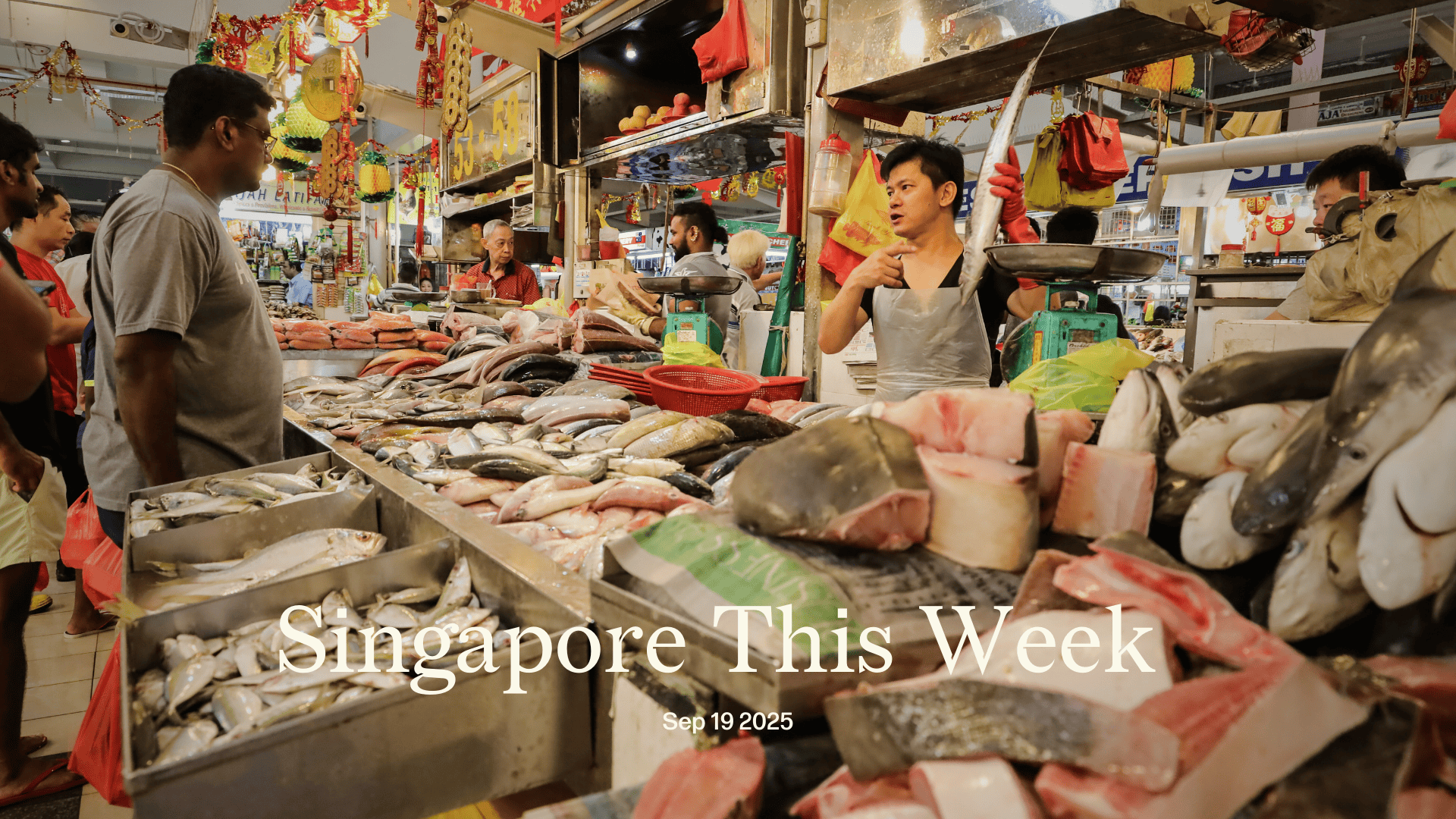
Armed with a portable Jisulife fan, office workers make a beeline to the snaking queue of Han Kee Fish Soup store at Amoy Food Centre. They nibble on slices of fish, swimming in a clear, flavourful broth topped with fried garlic, accompanied by bee hoon or plain rice. Sliced fish soup has been dubbed the quintessential lunchtime meal for office ladies—and yet many of us may not know the exact species used.
It's a narrow-barred Spanish mackerel, more commonly known as batang fish. It’s typically used in other local dishes across cultures: otak-otak, assam pedas, sambal ikan tenggiri, fish curry, or simply fried with a turmeric marinate. Its popularity has put stress on its wild population, resulting in a near threatened (NT) conservation status on the International Union for Conservation of Nature and Natural Resources (IUCN) Red List. NT is but a step away from Endangered (after which comes Critically Endangered and Vulnerable). Although South-east Asia generally has healthy fishery stocks, overfishing and overconsumption for specific species is a persistent problem. In 2016, the World Wide Fund for Nature Singapore (WWF-Singapore) reported that three out of four fish species commonly eaten here are unsustainable: threadfin (ngoh hur), used in fish porridge; silver pomfret, typically in Teochew-style dishes; and yellowbanded scad (ikan kuning), fried fish for nasi lemak.
How can we enjoy the same local dishes more sustainably? Pasarfish, a local educational research and outreach platform, has advocated for diversifying the fish we consume by opting for alternatives. For instance, substituting silver pomfret with black and golden pomfret, which is also tasty pan-fried (and is cheaper). For steaming, try tuskfish. Additionally, WWF-Singapore has a sustainable seafood purchasing guide.
However, inherent to this problem is our general disconnect with food sources. The majority of us eat out because we don’t have time to cook; we thus rarely experience food preparation. Besides not being able to identify particular fish species, we also don’t have an understanding of how each fish is caught or farmed, and how it’s transported to the marketplace. This disconnect makes it difficult for us to understand the impact of our consumption to the environment, and hinders us from seeking sustainable alternatives. Perhaps, as a start, what we need is time spent at the pasar (wet market) where we intentionally get acquainted with local produce—an initiative that Pasarfish has been pushing through their educational market tours to Tekka market.
Earth: Charged Up
Some 16 years after the government announced plans to turn Singapore into a “Living Lab” for testing Electric Vehicle (EV) feasibility, and six after the then environment minister expressed serious doubts about the project, EVs account for two in five new cars sold here. (A higher share, incredibly, than in San Francisco.) The reasons are many. Battery packs, the costliest EV component, have become nearly 40 percent cheaper since 2020 (and 90 percent since a decade ago) thanks to better tech and better economies of scale. Meanwhile, aside from rigging out the country with public chargers, one for every three EVs now, the authorities have fuelled demand with generous subsidies for EV buyers even as they raise levies for petrolheads.
On the supply side, there are now 34 EV brands sold here, and the intense competition has further reduced prices. China dominates. Beyond BYD—couldn’t throw a brick without hitting one these days—15 other Chinese brands are hawking EVs here. Virtually all have surpassed last year’s numbers: tech, policy and the Singapore consumer’s increasingly torrid love affair with Chinese goods driving growth. Although rebates and subsidies will be scaled down, and eventually withdrawn by 2027, demand is expected to stay hot, and the transition to 100 percent cleaner-energy vehicles (electric, hybrid or hydrogen) by 2040, smooth.
Can we do better? Today, 95 percent of the electricity powering the national grid comes from natural gas—cleaner than coal or oil (although the label is contested), but not clean. To be sure, progress is being made, with the recent discussions on nuclear power and a regional agreement that could unlock large amounts of renewable energy. Yet, as Jom has noted, this embrace of renewables must not come at the cost of fragile ecosystems and the livelihoods of communities beyond our borders. If anything, as we move towards fossil fuel-free roads, supply chains warrant even more scrutiny. Take, for instance, copper. Because of its conductive ability, the metal is essential for EVs as well as EV chargers; demand for it is expected to treble by 2050. Most of the new mines needed to meet this demand are either in water-scarce areas (copper extraction is extremely water intensive), within fragile eco-systems, or on lands belonging to vulnerable communities. Through ethical sourcing, prudent use and effective recycling in a nascent industry, Singapore has a rare chance to secure not just clean roads but also a clean conscience. Will we take it?
History weekly by Faris Joraimi
In February 1943, Subhas Chandra Bose, the Indian anti-colonialist, boarded a submarine in Germany headed for the Indian Ocean. Together with his secretary Abid Hassan, he went deep under the tides of the North Sea, the Atlantic, then round the Cape of Good Hope. Off eastern Madagascar, Bose and Abid were transferred to a Japanese submarine. (Failing to get Hitler to support his plans for India’s independence, Bose had sought Japanese help.) This bore them further east to Sumatra, where they landed in May. By June, Bose was in Singapore commanding the Indian National Army, delivering his famous speech vowing to take them “to Delhi!” The submarine journey took three months, lengthened by obvious wartime dangers. Uncomfortable and mostly uneventful besides a few close shaves, the trip adds to Bose’s complicated legacy of collaboration with Nazis and fascist Japan.
But it has the right ingredients to belong in the romantic saga of a freedom-fighter: exile, the secret passage, gathering forces on arrival for the final victory (which never came). Most importantly, I think, the submarine makes the legend. The stuff of science fiction-come-true, it takes on the quality of miraculous transport, granting passengers concealment from adversaries. One imagines Bose in the cramped submarine, plotting his manoeuvres. For him it was a temporary habitat, a means to the terrestrial world of political action. Not so for Captain Nemo, the antihero of Jules Verne’s 20,000 Leagues Under the Seas, for whom the submarine was a permanent shell of seclusion from chaotic, misguided humanity. Nemo had everything in there for blissful solitude: a vast library, ocean delicacies, research tools, and electricity to roam forever. Yet both Nemo and Bose’s destinies were linked by British imperialism in India. Nemo’s revealed to be “Prince Dakkar”, descended from the rajas of Bundelkhand and Mysore. His family lost their princely state after the Rebellion of 1857. With the means to retreat from politics and society, Nemo took a path radically different from Bose’s.
Both had precursors who traversed the Indian Ocean’s depths. The Sejarah Melayu (Malay Annals) reported that Raja Chulan (Rajendra Chola I) ordered a device built to let him descend into the sea and marvel at God’s creations unknown on land. Down he went in a glass case—an ancient motif going back to stories of Alexander the Great—and found an underwater kingdom. He married a sea-princess, with whom he conceived the father of Sang Nila Utama.
Arts: Fantasy figures
It’s 2018, and RF Kuang is about to turn 22. She’s also just about to publish her first book, The Poppy War. It’s a grimdark fantasy about the young mage Rin: a Mao Zedong-in-the-making, but in the body of a teenage girl. Kuang, who was born in Guangzhou and grew up in Texas, culled her inspiration from histories of domestic warfare in China—from the Opium War to the Nanjing Massacre—but also from the animated series that gripped a generation of kids growing up in the early noughties: “Avatar: The Last Airbender”. Her densely plotted, darkly entrancing novel will soon dominate various bestseller and “best book” lists of the year. But she doesn’t know that yet. She’s at a science-fiction and fantasy convention, and one of the headliners is the speculative fiction giant, Ken Liu. He’s swept the Nebula, Hugo and World Fantasy awards for his short story “The Paper Menagerie”; his translation of Liu Cixin’s The Three-Body Problem has been credited for popularising Sinophone scifi in the Anglophone realm. At the convention, they talk about the challenges of drawing from Chinese folklore in their genres of work where, unlike western mythology, it may be fetishised for its specificity rather than read as universal. Seven years and five books later, the preternaturally prolific Kuang has acquired a list of accolades that very much resemble Liu’s, and the two will be meeting again, this time at a literary convention a lot closer to home: the Singapore Writers Festival in November. The Arts House Group, which organises the annual festival, offered up a tantalising preview of writers to come, including food writer Fuchsia Dunlop, best known for her sumptuously researched cookbooks on Sichuan cuisine, and poet Raymond Antrobus, whose muscular verse about deafness is also dexterous in its treatment of race, masculinity and loss.
Undergirding this sprawling festival of over 200 events and 300 presenters are anxieties about the creeping tendrils of AI ensnaring our literary universe. The festival concludes with its traditional closing debate, where this time Singapore-based writers will either defend or protest the motion “This House Believes That Robots Are Our Friends”. It’s an existential worry that also pervades another much more intimate festival happening next weekend, the inaugural Translation Day Singapore organised by the Singapore Book Council. Here, panellists will probe both the possibilities and limits of machine translation and AI-assisted tools and interrogate notions of ethics, authorship and creative control. Both Liu and Kuang have grappled with the conundrums of what it means to transmute one language into another; in her novel Babel, or the Necessity of Violence, Kuang conjures an alt-universe version of the Oxford elite, where a gifted minority initially believe that “[t]ranslation, from time immemorial, has been the facilitator of peace”. They quickly realise that their multilingualism is being exploited to facilitate imperialism instead. That, perhaps, is the larger worry, regardless of whether you’re human or machine.
Arts: “The category is... Dance or Die.”
A woman stalks the stage in what looks like a mech suit straight out of Tom Cruise’s alien invasion flick “Edge of Tomorrow”. She—and her pincer prosthetics—are attached to a long metal batten running diagonally across the staging area of a sloped dugout, in the centre of the green expanse that is Melbourne’s Kings Domain. Perched above the rows of audience members in the stalls and on the floor are Gabber Modus Operandi, the Balinese duo blending the throbbing hardcore beats of gabber and the strains of Indonesian folk dangdut and trance dance jathilan. It’s a crisp summer evening in February, and the wind is filtering into the Sidney Myer Music Bowl beneath its thin bandshell canopy, fastened to the earth by a lattice of steel cables. Except that it also feels like we’re in the caldera of a dormant volcano somewhere in-between Indonesia’s ring of fire and a heady, high-octane midnight rave. This is the premiere of U>N>I>T>E>D by Australian contemporary dance company Chunky Move, arriving in Singapore by way of Esplanade’s da:ns focus platform next weekend. This transporting hour of cyberpunk futurisms and techno gamelan is one in a lineup celebrating South-east Asian experiments in dance, but also the pas de deux between human and machine, whether that’s Chunky Move’s channelling of the more-than-human divine in our post-industrial epoch, or Thai dancer-choreographer Pichet Klunchun’s duet with ChatGPT.
Running alongside the spine of Esplanade’s programming are other free satellite shows that move us from the stage to the studio. Organised by choreographic centre Dance Nucleus, which supports independent artists, the annual VECTOR programme, which favours emerging and unsung acts, offers a compact but diverse range of interactive installations and improvisatory showcases that insist on intimacy. This includes Hee Suhui’s “Ill Behaviour”, which takes the guts and the gurgling of our viscera and pours it into the soundscape of a hypnotic performance that confronts our very particular experiences of pain. The show, which recently travelled to the Edinburgh Festival Fringe, portrays the self as a “hot, sticky, heaving bag of guts and mucosa trying to stand upright”, according to the British Theatre Guide. And as we’re encountering other bodies, perhaps that’s something we should be reminded of: that we’re fleshy shapes both shaped by our environments and shaping those we press up against.
Faris Joraimi, Abhishek Mehrotra, Sakinah Safiee, Corrie Tan, and Sudhir Vadaketh wrote this this week’s issue.
If you enjoy Jom’s work, do get a paid subscription today to support independent journalism in Singapore.