
News this week included: a roundup of Budget 2026; the tragedy of a six-year-old Indonesian girl killed by a seemingly reckless driver who’s now under investigation; publication of Policy, Fairness and Compassion, a collection of speeches by K Shanmugam, home affairs minister; debates about Shanmugam’s financial “sacrifice” when leaving legal practice for public service; a student-led survey that found that one in three employers do not regularly provide rest days for their foreign domestic workers; an Iranian TikToker’s comment about this “toxic city” sparks a debate about Singapore’s social norms and work culture; and our fab disease-fighting scientists have just published an article, “Dengue Suppression by Male Wolbachia-Infected Mosquitoes”, in The New England Journal of Medicine.
Below are the issues we chose to explore in more depth.
Our picks
Society: The movement to end female genital cutting (FGC)
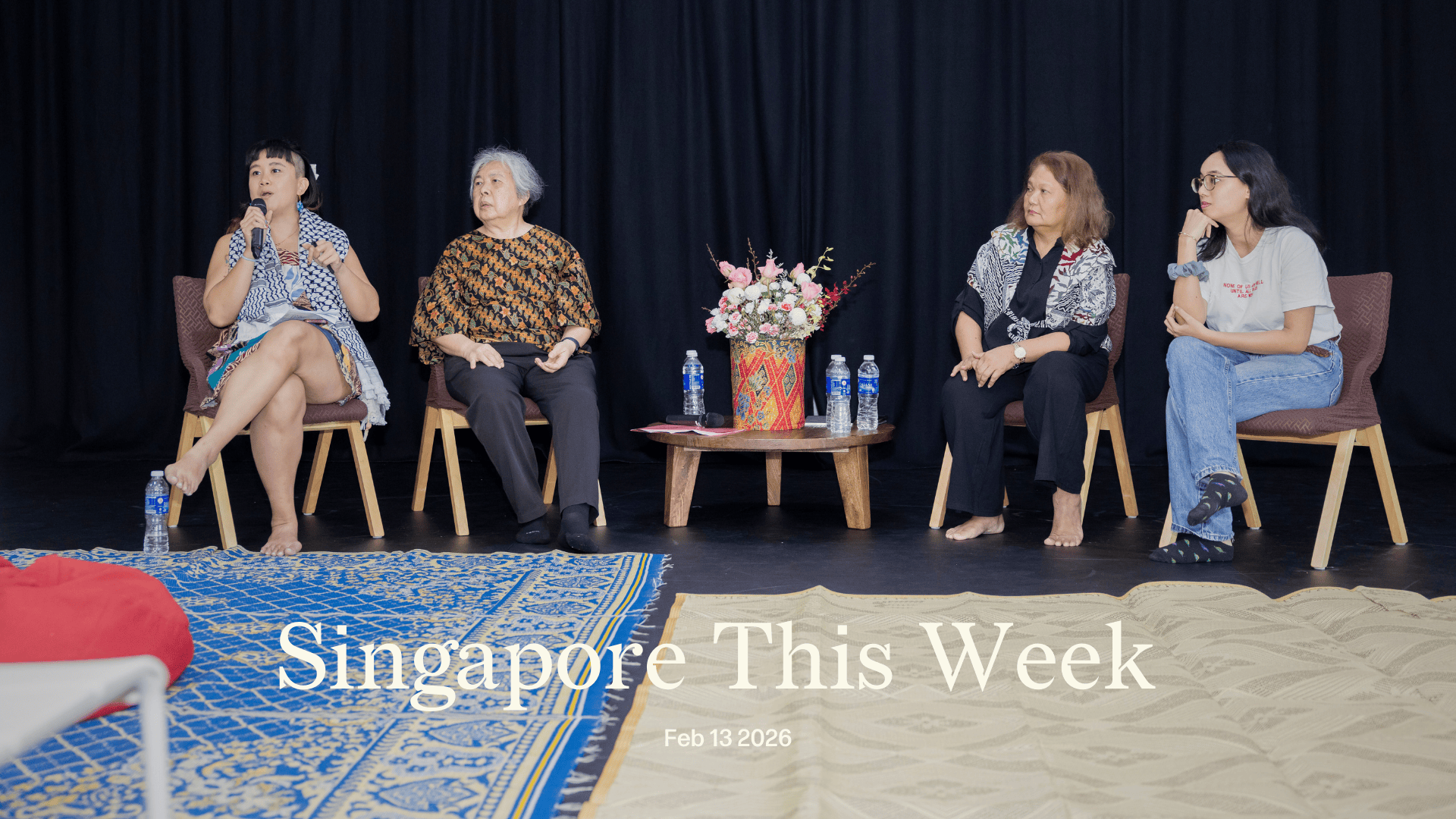
The Goodman Arts Centre straddles Singapore’s multitudes. Humble 1960s Jalan Batu flats on one side, Mountbatten mansions on the other. Narrow-laned, gritty, gentrifying Geylang to the north, and the lush, broad ECP superhighway between Changi and CBD to the south. Last Sunday, as kids kicked footballs around its green lawns, three floors up, in a dance studio, Malay Muslim women recounted the moments when they discovered their infant genitalia had been cut. Such intimate sharing might suggest a protected space. But this was a celebratory, open session, allies of all ethnicities and genders welcome.
At a registration table were books and pamphlets detailing the practice, as well as a guide on supporting survivors, alongside more light-hearted fare: a pink, “Protect all vulvas” bookmark, the organ illustrated nestled in a strawberry; and stickers with liberating mantras like “Wild & Free” and “Women deserve sexual pleasure too”. Guests ambled over to a table overflowing with curry puffs, chicken rendang, cupcakes, kuih, and teh tarik. Panel discussions were followed by a participatory dance work, for the fifth birthday bash of the End FGC Singapore movement.
Saza Faradilla, one of the group’s co-founders and its recognisable, effervescent face, opened with acknowledgements to Singapore’s ancestral stewards, early feminists, survivors and others; notes on safe spaces; and a trigger warning. The group’s pilot 2020 study found that 75 percent of 360 Muslim women surveyed have been cut. As troubling was the uncertainty. What was done? What was cut? What equipment was used? A plurality, if not majority of respondents, said “I don’t know.” For so many women, an early violation of their bodies will forever remain a mystery.
It is a fiendishly challenging issue for them to address. Why doesn’t a developed, global city simply ban the practice? The state prefers non-interference, under a misguided conception of CMIO multiculturalism, in what’s seen as a religio-cultural practice of Malays. (Muslims’ personal and family matters are governed under a separate, Islamic jurisprudence in Singapore.) If a religion practised child sacrifice, would Singapore allow it, deadpanned Vivienne Wee, a co-founder of AWARE and author of a seminal 2016 paper on FGC, to chuckles from an audience by then primed for absurdity. For the “crime” of distributing pamphlets at a Ramadhan bazaar, Saza recalled, three cops interrogated her for 90mins, asking 90 odd questions, many inane, and trying to get her to rat on the others involved. (She reported the lead and he was taken off the case.) Muslim conservatives accuse the group of Islamophobia. The embarrassment and backlash is worsened when some foreign media objectify “primitive” practices for, perhaps, their own saviour narratives.
Diana Rahim, editor of Beyond The Hijab, spoke about the base struggles of marginalised people, who lack resources to organise, but also have to contend with societal conditioning around productivity. Work harder! For activists, this translates into insufficient sensitivity for comrades’ capacity and accessibility. Muslim women's groups, resisting those impulses, ground their activism in an ethics of care for each other. Though much work remains, there’s been clear progress over the past five years: more government channels open, 15 lobbying-meetings with political office holders, 4,000 booklets distributed, and a larger philosophical shift, “from silence and denial into public, critical dialogue, reframing it as a gendered and ethical issue rather than an unquestioned tradition.” Others wondering how social change can be effected would do well to learn from this triply-minoritised group. Follow them on Instagram and/or donate to their cause.
Some further reading:
“Let’s talk about sunat perempuan [female genital cutting]” is available on End FGC Singapore’s site. Among other things, it explores the pre-Islamic history of the practice, and the reasons why only some schools here (exclusively to Malay Muslims) still follow it.
In “CEDAW and the battle for gender equality”, an essay for Jom, Saza wrote about the Singapore government’s complicated relationship, particularly vis-a-vis the rights of Muslim women, when it comes to the UN’s Convention on the Elimination of Discrimination Against Women (CEDAW).
Society: If you can’t measure it, you can’t manage it
Beyond Dickensian musings about the best and worst of times, we've never really known about the gap between those driving the Bentleys in Sentosa on one end, and on the other, the cardboard collectors, rough sleepers, and 100,000 seniors who live alone and can’t afford a hot meal every day. The government’s measures of inequality have long been patchy, as critics have bemoaned. With income inequality, among other issues it’s assessed only work income, omitting investment income, thus undercounting the earnings of the rich. And it’s never even bothered to measure wealth inequality, which, from Thomas Piketty to the Californian taxman, is the defining issue of our times.
Kudos then to the Ministry of Finance (MOF) for including new data from the Department of Statistics (DOS), in an occasional paper detailing Singapore’s income growth, inequality, and social mobility trends. A new “market income” refers to employment and non-employment sources (such as investment returns, rental income, and CPF Lifelong Income Fund For the Elderly payouts). From 2015 to 2025, Singapore’s Gini coefficient—a measure of inequality that ranges from 0 to 1, with a higher number denoting a more unequal society—has declined, whether relying on traditional employment income (0.359 after taxes and transfers in 2025) or the new market income (not much higher, at 0.379). “Resident households at all deciles saw real income growth over the last decade, with lower-income households experiencing higher real income growth,” said MOF.
As MOF contends, it’s tricky measuring wealth inequality, given the challenges in tracking and valuing assets such as foreign investments and equity in private firms. Underreporting, particularly by the wealthy, is surely rife. DOS relied on administrative data and household surveys to estimate household wealth: the sum of property asset values, net CPF balance, and other financial assets minus mortgages and other liabilities. MOF arrived at a wealth Gini coefficient of 0.55, which it says is broadly comparable to other advanced economies.
Chris Kuan, a former Singaporean banker, said on Facebook that we should treat this comparison with “extreme caution”. The key distinction, he said, concerns whether and how pensions are counted. For example, MOF treats CPF savings as wealth but in other countries, pensions aren’t counted as such. This inclusion of CPF savings reduces Singapore’s wealth inequality since CPF savings constitute a much larger percentage of household assets for the working and middle classes than for the (super-)rich. The other major methodological issue is that while data for OECD countries include all households, in Singapore it’s limited to residents. But about one in three people here are non-residents. How do we make sense of their wealth in Singapore, flowing into property and much else?
As Bloomberg has reported, the top quintile of resident households held an average wealth of about S$5.3 million in 2023 (with 58 percent being property asset value), and are collectively richer than the bottom 80 percent. The forms of wealth also warrant scrutiny. While funded pension balances such as CPF are conceptually part of household wealth, equating them with more liquid assets may understate the inequities between classes. Separately, while nominal property values offer a useful snapshot, can we ever really compare the intergenerational wealth in a freehold property with that in the so-called “ticking time bomb” of a 99-year HDB?
Whatever the case, these statistical improvements should be cheered, along with MOF’s clear-eyed view that “as Singapore’s economy matures, our social mobility has shown signs of gradual moderation”. We all have much to do to ensure that every working-class household’s child can aspire to be the next Lawrence Wong.
International: ‘Uncle’
One word is all it took to upend Thai politics yet again. Thailand-Cambodian border tensions were on the boil last year when then-prime minister Paetongtarn Shinawatra addressed a senior Cambodian leader in a leaked phone call, pleading with him to have “sympathy for [his] niece”. Worse, she appeared to criticise a senior Thai general’s handling of the crisis. The perceived debasement of national pride provoked popular fury that turfed Shinawatra from office. Then after months of drama which included the installation and removal of a new prime minister within the same day, Shinawatra’s Pheu Thai party lost power entirely. Anutin Charnvirakul of Bhumjaithai Party, a former Pheu Thai coalition partner, became prime minister thanks to support from another outfit, the People’s Party.
The People’s Party is Thailand’s most progressive political player, calling for democratic reforms that include loosening the army’s grip on national politics and easing the country’s notorious lese-majeste laws. This challenge to the country’s biggest power centres resulted in its previous incarnations—Future Forward and Move Forward—being dissolved by the Thai Constitutional Courts, and two hugely popular leaders banned from politics for a decade in 2020 and 2024 respectively. Both dissolutions occurred after strong electoral showings. Anticipating continued popular support, the People’s Party decided to back Anutin for prime minister last year on the condition that he hold snap elections. This week, he did. He won. Analysts are scrambling for explanations.
Anutin is a royalist and a conservative who embodies “the very political order that the People’s Party had vowed to dismantle,” wrote Bloomberg. Many People’s Party supporters simply couldn’t stomach this “betrayal”. More practical ones perhaps decided that there was little point in voting for it; if it won, the old guard’s machinations would stymie it yet again. Thailand may be a democracy, but until systemic reforms, it will remain a moth-eaten one. Meanwhile, Erin Cook, a long-time observer of South-east Asian politics, drew parallels with Singapore’s GE results last year. “[T]he consensus was very much to expect WP [Workers’ Party] to continue its gains,” she wrote. “[But] Singaporeans backed the safe pair of hands amid such global uncertainty over the progress or reform many voters had previously supported.” Besides, Thailand’s economy has stalled, and the border conflict with Cambodia made voters more amenable to Anutin’s business-friendly reputation and bravado—not only has he promised to build a barrier along the disputed border, he is also considering revoking a quarter-century old maritime agreement between the two nations that had settled an older conflict.
Anutin’s Bhumjaithai may be the first conservative party to rule Thailand this century but its win continues a larger trend among Asian economies: besides the PAP here, Sanae Takaichi has just cemented her hold over Japan, Prabowo Subianto reigns over Indonesia, and Narendra Modi, India. Add to that the de facto regimes in China, Saudi Arabia, and the UAE (albeit with their own variants). Liberals better hunker down for a long winter.
Sport: On the high seas
In 2013, the Media Development Authority (MDA) told Singtel to share its English Premier League broadcasting rights with Starhub so fans would not be forced to switch service providers. Singtel had paid an undisclosed sum rumoured to be around S$245m for the right to beam premier league matches in football-crazy Singapore for three years. Big money, but Singtel was still a new entrant to the football broadcasting market—having broken Starhub’s decade-long dominance only in 2010—and its plan was to entice consumers with initially subsidised prices before, presumably, hiking them. MDA’s order was meant to widen public access, which it did in a manner of speaking, but it also pushed Singtel into increasing the price of its standalone EPL package from S$34.90 in 2012-13 to S$59.90 per month the next season. Per MDA, Starhub had to offer the same prices. Singapore became one of the world’s priciest places to watch the EPL.
By then, it was also one of the most well-connected countries in the world. The first generation of digital natives and quasi-natives was coming of age; raised on a diet of high-speed broadband; used to watching what they wanted, when they wanted; and in an ambivalent relationship with paid content anyway (content piracy was quite widespread already). These priced-out youth (and undoubtedly some savvy older folks) gorged on their favoured matches and players via the “dark arts”: User-Generated Content (UGC) sites; VPNs, P2P networks. Online forums and message boards, 21st-century speakeasies with their own language and sub-cultures, buzzed with activity before big games as users shared info on how best to watch them. Singapore, and much of South-east Asia, became a hub of illicit activity with 60 percent of respondents in one contemporary local survey admitting to watching pirated content—among the highest in the world.
Alarmed, the Premier League in 2019 set up its first overseas office, in Tanjong Pagar, with the mandate of fighting piracy. “[I]t is critical that we now deploy local resource [sic] and expertise to combat the increasing threat of piracy which undermines all stakeholders in the creative industry,” said Paul Molnar, then the league’s director of broadcasting. Prices were already stabilising then, and today, a Starhub customer can watch premier league matches on their laptop or phone for S$40 per month (Singtel customers pay more).
MDA’s belief that its “cross-carriage” rules would benefit consumers in the long run has perhaps come true. What the agency could not have anticipated is just how culturally entrenched piracy would become. Economically too, it makes more “sense” than ever, with the spread of physical devices that stream other sports as well as movies, and TV shows for which consumers would otherwise have to subscribe to tens of OTT services. Earlier this year, a Sim Lim retailer was handed a four-month jail sentence for selling one such device; this is in addition to the 800 domains in Singapore and 30,000 sites across Asia Pacific that the courts have helped the premier league ban since 2020. In this context, the High Court’s order directing local Internet Service Providers (ISPs) to block 47 pirate sites is perhaps less a clash with digital buccaneers, more a fist-fight with the tides.
Culture: All swiped out
The online dating revolution swept us off our feet with the promise of optimisation: these apps would sort through the chaff for us, we believed, providing us with 99th-percentile matches based on the bytes we fed them. But data doesn’t a personality make. These days, thumbing mindlessly through Tinder profiles is what we do on the toilet. “[D]ating apps have encouraged people to treat looking for a partner a bit like online shopping: the temptation is always to keep swiping in search of a more perfect match,” Sarah O’Connor wrote recently for The Financial Times. Here in Singapore, a generation of singles is beginning to tire of the gamified, algorithmically defined confines of our intimate lives—and beginning to realise that if we treat others as disposable then, well, we’re disposable too. Following the ebb of previous platforms, a new tide is here: mixers and matchmakers that promise a more “genuine” way to connect. Where Singaporeans once shunned the group-bonding activities of the Social Development Unit (SDU)—an acronym once reserved for singles “on the shelf”—they’re now organising these in-person events for singles weary of being shelved because of another’s pre-determined metrics. There’s Kopi Date, which plans an entire date for you, including an “experience kit” with conversational prompts in case you run out of things to say. And then there’s the anonymous matchmaking app Amble where, in the spirit of the popular reality series “Love is Blind”, you have no idea who you’re talking to or what they look like. “We decided we didn’t want to be an appearance-first app,” its co-founder Alyssa Chua told CNA. “We wanted to be either an emotional- or intellectual attraction-first type of app.”
So frustrating is the hunt for love in the nation-state that Google exec Mira Sumanti wrote a whole book about her dating dead-ends. Swipe Therapy, the love child of chick lit and self-help genres, follows the 38-year-old’s romantic romps but also her life hacks: how to decide on a place for a first date, the potential returns on investment from a wedding, and even a “Google-able Scale” on a potential partner’s digital presence and how that translates into building trust. Reading her tell-all may not land you a life partner, but Sumanti—now married with a toddler—does have one final word of advice: “Go out and date.” You now have plenty more social mixers to pick from that both encourage low-pressure mingling and experiment with high-concept formatting. There’s the popular international platform Timeleft, which started out organising drinks and dinners for groups of strangers, though you can now go running with them too; and there’s local newcomer Fishbowl, where singles pitch themselves to others with playful PowerPoint presentations (“think shark tank, but friendly!” proclaim their socials). And these mixers aren’t just for those looking for love. Screaming Pigeons is specifically for women in their 20s and 30s “who are tired of surface-level socialising, and who are looking for intentional connections & female friendships that can grow over time”. These “soul led social events” include book clubs and bellydancing, and a Galentines’ dinner and social this weekend. In an atomised, polarised world, we’re really all looking for ways to reconnect with one another, whether platonically or romantically. “We literally have a self-help revolution. But self-help doesn’t actually help us answer the questions of our shared life,” said Priya Parker, author of the bestselling book The Art of Gathering, in a recent interview. “What we actually need are also tools for group help.”
Abhishek Mehrotra, Sakinah Safiee, Corrie Tan, and Sudhir Vadaketh wrote this week’s issue.
Letters in response to any blurb can be sent to sudhir@jom.media. All will be considered for publication on our “Letters to the editor” page.
If you enjoy Jom’s work, do get a paid subscription today to support independent journalism in Singapore.